| THE HIDDEN NUMBER €3,000 The Central Bank of Ireland has estimated that some Irish homeowners could save up to €3,000 every year simply by switching lender. That is not marketing puffery, that is the regulator’s own estimate. Yet, in mid-2026, most eligible switchers still don’t act. This pillar guide breaks down the loyalty penalty, the 2026 Irish lender landscape and how to run the numbers on your own switch, with the actual rates, cashback offers and break-fee rules that apply right now. |
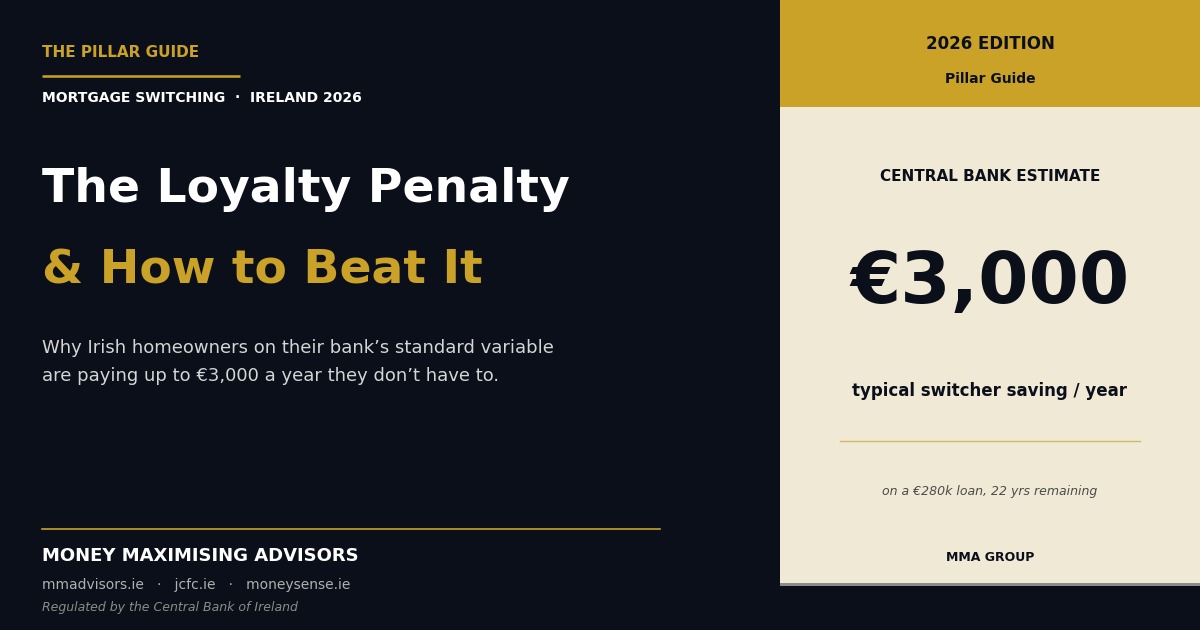
The Central Bank of Ireland has estimated that some Irish homeowners could save up to €3,000 every year simply by switching lender. That is not marketing puffery, that is the regulator’s own estimate. Yet, in mid-2026, most eligible switchers still don’t act. This pillar guide breaks down the loyalty penalty, the 2026 Irish lender landscape and how to run the numbers on your own switch, with the actual rates, cashback offers and break-fee rules that apply right now.
Roughly 70% of Irish mortgage holders are now on a fixed rate, according to the Central Bank of Ireland. Two out of three of them will roll off that fix within the next 24 months. When they do, most will default onto their existing bank’s standard variable rate (SVR), which in 2026 sits as high as 5.15% with some lenders. That is what the market calls the loyalty penalty, and it is the single most expensive mistake in Irish personal finance right now.
This pillar guide from the Money Maximising Advisors Group:- with offices in Galway (mmadvisors.ie), Donegal (jcfc.ie) and Kerry (moneysense.ie)- walks you through when switching your mortgage in Ireland actually pays off, the 2026 lender-by-lender switcher landscape, the mortgage switching costs that catch people out, and the Central Bank of Ireland rules that protect you along the way.
For our full Mortgage Comparison Advice service, see the primary hub. Related pages: Mortgages, Mortgage Protection, Public Sector Mortgages, Buy-to-let Mortgages, and Irish Ex-pat Mortgages.
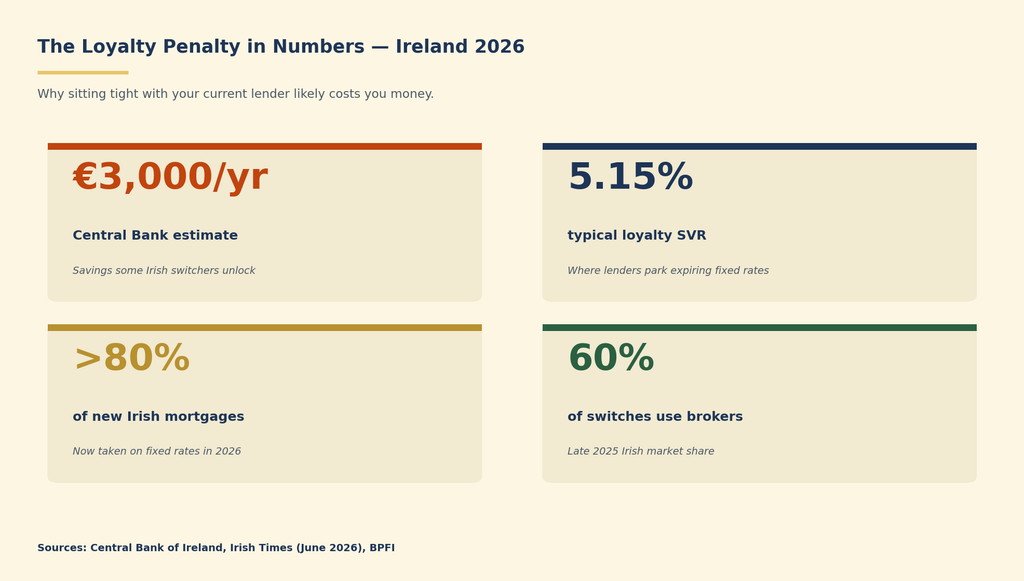
The Irish loyalty penalty in four numbers, what most switchers only find out after they act.
The Quick Answer: seven questions Irish homeowners ask before switching
What is mortgage switching in Ireland?
Mortgage switching means moving your existing home loan from your current lender to a new one, usually to secure a lower interest rate, a better fixed term or a cashback incentive. Your debt, your property and your term don’t change; only the lender does. Switching is distinct from remortgaging (which usually means taking additional equity out), and it is exempt from the Central Bank’s LTI cap — an important detail if your income has changed since drawdown.
How do I switch my mortgage in Ireland?
The process has five stages:
(1) commission a mortgage broker (or DIY) to run quotes across the full Irish lender panel;
(2) apply for Approval in Principle from your chosen new lender;
(3) get an approved valuation of the property (€150–€250)
(4) receive a written Loan Offer within the Central Bank’s 10 business day rule
(5) instruct a solicitor to complete the deed transfer. End-to-end, expect 6–8 weeks.
Is switching a mortgage worth it in Ireland?
For most homeowners in 2026, yes. Even a 0.50% rate reduction on a €250,000 mortgage saves more than €1,000 per year. Lenders offer switcher cashback (up to €5,000 flat with Haven, or 3% of the loan with Bank of Ireland) that usually covers the switching costs and leaves a genuine surplus. The one case where it may not be worth it: fixed rates on loans of under €100,000 with more than three years remaining and a rising rate environment.
Can I switch my mortgage before my fixed rate ends?
Yes, but you may face a break fee, the cost the bank pays to unwind the funding it locked in for you. In 2026’s stable-to-falling rate environment, break fees are often €0 or very small (typically €0–€3,000 range). You are legally entitled to a written break-fee quote from your current lender before you make a decision — request it in writing.
How long does it take to switch a mortgage in Ireland?
Six to eight weeks end-to-end is typical. The Central Bank of Ireland Consumer Protection Code requires new lenders to issue a decision within 10 business days of receiving a complete application, and existing lenders to hand over your title deeds within 10 days of the request. In our experience, solicitor turnaround times are what usually dictate the total timeline.
What documents are required to switch a mortgage?
The core pack: photo ID, PPS number, latest 6 months of current-account bank statements, 3 months of payslips plus a P60 or Statement of Liability, a mortgage statement from your current lender, home insurance certificate, mortgage protection certificate, and a BER certificate. Because you’ve already proven yourself as a borrower, the switcher pack is normally lighter than a first-time buyer application.
Can I switch my mortgage to another lender?
Yes, and in fact your existing lender has no ability to stop you. As of late 2025, 60% of Irish mortgage switches were arranged by brokers rather than direct with the new bank, because brokers can compare the full panel of five active switcher lenders (AIB, Bank of Ireland, Haven, PTSB, Avant Money) plus non-bank options such as ICS Mortgages, Finance Ireland and MoCo.
Meet the MMA Group: three offices, one national reach
| TUAM · GALWAY mmadvisors.ie National coverage Flagship group HQ, full mortgage, pension, protection and inheritance advice. | MOUNTCHARLES · DONEGAL jcfc.ie North West Ireland Joe Coyle Financial Consultants, business-owner and family finance specialists. | KILLARNEY · KERRY moneysense.ie South West Ireland Money Sense Financial Services, family-run, 40+ years Irish experience. |
The 2026 Irish switcher landscape, lender by lender
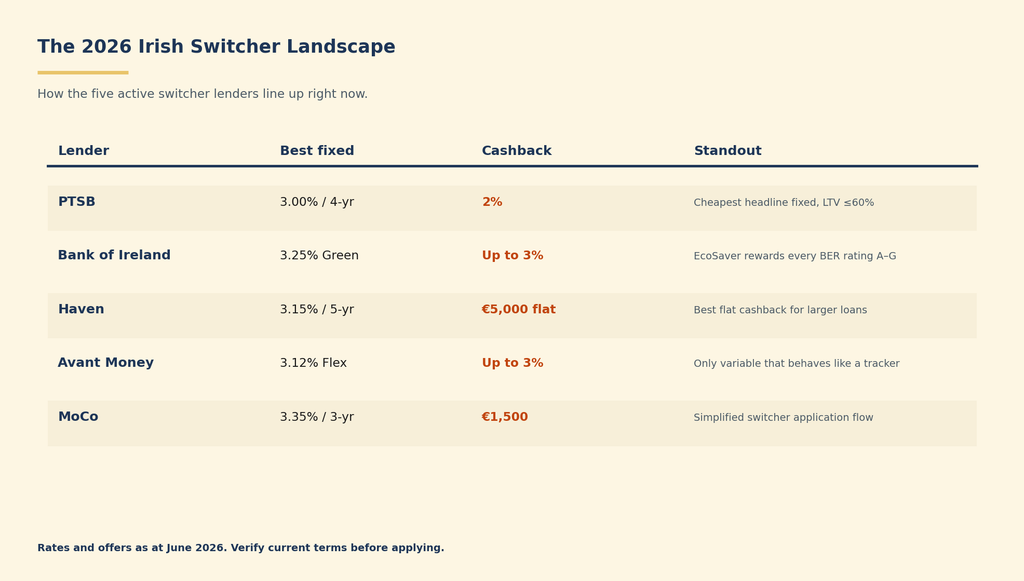
The five most active switcher lenders in Ireland as at June 2026. Verify current rates before applying.
PTSB — the rate cutter
PTSB has cut fixed rates twice since September 2025 and again in early 2026, aggressively repricing to attract switchers. Their headline 4-year fixed at 3.00% (for LTV ≤60%) is the cheapest available in the Irish market in mid-2026. Cashback is a straightforward 2% of the loan value, credited on drawdown. Best for: switchers with lower LTV who want the lowest headline rate.
Bank of Ireland — the incentive-heavy option
BoI’s Cashback Plus gives up to 3% back on qualifying switcher mortgages. Their EcoSaver green-rate approach is unique in Ireland: instead of restricting green rates to BER A/B homes, EcoSaver offers a tiered discount to every BER-rated home from A right down to G, with the discount scaling to how energy-efficient the property is. Best for: switchers with sub-A/B rated homes who still want some green benefit.
Haven the flat-cashback specialist
Haven (an AIB Group brand) leads the switcher space with a €5,000 flat cashback for switchers borrowing more than €250,000. On larger loans, that flat structure often beats percentage-based offers from the same group. Their competitive Green 4-year fixed is another draw. Best for: larger mortgages (€300k+) with A/B-rated homes.
Avant Money — the tracker-like variable
Avant Money remains the innovator of the Irish market. Their Flex Mortgage variable rate is benchmark-plus-margin (reset annually against 12-month Euribor) and behaves much like the old tracker mortgages that disappeared from the market post-2008 — at 3.12% in mid-2026 for LTV ≤80%. Overpay anytime with no charge. Best for: switchers who value flexibility and expect a lump sum or salary rise.
MoCo — the streamlined newcomer
MoCo is a non-bank lender running a simpler switcher application process, with €1,500 cashback and competitive fixed rates. They tend to be more flexible on variable-income and self-employed applicants than the pillar banks. Best for: switchers with less-conventional income or self-employed status.
| WHAT COMPETITOR GUIDES USUALLY MISS Most Irish switcher articles quote a ‘lowest rate’ without telling you it comes with an LTV band (≤60%) and a BER cap (A or B rating) that only a minority of homes actually qualify for. When you’re comparing, ask two questions: (1) what is my LTV band today, has property price appreciation moved you into a cheaper tier? (2) is my home BER-eligible for the green rate I’m being quoted? The answers to those two questions typically move the ‘best rate for you’ by 0.30–0.60%. |
Three switching myths still holding Irish homeowners back
| MYTH “Because I locked in a low fixed rate a few years ago, I can’t switch until my fixed term ends.” | FACT You can switch at any time. If rates are stable or falling, the break fee is often €0. Your current lender must give you a written break-fee quote on request — always ask before assuming. |
| MYTH “Switching costs so much in legal and valuation fees that the savings won’t justify it.” | FACT Typical costs are ~€1,800 (€150 valuation + €1,500–2,000 solicitor). Cashback offers of 2–3% or €5,000 flat usually leave a net surplus, you’re paid to switch. |
| MYTH “I already tried once and my income doesn’t meet the 4× LTI cap anymore.” | FACT Switchers are exempt from the Central Bank’s LTI cap, provided you’re not borrowing additional funds. This is one of the biggest misconceptions in the Irish market. |
The break-fee formula, demystified
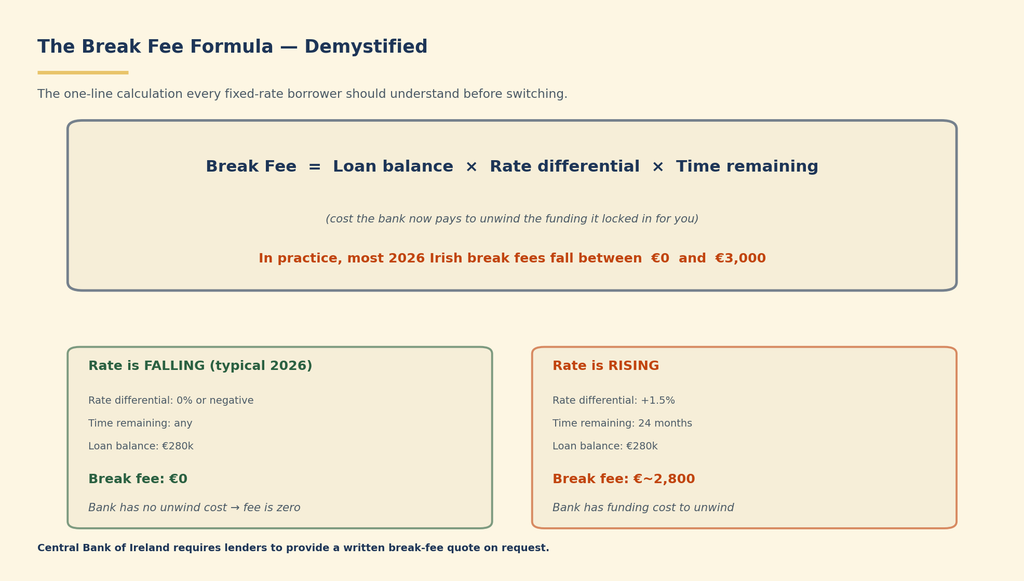
How Irish lenders actually calculate a break fee and why 2026’s market usually produces a small number.
The break fee is the cost the bank pays to unwind the funding it locked in for you when you fixed. In plain English:
Break fee = Loan balance × Rate differential × Time remaining on the fix
Two variables matter: how much lower the current interbank rate is versus what you’re paying, and how much of your fix is left. Because 2026 is a stable-to-falling rate environment, most break fees on rate-locks taken out in 2023–2024 are now €0 or in the low hundreds. Break fees on 2022-era locks (where you fixed at ~1.95%) will be higher because current wholesale rates are further above your locked rate.
Your Central Bank protections when switching
Under the Consumer Protection Code, every Irish lender must:
- Tell you about cheaper mortgage options 60 days before your fixed rate is due to end.
- Show you switching alternatives if your home equity has changed.
- Give you a euro-value estimate of what you could save on each alternative.
- Send you a reminder 4–8 weeks after the first notification.
- Decide on a completed switcher application within 10 business days.
- Provide title deeds within 10 days of your solicitor’s request.
| Ready to talk? Book a free, no-obligation consultation with the Money Maximising Advisors Group. Enquire Now • Book an Appointment • Contact Us |
Real-world scenario: a Galway couple, three lenders, one clear winner
A Galway couple with a €280,000 mortgage balance, 22 years remaining and an A3-rated home came to Money Maximising Advisors in April 2026. Their current 4-year fix was ending in September with their existing bank’s SVR at 4.55%. Three switcher offers were on the table:
- PTSB 4-year fixed at 3.10% (LTV band 60–80%): monthly repayment €1,338, 2% cashback = €5,600 net
- Haven green 5-year fixed at 3.15%: monthly repayment €1,344, €5,000 flat cashback
- BoI EcoSaver 5-year at 3.25%: monthly repayment €1,358, 3% cashback = €8,400
Compared to their current SVR of 4.55% (€1,562/mo), the PTSB switch delivered €224 saved per month, €2,688 per year, and €5,600 upfront. Over the fixed term, total gain: €16,352 — before considering what the same couple would have paid on their SVR.
Six mistakes Irish switchers still make in 2026
- Sitting on the SVR because the paperwork feels overwhelming. Every month you delay is a real euro loss.
- Comparing headline rates only. Look at APRC — Annual Percentage Rate of Charge — which includes the follow-on variable rate applied after your fix ends.
- Forgetting the mortgage protection assignment. Your existing policy usually just needs a lender-name reassignment, not a new policy.
- Cancelling the old mortgage protection before the new one is in force. A one-day gap breaches the Consumer Credit Act 1995.
- Missing the 60-day pre-fixed notification. Your existing lender is legally required to send it — don’t bin it as junk mail.
- Assuming an income change disqualifies you. Switchers are exempt from the 4× LTI cap.
Related posts
| Related post | Category | Read more |
|---|---|---|
| Mortgage Broker in Dublin: Switching Mortgage — How to Get My BER Certificate (2026 Guide) | Mortgage advice | View → |
| First Time Mortgage Buyers in Galway: Inflation and Its Impact on Interest Rates | First-time buyer | View → |
| 10 Things to Know Before Applying for a Mortgage in Ireland | Mortgage basics | View → |
| Public Sector Mortgage Ireland: What Do I Need to Apply for a Mortgage? | Public sector | View → |
| The Impact of Irish Mortgage Interest Rates on Home Loans (2026) | Mortgage rates | View → |
Frequently asked questions about switching mortgages in Ireland
Do I need a solicitor to switch my mortgage in Ireland?
Yes. Every mortgage switch in Ireland requires a solicitor to handle the transfer of the legal charge from the old lender to the new one. Legal fees typically run €1,500–€2,000 including outlays. Some lenders offer free-legal packages that cover this cost entirely.
Will switching mortgage affect my credit score?
The new lender will do a Central Credit Register (CCR) check, which is standard for any mortgage application. This is not a hard credit hit in the way a missed payment would be. Your credit history remains identical after the switch, you’re just paying a different lender.
Can I switch mortgage if I’m in negative equity?
Switcher applications generally require positive equity (LTV under 90%). If you’re in negative equity, you may still qualify for a same-lender product review (staying with your existing bank on a different product), or in limited cases some lenders will consider an above-90% switch for well-qualified applicants.
What if I want to release equity as part of the switch?
That is technically a remortgage, not a switch, and the Central Bank LTI cap applies to the additional borrowing. You will need to income-qualify for the new total. If pure switching (same balance) is exempt from LTI, adding funds is not.
How often can I switch mortgage in Ireland?
There is no legal limit, but most lenders require you to be at least 12 months into a new mortgage before switching again. Watch the cashback claw-back clauses, if you switch away from a cashback deal within 5 years, some lenders will require you to repay a proportion of the cashback.
| Reviewed by Money Maximising Advisors Money Maximising Advisors Limited is regulated by the Central Bank of Ireland and operates as a Multi-Agency Intermediary across the main Irish lenders, insurers and pension providers. Our advisors hold QFA, RPA, CFP and FA designations and every recommendation is documented in a written Statement of Suitability. Verify our authorisation on the Central Bank Register, or learn more about us. |
Get a free, no-obligation mortgage switch review
If your fixed rate is ending in the next 24 months, or you’ve been sitting on your bank’s standard variable rate, the Money Maximising Advisors Group will run switcher quotes across every active Irish lender at no cost to you. Whether you’re based in the West with our Galway or Kerry teams, or the North West with our Donegal team, you’ll get the same lender panel and the same regulated advice.
| Ready to talk? Book a free, no-obligation consultation with the Money Maximising Advisors Group. Enquire Now • Book an Appointment • Contact Us |
Important information
WARNING: If you do not meet the repayments on your mortgage, your account will go into arrears. This may affect your credit rating, which may limit your ability to access credit in the future. WARNING: If you switch to an alternative mortgage, you may save money over the term of the mortgage. WARNING: You may have to pay charges if you pay off a fixed-rate loan early. Rates, cashback offers, fixed-rate ranges, and Central Bank Consumer Protection Code references reflect Irish market conditions as at June 2026 and are subject to change. Money Maximising Advisors Limited is regulated by the Central Bank of Ireland. This article is for general information only and does not constitute financial or tax advice. You should seek personalised advice from a Qualified Financial Advisor before switching, remortgaging or paying off a mortgage.