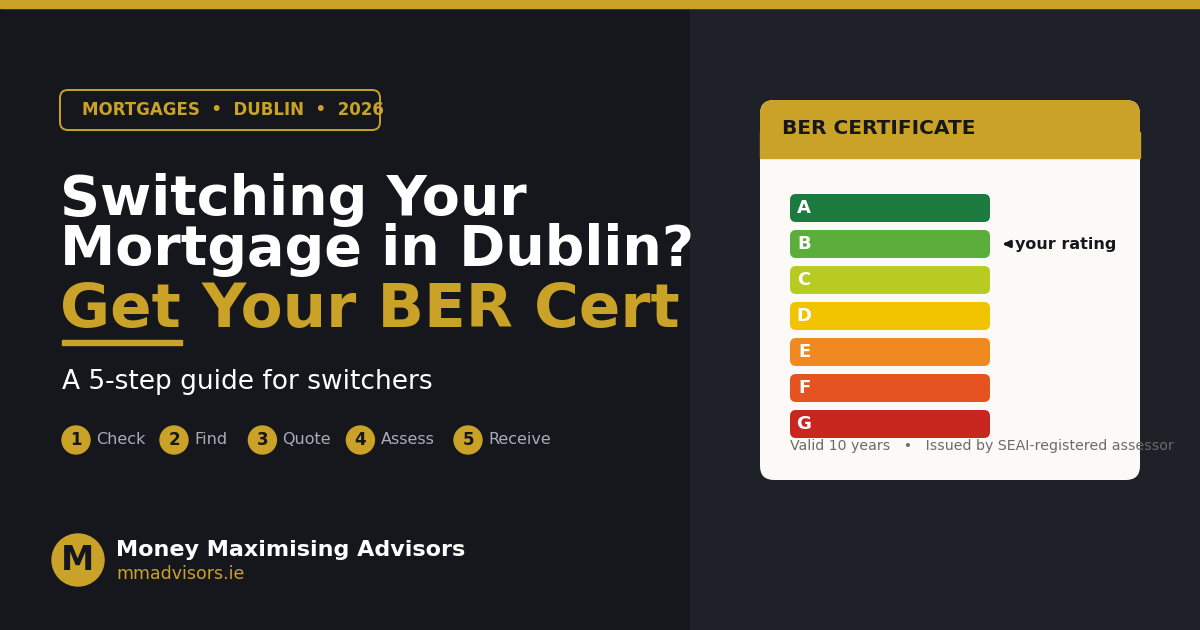
If you are thinking about switching your mortgage in Dublin, one piece of paperwork tends to catch homeowners off guard: the Building Energy Rating (BER) certificate. Almost every Irish lender will ask to see one before approving a switch, and the rating you hold can also unlock significantly cheaper “green” mortgage rates. At Money Maximising Advisors, we guide switchers through the full process every week. This pillar guide walks you through exactly what a BER cert is, when you need one, how to obtain it step by step, what it should cost in 2026, and how to use a strong rating to lower your repayments.
| This article sits within our Mortgages hub and supports the cluster of pages our switchers most often visit, including Mortgage Comparison Advice, Equity Release Mortgages, Public Sector Mortgages, Irish Ex-pat Mortgages and Buy-to-let Mortgages. |
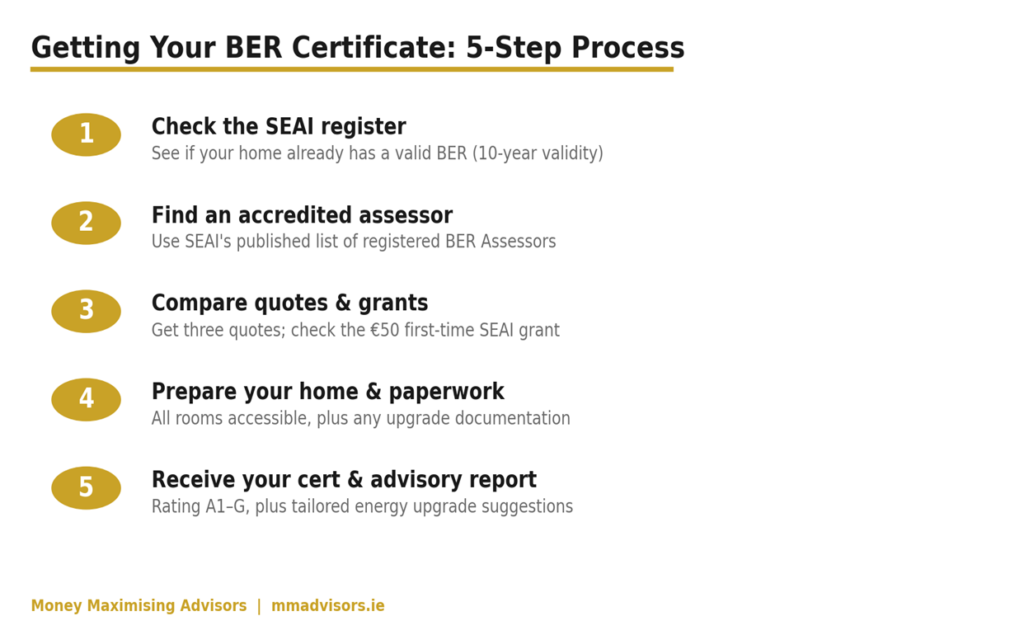
The five-step BER process for Irish mortgage switchers.
What is a BER certificate and why does your new lender need it?
A BER is the official energy rating issued for an Irish dwelling, scored on a scale that runs from A1 (most efficient) down to G (least efficient). It captures how much energy the home is expected to use for heating, hot water, ventilation and lighting under standard occupancy. The certificate is produced by an independent assessor registered with the Sustainable Energy Authority of Ireland (SEAI), using SEAI’s DEAP software to crunch the underlying data.
When you switch your mortgage, the new lender effectively re-underwrites your home. Alongside payslips, recent bank statements, an up-to-date salary certificate and proof of repayments on your existing loan, a current BER cert is part of the standard pack. It tells the lender something about the property’s long-term value and, increasingly, decides whether you qualify for a discounted green rate. Our Mortgage Comparison Advice service includes a full checklist of what your chosen lender will look for, so nothing trips you up at the last minute.
When is a BER certificate mandatory in Ireland?
BER certificates have been part of the Irish system for almost twenty years. They first became mandatory in January 2006 for new homes lodging a planning application, and from January 2009 the requirement was extended to every existing home being put up for sale or rent. In practical terms, that means almost any home you might want to mortgage today either already has a cert on file or has had one at some stage.
Each certificate is valid for 10 years, provided no material energy upgrades have been carried out in the meantime. If you have completed work such as a new heating system, external wall insulation, replacement windows or solar PV, the old rating may understate the current performance of your home — and it is worth re-rating before applying to switch.
Step 1: Check whether your home already has a valid BER
Before you spend a cent, find out whether there is already a valid certificate on the system. Head to the SEAI National BER Register and run a search using either your existing BER number or the property’s MPRN — the Meter Point Reference Number printed on every ESB Networks electricity bill. If a valid certificate appears, you can download it as a PDF in seconds and forward it directly to your broker or solicitor.
Two situations push you into Step 2. The first is when no certificate exists for the address at all. The second is when a certificate exists but is either expired (older than 10 years) or out of date because of works you have carried out. In both cases you will need a fresh assessment. If you are not sure which camp you fall into, give us a call before booking anything in — a quick check with our Mortgage Comparison Advice team often saves clients a wasted survey fee.
Step 2: Find an accredited SEAI BER assessor
Only registered, independent professionals can issue a valid Irish BER. SEAI maintains the official directory of assessors, which you can browse on the SEAI Register of BER Assessors. Filter by county or town to find someone covering Dublin (or whichever area your property is in) and shortlist a small panel to contact.
As a rule of thumb, gather at least three quotes. Pricing, lead time and the level of service all vary, and a couple of phone calls is the quickest way to avoid overpaying. If you live in an apartment complex with several recent BER ratings on the register, ask the assessor whether their familiarity with the development brings the cost down. Our about us page lists the kinds of local relationships our advisors leverage on your behalf as a Dublin mortgage broker.
Step 3: Compare quotes and check your grant eligibility
Typical 2026 BER costs and the €50 first-time SEAI grant.
Most homeowners we work with end up paying somewhere between €150 and €300+ for a BER assessment, with the variation driven by floor area, the number of habitable rooms, ease of access and travel time for the assessor. A small two-bed apartment in Dublin 8 sits at the lower end of that range; a larger detached home in south county Dublin can land closer to the top.
If you have never claimed BER grant funding before, you may be entitled to a €50 SEAI grant toward the cost of your first assessment. Homeowners completing a Home Energy upgrade often see this applied automatically as part of the broader works grant. Worth asking each assessor whether they will handle the application for you. While you are reviewing the wider household budget, our Money Management Advice team is on hand to help line up your switch with other savings goals.
| Thinking about switching but unsure which lender is best for your situation? Book Now for a free consultation with a Dublin mortgage broker, or Enquire Now and we will be in touch within one working day. |
Step 4: Prepare your home and paperwork for the survey
The assessment itself usually takes between one and two hours, depending on the size of the property. The assessor will need physical access to every habitable room in the dwelling, including the attic where reachable, the boiler or heat pump, and any visible insulation. Clearing storage out of awkward corners in advance speeds the visit up noticeably.
Paperwork makes a real difference to the rating you receive. For new builds, the assessor will look for the architectural specifications of the walls, roof and floors, along with performance certificates for the heating system, windows, ventilation units and any renewable technologies installed. For existing homes, the goal is to evidence every energy upgrade carried out since construction — invoices, installer certificates, product specifications and dated photographs of the works are all valuable. Each item should clearly identify the property address, what was installed and the products used.
Where the assessor cannot verify a component, they are obliged to fall back on conservative default values based on the property’s age and construction type. Defaults almost always assume the worst-case performance, which means your final rating may be lower than the home truly deserves. The fix is straightforward: pull your folder of receipts and certificates together before the visit, not after.
Step 5: Receive your certificate and advisory report
Once the survey is complete, the assessor inputs the data into SEAI’s official DEAP software, which calculates your final rating somewhere on the A1–G scale. You will receive two documents by email: the formal BER certificate (the one your lender wants) and a personalised Advisory Report detailing the upgrades that would have the biggest impact on your home’s efficiency, cost-effectiveness and comfort.
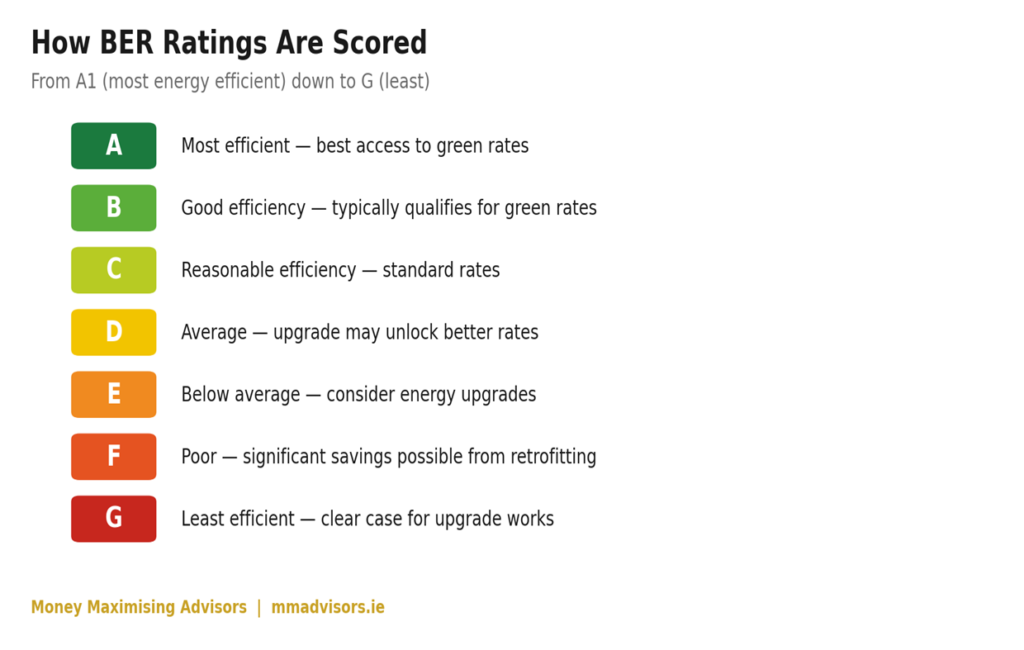
How A–G ratings line up with typical Irish mortgage rate eligibility.
Forward your certificate to your broker or directly to your prospective lender as soon as it lands. If your rating is in the B band or above, flag this clearly, it often unlocks the green rate on the loan offer. For a visual walkthrough of switching from start to finish, see our Money Maximising Advisors YouTube channel.
How your BER affects green mortgage rates and switching value
Most active Irish lenders now reward energy efficiency with a discounted green mortgage rate, typically offered to homes rated B3 or higher. The discount tends to be between 0.10 and 0.30 percentage points off the standard fixed rate — small on paper, meaningful over the life of a 25 or 30-year loan. For a €350,000 mortgage, every 0.10% saving works out to roughly €18–€22 a month, or around €6,000–€7,000 across a typical term.
That is why it can be worth investing in straightforward upgrades — attic insulation, an air-to-water heat pump or improved glazing — before you switch. A jump from C2 to B3 might cost a few thousand euros but pay back many times over once the better rate is locked in. We model these scenarios with clients every week as part of our Mortgage Comparison Advice service, alongside protection products such as Mortgage Protection, Income Protection and Serious Illness Cover, which most lenders expect to see in place at drawdown.
Common mistakes to avoid
A few patterns trip people up when they leave the BER until the eleventh hour:
- Booking a survey before checking the register. A valid cert may already exist for your address — always run the SEAI search first.
- Ignoring an expired certificate. Anything older than 10 years is no longer valid, even if the property has not changed.
- Skipping documentation. Without proof of upgrades, default values will likely pull your rating down a band or two.
- Choosing on price alone. Cheap assessors with long lead times can delay your switch by weeks; balance cost against availability.
- Forgetting the green-rate angle. If you are close to a B3, ask your broker whether a small upgrade now would change which lender becomes the best fit.
Most-read mortgage guides
Reading next? These are among our most-visited mortgage guides for Irish switchers and buyers:
- Irish Mortgage Market 2026: Rates, Rules, and What’s Changed
- Fixed or Variable Rate Mortgage: Which One Is Right for You?
- Is It Worth Switching to a Fixed-Rate Mortgage?
- Best Mortgages Ireland: How Much Does It Cost to Switch Mortgage?
- How to Choose the Best Mortgage Lender in Ireland
- Effective Mortgage Repayment Hacks to Clear Debt Faster
Explore our full range
This guide is part of our wider Mortgages hub. You can also explore our Pensions, Protection, Public Sector, Savings & Investments and Inheritance Tax hubs, or learn more about us.
Our Services & Products
Our Services
Our Products
Related posts
- New Buy-to-Let Lender in Ireland: Lower Rates for Experienced Landlords
- Irish Mortgage Market 2026: Rates, Rules, and What’s Changed
- Tips on How to Calculate Mortgage Repayments in Ireland
- How to Remortgage to Release Equity from Your Property
Frequently asked questions
How long does a BER assessment take?
The on-site survey usually takes between one and two hours for a typical Dublin home. Once data is entered into the DEAP software, most assessors issue the certificate and advisory report within a few business days.
How long is a BER certificate valid for?
A BER cert is valid for 10 years, provided no significant energy works (such as a new heat pump or major insulation upgrade) have been completed in the meantime.
Does my BER rating affect my new mortgage rate?
Yes. Most Irish lenders offer discounted green rates for homes rated B3 or higher, with savings of roughly 0.10–0.30 percentage points. Our Mortgage Comparison Advice team will model the impact for your specific loan amount and term.
Do I need a BER if I am only changing the rate with my current lender?
A formal switch to a new lender almost always requires a current BER. A simple rate change with your existing lender often does not, although it may be required to qualify for that lender’s own green rate. Enquire Now and we will check your specific lender’s requirements.
Ready to switch and save?
If you are a homeowner in Dublin — or anywhere across Ireland — looking to switch your mortgage, our team handles the whole process for you: sourcing the right lender, gathering your paperwork, coordinating with your BER assessor and managing the application end-to-end. Book Now for a free consultation, or visit Money Maximising Advisors to learn more.
Important information
WARNING: Your home is at risk if you do not keep up payments on a mortgage or any other loan secured on it.
WARNING: You may have to pay charges if you pay off a fixed-rate loan early.
Money Maximising Advisors Limited is regulated by the Central Bank of Ireland. This article is for general information only and does not constitute financial, tax or legal advice. Lending criteria, terms and conditions apply. You should seek personalised advice from a Qualified Financial Advisor before making any financial decision.