
If you are buying a home in Dublin in 2026, whether you are a first-time buyer in Cabra, a mover trading up in Rathfarnham, or an investor eyeing a rental in Smithfield, understanding how Irish mortgages actually work is the foundation of every good deal. This is a long-form pillar guide to the Central Bank rules, the current rate environment, the full cost stack of a mortgage, and the practical tips that separate a smooth application from a slow one. Written by the team at Money Maximising Advisors, it draws on the deals we arrange for Dublin buyers every single week.
| WHY THIS MATTERS NOW Dublin buyers face the tightest supply in over a decade, a fixed-rate lending environment where over 70% of new first-time buyer mortgages are locked in, and a Central Bank framework that rewards preparation and penalises last-minute applications. This guide walks you through the rules, the rates, the costs, the timeline and the ten most common mistakes, in the order you will actually meet them. |
| This pillar sits within our Mortgages hub and connects the Dublin buyer to the specific products most likely to fit: Public Sector Mortgages, Irish Ex-pat Mortgages, Buy-to-let Mortgages, SPV Mortgages and Equity Release Mortgages. |
What are the rules for getting a mortgage in Ireland?
Every Irish mortgage sits within two rulebooks: the Central Bank of Ireland’s macro-prudential rules, and each individual lender’s own credit policy. The Central Bank rules are the ones you cannot negotiate around; the lender rules are where a broker’s access matters.
The Central Bank macro-prudential framework
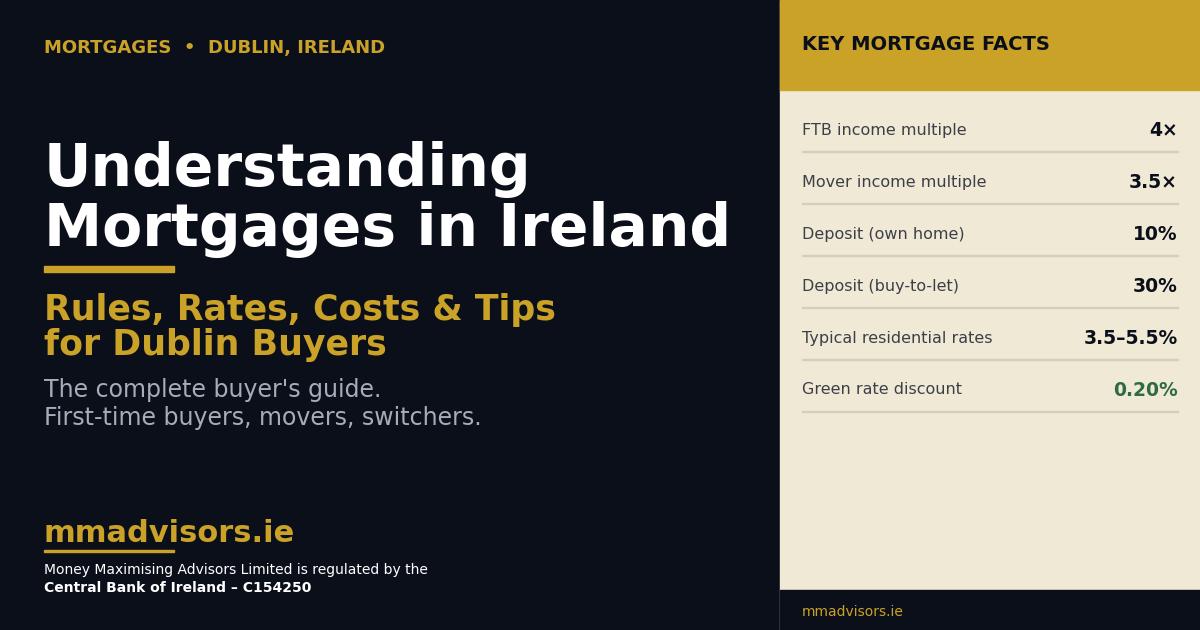
The Central Bank applies two headline limits. The first is a loan-to-income (LTI) cap of 4× gross income for first-time buyers and 3.5× gross income for movers and switchers. The second is a loan-to-value (LTV) minimum deposit of 10% for a home you will live in and 30% for a buy-to-let. Lenders are allowed a limited annual quota of exceptions above those limits, but reliance on those exceptions has fallen sharply since 2023, do not build a plan around one.
Lender-specific credit policy
On top of the Central Bank rules, each lender applies its own criteria: how it treats bonuses and overtime, minimum service periods, probation policy, self-employment income tests, and stress-testing above the actual rate. This is where broker access changes outcomes, our Mortgage Comparison Advice service maps your specific profile against the credit policies of every active lender in the market. For a broader picture of what changed this year, see Irish Mortgage Market 2026: Rates, Rules and What’s Changed.
How much deposit do I need for a mortgage in Ireland?
The Central Bank floor of 10% for a home you will live in is exactly that, a floor. On a €450,000 Dublin home that means €45,000, but you should aim higher whenever you can, because loan-to-value bands also drive the interest rate you get offered. A larger deposit routinely unlocks a cheaper rate, particularly with lenders like AIB whose variable rate is directly tied to LTV. For buy-to-let purchases the minimum is 30%, capping borrowing at 70% loan-to-value. For a walkthrough of the rates and structures on the investment side, see our full guide to Comparing the Best Buy-to-Let Mortgage Rates in Ireland.
Government supports for first-time buyers
Two schemes matter most for Dublin first-time buyers. Help to Buy provides a tax rebate of up to €30,000 (or 10% of the purchase price, whichever is lower) toward the deposit on a new-build home. The First Home Scheme is a shared-equity scheme where the State takes an equity stake of up to 30% (20% if you are also using Help to Buy) in your new home. Between them, they can meaningfully shrink the deposit and mortgage you need. Public sector workers should also read Public Sector Mortgages in Ireland: Qualify for Larger Loans, Lower Rates and Faster Approval for the sector-specific advantages.
How much can I borrow for a mortgage in Ireland?
The maximum figure most Dublin buyers can borrow is the LTI cap: 4× gross income if you are a first-time buyer, 3.5× if you are a mover or switcher. On a combined gross income of €110,000, that is up to €440,000 as a first-time buyer or €385,000 as a mover, before deposit is added to derive your maximum purchase price.
What actually gets approved, however, depends on affordability, existing credit, employment stability and stress testing. Lenders will typically stress-test your repayments at 2% above the rate you are applying for, and any personal loan or car finance running in the background will drag the number down. If you are approaching this while also considering a lump sum from a redundancy, walk through What Is the Average Redundancy Package in Ireland? first, how you deploy that lump sum can materially change your borrowing capacity.
For Irish ex-pats considering a return, criteria differ significantly. Non-resident income assessment, deposit sourcing, exchange rate treatment and rental income tests all come into play. Our Ex-Pat Mortgages Ireland: A Complete Guide for Overseas Buyers and Investors and Irish Mortgages and Buying Property in Ireland as an Ex-Pat go through the lender-by-lender approach in detail.
What mortgage rates look like in Dublin right now
Residential mortgage rates in Ireland typically sit in a 3.5–5.5% APR range across the active lenders, with buy-to-let rates running roughly 0.5–1% higher, typically 4.5–6.5% APR. Green rates for homes with a BER of B3 or better can shave around 0.20 percentage points off, which sounds small but adds up to roughly €10,000–€16,000 over the life of a €300,000 mortgage. If your BER is close to that threshold, a small upgrade before drawdown is often the highest-ROI move you can make.
Fixed rate, variable rate, or split?
Fixed-rate uptake in Ireland now runs at over 70% of new first-time buyer mortgages, and for good reason: the certainty of a locked repayment for two, three, five, seven or occasionally ten years matters when household budgets are already stretched. A handful of lenders now offer long-term fixed products (up to 30 years). Variable rates can rise or fall at any time and, in some cases, are linked to alternative benchmarks, for example Avant Money’s Flex mortgage tracks the 12-month Euribor rather than the ECB rate. AIB offers LTV-linked variable rates where a smaller loan-to-value ratio unlocks a cheaper rate.
Comparing APR vs APRC
When you compare offers, the number that matters is the APRC (Annual Percentage Rate of Charge), it includes all costs over the full mortgage term, not just the headline rate. Cashback offers are attractive at drawdown but are effectively pre-paid interest and rarely change the winning offer once APRC is included. The CCPC Mortgage Comparison Tool is an excellent starting point, and our Mortgage Comparison Advice service goes further, layering in credit policy, service level and access to broker-only lenders.
The full cost of a Dublin mortgage, beyond the deposit
Most Dublin buyers underestimate the total cash-out on the day the sale closes. Beyond your deposit, the essentials are:
- Stamp duty. Residential rate is 1% on the portion up to €1 million and 2% above. New builds may be lower once the VAT-inclusive rules are applied.
- Legal fees. A solicitor typically charges €1,500–€3,000 plus outlays (Land Registry, searches, planning) and VAT.
- Valuation report. Every Irish lender requires one, usually €150–€250, arranged with an approved valuer.
- Structural survey. Optional but strongly advised for older properties. A full report from a Society of Chartered Surveyors Ireland (SCSI) member typically runs €400–€800. A quick walk-around inspection is cheaper (€150–€250) but comes without a written report.
- Life & mortgage cover. Every Irish lender requires Mortgage Protection in place before drawdown. Consider Income Protection and Serious Illness Cover at the same time, they cost less and process faster when arranged together.
Which type of Dublin mortgage is right for you?
First-time buyer mortgages
The standard route: 4× income, 10% deposit, layered with Help to Buy or the First Home Scheme where eligible. For the exact application timeline and documents, see 10 Things to Know Before Applying for a Mortgage in Ireland and, if you are switching, Mortgage Broker in Dublin: How to Get My BER Certificate.
Public sector mortgages
Teachers, gardai, nurses, HSE staff and civil servants often qualify for larger loans, lower rates and faster approval than the standard route, a reflection of income stability and defined-benefit pension entitlement. Read Public Sector Mortgages in Ireland: Qualify for Larger Loans, Lower Rates and Faster Approval and Public Sector Mortgage Ireland: What Do I Need to Apply for a Mortgage? for the sector-specific documentation.
Buy-to-let and SPV mortgages
For Dublin investors, individual buy-to-let mortgages require a 30% minimum deposit, higher rates and typically an interest coverage ratio (ICR) test on the rental income. Larger investors and pension-backed portfolios often use SPV company structures. For a full comparison of the routes and rates, see Comparing the Best Buy-to-Let Mortgage Rates in Ireland: Options for Individuals, Pensions and Companies.
Ex-pat and overseas buyer mortgages
Irish citizens abroad and returning ex-pats face bespoke lender criteria, non-resident income treatment, currency conversion, and deposit sourcing all matter. Start with our Ex-Pat Mortgages Ireland: A Complete Guide for Overseas Buyers and Investors or the more scenario-driven Irish Mortgages and Buying Property in Ireland as an Ex-Pat, then book a call.
What is the mortgage approval process in Ireland?
The Irish mortgage journey moves through five distinct stages. Understanding each in advance is what separates a smooth application from a stressful one.
- 1. Pre-approval preparation. Clean up your current account activity for at least six months, save consistently, clear short-term debt where possible, and confirm your BER status, the BER cert is required by every mortgage lender.
- 2. Approval in Principle (AIP). Lender confirms a maximum figure you can borrow subject to full underwriting. Valid typically for 6 months. Do not view homes without it.
- 3. Sale agreed and full application. Once you go sale agreed, you submit the full application: valuation report, life cover, mortgage protection, solicitor details.
- 4. Formal loan offer. Lender issues the formal offer document. Your solicitor reviews it. If green rate eligibility depends on BER, this is where it locks in.
- 5. Drawdown. On the closing date, funds transfer to your solicitor’s client account and the property becomes yours. Mortgage protection must be active on the same day.
How long does mortgage approval take in Ireland?
From a well-prepared application to Approval in Principle, 2 to 4 weeks is typical, though a straightforward salaried case with a specialist broker-only lender can complete faster. From sale agreed to drawdown, 6 to 10 weeks is the common range, with the bulk of the variability driven by your solicitor’s speed, the vendor’s readiness, and any planning or title issues that surface. In a market where Dublin resale properties often go sale-agreed within days, having your AIP live and your solicitor briefed before you start viewings is critical.
| Ready to move? Enquire Now to have one of our advisors map your specific position against every active Irish lender, or Book Now for a free 30-minute consultation. |
10 practical tips before you apply for a Dublin mortgage
- Compare on APRC, not the headline rate. Include the full term cost of any cashback offer.
- Get your BER sorted early. Green rates for B3+ often decide which lender becomes the best fit.
- Save consistently for at least six months. Lenders look for a savings pattern, not a lump sum arriving from nowhere.
- Clear or consolidate short-term debt. Personal loans and credit-card balances materially reduce your borrowing capacity.
- Verify what your employer will confirm. Bonuses, overtime, commission, policies vary widely between lenders.
- Consider your family situation early. If college savings are on the horizon, our guide to Smart Savings and Investment Plans for College Education in Ireland pairs well with mortgage planning.
- Book life cover in parallel, not last. Underwriting for larger sums can take longer than the mortgage itself.
- Verify your solicitor is on the lender panel. A quick call before you engage saves weeks later.
- Do not touch your savings deposit close to drawdown. Any large transfer or non-obvious withdrawal will need explaining.
- Use a broker. Not every lender goes through branches, Haven, Avant, ICS, Finance Ireland, MoCo and Nua are all broker-only.
Frequently asked questions
1. What are the rules for getting a mortgage in Ireland?
Two Central Bank limits set the framework: loan-to-income (4× for first-time buyers, 3.5× for others) and loan-to-value (10% minimum deposit for own home, 30% for buy-to-let). Every lender then applies its own credit policy on top.
2. How much deposit do I need for a mortgage in Ireland?
The floor is 10% of the purchase price for a home you will live in and 30% for a buy-to-let. Help to Buy and the First Home Scheme can meaningfully reduce the cash you need on new builds.
3. How much can I borrow for a mortgage in Ireland?
Up to 4× gross income as a first-time buyer or 3.5× as a mover, subject to affordability, stress-testing at 2% above the rate you are applying for, and existing debt. On a €110,000 combined income, that is a maximum of €440,000 (FTB) or €385,000 (mover) before deposit.
4. What is the mortgage approval process in Ireland?
Five stages: preparation, Approval in Principle, sale agreed + full application, formal loan offer, drawdown. Your BER cert, mortgage protection and any life insurance need to be lined up before drawdown.
5. How long does mortgage approval take in Ireland?
Approval in Principle typically takes 2–4 weeks from a complete application. From sale agreed to drawdown is usually 6–10 weeks, driven mostly by conveyancing speed.
Reviewed and researched by our Dublin mortgage team
This pillar was prepared by the mortgage team at Money Maximising Advisors, drawing on live 2026 lender data and Central Bank guidance. For personalised advice, Book Now or Enquire Now. Watch our video walkthroughs on the Money Maximising Advisors YouTube channel.
Dublin buyer? Let’s talk.
Whether you are a first-time buyer, switcher, mover or investor, our Dublin mortgage team maps your position against every active Irish lender, including broker-only options that never appear on the high street. Book Now for your free consultation, or visit Money Maximising Advisors for more.
Important information
WARNING: Your home is at risk if you do not keep up payments on a mortgage or any other loan secured on it.
WARNING: You may have to pay charges if you pay off a fixed-rate loan early.
Rates, thresholds and Central Bank rules are correct at the time of writing and are subject to change. Money Maximising Advisors Limited is regulated by the Central Bank of Ireland. This article is for general information only and does not constitute financial, tax or legal advice. Lending criteria, terms and conditions apply. You should seek personalised advice from a Qualified Financial Advisor before making any financial decision.