
SPV’s & SPV Mortgages Limited Company Mortgages in Ireland
Buy an investment property through a limited company
Looking to buy an investment property in Ireland? An SPV mortgage allows a limited company set up for property investment to purchase and own the property.
70%Up to maximum LTV
30%Deposit required
FixedRate options
VariableRate options
BENEFITS SUMMARY
Benefits of buying property through a limited company
Access to specialist mortgage finance for investment property purchases.
More tax-efficient than owning property in your own name.
Protect your personal money if something goes wrong.
Easier to qualify for finance for property purchases.
More suited to investors looking to grow their property portfolio.
Use personal funds through a Director’s Loan where appropriate.
Use existing company funds through a subsidiary and Intercompany Loan where appropriate.
A potential succession tax planning tool for passing assets to children.
How it Works
Buying Property Through a Limited Company Work?
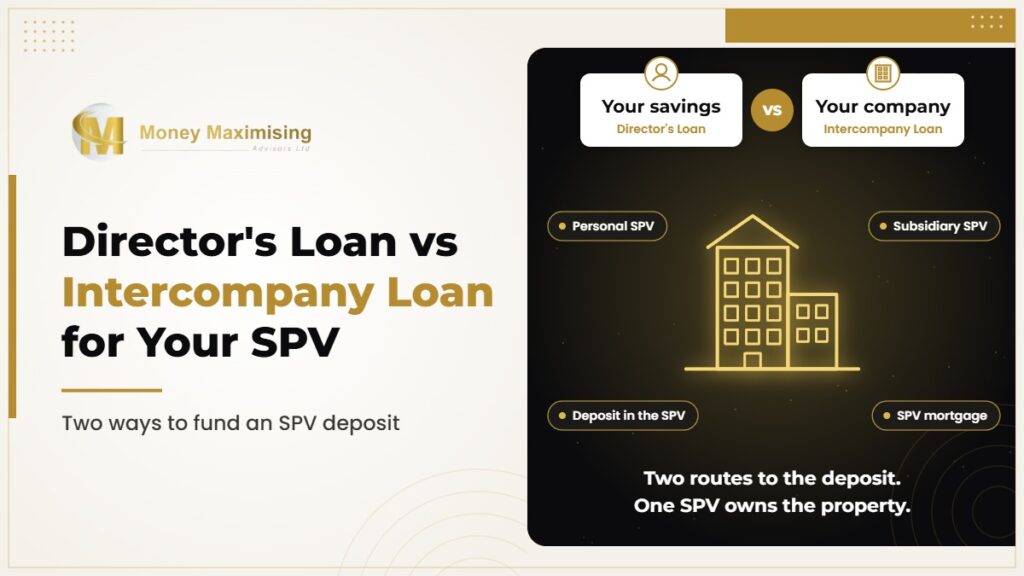
There are two common ways to structure an investment property purchase through a limited company.
1Set Up an SPV Personally
You can personally set up an SPV as a separate limited company for property investment.
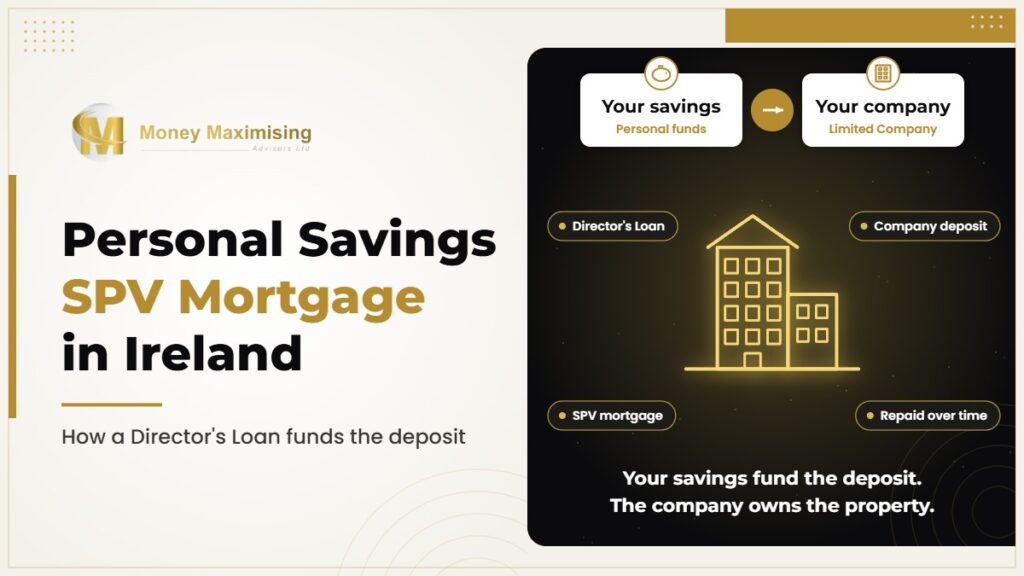
Your personal savings may be introduced into the SPV through a Director’s Loan, which can then be used towards the property deposit.
Personal SavingsYour SPVDirector’s LoanDepositSPV MortgageProperty
2Set Up an SPV Through Your Existing Company
If you already own or operate a company, that company can set up a separate SPV for property investment.
Funds from your existing company may be transferred to the SPV through an Intercompany Loan, depending on your company structure and circumstances.
Existing CompanyProperty SPVIntercompany LoanDepositSPV MortgageProperty
For example, on a €500,000 investment property:
Property value€500,000
30% deposit€150,000
Potential mortgage€350,000
Both approaches can be viable depending on your circumstances, existing company structure, available funds and lender criteria.
What Is an SPV?
What Is a Limited Company (SPV) for Property Investment in Ireland?
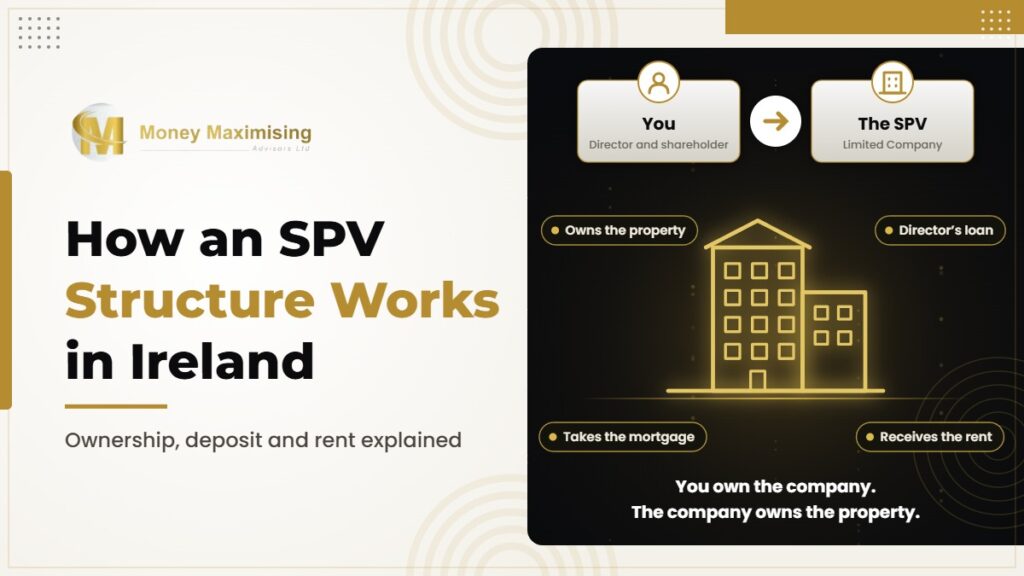
An SPV (Special Purpose Vehicle) is a private limited company set up specifically to buy and own investment property.
The property is owned by the company rather than an individual, and the company can apply for an SPV mortgage to finance the purchase.
SPV Requirements
- A minimum of one shareholder and one director.
- Director Requirements
- At least one director must be resident in Ireland.
- Working and paying tax in Ireland.
An unlimited number of shareholders from all nationalities can own an SPV for property investment.


How to Set Up an SPV for Property Investment in Ireland
A qualified accountant will be required to set up an SPV.
A company name must be chosen and registered.
A company bank account must be opened.
Company shareholders’ names must be declared.
Taxation Benefits of SPVs
Taxation on Profits: Corporation Tax
- 25% on non-trading income profits (e.g. rental income).
Director's loans into the company to fund the deposit for a property purchase.
Director Benefits
- Can be extracted tax-free from SPV and paid back to director.
- Interest can also be charged on directors' loans.
The SPV
- Interest repayments are tax-deductible.
These SPV tax benefits make an SPV limited company buy-to-let mortgage highly efficient for investors.
Reducing Corporation Tax on Profits
Tax-deductible expenses that reduce Corporation Tax
- 1. Pension contributions are permitted within an SPV, subject to Revenue rules
- 2. Family members can be hired and paid a salary from the business
- 3. Subsistence/Mileage can be paid from the company
- 4. Director loan repayments and interest
- 5. Salaries of family members (up to €13,000 per year per family member can be very tax-efficient)
Capital Acquisition Tax Planning Using SPVs
SPVs can be used as a way of passing assets on to family members and may reduce or eliminate Capital Acquisition Tax (CAT) liabilities on gifts or inheritances.
Examples:
- Making children 100% shareholders of the SPV and you as the director with no shareholding.
- Gifting €3,000 worth of SPV shares to each of your children each year until they own 100% of the shares.
SPV Mortgages/Limited Company Mortgages for Investment Property
Shareholders/directors of an SPV can apply for a mortgage through an SPV. It is the SPV that is borrowing the money, not the individual.
Depending on the lender and circumstances, mortgage options may include:
- Up to 70% LTV
- 30% deposit
- Fixed mortgage rates
- Variable mortgage rates
- Interest-only options
- Capital and interest repayment options
- Terms of up to 30 years, depending on lender and product
For example, on a €500,000 investment property, a 30% deposit would be €150,000, with potential mortgage finance of €350,000, subject to lender criteria.
WHO OFFERS SPV MORTGAGES IN IRELAND?
Specialist lenders provide mortgage finance for investment properties purchased through a limited company.
ICS MORTGAGES
One of the main providers of SPV mortgage finance in Ireland.
CAPITALFLOW
Another provider of finance for property investment through a limited company.
INDICATIVE SPV MORTGAGE RATES5% to 6%
Subject to lender and individual circumstances.
MORTGAGE OPTIONS
- Fixed rates
- Variable rates
- Interest-only options
- Capital and interest repayments
- 2, 3 or 5-year fixed-rate periods
WHAT ABOUT THE MAIN BANKS?
Pillar banks such as AIB, Bank of Ireland and PTSB are generally less active in this type of lending, so specialist lenders may be relevant when considering an SPV mortgage.
Rates and mortgage terms can change and should be confirmed at the time of application.
Conditions of an SPV Mortgage
Key criteria for a Limited Company mortgage for investment property.
DIRECTORS’ REQUIREMENTS
Minimum salary of €40,000 (can be from combined director salaries).
Between the ages of 21 and 70.
MAX MORTGAGE
70% of the property market value
DEPOSIT REQUIRED
30% of the property purchase price
(funded by directors’ loans or loans from subsidiary companies, etc.).
TERM
5 to 35 years
Lenders will lend up to the youngest shareholder or director’s 80th birthday.
INTEREST RATE
Variable rate: 5.15% to 6%
10-year interest-only option (moving to capital and interest afterwards).
Capital and interest option
AFFORDABILITY
Rent must cover mortgage repayments by at least 1.2 times.
85% when the director has more than 1 Residential property.
Individual income is not assessed, so it can be easier to qualify.
OVERPAYMENT OPTION
No penalty or limit on overpaying the mortgage.
SIMPLIFIED APPLICATION
Individuals’ income and personal finances are not assessed, so significantly less paperwork is required.
IMPORTANT Lender criteria and rates can change. Confirm current requirements and terms at the time of application.
Documents Required to set up an SPV
The following documentation must be provided for your SPV application.
Company Name Details
- Your chosen company name (must be unique and approved by the CRO).
Company Registered Office Address
- An official Irish address where CRO correspondence will be sent.
- Anti-money laundering (AML) documentation for all directors and shareholders.
- A recent utility bill or bank statement for the company (usually dated within the last 3 months).
Buy-to-Let Mortgage vs. SPV Mortgage
| Aspect | SPV Ownership | Personal BTL Ownership |
|---|---|---|
| Ownership | Property is owned by a limited company (SPV) | Property is owned personally by the individual |
| Establishment | Company | Individual |
| Maximum Mortgage | 70% of Property Value | 70% of Property Value |
| Minimum Deposit | 30% of Property Value | 30% of Property Value |
| Transfer to Children | Shares in the company can be passed on | Property itself is inherited |
| Tax-efficient (income & gains) | ||
| Income Tax on rental income | 25% Corporation Tax on non-trading income and 12.5% on trading income. | If rental income is above 14k, whole income is exposed to 50% tax. |
| Mortgage interest | Deductible as a business expense for the SPV. | Deductible from rental income for BTL. |
| Pension contributions | Can contribute rental profits to pension (age-based limits apply). | Cannot use rental income for pension. |
| Deposit extraction | Directors can show deposits as a loan to the company, and withdraw them tax free, when profits are available, reducing tax liability. | Deposits cannot be withdrawn unless the property is sold. |
What Residential Properties Qualify for Limited Company Mortgage Finance?
If you’re considering buying an investment property through a Limited Company, it’s important to know that not every property will qualify for mortgage finance.
Key Requirements
Residential properties only
Commercial properties and development finance are excluded.
Ready to rent
The property should be rentable straight away. Derelict properties would not qualify.
No self-builds
Self-build properties are excluded.
Suitable location
The property should be in an established town or city with strong rental demand, typically with a local population of around 3,000 to 5,000 people or more, depending on the lender.
IMPORTANT Lender criteria can vary, so if you have a property in mind, it’s worth checking whether it meets the relevant lending requirements before moving forward.
Pre-Submission Documents required to apply for an SPV mortgage
Anti-Money Laundering Documentation
- Proof of ID
- Proof of address
- Proof of PPS number
Proof of Income
Self-Employed/Directors
- 2 years’ certified accounts (financial statements audited by your accountant)
- 2 years’ Form 11s and Chapter 4s (proof of income)
- Tax clearance certificate (a letter from your accountant confirming your tax affairs are up to date)
- At least 6 months’ statements for any loans held by the company
Employees
- Last 3 payslips
- Employment Detail Summaries (EDS) for the last 2 years (formerly known as P60s)
- Signed salary certificate from your employer
Other Documents That May Be Required
- Tenancy documents: if you are refinancing an investment property.
- Foreign credit checks: if you have lived in a different country in the last 5 years.
- Additional loan statements: if you have any debts that do not appear on your Central Credit Register report, 24 months’ statements are required.
SPV Documents Required After Approval in Principle (AIP)
The following are required at a later stage, after mortgage approval in principle (AIP)
SPV company-related documents
- Certified copy of certificate of incorporation.
- Certified copy of the Memorandum and Articles of Association or Constitution.
- Copy of a recent SPV bank statement (only if existing SPV).
- These documents will be provided by your accountant once an SPV is set up.
AN UP-TO-DATE CREDIT REPORT (CCR) IS REQUIRED FOR ALL SHAREHOLDERS AND DIRECTORS
Example Scenarios
EXAMPLE 1
USING EXCESS COMPANY FUNDS TO PURCHASE AN INVESTMENT PROPERTY
Meet Mark. He runs a successful business and has excess profits sitting in his company bank account, making little or no return while being eroded by inflation.
Rather than leaving these funds sitting in the account, Mark considers using them alongside a mortgage to purchase an investment property through a Limited Company.
For example, if the property costs €500,000, Mark could potentially use €150,000 in company funds as the 30% deposit, with a mortgage of up to €350,000 at 70% LTV, subject to lender criteria.
Limited Company mortgage options may include fixed, variable and interest-only rates, with terms of up to 30 years, depending on the lender and circumstances.
The longer term can also make the affordability test easier to meet, as the market rent needs to be 1.2 times the mortgage repayments.
EXAMPLE 2
USING PERSONAL SAVINGS TO BUY AN INVESTMENT PROPERTY THROUGH A LIMITED COMPANY
Meet John and Mary. They are both public servants and already own their principal private residence and one buy-to-let property.
They want to grow their property portfolio and have €150,000 in savings available.
They decide to purchase their next investment property through a Limited Company. Their €150,000 savings are introduced into the company as a Director’s Loan, providing the 30% deposit on a €500,000 investment property.
The remaining €350,000 could potentially be funded through an SPV mortgage, subject to lender criteria.
EXAMPLE 3
USING EXISTING COMPANY FUNDS TO PURCHASE AN INVESTMENT PROPERTY
Meet Mark. He runs an engineering firm with €150,000 sitting in his company account.
He explores setting up a subsidiary company as an SPV and transferring the €150,000 across as an Intercompany Loan.
This provides the 30% deposit on a €500,000 investment property, with an SPV mortgage potentially financing up to the remaining 70%, subject to lender criteria.
Mark’s company structure now includes a property investment that may generate rental income and may increase in value over time.
EXAMPLE 4
USING EQUITY FROM EXISTING PROPERTIES TO FUND YOUR NEXT INVESTMENT
Meet David. He is an experienced property investor with a number of properties already in his portfolio.
Over time, the value of his properties has increased, leaving him with equity built up in his existing portfolio.
David explores releasing €300,000 of equity from his existing properties.
This could potentially provide the 30% deposit for a €1 million property purchase, with the remaining €700,000 potentially funded through an SPV mortgage, subject to lender criteria.
The €300,000 is introduced into the Limited Company as a Director’s Loan and used towards the deposit.
EXAMPLE 5
SECURE YOUR CHILD’S COLLEGE ACCOMMODATION THROUGH A LIMITED COMPANY
Meet Paddy and Jane. Their child is sitting the Leaving Cert and plans to attend college in Limerick.
With student accommodation in high demand, they are considering buying a property that their child can live in while attending college.
Paddy and Jane set up a Limited Company (SPV) with Mum and Dad as shareholders and purchase the property through the company.
They use 30% of their cash reserves as the deposit, with the remaining 70% potentially funded through an SPV mortgage, subject to lender criteria.
Their child has accommodation for the duration of college, while Paddy and Jane retain the property as an investment that could continue generating rental income after their child finishes college.
EXAMPLE 6
BUYING A SECOND OR THIRD PROPERTY THROUGH A LIMITED COMPANY
Meet John and Mary. They already own their home and a buy-to-let property and are considering purchasing another investment property.
When buying personally, their personal income can be an important part of the lender’s assessment.
They explore using an SPV, or Special Purpose Vehicle, where the borrowing is taken out by the company.
The lender’s assessment may place significant emphasis on the property’s expected rental income. Some lenders may require market rent to cover the mortgage repayment by around 1.2 times.
Mortgage finance of up to 70% LTV, with a 30% deposit and terms of up to 35 years, may be available subject to lender criteria.
Illustrative examples only. Figures are simplified for illustration; actual amounts, interest rates and repayments will depend on your individual circumstances and lender approval.
FREQUENTLY ASKED QUESTIONS (FAQs)
These FAQs are general information only and are not tax, legal or lending advice. Tax rules, reliefs, and mortgage criteria can change, and the appropriate structure depends on the investor’s circumstances.
What is an SPV mortgage?
An SPV mortgage is borrowing taken by a limited company established or used to hold investment property. The company owns the property and is responsible for the mortgage, subject to the lender’s terms and any guarantees required.
Are SPV mortgage repayments tax deductible?
Not in full. The capital or principal part of the mortgage repayment is not deductible. Qualifying mortgage interest may generally be deducted in calculating rental profit, subject to Revenue rules and the circumstances of the property.
Is mortgage interest also deductible for a personal landlord?
Yes, qualifying interest may also be deductible for an individual landlord. The core distinction is therefore not that an SPV can deduct the whole mortgage; it cannot. The bigger difference is the tax treatment of the rental profit.
How is rental profit taxed in an SPV?
Irish company rental income is generally non-trading income and is subject to Corporation Tax at 25%. Other company tax rules may also apply.
How is a personal landlord taxed?
Rental profit is generally taxed as part of the individual’s income. Income Tax, USC and PRSI may apply depending on the landlord’s overall circumstances. Qualifying individual residential landlords may also be able to claim Residential Premises Rental Income Relief; the maximum for 2026 is €1,000 and the relief is not available to companies.
Does 25% Corporation Tax mean I can withdraw the SPV profits at 25% tax?
No. The cash belongs to the company. Taking it out personally, for example by dividend or salary, can create additional personal tax. The extraction strategy should therefore be considered before choosing an SPV.
Can an SPV retain rental profits to help buy another property?
It can retain cash after tax and costs, which may support future investment. However, many property SPVs are close companies, and a 20% surcharge can apply to certain undistributed after-tax rental and investment income. The detailed position should be modelled rather than assuming profits can accumulate indefinitely at 25%.
What is the close company surcharge, and are there ways to mitigate it?
A close company can face a 20% surcharge on undistributed after-tax estate/investment income, including rental income, if it is not distributed within 18 months of the end of the accounting period.
There are various allowable expenses and uses of company funds that may reduce taxable profits, depending on the circumstances. These can include:
- Director salaries
- Employing family members
- Pension contributions
- Using funds as a deposit to purchase additional properties
- Repaying Director or Intercompany Loans
- Mortgage interest
- Accountancy fees
- Maintenance costs
What tax-deductible expenses can be used to reduce Corporation Tax?
Rental profits are generally taxed on the net amount after allowable expenses. Typical allowable costs can include insurance, repairs and maintenance, management and accountancy fees, certain service charges paid by the landlord, and qualifying mortgage interest, subject to Revenue conditions.
Capital improvements are not normally deductible as a revenue expense, and Local Property Tax (LPT) is not deductible.
What would a €100,000-rent example look like?
Illustratively, a €777,778 mortgage at 5.5% over 30 years costs about €53,000 per year. In Year 1, roughly €42,500 is interest and €10,500 is principal. If gross rent is €100,000 and other deductible costs are €10,000, taxable rental profit is about €47,500 before considering other deductions or allowances.
How can estate planning tools, like gifting €3,000 per parent, be utilised?
The Small Gift Exemption allows €3,000 per disponer (giver) per recipient per calendar year without using the recipient’s CAT threshold.
For example, two parents could each gift €3,000 to a child, allowing €6,000 per child per year, subject to the relevant rules.
Company shares may also form part of succession planning, but CAT rules and the company structure should be considered.
What are the tax implications of selling a property?
If owned personally, a gain may be subject to Capital Gains Tax (CGT) at 33%, subject to applicable reliefs or exemptions.
If owned by a company, the gain is subject to the applicable Corporation Tax rules on chargeable gains. Further tax may arise when proceeds are extracted personally, so exit planning is important.
Can I use personal savings or company funds to fund an SPV property deposit?
Potentially, yes.
If using personal savings, the funds may be introduced into the Limited Company through a Director’s Loan and used towards the property deposit.
If you already have an established company, you may be able to set up a subsidiary company and transfer funds through an Intercompany Loan, depending on the company structure and circumstances.
The documentation and lender assessment requirements can vary.
Is an SPV always better for a higher-rate taxpayer?
No. An SPV may be useful where profits are intended for reinvestment, but the comparison also needs to include mortgage pricing, company costs, close-company surcharge, extraction tax and the eventual exit. Personal ownership can be simpler and may suit investors who want the rental income for personal use.
How do I set up an SPV (Special Purpose Vehicle)?
The general process includes:
- Incorporating an Irish LTD company
- Appointing directors and a secretary
- Opening a business bank account
- Registering for taxes as required
- Filing beneficial ownership details with the RBO
- Maintaining the required company records and compliance
What are the filing obligations for returns?
Companies generally have ongoing obligations including CRO annual returns, maintaining beneficial ownership details with the RBO, and filing Corporation Tax returns and paying Corporation Tax by the relevant deadlines.
Your accountant will typically manage these filings, but directors remain responsible for compliance.
Can I borrow for both residential and commercial property purchases?
Potentially, but lender policy, underwriting and security requirements can differ between residential buy-to-let, commercial property and company borrowers.
The relevant property type and lender criteria should be confirmed before applying.
Can I purchase a property using my existing trading company?
It can be possible, but it depends on your circumstances and company structure.
Another option may be to establish a separate subsidiary SPV for the property investment. This can help keep the property investment separate from the existing trading company.
What are the benefits of an SPV company?
An SPV can offer:
- Potential tax advantages, subject to applicable rules
- Company-based property ownership
- Access to specialist SPV mortgage finance
- Potential flexibility in funding a property purchase
- A structure that may suit investors looking to build a property portfolio
Who typically uses SPVs?
SPVs are commonly used by landlords and property investors looking to purchase or build a portfolio of buy-to-let investment properties through a Limited Company.
How many investors can be in an SPV?
An SPV can have one or several shareholders, depending on the company structure and applicable requirements.
What’s the difference between a normal company and an SPV company?
Both can be Limited Companies, but an SPV is set up specifically to purchase and hold property, while a normal company may be used for trading or other business activities.
What should I compare before applying for an SPV mortgage?
Compare the available loan-to-value, interest rate, term and lender requirements alongside projected rent, running costs, tax, company administration costs and your plans for retained profits. Tax and legal advice should be obtained for your specific structure.
What documents are required to apply for an SPV mortgage?
You may need proof of ID, proof of address and proof of PPS number. Self-employed applicants/directors may need two years’ certified accounts, two years’ Form 11s and Chapter 4s, a Tax Clearance Certificate and at least six months of company loan statements. Employees may need their last three payslips, the last two years’ Employment Details Summaries and a signed Salary Certificate. An up-to-date CCR is required for all shareholders and directors. Depending on the circumstances, tenancy documents, foreign credit checks and additional loan statements may also be required.
Need the numbers modelled?
A useful SPV assessment compares personal ownership and company ownership on the same property, mortgage and rental assumptions, including tax, cash flow, mortgage amortisation and how profits will ultimately be used.
MORE HELPFUL GUIDES & ADVICE
Guides for SPV Mortgages
CLIENT TESTIMONIALS
What Our Clients Say
Trustindex verifies that the original source of the review is Google. Excellent thorough service provided by Lorna.Posted on GoogleTrustindex verifies that the original source of the review is Google. MMA team made my mortgage application to approval easy and possible. They are efficient and swift with responses. The level of professionalism is second to none and special thanks to Cris for her support. At some point I was the one delaying the process yet you were very patient with me, guide me through every process and arrange meetings for clarity. Surely this is the best mortgage adviser I have encountered and I strongly recommend them cause they don’t disappoint. Thanks team ElizabethPosted on GoogleTrustindex verifies that the original source of the review is Google. Great company! My advisors, Jack and Maricris, were very attentive, very professional. No advanced fees charged and as advertised, if you don’t close a deal, if you don’t draw down, there’s no charge, which unfortunately was my case, so after being helped through the process, they didn’t charge me anything.Posted on GoogleTrustindex verifies that the original source of the review is Google. Cris and Sean were excellent and couldn’t do enough to help me in getting the keys to my first home. Sean is incredibly knowledgeable and very personable. I highly recommend them.Posted on GoogleTrustindex verifies that the original source of the review is Google. I'd like to thank everyone at MM Advisors especially Sean and Cris. They were amazing throughout the whole process. Extremely professional and always on hand to help us along the way.
Ready to Explore Your Options?
Money Maximising Advisors Limited is regulated by the Central Bank of Ireland – C154250.
Warning: If you do not meet the repayments on your loan, your account will go into arrears. This may affect your credit rating, which may limit your ability to access credit in the future.
Warning: The cost of your monthly repayments may increase.
Warning: You may have to pay charges if you pay off a fixed-rate loan early.