Ireland has roughly 40,000 civil servants working across dozens of Government departments and agencies. If you are one of them, you are looking at some of the most straightforward mortgage applications a lender will see this year. This guide from Money Maximising Advisors explains exactly how civil service employment translates into better mortgage terms.
You will see the borrowing capacity at each grade. You will see the specific documents that speed up approval. And you will see how to position your application for the best rate.
| QUICK ANSWER: Irish civil servants benefit from three specific mortgage advantages: government-backed employment removes the biggest lender risk factor, defined-benefit pension entitlement is factored into long-term affordability assessments, and structured salary progression (CO through PO grades) is highly predictable. Typical Approval in Principle timeline is 2–4 weeks. Standard Central Bank rules apply (4× income for FTBs, 10% deposit), but civil servants access these limits more easily than most private sector applicants. |
| This pillar connects Irish civil servants to Public Sector Mortgages, Public Sector Superannuation Advice, Public Sector AVCs and Public Sector Salary Protection. |
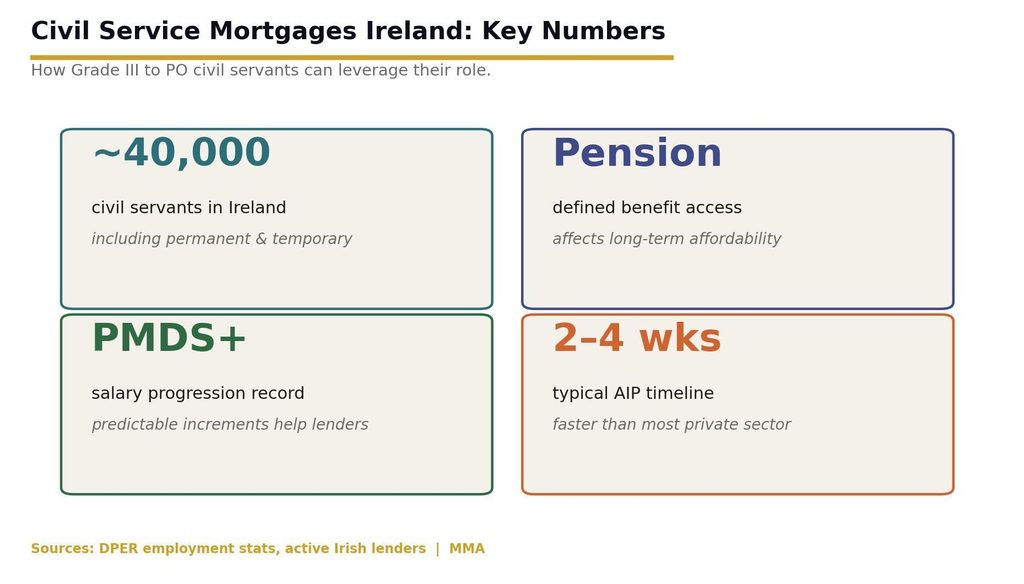
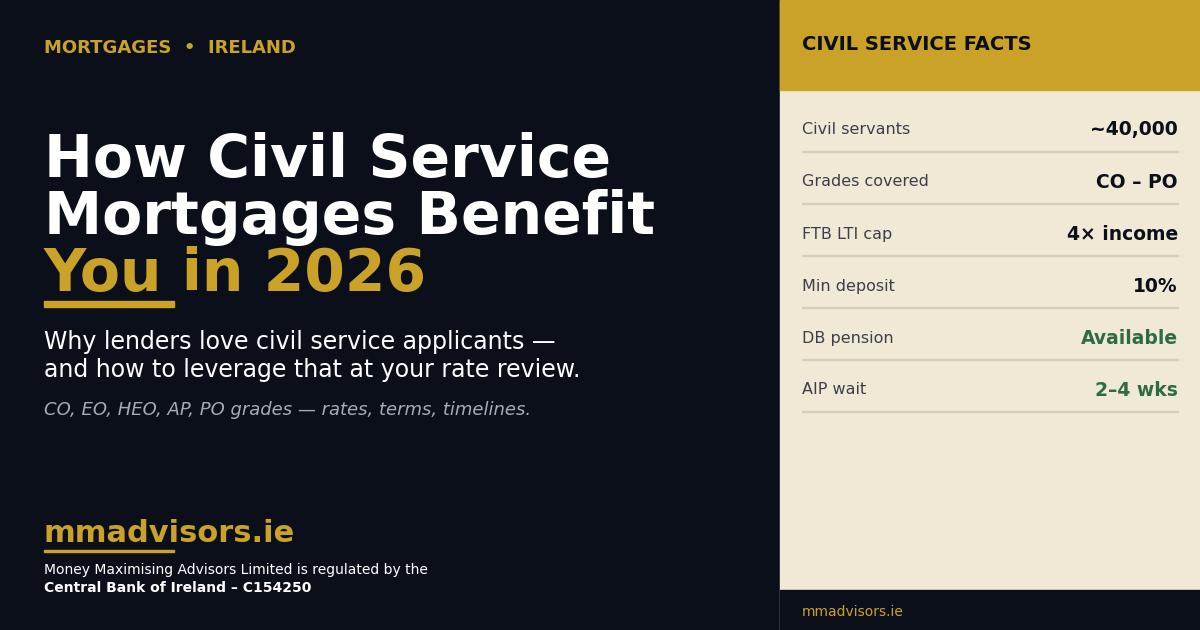
The four numbers every Irish civil servant should know when applying for a mortgage.
Who counts as a civil servant for mortgage purposes?
The Irish civil service employs approximately 40,000 people across Government departments, offices and agencies. Every one of them qualifies as “civil service” under Irish mortgage lender criteria.
Government departments
Central departments
Department of the Taoiseach, Department of Finance, Department of Public Expenditure and Reform (DPER). These employ the largest cohort of AP, PO and Assistant Secretary General staff.
Service-delivery departments
Department of Social Protection (largest single employer of COs and EOs), Department of Justice, Department of Employment Affairs, Department of Agriculture, Food and the Marine.
Policy departments
Department of Health, Department of Education, Department of Housing, Department of Foreign Affairs, Department of Transport.
Civil service offices and agencies
Revenue Commissioners
Revenue is one of the largest employers of civil servants outside the main departments. Includes central Revenue in Dublin and regional offices.
Office of the Attorney General
Small but professional cohort of legal staff, plus supporting administrative civil servants.
Central Statistics Office (CSO)
Cork-based agency employing civil servants across statistical, IT and administrative grades.
Public Appointments Service (PAS)
The recruiter for most civil service positions, itself an employer of civil servants.
How much can you borrow at each civil service grade?
The Central Bank of Ireland caps borrowing at 4× gross income for first-time buyers and 3.5× for movers. Here’s what that looks like in practice for the main civil service grades.
Clerical Officer (CO) grade
Salary range
The CO scale runs from approximately €33,000 at entry to €53,000 at the top of the scale, with 15–16 increments.
Borrowing capacity
As a first-time buyer, borrowing capacity ranges from €132,000 to €212,000 at 4× income. Practically, most COs will look at properties in the €160,000–€240,000 range depending on deposit size.
Executive Officer (EO) grade
Salary range
EO salaries range from approximately €38,000 to €57,000. Progression through the scale is typically 12–13 increments.
Borrowing capacity
First-time buyer borrowing capacity: €152,000 to €228,000. Joint applications with a spouse or civil partner can substantially increase this figure.
Higher Executive Officer (HEO) grade
Salary range
The HEO scale spans approximately €58,000 to €73,000. This is a key promotion grade for many civil servants.
Borrowing capacity
First-time buyer borrowing capacity: €232,000 to €292,000. This grade often opens up 3-bed family homes in most Irish regional cities.
Assistant Principal (AP) grade
Salary range
AP salaries run approximately €76,000 to €98,000 across the scale. AP is a management-tier grade with substantial responsibility.
Borrowing capacity
First-time buyer borrowing capacity: €304,000 to €392,000. A joint AP + AP application can reach €750,000+ in borrowing.
Principal Officer (PO) grade
Salary range
PO salaries span approximately €104,000 to €128,000. Higher scales apply to some specialist and senior POs.
Borrowing capacity
First-time buyer borrowing capacity: €416,000 to €512,000. Realistic access to properties across all price ranges in most parts of Ireland.
The three specific benefits of civil service employment
Benefit 1: Guaranteed income stream
Why lenders value it
Every mortgage lender models default risk. Government-backed employment removes the biggest single risk factor, employer insolvency.
Practical impact
Civil service applications hit affordability limits more easily than private sector equivalents. Full 4× borrowing is typically accessible without additional criteria.
Benefit 2: Defined benefit pension entitlement
Why lenders value it
Civil servants participate in defined benefit pension schemes. Retirement income is guaranteed, not dependent on investment performance.
Practical impact
This affects long-term affordability. For applicants closer to retirement, lenders extend the age at which they’ll lend because the DB pension provides ongoing income. Our Public Sector Superannuation Advice service walks through how this maps to your specific scheme.
Benefit 3: Structured salary progression
Why lenders value it
Civil service pay is set by public sector pay agreements. Progression through the scale is predictable, typically an increment per year until top of scale, plus promotion opportunities every few years.
Practical impact
Lenders factor future income growth into affordability. This is particularly valuable at entry grade, a Clerical Officer at the start of the scale has 15+ years of increments ahead.
| Civil servant ready to buy or switch? Book Now for a free 30-minute consultation, or Enquire Now, we reply within one working day. |
What documents do civil servants need for a mortgage?
Preparation is the difference between a 2-week and a 6-week Approval in Principle.
Employment documents
Salary certificate
Your HR unit issues this on request. It confirms your grade, service length, and current salary. Most departments turn this around within 3–5 working days.
Contract of employment
Your original letter of appointment or most recent contract if you have moved grades. Confirms permanent/temporary status.
Recent payslips
The most recent 3 months of payslips. These verify take-home pay and any allowances.
Pension documents
Pension modeller output
A projection of your retirement benefits. The most powerful supporting document for a civil service mortgage application. Available from your HR pension section.
PRD statement
Confirms your ongoing pension contribution. Standard for all civil servants under the Single Public Service Pension Scheme.
Financial documents
Bank statements
6 months of personal and any joint account statements. Lenders look for a consistent savings pattern rather than a single large deposit.
Credit bureau check
Your broker will pull the Central Credit Register report to verify existing loans and credit history.
The civil service mortgage timeline
Stage 1: Preparation (1–2 weeks)
Gather documents, engage a broker, run affordability calculations. Fix any short-term debt issues.
Stage 2: Approval in Principle (2–4 weeks)
Application submitted. Lender assessment. AIP issues confirming maximum loan available. Valid 6 months.
Stage 3: Property search and sale-agreed
Variable timeline, depends on the market and what you’re looking for. Some buyers go sale-agreed within days; others take months.
Stage 4: Full application (6–10 weeks to drawdown)
Full underwriting on the specific property. Valuation, survey, life cover, solicitor’s undertaking. Drawdown on closing date.
Mortgage products specifically for civil servants
First-time buyer mortgages
Standard route, 4× income, 10% deposit. Help to Buy for new builds. First Home Scheme available on many new builds.
Switching mortgages
Civil servants with existing mortgages often benefit from switching after 3–5 years. Green mortgage rates for B3+ properties routinely save €2,000+ per year.
Buy-to-let mortgages
Civil servants can also access Buy-to-let Mortgages. Stable employment income makes the rental income affordability case straightforward for lenders.
Equity release for older civil servants
Later-life applicants often use equity release. Our Equity Release Mortgages hub covers lifetime loans and remortgage options for civil servants approaching or in retirement.
Common civil servant mortgage mistakes
- Not requesting the pension modeller. This is the most powerful supporting document for a civil service application.
- Applying directly to one bank. You lose access to broker-only lenders and preferential civil service terms.
- Ignoring green rates. BER B3+ properties qualify for 0.10–0.20% rate discounts, significant over the life of a loan.
- Not switching after 3 years. Civil servants with equity routinely save €2,000+/year by switching to a better rate.
- Skipping public sector AVCs. A separate topic, but worth reviewing at the same time. Our Public Sector AVCs service handles this alongside mortgage planning.
Frequently asked questions
How can civil service mortgages benefit you in Ireland?
Three specific benefits: government-backed employment reduces lender risk (faster approval, easier access to full 4× borrowing), defined benefit pension entitlement is factored into long-term affordability, and structured salary progression is predictable. Typical AIP timeline is 2–4 weeks.
How much can a civil servant borrow?
Central Bank rules cap borrowing at 4× gross income for FTBs and 3.5× for movers. A HEO on €65,000 can borrow up to €260,000 as an FTB. An AP on €90,000 can borrow up to €360,000.
Do civil servants get lower mortgage rates?
Some Irish lenders publish specific public sector rate discounts. Others apply discretionary preferential terms. A broker with lender relationships surfaces these rates that direct applicants often can’t access.
What documents do civil servants need for a mortgage?
Salary certificate (from HR), employment contract, most recent 3 payslips, most recent P60 or T4, pension modeller output, 6 months of bank statements. The pension modeller output is the strongest supporting document.
Are civil service mortgage applications faster?
Yes. Well-prepared civil service files typically reach AIP in 2–4 weeks. Some straightforward cases complete in under 2 weeks. Employment and income are easy to verify through standard government documentation.
Can civil servants access buy-to-let mortgages?
Yes. Stable employment income makes the rental income affordability case straightforward for lenders. Standard BTL rules apply, 30% minimum deposit, ICR test on rental income.
Reviewed by our civil service mortgage team
This pillar was prepared and reviewed by the mortgage team at Money Maximising Advisors, drawing on Central Bank of Ireland rules, DPER civil service pay scales, and daily civil service applications we complete. MMA is regulated by the Central Bank of Ireland (C154250).
Civil servant? Let’s map your options.
Whether you’re at CO grade buying your first home or PO grade trading up, our team knows exactly how to position your civil service application for the best terms in the market. Book Now for your free consultation, or Enquire Now.
Important information
WARNING: Your home is at risk if you do not keep up payments on a mortgage or any other loan secured on it.
WARNING: You may have to pay charges if you pay off a fixed-rate loan early.
Civil service pay scales referenced are indicative and derived from Department of Public Expenditure and Reform (DPER) documentation. Actual borrowing capacity depends on individual affordability, existing debt, and Central Bank stress-testing. Money Maximising Advisors Limited is regulated by the Central Bank of Ireland (C154250). This article is for general information only and does not constitute financial advice. Lending criteria, terms and conditions apply.