An SPV, or Special Purpose Vehicle, is a limited company set up to hold rental property. It has become the default structure for serious Irish property investors. This guide from Money Maximising Advisors explains how SPVs work in Ireland, when they save tax, and how to set one up.
You will see the exact corporation tax rates. You will see when the close-company surcharge bites. And you will see how the numbers stack up against owning property in your own name.
| QUICK ANSWER: An Irish SPV pays 25% corporation tax on rental income, plus a 20% close-company surcharge if profits are retained beyond 18 months. This compares to individual income tax at up to 52% for higher earners. SPVs typically make sense for landlords planning to grow a portfolio of two or more properties. Setup takes 3–5 days through the CRO. Mortgages are available through specialist SPV lenders with 30–35% deposits. |
| This pillar connects Irish property investors to SPV Mortgages, Buy-to-let Mortgages, Directors Pension and Equity Release Mortgages. |
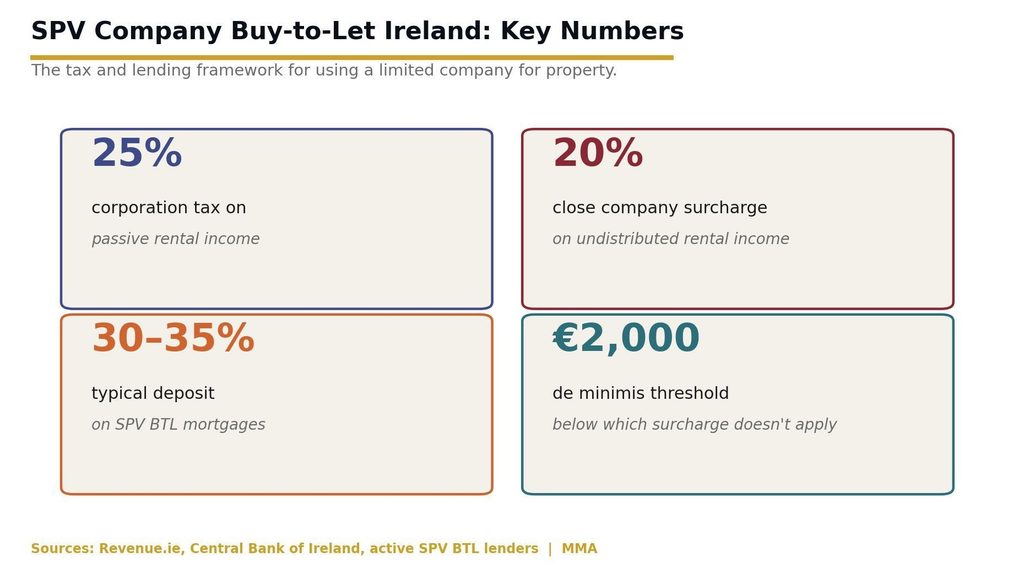
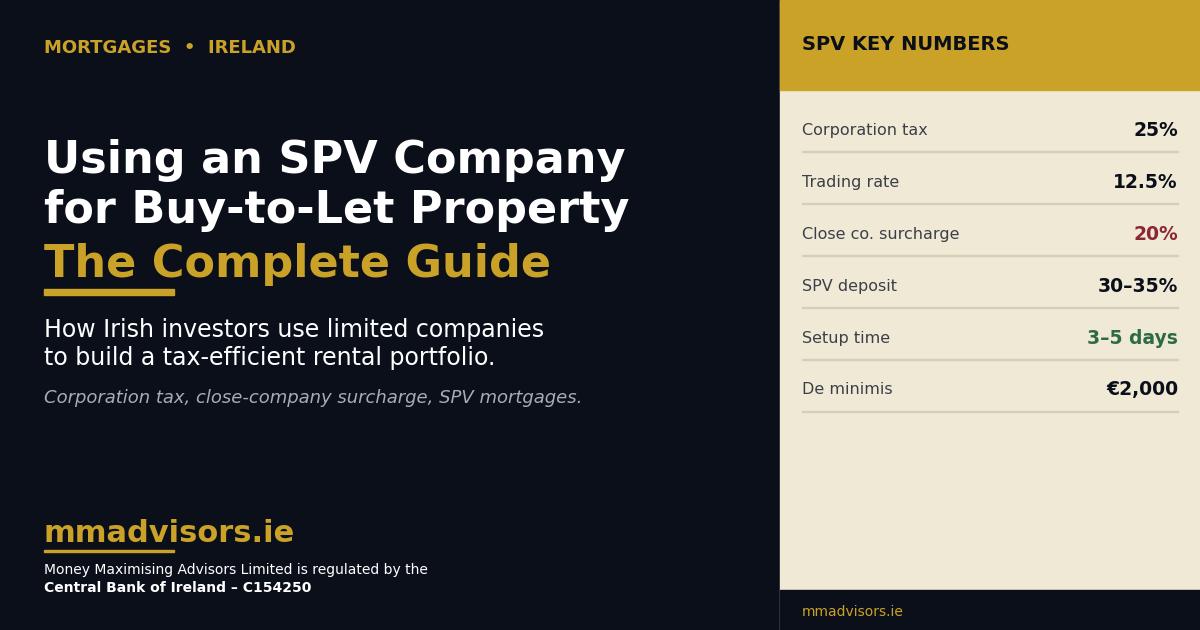
The four numbers every Irish investor considering an SPV should know.
What is an SPV in Ireland?
SPV stands for Special Purpose Vehicle. It’s a limited company set up for one specific purpose, in this case, owning rental property.
An SPV is a normal Irish limited company. It files annual accounts. It has directors and shareholders. It pays corporation tax.
The reason investors use SPVs is tax. Rental income and capital gains are taxed at company rates, typically much lower than personal income tax rates for higher earners.
How is an SPV taxed in Ireland?
This is where most investors get the maths wrong. There are three separate tax charges to consider.
Corporation tax on rental income
Rental income in an Irish SPV is taxed at 25%. This is the passive-income rate, not the 12.5% trading rate.
The reason: rental activity is legally “passive”, not a trade. Even large landlords generally can’t argue their way into the trading rate.
On €30,000 of rental profit, that’s €7,500 corporation tax. Compare this to individual ownership: a higher-rate taxpayer would pay income tax + USC + PRSI totalling around 52%, or €15,600 on the same profit.
Close-company surcharge
Here’s the trap. If your SPV keeps rental profits inside the company instead of paying them out to you, a 20% surcharge applies to the undistributed income.
A close company is one controlled by five or fewer people, or by directors. Most SPVs are close companies.
The surcharge applies on retained rental profits held beyond 18 months. There is a €2,000 de minimis below which it doesn’t apply.
The surcharge is designed to prevent investors sheltering income indefinitely at company rates. It effectively pushes SPVs toward paying regular dividends.
Personal tax on distributions
When you take money out of the SPV as a dividend or salary, you pay personal income tax. So the SPV route saves tax on the way in, but taxes on the way out.
The advantage: you control when. If you retire and drop into the lower tax band, distributions become dramatically more efficient.
When does an SPV actually save tax?
Not every investor benefits from an SPV. Here are the situations where it makes sense.
You are a higher-rate taxpayer
If you pay 40% income tax, USC and PRSI on rental profits, an SPV saves tax immediately. The 25% corporation tax rate beats 52% marginal personal tax.
You plan to reinvest profits
SPVs work best when you keep rental profits inside the company to buy more property. You pay 25% corporation tax on the profits and reinvest 75%.
Watch the close-company surcharge, pay yourself something each year to avoid triggering it on retained profits over 18 months.
You have a portfolio ambition
For a single rental property, personal ownership is usually simplest. For a portfolio of two or more, the SPV structure often pays for itself in tax savings within 3–5 years.
You want to separate personal and business risk
SPVs create legal separation between your personal assets and your rental portfolio. If a tenant sues, the company’s assets are the only assets exposed, not your home.
When an SPV doesn’t make sense
The SPV route has real costs. It’s not for everyone.
You only plan to buy one property. Setup, accountancy fees and CRO filings will absorb most of the tax saving on one small unit.
You want to live in the property yourself. SPVs are for arm’s-length rental only. Living in an SPV-owned property triggers complex tax and mortgage issues.
You need the rental income to live on right now. Taking money out of the SPV triggers a second layer of tax. Personal ownership is cleaner.
How do you get a mortgage on an SPV?
Not every Irish lender offers SPV Mortgages. The market is smaller than the residential BTL market. Most are broker-only.
Typical criteria for an SPV mortgage:
- Deposit: 30–35%. Some lenders require 40% for portfolio landlords.
- Rates: 5.5–6.5%. Slightly higher than personal-name BTL rates.
- Personal guarantee: expected. You are still on the hook personally if the SPV defaults.
- Business account: required. A dedicated business bank account is needed before drawdown.
- Business plan: yes. Especially if the SPV is new or has no existing rental income.
| Setting up an SPV for property? Book Now for a free structure review, or Enquire Now, we’ll come back within one working day. |
How to set up an SPV: the 5-stage process
Stage 1: Incorporate the SPV
Register the company with the Companies Registration Office (CRO). Standard registration takes 3–5 business days.
Choose a suitable company name. Set the objects clause to cover property investment. Appoint at least one director and a company secretary. Issue share capital.
Stage 2: Bank account and accountant
Open a business bank account for the SPV. Appoint an accountant. Register for corporation tax with Revenue.
If the SPV will have VAT-registered activity (rare for pure residential), register for VAT. Set up bookkeeping from day one.
Stage 3: Prepare the lender pack
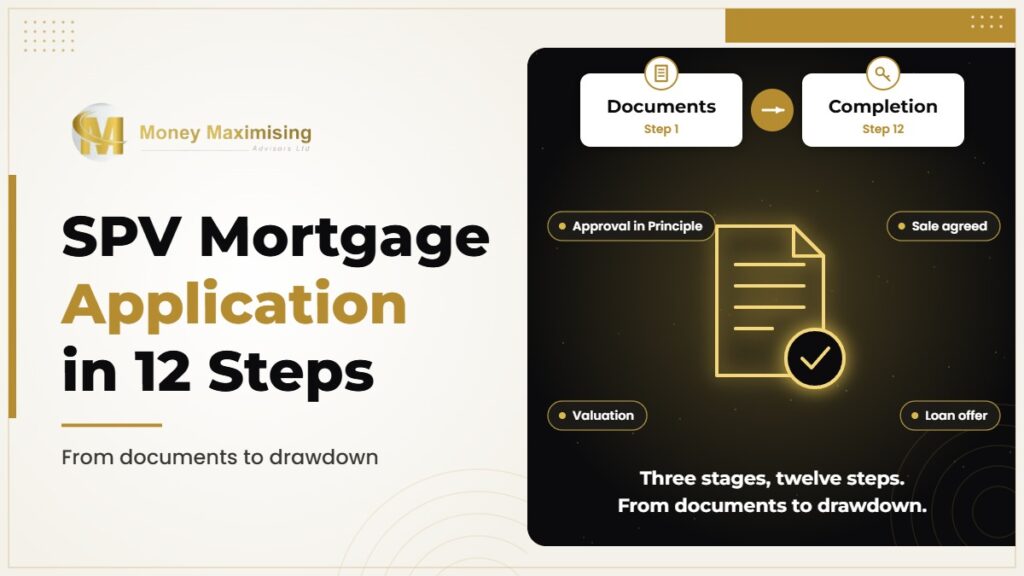
Your broker prepares the mortgage application. Documents required include the SPV’s incorporation certificate, a business plan, personal guarantees from directors, and evidence of deposit source.
Stage 4: Approval in Principle
A specialist SPV lender assesses the application. AIP typically issues within 1–2 weeks for a clean file. Valid for 6 months.
Stage 5: Property purchase and drawdown
Once you go sale-agreed on a property, full underwriting begins. The lender re-runs the affordability test against the specific property’s expected rent. Drawdown follows 6–8 weeks after sale-agreed.
Can I move an existing BTL into an SPV?
Yes, but it’s expensive. The transfer is treated as a sale from you personally to the SPV. Full stamp duty applies. Capital gains tax may apply on any uplift since you bought the property.
This transfer cost often wipes out three to five years of tax savings on day one. Most investors set up the SPV before buying, not after.
If you’re already holding a property personally and considering a transfer, take specialist tax advice first. Our Money Management Advice and mortgage teams work through this together with your accountant.
Common SPV mistakes Irish investors make
- Ignoring the close-company surcharge. Retained profits over €2,000 attract a 20% surcharge if not distributed within 18 months.
- Trying to claim the 12.5% trading rate. Rental income is taxed at 25%. Revenue applies the passive rate strictly.
- Transferring an existing property in. Full stamp duty and CGT apply. Set up the SPV before you buy where possible.
- Underestimating running costs. Annual accounts, CRO filings, an accountant and a business bank account are ongoing overheads.
- Skipping personal guarantees. SPV lenders always require them. Your personal assets are not fully protected.
- Not planning distributions. Without a distribution strategy, personal tax hits hard when you eventually extract profits.
Frequently asked questions
What is an SPV company in Ireland?
An SPV, or Special Purpose Vehicle, is a limited company set up for one purpose, typically owning rental property. It’s a normal Irish limited company that pays corporation tax on rental profits and files annual accounts.
What tax does an SPV pay on rental income?
An Irish SPV pays 25% corporation tax on rental income (passive income rate). If profits are retained inside the company for more than 18 months, a 20% close-company surcharge also applies. Distributing profits to yourself triggers personal income tax.
How much deposit is needed for an SPV BTL mortgage?
Typically 30–35% of the property value. Some lenders require 40% for portfolio landlords or riskier profiles. This is higher than personal-name BTL, which requires 30% minimum.
Can I transfer my existing BTL into an SPV?
Yes, but it’s expensive. The transfer is a sale for tax purposes. Full stamp duty is due on the market value. CGT may apply on any uplift since original purchase. Costs often wipe out several years of tax savings. Setting up the SPV before buying is usually more efficient.
What is the close-company surcharge?
A 20% surcharge on undistributed passive income (including rental profits) of a close company. It applies if profits are retained inside the SPV for more than 18 months. A €2,000 de minimis threshold applies. This is a key reason SPVs must plan regular distributions.
How long does it take to set up an SPV?
CRO incorporation takes 3–5 business days. From setup to first mortgage AIP typically takes 1–2 weeks. From setup to first drawdown, allow 6–10 weeks including property purchase.
Reviewed by our mortgage team
This pillar was prepared and reviewed by the mortgage team at Money Maximising Advisors, drawing on Revenue.ie corporation tax guidance, live SPV lender criteria, and daily SPV mortgage applications. MMA is regulated by the Central Bank of Ireland (C154250).
Ready to structure your portfolio?
Whether you’re incorporating your first SPV or refinancing an existing portfolio, our team handles the full process, lender selection, application, structure design and coordination with your accountant. Book Now for a free consultation, or Enquire Now.
Important information
WARNING: If you do not keep up your repayments you may lose your property or the security given for a loan.
Central Bank lending rules, corporation tax rates, and the close-company surcharge referenced are correct at time of writing and are sourced from the Central Bank of Ireland, Revenue.ie and the Companies Registration Office. Money Maximising Advisors Limited is regulated by the Central Bank of Ireland (C154250). This article is for general information only and does not constitute financial, tax or legal advice. Lending criteria, terms and conditions apply. You should seek personalised tax advice from a qualified accountant before making any structural decision.