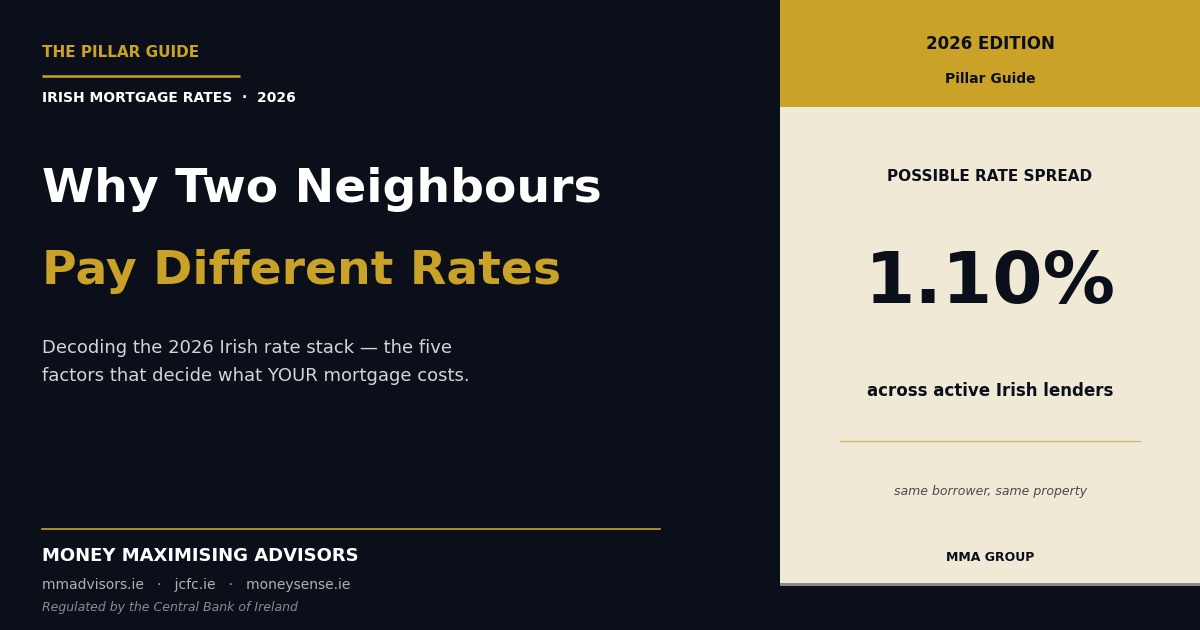
| THE HIDDEN NUMBER 1.10% The rate difference two neighbours can be quoted on the same street, on the same property size, with the same salary, depending on their LTV band, BER rating, chosen lender and product structure. On a €300,000 mortgage over 30 years, that 1.10% spread is roughly €72,000 over the life of the loan. This pillar guide decodes the 2026 Irish rate stack, the five factors that determine the number on your Loan Offer letter, and how to move each one in your favour. |
Irish mortgage rates have moved more in the past four years than in the previous decade. Between 2022 and 2023, the European Central Bank raised its deposit rate from -0.5% to 4.0% to fight eurozone inflation. Since then, rates have come back down: the ECB’s main refinancing rate now sits around 2.15–2.25% as of June 2026. Over 80% of new Irish mortgages are now on fixed rates, and the market has settled into an era of choice, not scarcity, with green rates, high-value discounts, cashback offers and BER-linked incentives widely available.
But headline market rates don’t explain why your personal rate is what it is. Two families in the same estate, buying similarly priced homes on similar salaries, can be quoted rates 0.60–1.10% apart, depending on their LTV band, BER rating, product structure and chosen lender. This guide from the Money Maximising Advisors Group, covering Ireland from Galway (mmadvisors.ie), Donegal (jcfc.ie) and Kerry (moneysense.ie), unpacks the 2026 rate stack from first principles.
For our full Mortgage Comparison Advice service, see the primary hub. Related pages: Mortgages, Public Sector Mortgages, Buy-to-let Mortgages, Irish Ex-pat Mortgages and Mortgage Protection.
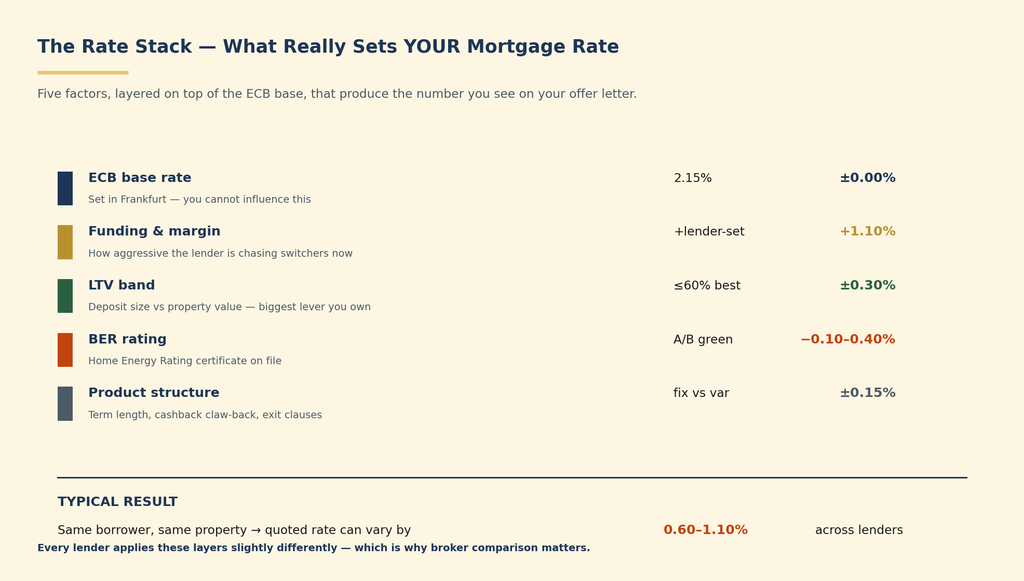
Five factors layered on top of the ECB base rate, producing the specific number on your Loan Offer.
The Quick Answer: seven questions Irish borrowers ask about mortgage rates
How do Irish mortgage interest rates affect monthly repayments?
On a €300,000 mortgage over 30 years, every 0.50% change in rate moves the monthly repayment by approximately €85–€90. A full 1% move is ~€180 per month, which is ~€65,000–€70,000 over the life of the loan. That is why the green rate discount of 0.20–0.40%, which sounds small at first glance, can be worth €10,000–€15,000 over the term.
Why are mortgage interest rates changing in Ireland?
Three forces set the price of an Irish mortgage:
(1) the ECB’s main refinancing rate, which drives the eurozone cost of money;
(2) interbank Euribor and swap rates, which reflect market expectations of future ECB moves; and
(3) domestic lender competition, which has intensified sharply since 2024 with Avant Money, MoCo, Haven and PTSB all fighting for market share. In practice, the third factor moves rates most day-to-day.
What is the current average mortgage interest rate in Ireland?
Central Bank of Ireland retail interest rates data shows the average rate on new Irish mortgage agreements at approximately 3.50% as at April 2026, close to the eurozone average, and materially below where it peaked in 2023. Behind that headline, the same borrower can be quoted anywhere from 3.00% to 4.70% depending on lender, LTV band, BER rating and product choice.
Should I choose a fixed or variable mortgage in Ireland?
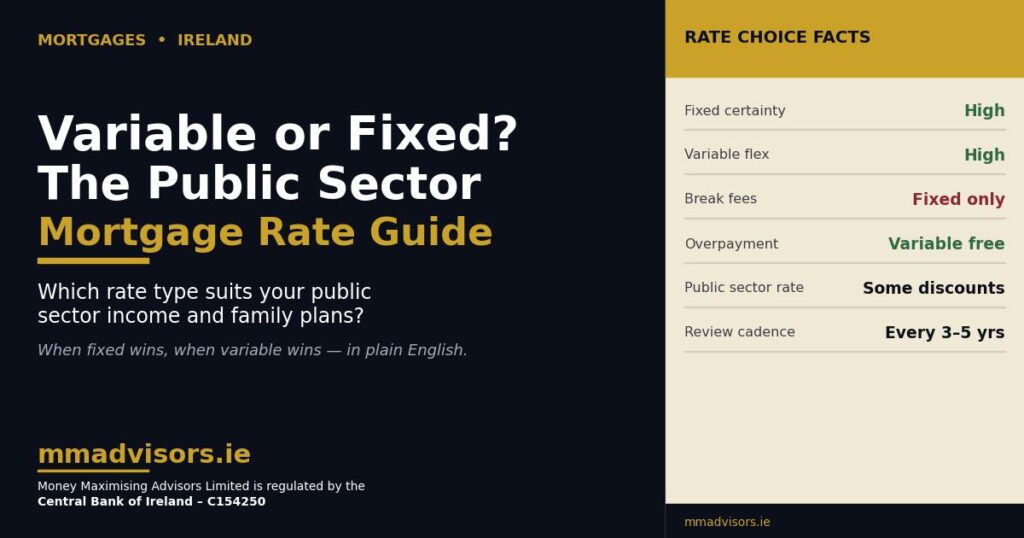
For most borrowers in 2026: fixed. Fixed rates are currently lower than most variable rates, which is unusual by historical standards. The 3–5 year fixed sweet spot suits most Irish households, giving planning certainty at a modest premium. Choose variable if you’re planning to overpay heavily, expect a lump sum, or think you may sell within 24 months. The Avant Money Flex Mortgage is unique among variables in Ireland, it resets annually against 12-month Euribor and allows overpayment at any time with no charge.
How does the ECB influence Irish mortgage rates?
Every 25 basis-point ECB move translates to approximately €13 per month per €100,000 outstanding on a variable rate mortgage, per the Central Bank of Ireland’s own guidance. On the average Irish mortgage of ~€300,000, that’s ~€39/month. Fixed-rate borrowers see no immediate impact until their fixed term ends, at which point they roll on to whatever the new market rate is.
Can I switch my mortgage if interest rates fall?
Yes, and there is generally no break fee when rates are falling. See our full guide: Switching Mortgages in Ireland (2026): The Loyalty Penalty Guide. Switchers are also exempt from the Central Bank’s 4× LTI cap, an important detail if your income has changed since drawdown.
How can I get the best mortgage rate in Ireland?
Three levers:
(1) lower your LTV band by increasing your deposit or waiting until property price appreciation moves you into a cheaper tier;
(2) ensure your home’s BER certificate is current and get any planned energy upgrade done before drawdown; (3) work with a Multi-Agency broker who can quote across every active Irish lender, not just one bank’s in-house products.
Meet the MMA Group: three offices, one national reach
| TUAM · GALWAY mmadvisors.ie National coverage Flagship group HQ, full mortgage, pension, protection and inheritance advice. | MOUNTCHARLES · DONEGAL jcfc.ie North West Ireland Joe Coyle Financial Consultants, business-owner and family finance specialists. | KILLARNEY · KERRY moneysense.ie South West Ireland Money Sense Financial Services, family-run, 40+ years Irish experience. |
The Rate Stack: five factors that determine YOUR rate
1. The ECB base rate, the floor you can’t move
Every eurozone mortgage rate starts here. In June 2026, the ECB’s main refinancing rate sits at ~2.15–2.25%. It is unlikely to fall much further in the near term, and there is upside risk. Your Irish lender adds a funding cost and margin on top of this. You have no ability to influence this layer; it is the same for every Irish borrower.
2. LTV band, the biggest lever you own
Your Loan-to-Value ratio (loan amount ÷ property value) puts you in a lender-specific band. Most Irish lenders offer four to five tiers: ≤60%, 60–80%, 80–90% and above. The difference between the highest and lowest LTV band on the same product is typically 0.20–0.40%, on the same lender. If you’re a switcher whose property has appreciated, verify your current LTV against your existing mortgage balance before you assume you’re still in your old band.
3. BER rating, the green discount
Homes with a Building Energy Rating of A or B qualify for green mortgage discounts from Haven, PTSB, EBS, AIB and others, typically 0.10–0.40% below the standard fixed rate.
| 2026 RULE CHANGE MOST GUIDES HAVEN’T CAUGHT UP TO AIB tightened its Green Fixed Rate eligibility in 2026. For BER Certificates with a validity date after 24 May 2026, the qualifying BER band narrows from A1–B3 (five bands eligible) to A0/A/B (three broader bands). This affects any new BER certificate issued in the second half of 2026 or later. Timing a BER assessment before or after that date can determine whether your home qualifies. Check your BER validity date carefully before commissioning any upgrade work. |
Bank of Ireland’s EcoSaver is the outlier: it applies tiered discounts to every BER-rated home from A right down to G, with the discount scaling to the rating. Even a G-rated home receives a small reduction on the standard fixed rate, which no other Irish lender offers.
4. Product structure, fixed vs variable vs green vs cashback
Different product structures carry different pricing. A cashback deal (BoI Cashback Plus 3%, PTSB 2%, Haven €5,000 flat) typically comes with a slightly higher headline rate than the no-cashback equivalent. A green fixed is cheaper than a standard fixed. A flex variable (Avant Money) resets annually against Euribor rather than being set by the lender. Each structure suits a different life stage; the wrong product at the right price is still the wrong product.
5. Lender competition, the day-to-day swing
The most volatile layer. PTSB cut fixed rates twice since September 2025 to attract switchers. Haven repriced its Green 5-year in Q1 2026. Avant Money extended cashback into 2026 to compete on total-package. In any given month, a Multi-Agency broker will know which lender is chasing market share and pricing sharpest, something bank-tied advisors cannot see.
| Ready to talk? Book a free, no-obligation consultation with the Money Maximising Advisors Group. Enquire Now • Book an Appointment • Contact Us |
BER discount economics: is upgrading worth it?
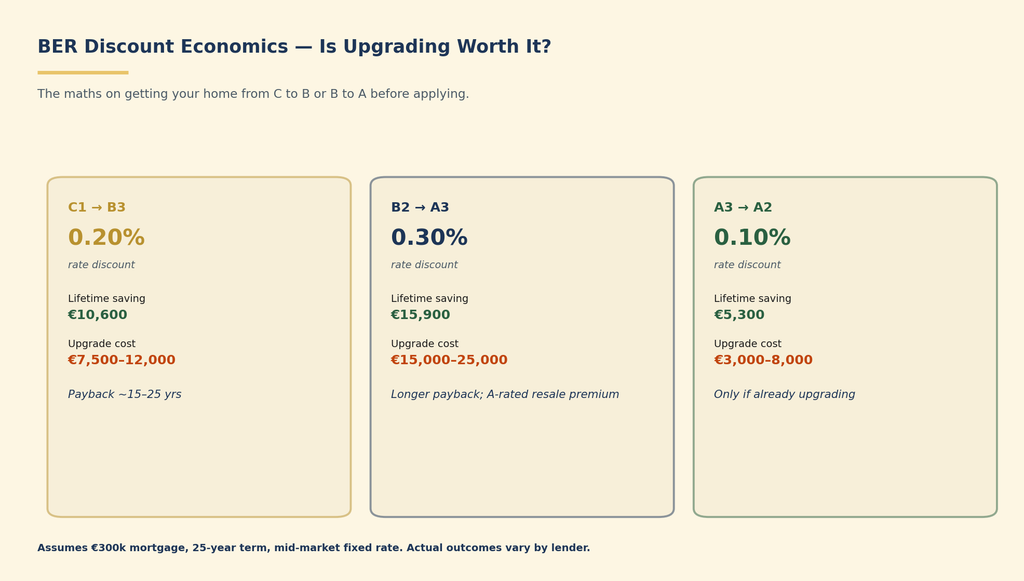
The maths on getting your home from C to B or B to A before applying, lifetime savings vs upfront cost.
A common question from switchers and second-time buyers: is it worth spending €15,000–€25,000 on insulation, heat-pump and solar to move your BER rating from C to B or B to A? The mortgage-rate-only answer is nuanced:
- Marginal upgrade (C1 → B3): costs ~€7,500–€12,000, saves ~€10,600 over 25 years on a €300k mortgage. Payback around 15–25 years, works if the property needs the insulation anyway.
- Meaningful upgrade (B2 → A3): costs ~€15,000–€25,000, saves ~€15,900 over 25 years. Longer payback, but the A-rated resale premium (typically 5–10% price uplift) often makes the difference.
- Cosmetic upgrade (A3 → A2): only makes sense if you’re already upgrading for other reasons. Marginal rate saving of ~€5,300 doesn’t justify the cost on its own.
The right answer isn’t purely mathematical. Energy upgrades reduce your utility bills, improve comfort, and (crucially) protect resale value. A-rated stock is increasingly what Irish buyers want. Take BER-driven mortgage advice alongside a Home Energy Assessment before you commit.
Fix for how long? The 2026 decision matrix
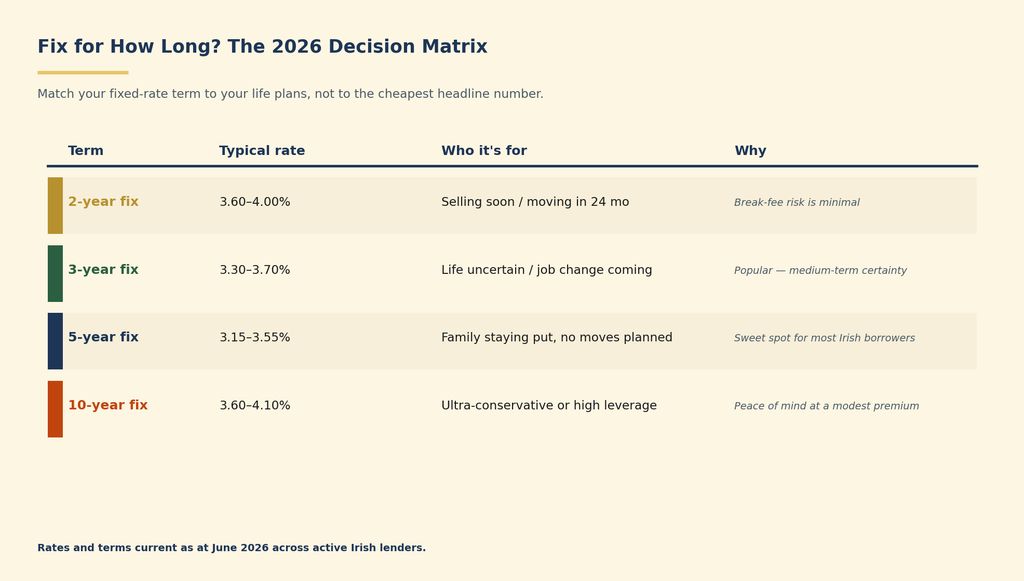
Match your fixed-rate term to your life plans, not to the cheapest headline number.
The right fixed-rate term isn’t the cheapest one on the rate card. It’s the one that matches how long you’re certain to stay in this home and how confident you are that your household income is stable:
- 2-year fix: only if you’re selling within 24 months. Break-fee risk is minimal, but you’ll be back in the market re-fixing at unknown rates in 2028.
- 3-year fix: popular for households with medium-term uncertainty, a job change coming, a possible move, a partner’s salary in flux. Rates typically 3.30–3.70%.
- 5-year fix: the sweet spot for most Irish borrowers in 2026. Rates typically 3.15–3.55%. Long enough to insulate from ECB volatility, short enough to keep options open.
- 10-year fix: for the ultra-conservative or highly-leveraged. Rates typically 3.60–4.10%. Meaningful break-fee exposure if you sell early.
Two rate myths still holding Irish borrowers back
| MYTH The lowest headline rate on the price comparison site is the best deal.” | FACT Compare the APRC (Annual Percentage Rate of Charge), not the headline. APRC includes fees, cashback, valuation costs and the follow-on variable rate that applies after your fix ends. A cheaper headline with an unfavourable follow-on rate is often a worse total deal. |
| MYTH Green mortgages are only for new builds. | FACT Any home with a valid BER Certificate showing A1–B3 qualifies with Haven, PTSB and EBS. AIB moved to A0/A/B for certificates valid after 24 May 2026. Bank of Ireland’s EcoSaver gives a tiered discount to every BER-rated home right down to G. |
Real-world scenario: same house, three lenders, three different rates
A Kerry couple approached Money Sense Financial Services (our Killarney office) in May 2026. They were buying an A2-rated home for €420,000, with a €65,000 deposit (LTV 84.5%) and combined gross income of €112,000. Three fixed-rate quotes came back:
- Haven Green 5-yr fixed at 3.15% (LTV 80–90% band, A-rated): €1,527/month, €5,000 flat cashback
- PTSB Green 4-yr fixed at 3.10% (LTV ≤90%, A-rated): €1,522/month, 2% cashback = €7,100
- BoI EcoSaver 5-yr fixed at 3.25% (A-rated, tiered discount): €1,545/month, 3% cashback = €10,650
On monthly repayment alone, PTSB wins by €5–€18/month. On cashback, BoI wins by €3,650 upfront. Over the full 5-year fixed period, the PTSB total cost (repayments + follow-on) came out marginally ahead, with the caveat that the 4-year fix would leave them re-fixing sooner. The couple chose PTSB for the cheaper rate, using the €7,100 cashback to fund emergency reserves rather than reduce the loan. Different couple, different priorities, different winner.
| Reviewed by Money Maximising Advisors Money Maximising Advisors Limited is regulated by the Central Bank of Ireland and operates as a Multi-Agency Intermediary across the main Irish lenders, insurers and pension providers. Our advisors hold QFA, RPA, CFP and FA designations and every recommendation is documented in a written Statement of Suitability. Verify our authorisation on the Central Bank Register, or learn more about us. |
Related posts
| Related post | Category | Read more |
|---|---|---|
| Mortgage Broker in Dublin: Switching Mortgage, How to Get My BER Certificate (2026 Guide) | Mortgage advice | View → |
| First Time Mortgage Buyers in Galway: Inflation and Its Impact on Interest Rates | First-time buyer | View → |
| 10 Things to Know Before Applying for a Mortgage in Ireland | Mortgage basics | View → |
| Public Sector Mortgage Ireland: What Do I Need to Apply for a Mortgage? | Public sector | View → |
| Switching Mortgages in Ireland (2026): The Loyalty Penalty Guide | Mortgage switching | View → |
Frequently asked questions about Irish mortgage rates
What is APRC and why does it matter?
APRC (Annual Percentage Rate of Charge) is the total annualised cost of the mortgage, including fees, valuation, and the rate that applies after the fixed term ends. Two 3-year fixed rates at 3.10% can have very different APRCs, because APRC captures the follow-on variable rate you’ll roll on to. Always compare APRCs alongside headline rates.
Do first-time buyers pay a different rate to switchers?
Sometimes. Some lenders offer switcher-only cashback or switcher-only rate tiers to attract new business. First-time buyers benefit from the Help to Buy scheme and First Home Scheme incentives, but the underlying rate is usually the same as an equivalent switcher on the same LTV band and BER rating.
Can my Irish mortgage rate change after I fix?
No, that’s the whole point of fixing. Your rate is locked for the full fixed term. When the fix ends, you roll onto your lender’s follow-on variable rate unless you actively choose a new fix. That follow-on rate is typically your lender’s standard variable, which in 2026 is where the loyalty penalty bites hardest.
Is there a way to overpay on a fixed-rate mortgage?
Most Irish lenders allow overpayment of up to 10% of the outstanding balance per year without triggering a break fee, even during a fixed term. Beyond that, break-fee rules apply. Avant Money’s Flex Mortgage allows unlimited overpayment on the variable product with no charge.
What is the difference between a green mortgage and an eco-saver mortgage?
“Green mortgage” is the industry-wide term for any BER-linked rate discount (Haven, PTSB, EBS, AIB, ICS). EcoSaver is specifically Bank of Ireland’s tiered green-rate product, unique in that it rewards every BER rating from A to G rather than restricting the discount to A/B homes only.
Get a personalised 2026 rate review
If your fixed rate is ending, you’re thinking about a move, or you’re a first-time buyer trying to figure out your true best deal, the Money Maximising Advisors Group will run live quotes across every active Irish lender and walk you through the rate-stack analysis for your specific situation, at no cost until you engage.
| Ready to talk? Book a free, no-obligation consultation with the Money Maximising Advisors Group. Enquire Now • Book an Appointment • Contact Us |
Important information
WARNING: If you do not meet the repayments on your mortgage, your account will go into arrears. This may affect your credit rating, which may limit your ability to access credit in the future. WARNING: The cost of your monthly repayments may increase. WARNING: You may have to pay charges if you pay off a fixed-rate loan early. Rates, LTV bands, BER eligibility criteria and Central Bank data referenced reflect Irish market conditions as at June 2026 and are subject to change. Money Maximising Advisors Limited is regulated by the Central Bank of Ireland. This article is for general information only and does not constitute financial or tax advice. You should seek personalised advice from a Qualified Financial Advisor before drawing down, switching or refinancing a mortgage.