If you live in Cork and you have ever quietly wondered whether the State Pension will actually see you through retirement, you are firmly in the majority. A national survey of 511 Irish adults conducted in May 2026 found that retirement confidence has collapsed: most working adults believe the State Pension on its own will not be enough, a large minority expect to work past 66, and one in three has never had any real pension advice. This pillar guide from Money Maximising Advisors turns that anxiety into a plan, walking you through what the State Pension actually pays, who qualifies for it, when you can claim it, and the practical retirement options available to Cork savers across the city, Douglas, Carrigaline, Ballincollig, Midleton and Mallow.
| WHY THIS MATTERS NOW Auto-enrolment (My Future Fund) went live in Ireland during 2025, transforming the pension landscape for private-sector employees. Combined with rising retirement expectations, tighter housing budgets and shifting Standard Fund Threshold rules, the case for building a private pension on top of the State Pension has never been stronger, particularly for Cork’s substantial pharma, tech and public sector workforce. |
| This pillar sits within our Pensions hub and supports the specific vehicles our Cork clients use most often: Pensions Advice, Retirement Planning Advice, Additional Voluntary Contributions (AVCs), Directors Pension and Pensions For The Self Employed. |
Is the State Pension enough to live on in Ireland?
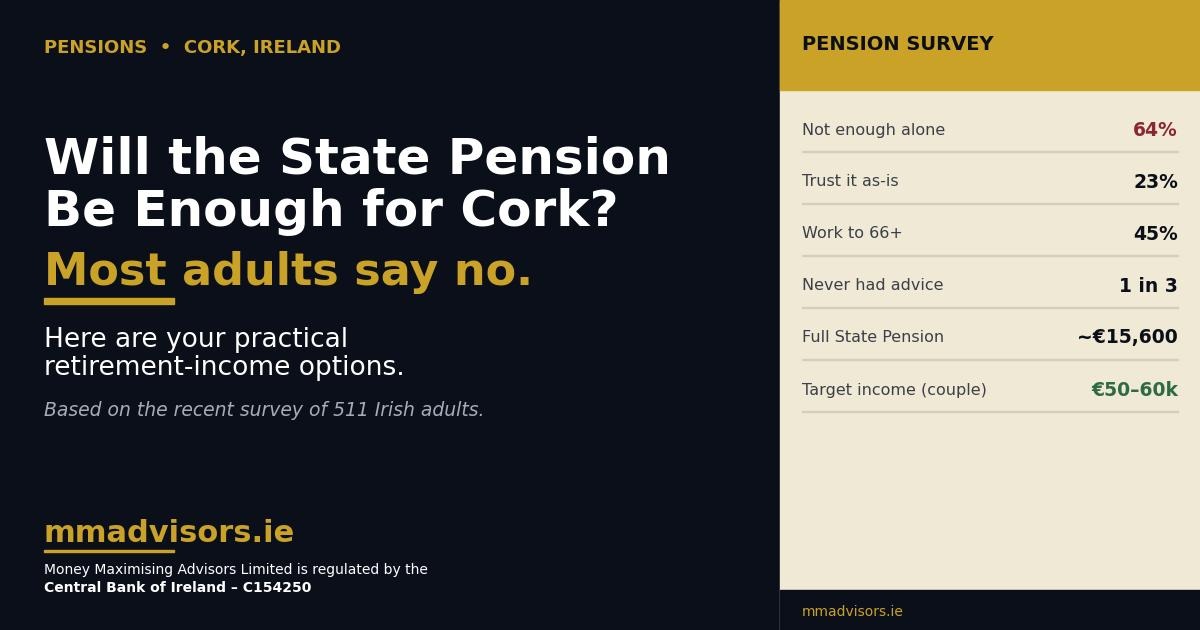
Not for most people. In the May 2026 survey, 64% of respondents said the State Pension alone would not be enough to live on, and only 23% believe the current State Pension will still exist in its present form when they reach retirement age. Cork’s pattern is consistent with the national one. The State Pension is designed as a safety-net floor, not a comfortable retirement income, and its purchasing power sits well below what most Cork households would recognise as “enough”.
How much is the Irish State Pension in 2026?
There are two main variants of the Irish State Pension:
- State Pension (Contributory). Paid based on your PRSI record. The maximum personal rate in 2026 is approximately €15,600 per year (before increases for adult and child dependents). Rates are set each Budget by the Minister for Social Protection.
- State Pension (Non-Contributory). A means-tested payment for those who do not have enough PRSI contributions to qualify for the Contributory pension. Payment amounts are reduced based on your other income and assets.
For a couple, if both partners qualify, combined income is roughly €31,200 per year from the State Pension, well below the €50,000–€60,000 that most retirement models suggest a Cork couple needs to maintain their pre-retirement standard of living. The gap of €20,000–€30,000 per year is what a private pension is designed to fill.
Who qualifies for the State Pension in Ireland?
Eligibility for the Contributory State Pension depends on your PRSI (Pay Related Social Insurance) record. In broad terms, you need:
- A minimum number of paid PRSI contributions (at least 520 full-rate weekly contributions, which is roughly 10 years’ worth).
- A qualifying yearly average of contributions from the start of your working life to the year before you reach State Pension age.
- Alternatively, under the Total Contributions Approach that has been phased in, a full pension typically requires 2,080 contributions (40 years’ worth), with pro-rata payments below that.
For those who do not meet the PRSI thresholds, the Non-Contributory State Pension is means-tested. If you have worked abroad, your foreign social insurance record can sometimes be combined with your Irish PRSI record under EU rules or bilateral social security agreements, relevant for many Cork ex-pats who spent years working overseas. On the ex-pat side, see also Ex-Pat Mortgages Ireland: A Complete Guide for Overseas Buyers and Investors and Irish Mortgages and Buying Property in Ireland as an Ex-Pat for the property side of returning-home planning.
What age can you claim the State Pension in Ireland?
The current State Pension age in Ireland is 66. A recent reform allows individuals to defer claiming until as late as age 70, in exchange for an actuarially uplifted payment for the rest of their life. From the 2026 survey, 45% of respondents expect to retire at 66 or later, including 13% into their late 60s, 5% beyond 70, and 4% who do not expect to retire at all. Only around one in ten expects to retire before 60.
If you are targeting an earlier retirement, which many Cork professionals in senior tech, pharma or medical roles genuinely can, you will need a private pension pot large enough to bridge the years between your chosen exit and the day the State Pension kicks in. That bridging analysis is at the heart of our Retirement Planning Advice service. Note that Pension Tax-Free Lump Sum at 50 Ireland, All You Need To Know and Standard Fund Threshold 2026: What It Means for Your Pension in Ireland both cover the mechanics of accessing a private pension before State Pension age.
Can you survive on the State Pension alone?
Technically yes, but the standard of living it supports is well below what most Cork households would consider comfortable. Analysts often use a rule of thumb that retirement income of around two thirds of pre-retirement income is needed to maintain your lifestyle. On a combined pre-retirement household income of €90,000, that means targeting roughly €60,000 in retirement, which even two full Contributory State Pensions would only cover about half of.
The survey also revealed how fragile Irish households’ short-term finances are. Over a third of respondents said they would run out of money within three months if their main income stopped, and only 17% have more than a year’s cushion. This is why Income Protection, Serious Illness Cover and, for public sector workers, Public Sector Salary Protection belong underneath the pension plan, not on top of it.
What are your practical retirement options?
Occupational pension scheme
If you work for a private sector employer in Cork, Apple in Hollyhill, Pfizer in Ringaskiddy, Stryker in Anngrove, Johnson & Johnson in Little Island, or any of the many pharma, medtech and tech employers across the city and the harbour, you may already be enrolled in a workplace scheme. Employer contributions typically match some or all of your own, and every euro you contribute attracts income tax relief at your marginal rate up to age-related limits. Our Employee Pensions and Occupational Pensions pages set out how to maximise the value.
PRSA and Personal Pension
If you do not have access to an occupational scheme, self-employed, contractor, sole trader, gig worker, a Personal Retirement Savings Account (PRSA) or Personal Pension is the standard vehicle. For a full breakdown of the self-employed options, see Pensions For The Self Employed. For maximising tax relief on contributions, Pension Tax Relief in Ireland: Maximise Your Benefits walks through the age-related percentage limits and how to structure contributions across a tax year.
AVCs, Additional Voluntary Contributions
If you already have an occupational pension and want to increase your fund at retirement, AVCs allow you to top up with the same tax-relief benefits as your main contributions. For Cork’s substantial public sector workforce, teachers, gardai, nurses, HSE staff, our Public Sector AVCs and Last Minute AVC services are specifically designed to maximise tax-efficient contributions in the run-up to retirement, and complement any Public Sector Mortgages planning.
Directors Pension
If you own or run a company in Cork, your most powerful retirement vehicle is usually a Directors Pension. Company contributions are typically a fully deductible business expense, contribution limits are generous, and the fund grows largely tax-free until drawdown. Used properly, this is often the single largest wealth-builder for owner-managed businesses across Cork’s SME base.
Approved Retirement Fund (ARF) at drawdown
At retirement, most private pensions are converted to an Approved Retirement Fund (ARF), the fund stays invested, and you draw an income as needed subject to minimum imputed distribution rules. Combined with the tax-free lump sum available at maturity, this is what your working-life contributions eventually become.
| Cork based and want to build a plan? Enquire Now for a no-obligation pension review, or Book Now for your free 60-minute consultation. |
What if you are already behind?
You are almost certainly not as behind as you feel. Tax relief on pension contributions actually increases with age, the percentage of earnings you can claim relief on rises at ages 30, 40, 50 and 60, which means late starters can catch up faster than they might expect. A Cork professional starting a serious pension contribution at 45 who maxes out age-related tax relief typically ends up with a substantially larger fund than they thought possible.
If you have just been made redundant
A redundancy lump sum is one of the most important pension moments most people will ever face. Statutory redundancy is generally tax-free; ex-gratia payments may qualify for further exemptions, and pension planning can meaningfully reduce the tax on the balance. Read What Is the Average Redundancy Package in Ireland? for the size of the typical package and the tax treatment before you make any decisions with the money.
If your main asset is your home
For Cork homeowners nearing retirement whose pension pot is small but home equity is substantial, equity release can supplement retirement income without requiring a house sale or downsizing. Read our Equity Release Mortgage Ireland 2026 Guide, the wider Unlocking the Potential of Your Home: Equity Release Mortgages Explained and, for over-60s, Seniors’ Equity Release Lifetime Loans. The equally comprehensive Unlocking Home Wealth, Expert Guide to Equity Release, Remortgage and Buy-to-Let Flexibility covers combined strategies where a property portfolio is involved. For general property investment as part of a retirement income mix, see Comparing the Best Buy-to-Let Mortgage Rates in Ireland: Options for Individuals, Pensions and Companies and the broader Irish Mortgage Market 2026 update.
If you also need to plan for family expenses
Cork parents in their forties and fifties often juggle pension building with saving for their children’s third-level education. Our Build Your Child’s Future: Smart Savings and Investment Plans for College Education in Ireland walks through how to run both plans in parallel without derailing either.
Common pension mistakes Cork adults should avoid
- Treating the State Pension as the plan. It is a foundation, not a strategy. Build a private layer on top of it from day one.
- Not knowing your employer match. If your Cork employer matches up to 6% and you only contribute 3%, you are leaving free money on the table.
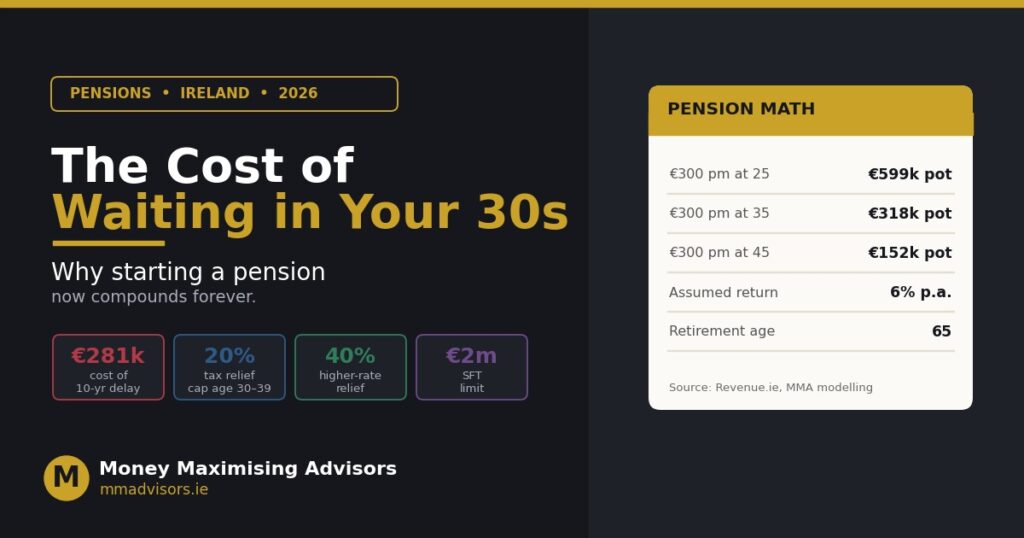
- Delaying until “things settle down”. They rarely do. Every decade of delay roughly doubles the contribution needed to reach the same target.
- Ignoring AVC headroom in the run-up to retirement. The last few years before drawdown often provide the biggest tax-relief opportunities of an entire career.
- Skipping advice because you feel behind. The survey is clear: most people are in the same boat, and starting late still beats not starting at all.
- Ignoring old pensions from previous jobs. If you have worked in Cork’s dynamic pharma or tech sectors, you may have several dormant pots.
Most-read Irish pension guides
- Standard Fund Threshold 2026: What It Means for Your Pension in Ireland
- Pension Tax-Free Lump Sum at 50 Ireland, All You Need To Know
- Pension Tax Relief in Ireland: Maximise Your Benefits
- Understanding Irish Inheritance Tax Categories for Blended Families and Beyond
Frequently asked questions
Is the State Pension enough to live on in Ireland?
For most people, no. The 2026 pension survey found that 64% of Irish adults believe the State Pension alone would not be enough. Analysts typically target around two thirds of pre-retirement income to maintain a lifestyle, the State Pension alone rarely reaches that level for most Cork households.
How much is the Irish State Pension in 2026?
The maximum personal Contributory rate is approximately €15,600 per year in 2026 (roughly €300 per week), with rates set each Budget. A means-tested Non-Contributory pension pays a lower rate depending on other income and assets.
Who qualifies for the State Pension in Ireland?
The Contributory State Pension is based on your PRSI record, you need at least 520 paid full-rate contributions (about 10 years), with the payment level depending on your total contributions or yearly average under transitional rules. The Non-Contributory pension is means-tested for those without a sufficient PRSI record.
What age can you claim the State Pension in Ireland?
The current State Pension age is 66. Since a 2024 reform, you can defer claiming until as late as age 70 in exchange for an actuarially uplifted rate for life. Any earlier retirement needs to be funded by private pension savings.
Can you survive on the State Pension alone?
Technically yes, but the standard of living is basic. Most retirement models suggest you need income of around 60–70% of your pre-retirement earnings to maintain your lifestyle, which the State Pension alone rarely reaches. This is why our Retirement Planning Advice service focuses on building a private pension layer on top of the State foundation.
Reviewed and researched by our Cork pension team
This pillar was prepared by the pension team at Money Maximising Advisors, drawing on the askpaul May 2026 national pension survey (511 respondents), Department of Social Protection State Pension rates, Revenue.ie age-related contribution limits, and the Standard Fund Threshold framework as it stands in 2026. For personalised advice, Book Now or Enquire Now. See our full library of pension walkthroughs on the Money Maximising Advisors YouTube channel.
Cork based? Let’s build your retirement plan.
Whether you are just starting a pension, picking up an old workplace pot, running your own company, or trying to make sense of what your employer is contributing on your behalf, our Cork pension team will give you a clear, no-jargon picture of where you stand and what your options are. Book Now for your free Cork pension review, or visit Money Maximising Advisors to learn more.
Important information
Survey statistics cited are from askpaul’s third annual national pension survey, conducted via SurveyMonkey by Fairstone Asset Management DAC (trading as askpaul) between 1 and 6 May 2026, with 511 Irish respondents. State Pension amounts are illustrative and subject to change each Budget. Money Maximising Advisors Limited is regulated by the Central Bank of Ireland. This article is for general information only and does not constitute financial, tax or legal advice. The value of pension investments can fall as well as rise, and past performance is not a reliable indicator of future returns. You should seek personalised advice from a Qualified Financial Advisor before making any pension decision.