If you work in the Irish public sector, you have real mortgage advantages. This guide from Money Maximising Advisors shows you exactly what those advantages are.
You will see how to hit the borrowing cap more easily. You will see where the rate discounts are. And you will see how to get from enquiry to keys in the fastest realistic time.
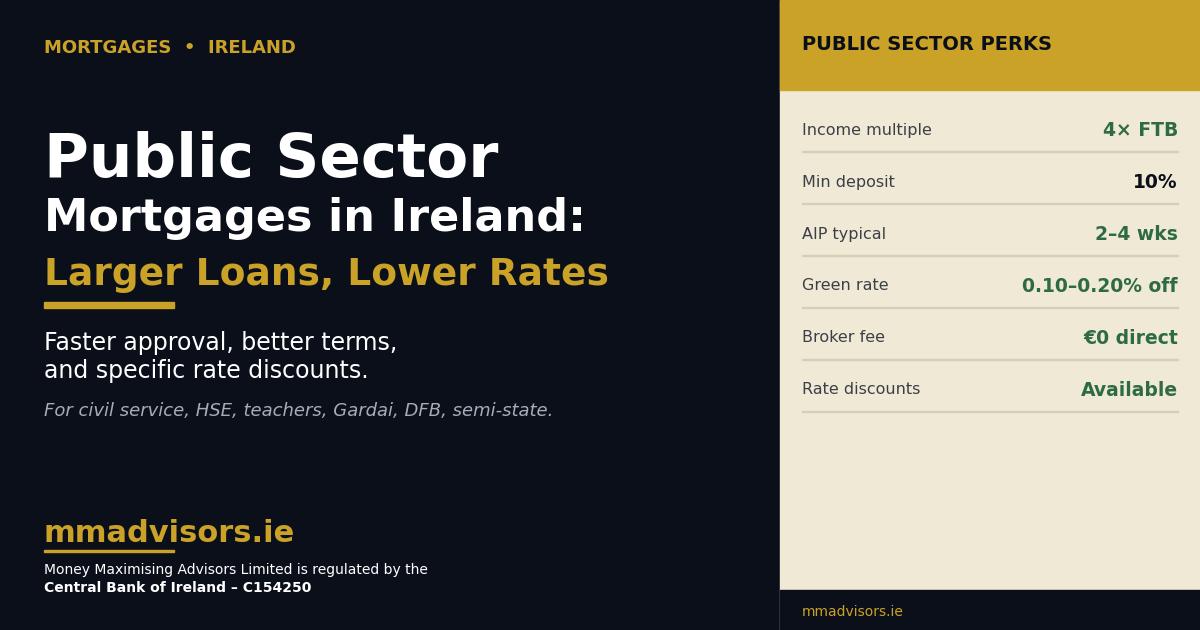
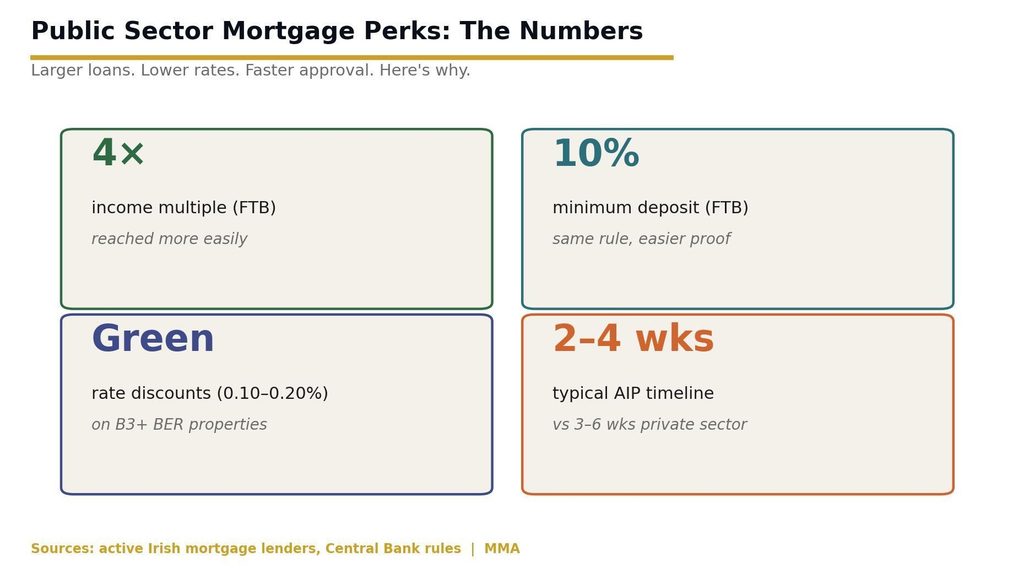
| QUICK ANSWER: Public sector employees in Ireland can qualify for larger loans (by hitting the 4× income cap more easily), lower rates (through specific public sector or professional discounts published by some Irish lenders, plus green rate discounts of 0.10–0.20% on B3+ BER properties), and faster approval (typically 2–4 weeks vs 3–6 weeks for private sector). Central Bank rules, 4× income for FTBs, 10% deposit minimum, apply equally. |
| This pillar connects public sector workers to Public Sector Mortgages, Public Sector AVCs, Public Sector Salary Protection and Public Sector Superannuation Advice. |
Larger loans: how you hit the 4× cap
The Central Bank of Ireland lets first-time buyers borrow up to 4× income. Movers can borrow up to 3.5×.
These are hard limits. Nobody borrows more, no matter what employment they’re in.
But hitting the limit consistently is easier for public sector applicants. Here’s why.
Predictable income progression
Public sector pay scales are published. Increments are known years in advance.
Lenders can factor in your salary trajectory. That means better long-term affordability modelling.
Stable employment classification
Public sector employment is treated as low employer-risk. There’s no realistic scenario where your employer goes bust.
Contract permanency verification is straightforward through your HR department.
DB pension entitlement
Public sector defined benefit pensions provide guaranteed retirement income. Some lenders extend the age at which they’ll lend as a result.
A private sector applicant with a defined contribution pension doesn’t automatically get the same treatment.
Lower rates: where the discounts are
Two rate advantages regularly come into play for public sector applicants in Ireland.
Specific public sector rate discounts
Some Irish lenders publish specific rate offers for public sector employees. Others apply preferential terms at discretion.
Typical saving: 0.10–0.20% below the standard equivalent rate. Over a 25-year term, that adds up to thousands in interest saved.
These preferential terms are rarely visible to applicants going direct. A broker with lender relationships surfaces them.
Green mortgage rate discounts
Every Irish lender now offers green mortgage rate discounts on B3+ BER properties. Public sector applicants qualify just like everyone else.
Typical green rate saving: 0.10–0.20% below the standard fixed rate. Over a 25-year term, this is significant.
Combining public sector eligibility with a green property can compound into real interest savings.
Faster approval: the 2–4 week AIP
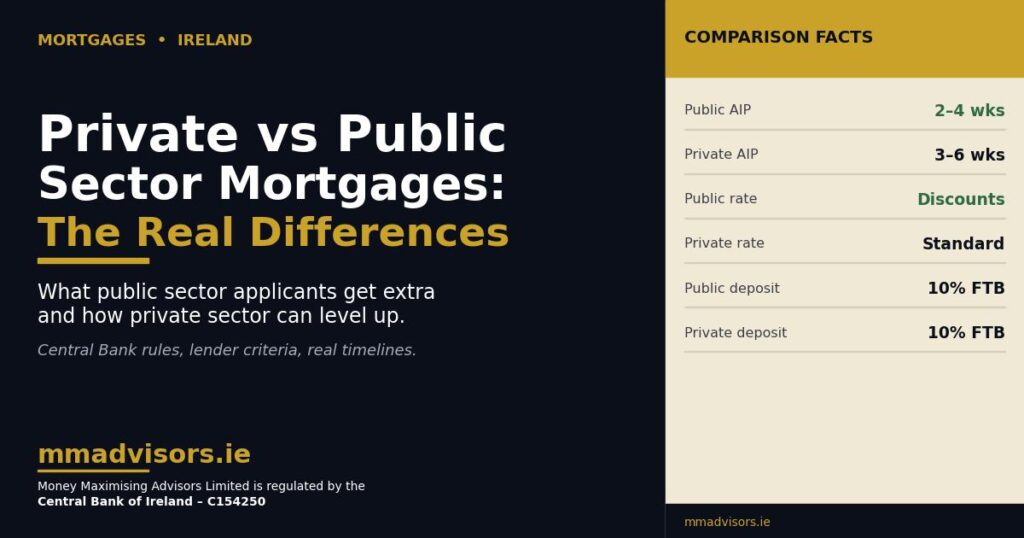
A clean public sector application typically reaches Approval in Principle in 2–4 weeks. Private sector applications typically take 3–6 weeks.
Why the gap? Everything on a public sector file is easy to verify.
Standardised documents
HR salary certificates. Standard employment contracts. Uniform payslip formats.
Underwriters can review a public sector file quickly. There are fewer edge cases to investigate.
Clean pension paperwork
Public sector pension modeller reports are consistent and universally accepted.
Private sector applicants often need to explain their pension arrangements more thoroughly.
Employer verification is trivial
Employer verification for public sector staff takes minutes. Private sector employer verification can take weeks in edge cases.
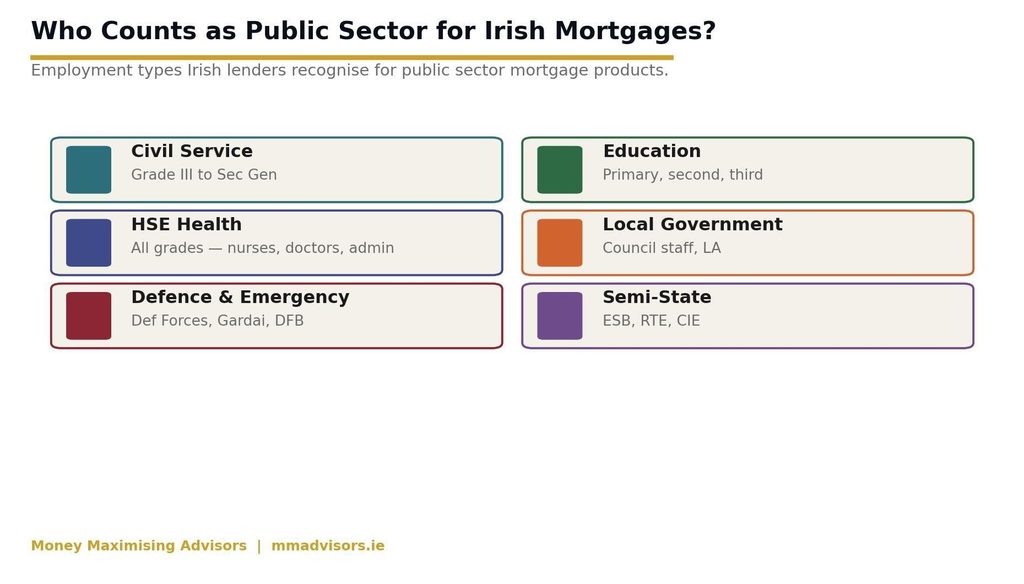
Who qualifies as public sector?
Civil Service
All grades from Clerical Officer to Secretary General. Permanent, contract, and Senior Civil Service positions all qualify.
Education
Primary teachers, secondary teachers, third-level lecturers. Special needs assistants and school administrators funded through DES.
HSE Health
All HSE grades. Doctors, nurses, midwives, health and social care professionals, administrative staff.
Section 38 and 39 organisations funded by HSE also count.
Local Government
City and county council staff at all grades. Engineers, planners, admin, outdoor staff, fire service.
Defence and Emergency
Defence Forces (Army, Air Corps, Naval Service). An Garda Siochana. Dublin Fire Brigade. Coast Guard where PAYE.
Semi-State
ESB, Bord Gais, RTE, Iarnrod Eireann, EirGrid, Bord na Mona, and many others.
| Want your public sector rate quoted? Book Now for a free 30-minute mortgage review, or Enquire Now, we reply within one working day. |
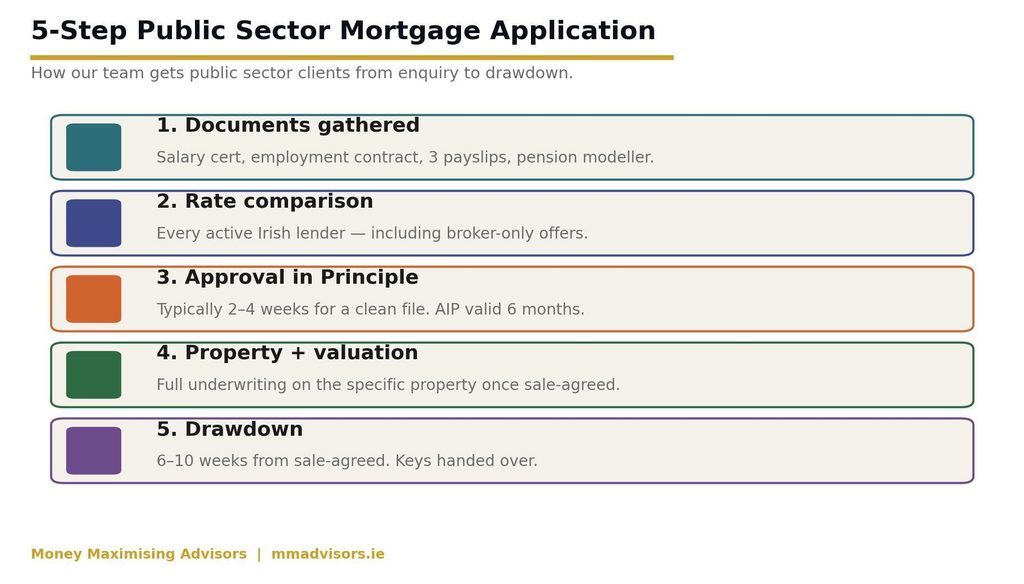
The 5-step application process
Step 1: Documents gathered
Salary certificate from HR. Signed employment contract. Most recent 3 payslips. P60/T4. Pension modeller report.
Six months of bank statements, current and any secondary accounts. Any evidence of overtime, allowances, or second income.
Step 2: Rate comparison
Every active Irish mortgage lender compared. Including broker-only offers and preferential public sector deals.
You see the numbers side-by-side. Fixed vs variable. Green vs standard. Public sector discount vs equivalent.
Step 3: Approval in Principle
A clean public sector file typically gets AIP in 2–4 weeks.
AIP is valid for 6 months. It gives you a firm budget for house hunting.
Step 4: Property and valuation
Once you’re sale-agreed, the lender undertakes full underwriting on the specific property.
An independent valuation is arranged. Usually 1–2 weeks.
Step 5: Drawdown
Legal work completed. Loan drawn down. Keys handed over.
Typical timeline from sale-agreed to keys: 6–10 weeks.
What documents to gather right now
- Salary certificate. Request from HR. Usually 3–5 working days to issue.
- Employment contract. Original signed copy or certified true copy.
- Most recent 3 payslips. Consecutive months. Both gross and net figures visible.
- Most recent P60/T4. Full-year earnings summary from your employer.
- Pension modeller output. Available from your pension section. Shows current entitlement.
- 6 months bank statements. Personal current accounts and any credit union or savings accounts.
Common questions from public sector applicants
What about contract or acting-up staff?
Contract public sector staff usually qualify for public sector treatment if the contract has 12+ months remaining.
Acting-up allowances count as income if you have documented history of receiving them.
What about part-time or job-share?
Part-time public sector staff qualify on their actual salary. Job-share applications count as full public sector employment.
Your salary is calculated pro-rata but your employment status is identical.
What about second income or private practice?
Additional income can be factored in with 2–3 years of documented history.
Nurses doing agency work, teachers giving grinds, doctors with private practice, all can add to your affordability position.
Common mistakes to avoid
- Applying directly to one bank. You lose access to broker-only lenders and preferential public sector rates.
- Skipping the pension modeller. It’s the single strongest piece of long-term affordability evidence you have.
- Not asking about green rates. A B3+ BER property unlocks additional discounts on top of public sector rates.
- Forgetting overtime or allowances. Documented overtime, weekend rates, and allowances add real capacity to your application.
- Waiting to switch. Public sector applicants who don’t switch after their fixed term expires typically lose €2,000+ per year in avoidable interest.
Frequently asked questions
Can public sector workers borrow more than private sector?
Not directly, Central Bank rules apply the same 4× income cap to both. Public sector applicants tend to hit that cap more easily because affordability is easier to prove and long-term income is more predictable.
Do public sector mortgages have lower rates?
Some Irish lenders publish specific public sector rate discounts. Others apply discretionary preferential terms. Typical saving is 0.10–0.20% below the standard rate. Not every lender offers this, comparing across all active lenders is essential.
How fast can a public sector mortgage be approved?
A clean public sector file typically reaches Approval in Principle in 2–4 weeks. From AIP through property, valuation, and drawdown, the full process typically takes 8–14 weeks.
What minimum deposit do public sector workers need?
Central Bank rules require 10% minimum deposit for first-time buyers and 20% for movers. This applies to public and private sector alike, there’s no reduced deposit rule for public sector employees.
Do all public sector employers count?
Yes. Civil Service, Education (all levels), HSE, Local Government, Defence Forces, An Garda Siochana, Fire Service, and Semi-State bodies all qualify as public sector for Irish mortgage purposes.
Can I combine public sector discounts with green rates?
Yes. A public sector applicant buying a B3+ BER property can typically stack both discounts. The combined saving over a 25-year mortgage is substantial, often tens of thousands in interest saved.
Reviewed by our public sector team
This guide was prepared and reviewed by the mortgage team at Money Maximising Advisors, drawing on Central Bank of Ireland rules, live lender criteria, and daily public sector mortgage applications. MMA is regulated by the Central Bank of Ireland (C154250).
Ready to unlock your public sector advantage?
Whether you’re a teacher, nurse, Garda, civil servant, or semi-state employee, our team compares every active Irish lender and finds the public sector rate you actually qualify for.
Ready to unlock your public sector advantage?
Book a free 30-minute mortgage review, or send us your details and we'll be in touch.
Money Maximising Advisors Limited is regulated by the Central Bank of Ireland – C154250
| Important information WARNING: Your home is at risk if you do not keep up payments on a mortgage or any other loan secured on it. WARNING: You may have to pay charges if you pay off a fixed-rate loan early. Rates, thresholds and Central Bank rules are those in force at time of writing (2026) and are subject to change. Public sector rate offers vary by lender and are subject to terms. Rates, thresholds and rules referenced are correct at time of writing and are subject to change. Money Maximising Advisors Limited is regulated by the Central Bank of Ireland (C154250). This article is for general information only and does not constitute personalised financial, tax or legal advice. You should always speak to a Qualified Financial Advisor before making any decision. |