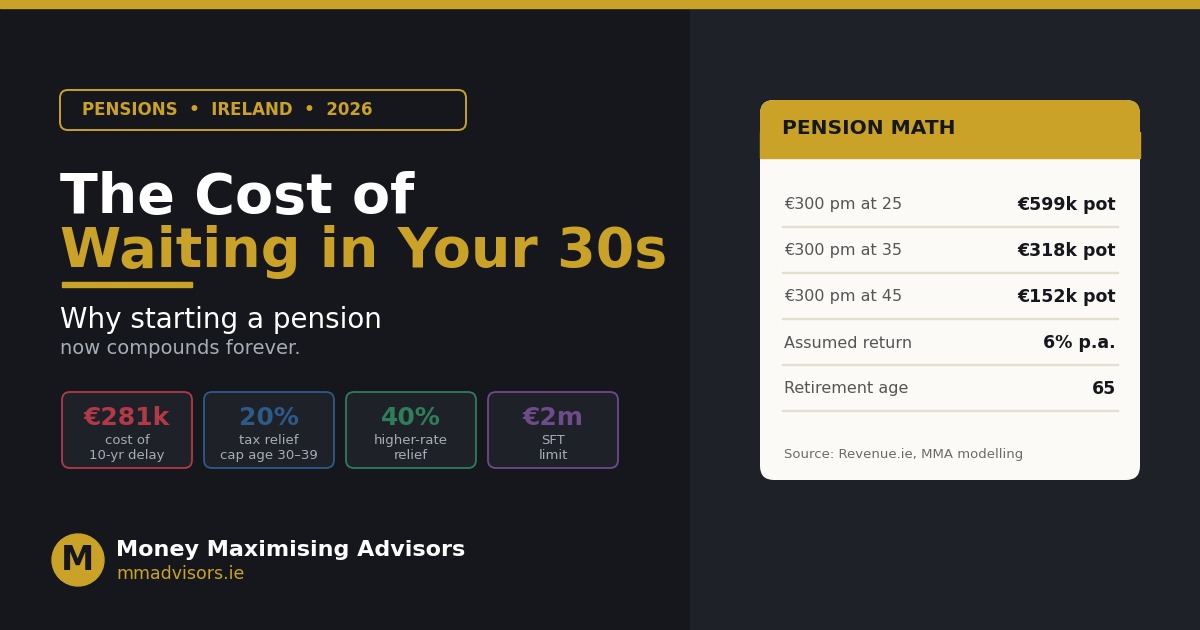
| ▶ WATCH THE 60-SECOND EXPLAINER The 60-second reel shows what happens when three people all contribute the same €300/month into a pension, but start at ages 25, 35 and 45. The difference at retirement is not small. Watch it, then work through the numbers below to see what starting today, at your current age, could do for you. Reel: https://www.instagram.com/reel/DaIyaXNKnoU/ |
| IN THIS ARTICLE Why every year in your 30s counts, the compounding math Quick answers to the six most-asked pension questionsHow tax relief actually works in Ireland (age-based caps)The employer-match multiplier every worker should useWhat if you’re starting at 35, 38 or 39?How to set up (or top up) a pension in the next 30 days |
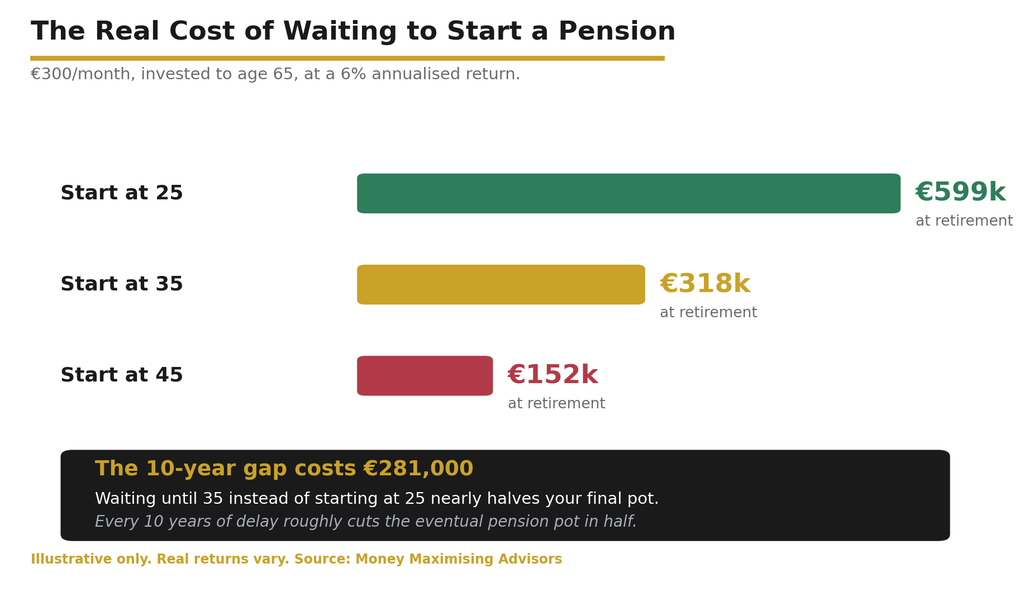
Same €300/month, three different starting ages, three very different retirement outcomes.
If you are in your 30s in Ireland and haven’t started a pension or your only pension is a modest auto-enrolled workplace scheme, you are almost certainly the target audience for this guide. Pension planning ireland is one of the most tax-efficient wealth-building tools available anywhere in the OECD, and the years between 30 and 40 are the highest-leverage decade to act. This is not because retirement planning Ireland workers need to think about retirement being close, it isn’t but because compound interest mathematically rewards early starters at a level that later contributions can never catch up with. This guide walks you through how workplace pension Ireland schemes, tax relief, employer matching and personal PRSAs interact for someone in their 30s today, and what the true cost is of waiting five more years. Talk to us via our pensions advice service or book an appointment for a free consultation.
Quick answers: six questions every 30-something Irish worker asks about pensions
Why should I start a pension in my 30s?
Because compound interest rewards time above every other variable. A worker contributing €300/month into a pension from age 25 with a 6% average annual return reaches approximately €599,000 by age 65. Starting at 35, the same €300/month reaches €318,000. Starting at 45, it reaches €152,000. Every decade of delay roughly halves the outcome, and the tax relief you claim along the way makes those pension contributions Ireland workers make the cheapest euros they will ever invest.
What happens if I delay my pension contributions?
Two things compound against you:
(1) you lose years of investment growth on money that never gets in, and
(2) you lose Irish tax relief on any year where you were entitled to claim it. Both are irrecoverable. There is no lookback, relief unclaimed for a tax year is generally lost, and years of compounding cannot be added back later.
How does compound interest affect my pension?
Compound interest means growth is earned on both your contributions and on the previous years’ growth. In the earliest years of a pension, most of the balance is your contributions. In the last decade before retirement, most of the balance is growth on growth. This is why pausing for five years in your 30s is much more damaging than pausing for five years in your 50s, the money you skip in your 30s would have compounded through three or four full cycles before you retire.
Is it too late to start a pension at 35?
Absolutely not. Age 35 is still an excellent starting point, you have 30 years of contributions and growth ahead of you, higher tax relief caps than a 25-year-old (20% of net relevant earnings at ages 30-39, rising to 25% at 40-49), and typically a higher salary base to contribute from. The right question isn’t whether it’s “too late” it’s whether you can make up for the earlier years by contributing more aggressively now.
How much should I contribute to my pension?
A common rule of thumb: contribute a percentage of your gross salary equal to half your current age. At 34, aim for around 17%. Irish tax relief caps make this achievable at real cost of roughly 10-11% of net pay for a higher-rate taxpayer once relief is applied. At minimum, contribute enough to capture the full employer pension contributions available anything less is leaving free money on the table.
What are employer pension contributions?
Employer contributions are payments your employer makes directly into your pension usually as a match to your own contribution up to a set percentage. A typical Irish scheme might match €1-for-€1 up to 5% or 6% of salary. Employer contributions are not taxable in your hands and don’t count against your personal age-related tax relief cap which makes them among the most valuable elements of your total remuneration package.
How Irish pension tax relief actually works
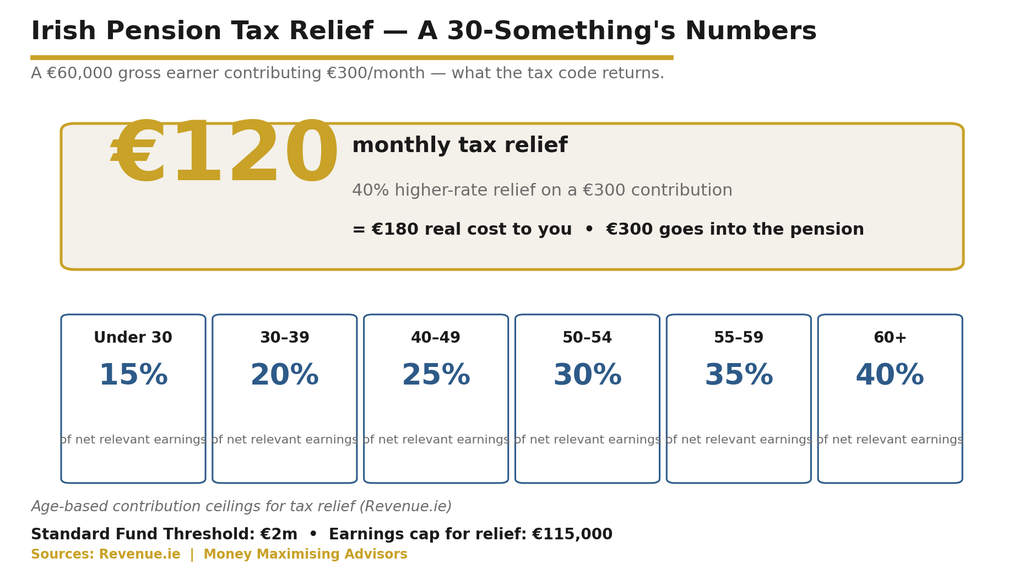
Age-based caps on tax-relievable contributions the Irish state’s single biggest gift to your future self.
Ireland runs one of the most generous personal pension tax-relief regimes in Europe. Contributions to an occupational scheme, PRSA or personal pension attract full income tax relief at your marginal rate, up to 40% for a higher-rate taxpayer. If you contribute €300 gross into a pension, and you’re a higher-rate taxpayer, the real cost from your take-home pay is only €180, the other €120 is tax you would otherwise have paid to Revenue.
The maximum contribution eligible for tax relief is capped at a percentage of your net relevant earnings, rising with age:
- Under 30: 15% of net relevant earnings
- 30-39: 20% of net relevant earnings
- 40-49: 25% of net relevant earnings
- 50-54: 30% of net relevant earnings
- 55-59: 35% of net relevant earnings
- 60 and over: 40% of net relevant earnings
Net relevant earnings are capped at €115,000 for tax-relief purposes. On top of these personal caps, there is a Standard Fund Threshold (SFT) of €2 million, the total lifetime pension pot above which additional tax charges apply on drawdown.
Where to get advice the Money Maximising Advisors group
| MONEY MAXIMISING ADVISORS GROUP — NATIONAL COVERAGE The article you are reading is from mmadvisors.ie, the flagship of the Money Maximising Advisors group. Two sister brands now form part of the same Central Bank-regulated group and provide localised advice across Ireland: • mmadvisors.ie — Money Maximising Advisors Limited (Tuam, Co Galway) — national coverage, HQ for the group. Full product range across mortgages, pensions, protection, savings, investments and inheritance tax. • jcfc.ie — Joe Coyle Financial Consultants (Mountcharles, Co Donegal) — North West Ireland specialists, with a particular focus on business-owner protection, pensions and succession advice. • moneysense.ie — Money Sense Financial Services (Killarney, Co Kerry) — South West Ireland family-run advisory, over four decades of experience across financial planning, mortgages, protection and retirement. |
Real-world scenario: a Cork tech worker at age 32
| CASE STUDY: PRODUCT MANAGER, CORK, AGE 32, €85,000 SALARY Ciarán is 32, earns €85,000 in a Cork-based tech role, and has drifted along on his employer’s default 5%/5% pension match for three years. He’s never increased his contribution. His employer offers to match up to 8% of salary. Ciarán increases his personal contribution to 8% (€6,800/year, €566/month). His employer matches another €6,800. Because Ciarán is a higher-rate taxpayer, the tax relief on his €566/month is €226, so his real monthly cost from net pay is only €340, but the total going into his pension is €1,132/month (his €566 + employer’s €566). Over 33 years at 6% average annual growth, that additional €340/month of net cost builds an incremental €475,000 pension pot at age 65 that would otherwise not exist. |
The employer-match multiplier: the biggest lever you’re probably not pulling
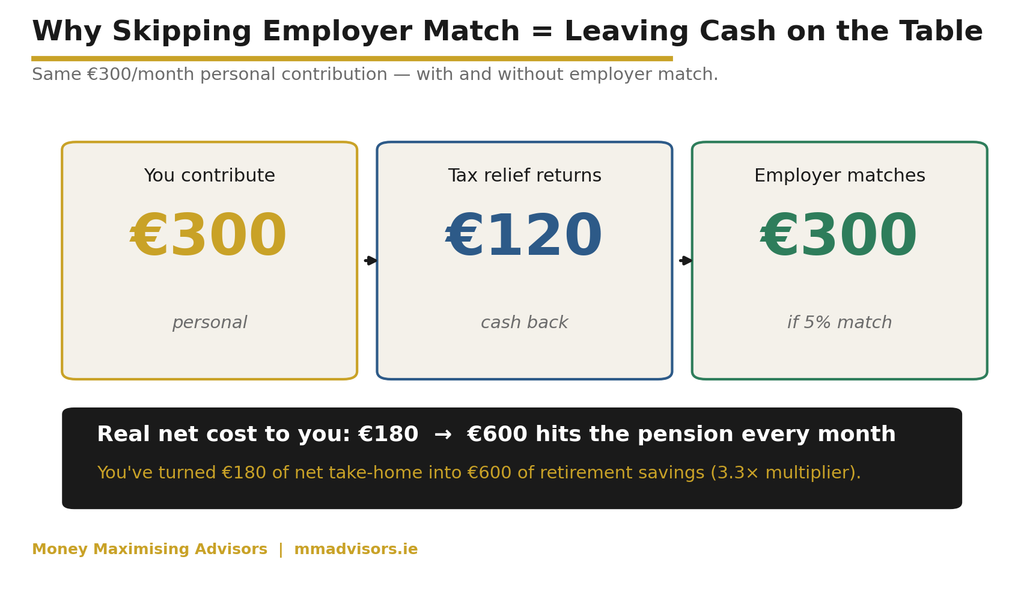
Combining your contribution, tax relief and employer match delivers a 3.3× multiplier on every euro of net cost.
If your employer offers matching pension contributions and you are contributing below the match ceiling, you are almost certainly making a financial mistake. Here is the arithmetic for a higher-rate taxpayer whose employer matches €1-for-€1 up to 5% of salary. You contribute €300 gross from your pay. Because you’re a higher-rate taxpayer, tax relief returns €120. Your net cost is €180. Your employer matches your €300 with another €300. Result: €600 into your pension for a real net cost of €180, a 3.3× multiplier on every euro that lands in your account.
Fail to capture the full employer match and you are declining part of your salary package. There is no better use of pension budget than reaching the match ceiling first, before any other pension planning.
| READY TO TALK TO A CENTRAL BANK-REGULATED ADVISOR? Not sure whether you’re capturing your full employer match, or whether your PRSA is invested in the right fund for your age? A 30-minute review with our pensions team will tell you. → Enquire Now | → Book an Appointment | → Contact Us |
Common pension mistakes 30-somethings in Ireland make
- Sticking with the default fund. Most workplace pensions default new members into a low-risk lifecycle fund appropriate for someone near retirement. For a 34-year-old, that’s far too conservative, review the fund choice at least annually.
- Contributing below the employer match. The single most expensive mistake in the Irish pension system.
- Ignoring old pensions from previous jobs. Small legacy pots from former employers often sit in expensive default funds. Consolidating them into a single scheme (or a Personal Retirement Bond) reduces fees and simplifies management.
- Assuming the State Pension will cover retirement. The full contributory State Pension in 2026 is approximately €289.30/week (~€15,000/year). Even a modest lifestyle in retirement costs multiples of that.
- Not claiming tax relief on personal contributions. Occupational scheme relief is automatic. Personal PRSA contributions may need a separate claim via your Revenue Online Service (ROS) account or Form 12/11.
Related reading
| Related post | Category | Read more |
|---|---|---|
| Standard Fund Threshold 2026: What It Means for Your Pension in Ireland | Pensions | Read article |
| How Pension Advice Saves You Tax — Blended Families and Beyond | Pensions | Read article |
| Pension Tax-Free Lump Sum at 50 Ireland: All You Need to Know | Pensions | Read article |
| Pension Tax Relief in Ireland: Maximise Your Benefits | Pensions | Read article |
Frequently asked questions
Can I contribute more than the age-related cap?
You can, but the excess won’t attract income tax relief for that year. Contributions can still be made and grow tax-free within the pension, they simply come from post-tax income. Unused tax relief cannot be carried forward except in limited AVC top-up situations near retirement.
Do I need a PRSA or a personal pension if I already have a workplace scheme?
Not usually. If your employer offers a workplace scheme with a match, prioritise that. A PRSA becomes useful if you leave employment, want additional contributions above what the workplace scheme allows, or want to consolidate old pensions in one place.
What is Auto-Enrolment and how does it affect me?
Ireland’s Auto-Enrolment retirement savings scheme (branded “My Future Fund”) is being phased in for eligible workers aged 23 to 60 earning over €20,000 who are not already in a workplace pension. Contributions start low and step up over the initial years. If you are already in an occupational scheme, you are opted out of Auto-Enrolment, you continue with your existing pension arrangements.
About the author
| REVIEWED BY: MONEY MAXIMISING ADVISORS This guide is reviewed by advisors at Money Maximising Advisors Limited, a Qualified Financial Advisor firm regulated by the Central Bank of Ireland. Our team holds QFA, CFP®, RPA and Specialist Investment Adviser qualifications and works alongside our sister brands jcfc.ie (Donegal) and moneysense.ie (Kerry) to deliver advice across every county in Ireland. Every recommendation is documented in a written Statement of Suitability. |
Ready to talk to a pensions specialist?
| READY TO TALK TO A CENTRAL BANK-REGULATED ADVISOR? Our pensions team reviews workplace schemes, PRSAs and old employer pensions for clients across Ireland. Free first consultation, transparent fees, and every recommendation documented in a written Statement of Suitability. → Enquire Now | → Book an Appointment | → Contact Us |
Important information
WARNING: The value of your investment may go down as well as up.
WARNING: Past performance is not a reliable guide to future performance.
WARNING: If you invest in this product you will not have access to your money until you retire.
Age-related tax-relief caps (15%-40% of net relevant earnings), the €115,000 earnings cap for pension tax relief, the Standard Fund Threshold of €2 million, the State Pension full contributory rate (approximately €289.30/week in 2026) and Auto-Enrolment thresholds referenced in this article are correct as at June 2026. Illustrative pension pot figures assume a 6% average annual gross return net of costs and are for illustration only, actual investment returns will vary. Money Maximising Advisors Limited is regulated by the Central Bank of Ireland. This article is for general information only and does not constitute financial, tax or legal advice.