
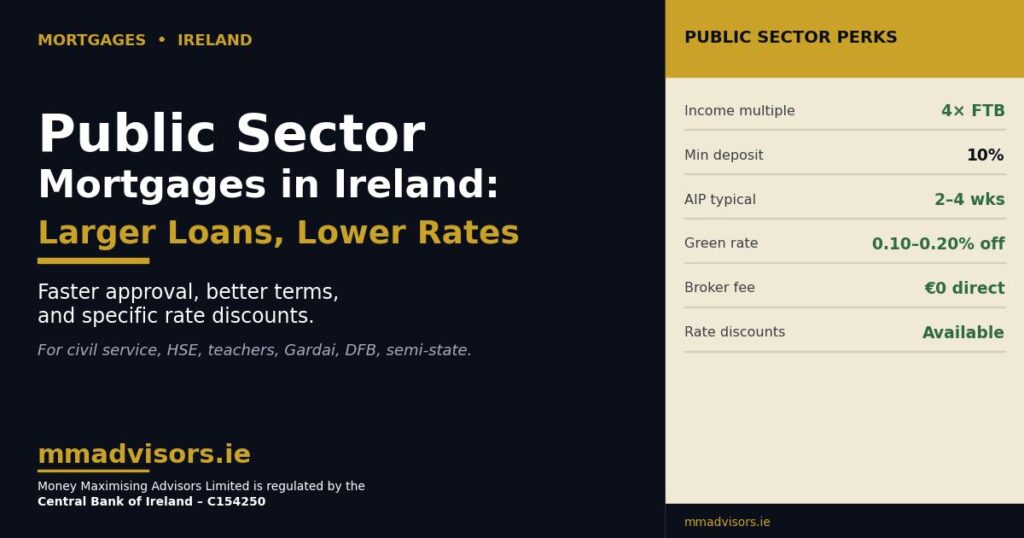
Public Sector Mortgages in Ireland Mortgage options designed around public sector employment
As a public sector employee, you may have access to mortgage options that recognise your employment stability and long-term earning potential.
Whether you’re buying, moving, switching lenders or releasing equity, some lenders may consider salary progression, overtime and qualifying allowances.
Up to 5Pay-scale points
Up to 100%Overtime & allowances
40 yearsMaximum mortgage term
Age 80Maximum age at maturity
BENEFITS SUMMARY
Benefits of a Public Sector Mortgage
May qualify for a larger mortgage than under standard income assessment.
Future salary progression may be considered, with some lenders assessing income 3–5 points up your current pay scale, plus qualifying overtime and allowances.
Child Benefit may be recognised as income, subject to lender criteria.
Mortgage terms of up to 40 years may be available.
Some lenders may allow the mortgage term to extend to the applicant’s 80th birthday.
More flexible proven repayment-capacity requirements may apply.
Flexible repayment options.
Streamlined online application process.
Available for first-time buyers, switchers and equity release.
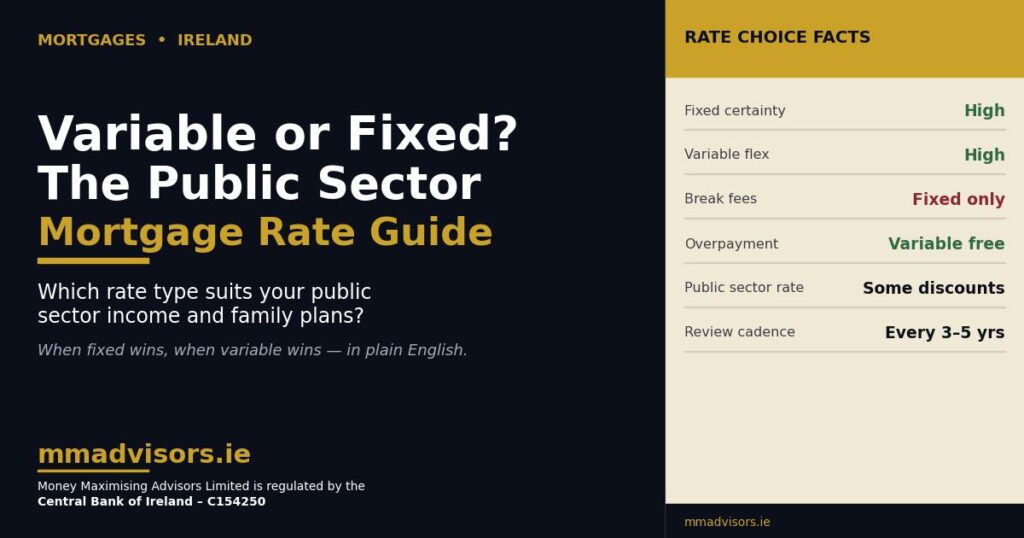
Fixed and variable rate options may be available.
Public sector employees who have been promoted or transferred while on probation may still be considered. New entrants are assessed on a case-by-case basis.
Overpayments of up to 20% in a 12-month period may be available, depending on the lender and mortgage product.
Up to 4 applicants may be allowed on one mortgage application, depending on the lender.
Regular overtime and qualifying allowances may also be included as income, subject to lender criteria and supporting evidence.
How it Works
How Can a Public Sector Mortgage Increase Your Borrowing Capacity?
Public sector mortgage options may assess your income differently from a standard mortgage, particularly where your salary is linked to a structured pay scale. Depending on the lender and mortgage product, your assessment may take into account:
Current salary
Potential salary progression within your pay scale
Qualifying overtime and allowances
Your total qualifying income
Together these determineYour borrowing capacity
This approach may increase the income used in your mortgage assessment compared with using your current basic salary alone.
Your actual borrowing capacity will depend on the lender’s criteria, affordability assessment, Central Bank mortgage measures and your individual circumstances.
What Is a Public Sector Mortgage?
A Mortgage Designed Around You
To make homeownership more accessible, some lenders may assess your income at up to 5 points above your current pay scale, potentially increasing the amount you can borrow.
Up to 100% of regular overtime and guaranteed allowances may also be considered, subject to lender criteria and employer confirmation.


Why This Mortgage Stands Out
Our mortgage consultants are experienced in public sector pay scales and employment terms, helping to make the journey from application to approval as straightforward as possible.
Rates from 4.85%
Alongside mortgage rates currently starting from 4.85%, you can choose from variable, 3-year or 5-year fixed-rate options, subject to lender criteria.
Flexible repayments
Flexible repayment options may also be available, including overpayments and mortgage payment breaks, depending on the lender and product.
Newly promoted or on probation?
Even if you're newly promoted or currently on probation, your application may still be considered based on your employment history and lender criteria.
Only one applicant needs to be in the public sector
For certain Public Sector Mortgage products, only one applicant needs to be employed in the public sector. Whether you're a first-time buyer, moving home, switching your mortgage or releasing equity, a Public Sector Mortgage may be an option for you.
Who Can Apply for a Public Sector Mortgage?
Public Sector Mortgage options may be available to a wide range of public-sector employees, including:
Teachers
Nurses
Gardaí
Doctors
Civil servants
Firefighters
Prison officers
Army officers
Local authority employees
Other government and State-employed workers
ELIGIBILITY Eligibility depends on the lender, employment circumstances, income and other lending criteria. For joint applications, certain lenders may allow an application where only one applicant works in the public sector.
Suitable For
First-Time Buyers
Buying your first home and looking to maximise your borrowing capacity?
Home Movers
Moving to a new property while continuing your public-sector career?
Mortgage Switchers
Looking to review your existing mortgage and potentially move to a different lender?
Equity Release
Looking to release equity from your home for an approved purpose?
Equity release or mortgage top-ups may be used for purposes such as home improvements, educational fees or medical expenses, subject to lender approval.
Non-Irish Nationals May Also Qualify
Non-Irish nationals working in the public sector may also qualify for a mortgage, provided they have the required permission to reside and work in Ireland and meet the lender’s eligibility criteria.
Still on probation? Applicants do not always need to have completed their probation period. Existing public sector employees who have been promoted while on probation may be considered, while new entrants on probation are generally assessed on a case-by-case basis.
The following visas are accepted:
- Stamp 1
- Stamp 1G
- Stamp 2
- Stamp 3
- Stamp 4
- Stamp 5
- Stamp 6
Accepted immigration permissions and visa requirements vary between lenders, so eligibility should be confirmed based on the applicant’s individual residency and employment status.
Can I Get a Public Sector Mortgage With Previous Credit Issues?
If you have previous issues with your credit history, you may still qualify for a Public Sector Mortgage. Lenders review your Central Credit Register (CCR) report and make lending decisions based on their own credit criteria.
Applications with previous credit issues are assessed on a case-by-case basis. Recent missed repayments may affect eligibility; some brokers currently require missed payments to have been cleared for 2 years before proceeding.
Examples of credit issues that may be overlooked include:
- Previous missed credit card or loan repayments
- Repayment issues arising from joint borrowing or a previous relationship
THE CCR DOES NOT PROVIDE A CREDIT SCORE
It records your borrowing and repayment history, while the lender makes the final lending decision.
Up to 4 Applicants
Can Four People Apply Together?
Up to 4 applicants may apply together on the same mortgage application with certain lenders. For example, this could potentially involve:
ExampleTwo couples
ExampleSiblings
ExampleOther eligible applicants
All applicants must meet the relevant lender’s affordability and eligibility requirements.
If the application is to be treated as a first-time buyer application, all borrowers must qualify as first-time buyers under the Central Bank’s mortgage rules.
Public Sector Mortgages: Application Requirements
Who Can Apply
- Applicants must be aged 18 or over.
- Some lenders allow the mortgage term to extend up to the applicant’s 80th birthday.
- The property must be located in the Republic of Ireland and intended for use as your main residence.
- Proven repayment capacity is still required, although some lenders offer more flexible affordability criteria for public sector applicants.
Deposit
- A minimum 10% deposit is generally required for first-time and second/subsequent buyers.
- The deposit may come from savings, an eligible Help-to-Buy (HTB) refund for qualifying first-time buyers, and/or a non-repayable gift from family.
- The enhanced HTB scheme currently provides up to €30,000 or 10% of the purchase value, whichever is lower, subject to Revenue rules.
Valuation & Insurance
- A full property valuation.
- Buildings insurance in place before drawdown.
- Mortgage protection/life cover in place before drawdown.
Online Application Process
A streamlined online application process can help make the application and approval process quicker and easier. Approval times will depend on the lender, application and supporting documentation.
APPLY ONLINE TODAY
Take the next step towards owning your home with flexible lending criteria and the potential for increased borrowing power tailored to public sector employees.
Watch These Real-Life Scenarios on YouTube
EXAMPLE 1
Public Sector Mortgage for First-Time Buyers
Meet Tom and Sarah. They both work as civil servants and each has an annual salary of €45,000. Both are on point 5 of their salary scales. Point 8 of the civil servants’ pay scale is €52,000.
The future salary of up to 3 points above their current pay grades can be used as their qualifying incomes. This increases their borrowing power and max mortgage by €28,000.
As First-Time Buyers, they will qualify for the Help to Buy scheme and the First Home Scheme. They have €10,000 in savings.
By utilising all of the incentives available to them, Tom and Sarah managed to purchase a property for €498,000:
- €416,000 from a Public Sector Mortgage
- €30,000 from the Help to Buy scheme
- €42,000 from the First Home Scheme
- €10,000 from their own savings
EXAMPLE 2
Qualify for a higher mortgage as a public servant
Meet Pat and Mary, both working in the public sector. Pat is a clerical officer in the Department of Health, and Mary is a clerical officer in the Department of Education.
Pat is on Grade 7 – pay point 4 with a salary of €53,904, and Mary is a Clerical Officer Grade 4 – pay point 6 with a salary of €36,215.
Under Central Bank rules, a first-time buyer can borrow up to 4 times their qualifying income. With a Public Sector Mortgage, qualifying income is taken as 3 points up a public servant’s current pay grade, plus any guaranteed average overtime and allowances:
- Pat’s qualifying income is now €61,975, calculated as 3 points up his current pay grade plus allowances of €3,360.
- Mary’s qualifying income is now €48,100, calculated as 3 points up her current pay grade plus guaranteed average overtime of €6,000.
Total combined qualifying income is €110,075, so the total mortgage they can borrow is €110,075 x 4 = €440,300. Added to their own 10% savings deposit, they could purchase a property worth €489,222.
With a Public Sector Mortgage, they were able to borrow €79,824 more than through a standard mortgage provider.
EXAMPLE 3
Public sector equity release for home renovations
Meet Seamus and Anne. They are both civil servants and would like to switch their mortgage of €220,000 from their current lender and are looking for an additional loan amount to renovate their home.
- Seamus is a Clerical Officer on Grade 7 – pay point 7 with a salary of €57,919.
- Anne is also a Clerical Officer on Grade 4 – pay point 9 with a salary of €41,274.
With a Public Sector Mortgage, they can borrow up to 4 times their qualifying incomes:
- Seamus: salary based on €65,612 (3 points up his salary scale) plus allowances of €2,168.
- Anne: salary based on €48,162 (3 points up her salary scale) plus consistent average overtime over the past 3 years of €4,500.
Total qualifying income for both applicants is €113,774, so the maximum mortgage they can borrow is €113,774 x 4 = €455,096.
After paying their current lender the outstanding €220,000, the couple will have €235,096 for home renovations. Under normal lending guidelines, they would only be able to borrow €396,772 (4 times their current combined salaries), with only €176,772 for renovations.
In this example, the applicants will have an additional €58,324 for renovations.
FREQUENTLY ASKED QUESTIONS (FAQs)
These FAQs are general information only. Lending criteria vary by lender and your individual circumstances.
Are non-Irish nationals eligible for mortgages in Ireland?
Yes, non-Irish nationals can qualify for a mortgage in Ireland, subject to the lender’s residency, employment and visa/work-permission requirements.
Public sector employees may also benefit from lending criteria that take salary progression, overtime and allowances into account.
What are the current mortgage rules in Ireland?
First-time buyers can generally borrow up to 4 times their gross annual income, while second and subsequent buyers can generally borrow up to 3.5 times gross income. Both generally require a minimum 10% deposit.
For Public Sector Mortgages, some lender products may assess basic salary at up to 5 points higher on the pay scale. Standard public sector products may use 3 points, while up to 100% of regular overtime and contractual allowances may also be considered, subject to lender criteria.
Which bank is best for mortgages in Ireland?
There is no single best mortgage lender for every applicant. The most suitable option will depend on factors such as your income, Loan-to-Value, mortgage amount, interest rate, employment status and repayment requirements.
For public sector employees, some lenders offer enhanced lending criteria, including salary-scale progression and the inclusion of regular overtime and allowances.
A mortgage broker can compare available lender options based on your individual circumstances.
How long do you have to work in Ireland to get a mortgage?
There is no single 6–12 month employment rule that applies to every mortgage lender. Employment and probation requirements vary depending on the lender and applicant.
Some Public Sector Mortgage products may consider applicants who are newly promoted, transferred or still on probation. New entrants may also be assessed on a case-by-case basis depending on their employment history.
Can non-Irish nationals get a Public Sector Mortgage?
Yes, non-Irish nationals may qualify for a mortgage in Ireland, subject to the lender’s residency, employment and immigration requirements. Applicants who require a visa or work permit may be asked to provide their Irish Residence Permit (IRP).
Public sector employees may also benefit from enhanced income assessment, including salary progression, regular overtime and contractual allowances, depending on the lender.
Which home loan option is easiest to qualify for?
There is no single mortgage that is easiest to qualify for, as all applications are subject to lender affordability and credit criteria.
However, some Public Sector Mortgages offer more flexible assessment criteria, including salary-scale progression, up to 100% of regular overtime and contractual allowances, and probation waivers in certain circumstances.
What is the maximum I can borrow for a mortgage in Ireland?
First-time buyers can generally borrow up to 4 times gross annual income, while second and subsequent buyers can generally borrow up to 3.5 times gross income.
For Public Sector Mortgages, some lenders may assess basic salary 3 points higher on the pay scale, or up to 5 points higher with certain mortgage products. Up to 100% of regular overtime and contractual allowances may also be included, subject to lender criteria.
How do I get mortgage approval in Ireland?
Mortgage approval starts with assessing your borrowing capacity and submitting the required documents, including identification, proof of income, payslips and bank statements.
Public Sector Mortgage applications may be completed through a streamlined application process, but approval times depend on the lender, applicant and supporting documentation.
A mortgage broker can help prepare your application and compare suitable mortgage options from the lenders they work with.
What is the minimum income for a mortgage?
There is no standard minimum income that applies across all mortgage lenders. The amount you can borrow depends on your income, affordability, repayment capacity and lender criteria.
For Public Sector Mortgages, some lenders may assess your basic salary 3 points higher on your pay scale and include up to 100% of regular overtime and allowances, potentially increasing your borrowing capacity.
What is the age limit for securing a mortgage in Ireland?
Mortgage age limits vary by lender. Some lenders require mortgages to finish around age 70–71, while certain Public Sector Mortgage products may allow lending up to the applicant’s 80th birthday, where sufficient retirement income can be evidenced.
This extended age limit may help applicants who are taking out a mortgage later in life, subject to affordability and retirement-income requirements.
Want to know how much you could borrow?
We can look at your pay scale, overtime and allowances against current lender criteria to show your potential borrowing capacity.
MORE HELPFUL GUIDES & ADVICE
Guides for Public Sector Mortgages
CLIENT TESTIMONIALS
What Our Clients Say
Trustindex verifies that the original source of the review is Google. Excellent thorough service provided by Lorna.Posted on GoogleTrustindex verifies that the original source of the review is Google. MMA team made my mortgage application to approval easy and possible. They are efficient and swift with responses. The level of professionalism is second to none and special thanks to Cris for her support. At some point I was the one delaying the process yet you were very patient with me, guide me through every process and arrange meetings for clarity. Surely this is the best mortgage adviser I have encountered and I strongly recommend them cause they don’t disappoint. Thanks team ElizabethPosted on GoogleTrustindex verifies that the original source of the review is Google. Great company! My advisors, Jack and Maricris, were very attentive, very professional. No advanced fees charged and as advertised, if you don’t close a deal, if you don’t draw down, there’s no charge, which unfortunately was my case, so after being helped through the process, they didn’t charge me anything.Posted on GoogleTrustindex verifies that the original source of the review is Google. Cris and Sean were excellent and couldn’t do enough to help me in getting the keys to my first home. Sean is incredibly knowledgeable and very personable. I highly recommend them.Posted on GoogleTrustindex verifies that the original source of the review is Google. I'd like to thank everyone at MM Advisors especially Sean and Cris. They were amazing throughout the whole process. Extremely professional and always on hand to help us along the way.
Ready to Explore Your Options?
Money Maximising Advisors Limited is regulated by the Central Bank of Ireland – C154250