Inheritance tax known formally in Ireland as Capital Acquisitions Tax, or CAT, is one of the most expensive surprises an Irish family can run into. A 33% rate, applied to almost everything received above relatively modest lifetime thresholds, can turn a family home or a working farm into a six-figure tax bill overnight. For Cork families, who often hold significant property wealth across the city, the harbour and the wider county, the difference between getting this right and getting it wrong can run into hundreds of thousands of euros. At Money Maximising Advisors, our Inheritance Tax Advice team works with Cork households every week to keep family wealth where it belongs with the family. This pillar guide answers the most common questions, walks through the rules, and explains the practical strategies that genuinely make a difference.
| This article sits within our Inheritance Tax hub and supports the cluster of pages our Cork clients use most often, including Inheritance Tax Advice, Section 72 Policies, Section 73 Policy Savings Plan and Small Gift Exemption Savings Plan. |
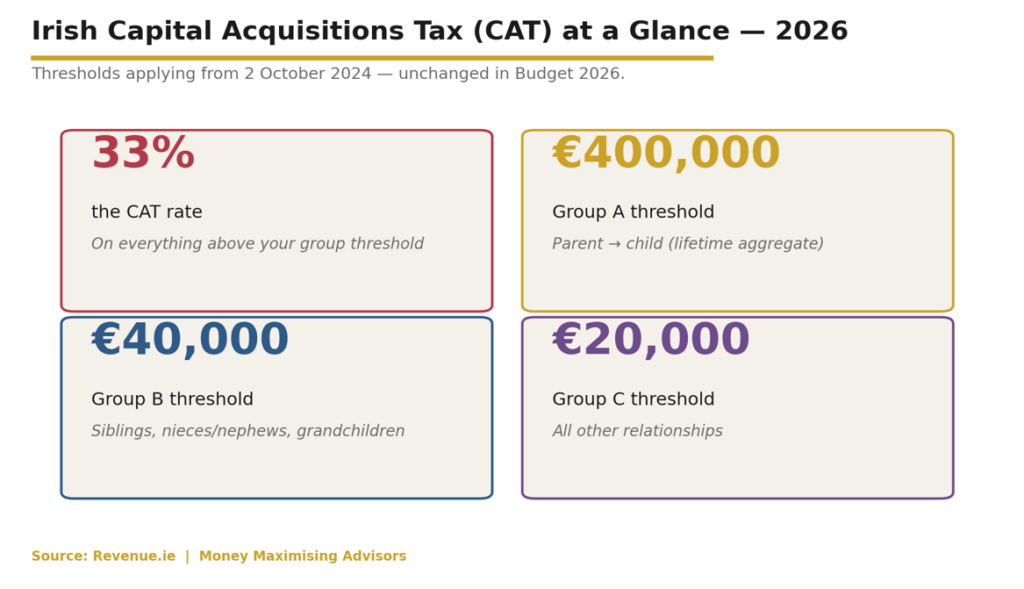
The four numbers every Cork family should commit to memory the 33% CAT rate plus the three lifetime group thresholds.
Quick answers: the seven questions most Cork families ask
How much inheritance tax do you pay in Ireland?
Inheritance tax in Ireland is charged at a flat 33% on the value of any gift or inheritance you receive above your lifetime tax-free threshold. The threshold itself depends on your relationship to the person giving the gift or leaving the inheritance, see the next question for the exact figures.
What is the current Capital Acquisitions Tax (CAT) threshold in Ireland?
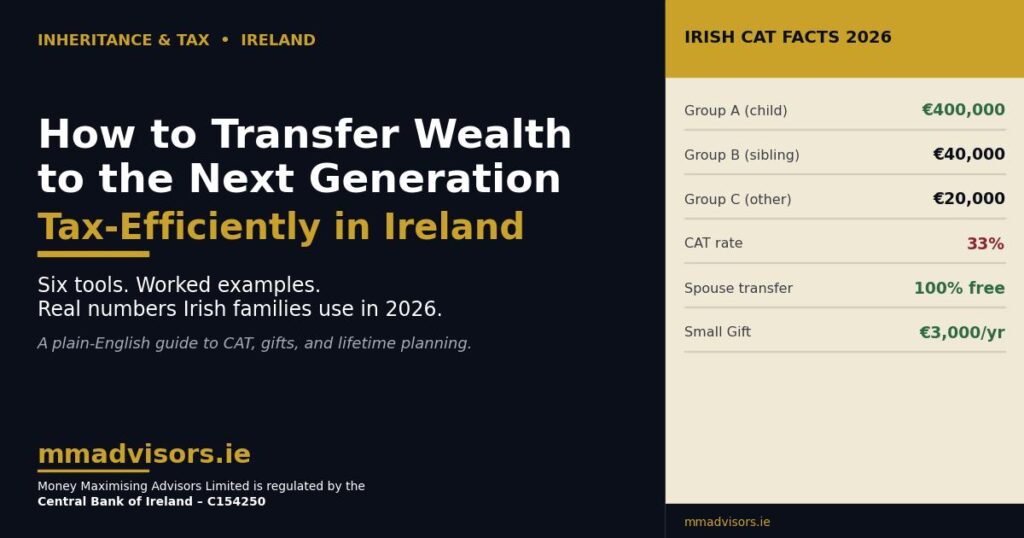
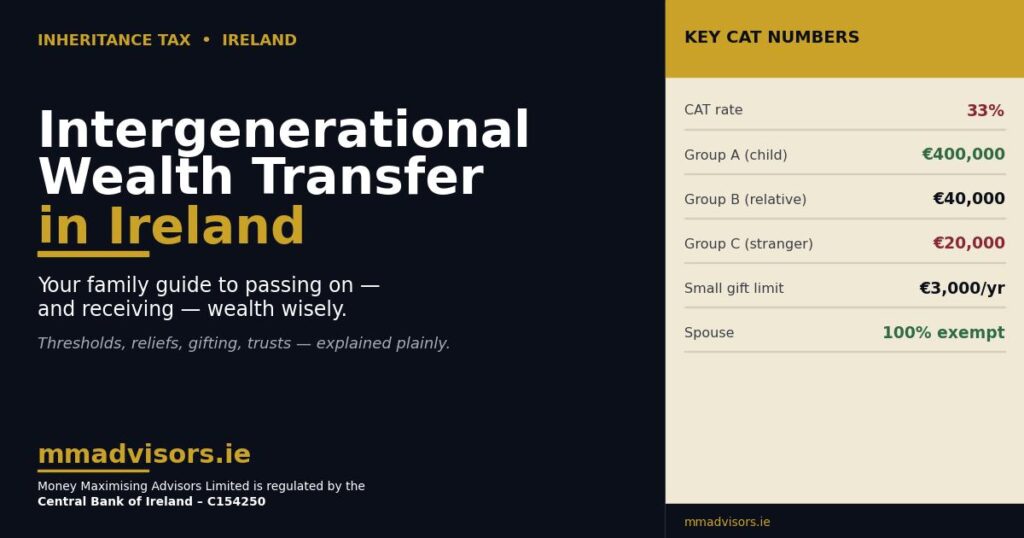
Three lifetime thresholds apply, depending on the relationship between the giver (the disponer) and the receiver (the beneficiary):
- Group A — €400,000: a child receiving from a parent.
- Group B — €40,000: siblings, nieces, nephews, grandchildren and grandparents.
- Group C — €20,000: any other relationship, including unrelated individuals.
These thresholds have applied since 2 October 2024 and were left unchanged by Budget 2026. They are lifetime aggregates every gift or inheritance you have received in the same group since 5 December 1991 is added together against the relevant threshold.
How can I reduce inheritance tax legally in Ireland?
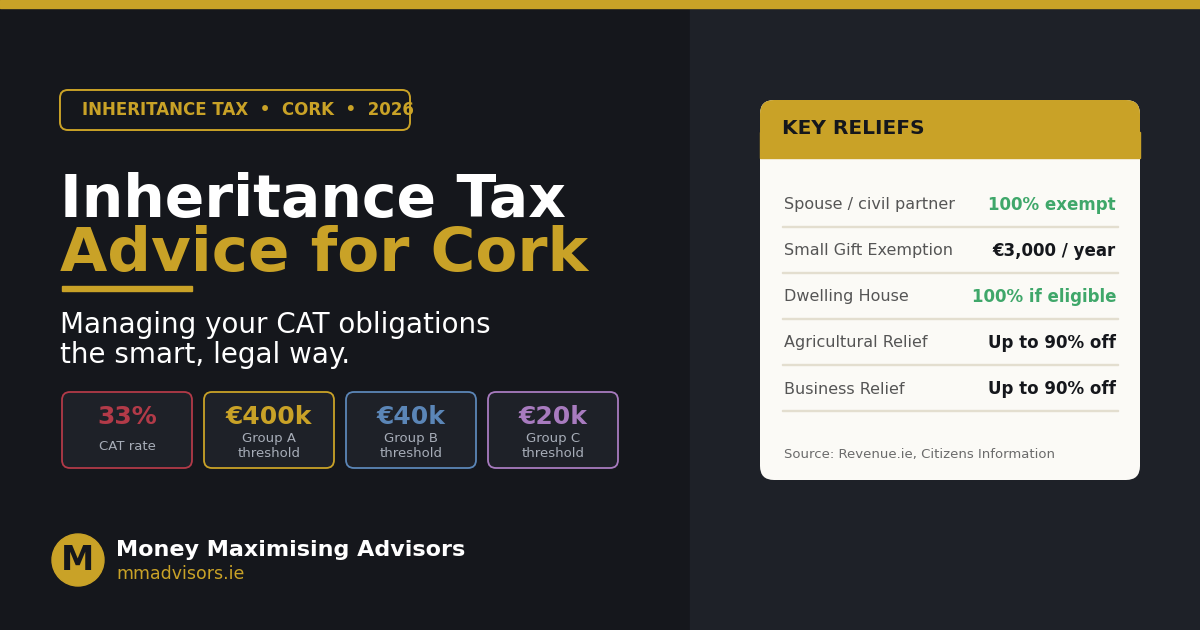
There are several legitimate routes, used alone or in combination: lifetime gifting using the Small Gift Exemption Savings Plan (€3,000 per giver, per recipient, every calendar year), using the Dwelling House Exemption where eligible, claiming Agricultural or Business Relief on qualifying assets, and pre-funding the eventual CAT bill through Section 72 Policies. Most well-planned Cork families use two or three of these together.
Is there a spouse exemption from inheritance tax in Ireland?
Yes, transfers between spouses or registered civil partners are completely exempt from CAT, with no upper limit. A husband can leave the family home and his entire estate to his wife (or vice versa) with no CAT arising at all. This is one of the most powerful features of the Irish system, and it is the foundation many estate plans are built around.
What reliefs are available for agricultural assets in Ireland?
Agricultural Relief reduces the taxable value of qualifying farmland and farm assets by up to 90%. A daughter inheriting a €1,000,000 Cork farm with full relief is assessed on just €100,000 of value, frequently bringing the CAT bill to nil after the Group A threshold is applied. The beneficiary must meet Ireland’s strict “farmer” test (broadly, 80% of their assets must be agricultural after taking the inheritance), and there is a six-year clawback period if the relief conditions are breached.
What is Business Relief for inheritance tax in Ireland?
Business Relief is the equivalent provision for qualifying business assets, typically shares in a genuine trading company, or a sole-trader/partnership business. It also delivers a 90% reduction in the taxable value, provided the disponer owned the assets for at least 2 years before an inheritance (5 years before a gift), the business is a real trade rather than a passive investment vehicle, and the recipient holds the assets long enough to clear the six-year clawback (10 years for business development land).
When does inheritance tax need to be paid in Ireland?
CAT runs on a 31 October Pay & File deadline following the relevant “valuation date” the technical date on which the benefit is treated as received. In broad terms, valuation dates falling between 1 September and 31 August in any year must be filed and paid by the following 31 October (a slightly later ROS-only extension typically applies). The return is Form IT38, and it must be filed if the cumulative value of benefits in a group exceeds 80% of the relevant threshold, or whenever you are claiming a relief such as Agricultural or Business Relief.
How CAT actually works in Ireland with a worked example
To turn the rules into a concrete number, run through it step by step. Below is the most common Cork case we see at the moment: a daughter inheriting her late father’s home, who previously received a parental gift toward her own first house.
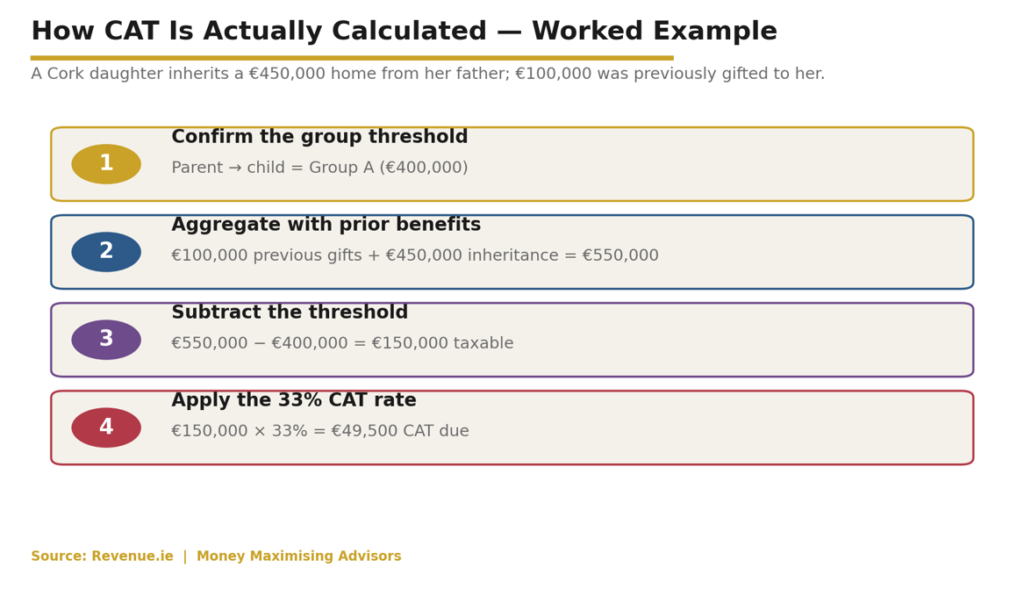
How the Group A threshold, aggregation rule and 33% rate combine in a real Cork inheritance.
Each part of the calculation matters. Aggregation the requirement to add everything received in the same group since 1991 is the most commonly overlooked rule, and the one that quietly turns what looks like a within-threshold inheritance into a sizeable CAT liability. Our Money Management Advice team will run the aggregation calculation across all prior gifts and inheritances on your file as part of a full review.
The most useful CAT reliefs for Cork families
The Irish tax code recognises that taxing the family home, the working farm and the family business at 33% would simply force their sale in many cases. So it provides a suite of reliefs that, used properly, can take a CAT bill close to zero. The five most useful for Cork families are:
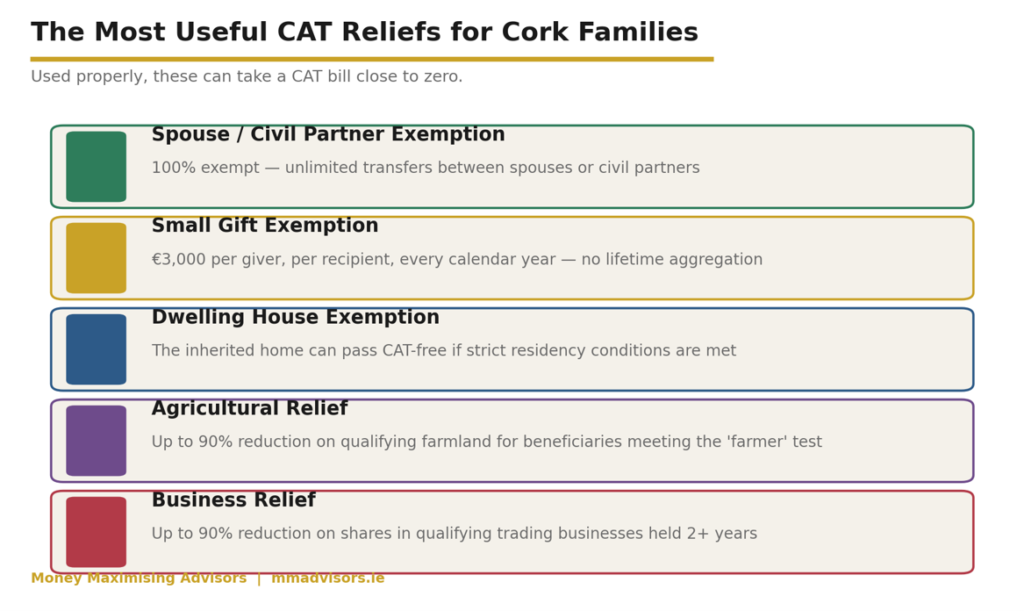
The five CAT reliefs that do the heaviest lifting in Cork estate plans.
Spouse and civil partner exemption
As noted above, transfers between spouses or civil partners are 100% exempt. There is no ceiling, no clawback, no qualifying conditions to meet beyond the relationship itself. This is the bedrock of almost every Cork estate plan.
Small Gift Exemption
Every individual can receive €3,000 a year from any one person, completely outside the CAT system. The gift does not eat into the recipient’s lifetime threshold, and the giver does not aggregate it with anything else. Two parents can therefore gift a child €6,000 every year, and each can also gift the child’s partner another €6,000, building substantial tax-free transfers over a decade. We package this systematically through the Small Gift Exemption Savings Plan.
Dwelling House Exemption
Where the inherited property is a dwelling that the beneficiary has been living in for a defined period before and after the inheritance, and where they do not own another dwelling, the entire value of the home can pass CAT-free. The conditions are strict and the rule is easy to get wrong; specific advice is essential.
Agricultural Relief
The flagship relief for Cork farming families. Done properly it reduces the value of qualifying farmland, buildings and stock by 90%, often turning a six-figure CAT bill into nothing once the Group A threshold is applied. Pre-planning is critical — the recipient typically needs to pass the 80% asset test on the valuation date, and there is a six-year holding requirement.
Business Relief
For families with a Directors Pension structure or an owner-managed trading company in Cork, Business Relief is often the single most valuable provision in the tax code. The 90% reduction applies to qualifying trading-business shares; it does not apply where the company’s value is mainly derived from passive investments. Our Corporate Investments specialists work alongside our inheritance team to keep the company’s structure on the right side of the rules well in advance of any succession event.
Practical CAT planning strategies for Cork families
Beyond the reliefs, there is a set of practical strategies that consistently reduce the eventual CAT bill for the Cork families we work with.
Plan early and gift systematically
Lifetime gifting beats post-death planning every time. The €3,000 annual exemption looks small but compounds quickly: €6,000 per child per year from two parents, invested over twenty years, can move hundreds of thousands of euros out of the parental estate without touching anyone’s lifetime threshold. Where the family home is in Cork suburbs like Douglas, Bishopstown or Ballincollig, and prices continue to rise, the earlier you start, the bigger the impact.
Pre-fund the eventual CAT bill
A Section 72 Policies is a specially designed life insurance policy whose proceeds are exempt from CAT when used to pay the beneficiary’s inheritance tax bill. Premiums are paid by the parents during their lifetime; the policy pays out on death and the children use the proceeds to settle CAT, keeping the family home or farm intact. For Cork families holding most of their wealth in property, this is one of the most popular planning tools we put in place.
Use Section 73 for tax-efficient lifetime gifting
A Section 73 Policy Savings Plan is a savings policy used in conjunction with the Small Gift Exemption to pre-fund larger future gifts to children in a CAT-efficient way. It is particularly powerful for families looking to help children with a Cork mortgage deposit ten or fifteen years from now.
Review the company structure long before succession
If a family business is heading for the next generation, the time to plan is now, not the year before retirement. Stripping passive investments out of a trading company, ensuring the disponer’s ownership period is long enough, and aligning the share structure with Business Relief’s conditions all take time.
| Want a tailored plan for your Cork family? Book Now for a free inheritance tax review, or Enquire Now and we will be in touch within one working day. |
Key deadlines and filing requirements
Get the timing right and you avoid interest, surcharges and a great deal of stress:
- Form IT38 — the CAT return. Required when cumulative benefits in a group exceed 80% of the lifetime threshold, or whenever you are claiming a relief such as Agricultural or Business Relief, even if no tax is ultimately due.
- 31 October Pay & File — the standard annual deadline following the valuation date. A typical ROS-only extension (usually to mid-November) is announced each year by Revenue.
- Valuation date — often the date of grant of probate for inheritances, or the date of the gift for lifetime transfers. Get this wrong and you can miss the deadline entirely.
- Aggregation back to 1991 — you must capture every prior gift or inheritance you have received in the same group since 5 December 1991, with documentation, not estimates.
- Surcharges and interest — missing the deadline triggers a percentage-based surcharge that escalates with delay, plus daily interest on the unpaid tax.
Common mistakes Cork families should avoid
From the inheritance tax reviews we run every year, these are the patterns that most often turn a manageable situation into an expensive one:
- Treating the €400,000 Group A threshold as per-parent. It is not — it is a lifetime aggregate from both parents combined, plus all earlier gifts.
- Forgetting about earlier gifts. That €50,000 wedding gift from twenty years ago still counts toward the threshold today.
- Assuming Agricultural Relief applies automatically. It does not, the beneficiary must pass the farmer test, and the asset must qualify on its own merits.
- Leaving Section 72 planning until late. Premiums are lower the earlier the policy is taken out; waiting until your seventies pushes costs up sharply.
- Missing the IT38 deadline. Even where no tax is due (because of a relief), the return must still be filed and the surcharge is automatic if you miss it.
Most-read inheritance tax guides
If you found this useful, these are some of our most-visited guides on the topic:
- How Much Money Can You Gift to a Family Member Tax-Free in Ireland?
- Inheritance Tax in Ireland: Thresholds, Rates, and How to Plan
- How to Inherit a Home Tax-Free in Ireland — Dwelling House Exemption Explained
- How to Pay Less Inheritance Tax in Ireland in 2026
- Avoiding Inheritance and Succession Pitfalls in Ireland
- Understanding Residency Rules for Irish Capital Acquisitions Tax (CAT)
Explore our full range
This guide is part of our wider Inheritance Tax hub. You can also explore our Pensions, Mortgages, Protection, Public Sector and Savings & Investments hubs, or learn more about us.
Our Services & Products
Our Services
Our Products
Related posts
- Inheritance Tax Ireland: Can You Inherit Debt?
- Understanding Irish Inheritance Tax Categories for Blended Families and Beyond
- Section 72 Life Insurance Quote for Inheritance Tax Purposes
- Inheritance Tax Savings Plans For Children in Ireland: A Complete 2026 Guide
Cork? Let’s protect your family’s wealth.
Whether you are planning ahead, dealing with a recent bereavement, or trying to make sense of a gift you have received, our team will give you a clear, no-jargon picture of where you stand and what your options are. Book Now for a free Cork inheritance tax review, or visit Money Maximising Advisors to learn more about how we work.
Important information
CAT thresholds, rates, exemptions and reliefs can change in any Budget; the figures cited above reflect the position as of 2026 and are sourced from Revenue.ie and Citizens Information. Money Maximising Advisors Limited is regulated by the Central Bank of Ireland. This article is for general information only and does not constitute financial, tax or legal advice. You should seek personalised advice from a Qualified Financial Advisor and, where appropriate, a tax adviser or solicitor, before making any decision about a gift or inheritance.