
Inheritance tax in Ireland can come as a shock to families who’ve worked hard to build up an estate. The good news is there’s a smart, legal way to manage it — a section 72 policy Ireland. At Money Maximising Advisors Limited, we help families across Dublin, Galway, and beyond use section 72 life insurance Ireland to protect their loved ones from an unexpected inheritance tax bill. In this guide, we explain exactly how it works — and why getting a section 72 life insurance quote could be one of the most valuable things you do for your estate.
What is a Section 72 Life Insurance Policy in Ireland?
A section 72 policy Ireland is a specific type of life assurance policy approved under Section 72 of the Capital Acquisitions Tax Consolidation Act 2003. It is designed specifically to pay inheritance tax (CAT) on your behalf — or more accurately, on behalf of your beneficiaries — when you die.
The key feature is that the payout from a section 72 life assurance quote policy is exempt from Capital Acquisitions Tax, provided it’s used solely to pay the inheritance tax bill on your estate. This makes it one of the most tax-efficient tools available for estate planning in Ireland.
How Does Section 72 Insurance Work?
Here’s how section 72 life insurance Ireland works in practice:
- Step 1: Your estate is valued and the potential CAT liability is calculated
- Step 2: You take out a section 72 life assurance policy for the amount needed to cover the expected tax bill
- Step 3: You pay regular premiums on the policy during your lifetime
- Step 4: On your death, the policy pays out a tax-free lump sum directly to your beneficiaries
- Step 5: Your beneficiaries use the proceeds to pay the Revenue Commissioners — without having to sell the family home, business, or other assets
The beauty of this approach is that your estate remains intact, and your children or other beneficiaries aren’t forced into a rushed sale of property or investments to cover a tax bill.
Is Section 72 Life Insurance Worth It in Ireland?
For many Irish families, the answer is a resounding yes. Consider this: if you own a house in Dublin worth €600,000 and have other assets, the inheritance tax bill on your estate could easily run to six figures. Without a section 72 life insurance Ireland policy in place, your children may need to sell assets to pay Revenue.
By contrast, a section 72 life insurance quote could provide the funds needed for as little as a few hundred euros per month in premiums — a fraction of the potential tax bill.
Key benefits include:
- The policy payout is exempt from CAT when used to pay inheritance tax
- Premiums are often surprisingly affordable relative to the cover provided
- It protects family wealth without the need to liquidate assets
- It’s a well-established, Revenue-approved planning strategy
To explore more advantages, see: The Non-Financial Benefits of Taking Out a Section 72 Policy in Ireland
Who Should Take Out a Section 72 Policy?
A section 72 policy Ireland is particularly suitable if you:
- Own property, investments, or a business that will form part of your estate
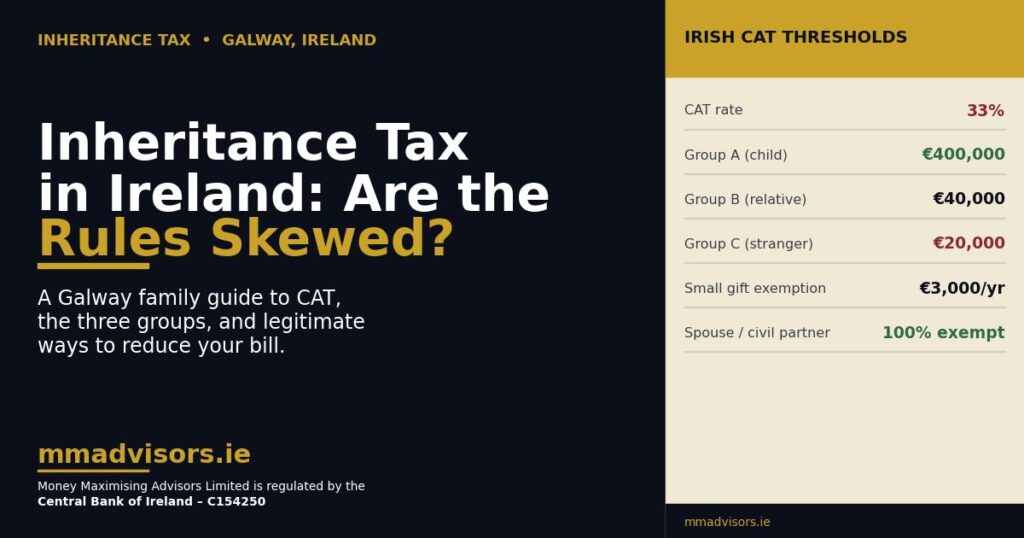
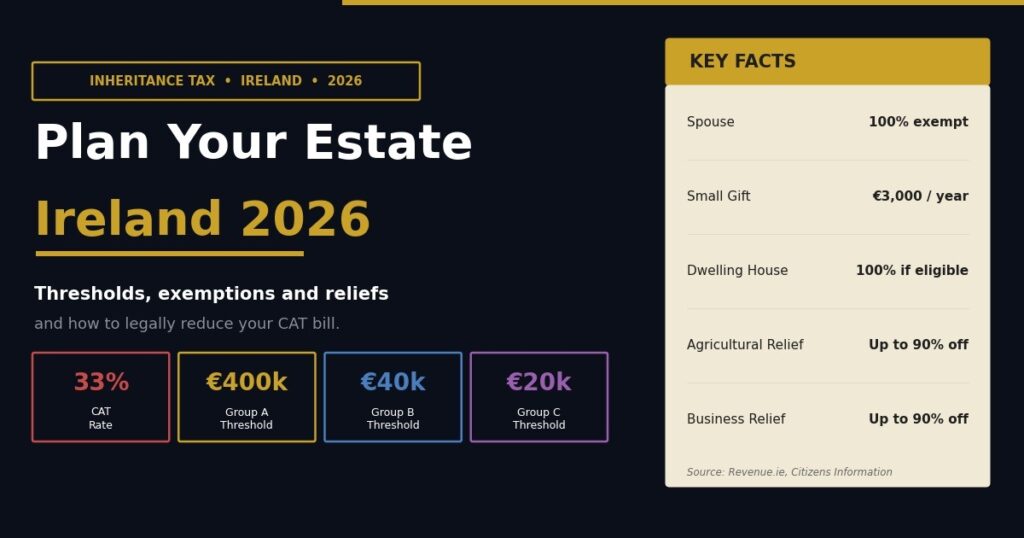
- Have an estate likely to exceed the CAT tax-free thresholds (e.g., Group A threshold of €335,000 for children)
- Want to preserve family wealth across generations without a forced sale
- Are looking for a straightforward, Revenue-approved inheritance tax planning strategy
It can also be combined with other strategies such as Section 72 Pension planning for a comprehensive approach to tax-efficient wealth transfer.
How to Get a Section 72 Life Insurance Quote in Ireland
Getting a section 72 life assurance quote involves:
- Estate Valuation: Assess the current value of your estate including property, investments, and business interests
- CAT Calculation: Estimate the expected inheritance tax liability based on current thresholds and relationships
- Policy Design: Structure the cover amount and term to match your needs — often a whole of life policy
- Underwriting: Complete a medical assessment if required by the insurer
Our team at Money Maximising Advisors Limited can guide you through each step and compare quotes from multiple insurers to find you the most competitive inheritance tax insurance Ireland solution.
For more reading: Simplifying Section 72: Paying Less Tax on Inherited Policies
Frequently Asked Questions (FAQs)
What is a Section 72 life insurance policy in Ireland?
A Section 72 policy is a Revenue-approved life assurance policy designed to pay your beneficiaries’ inheritance tax bill when you die. The payout is exempt from CAT when used for this specific purpose.
How does Section 72 insurance work?
You take out a policy for the estimated inheritance tax liability, pay regular premiums, and on your death the lump sum is paid tax-free to your beneficiaries to settle the Revenue bill — preserving your estate intact.
Is Section 72 life insurance worth it in Ireland?
For estates likely to incur significant CAT, it’s often excellent value. Monthly premiums can be modest relative to the potential six-figure tax saving, and it preserves family assets from a forced sale.
Who should take out a Section 72 policy?
Anyone with a substantial estate — particularly those owning property or a business in Dublin, Galway, or elsewhere in Ireland — should seriously consider it. It’s most effective when started earlier, as premiums are lower at a younger age.
Conclusion
A section 72 policy Ireland is one of the most effective, Revenue-approved ways to protect your family from inheritance tax in Ireland. Rather than leaving your loved ones with a surprise tax bill, you can plan ahead and ensure the funds are ready when needed. Money Maximising Advisors Limited specialises in estate planning for Irish families — and we’d love to help you get started.
Contact Us to discuss your estate planning needs.
Book an Appointment for a confidential consultation.
Enquire Now about Inheritance Tax Planning
Book via Inheritance Planning Page
Disclaimer
This article provides general information and should not be considered personalised financial or tax advice. Irish inheritance tax laws change periodically, and individual estate circumstances vary considerably. Always consult with our qualified financial advisors or tax professionals before making significant estate planning decisions.