The biggest transfer of wealth in history is happening right now. Over the next two decades, trillions will move from older generations to their children and grandchildren. A recent Aviva Intergenerational Wealth Shift Report reveals a worrying pattern: many Irish families are unprepared for it. This guide from Money Maximising Advisors is written for both sides of the conversation, parents planning to pass wealth on, and adult children expecting to receive it.
You will learn what the Irish CAT rules actually say. You will see how to have the family conversation. And you will see the specific tools Irish families use to keep more wealth in the family.
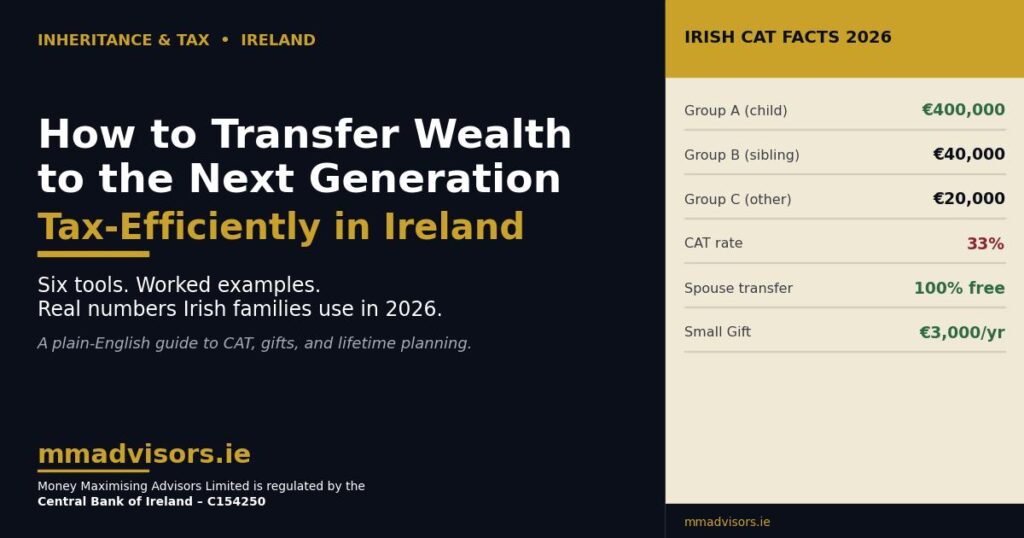
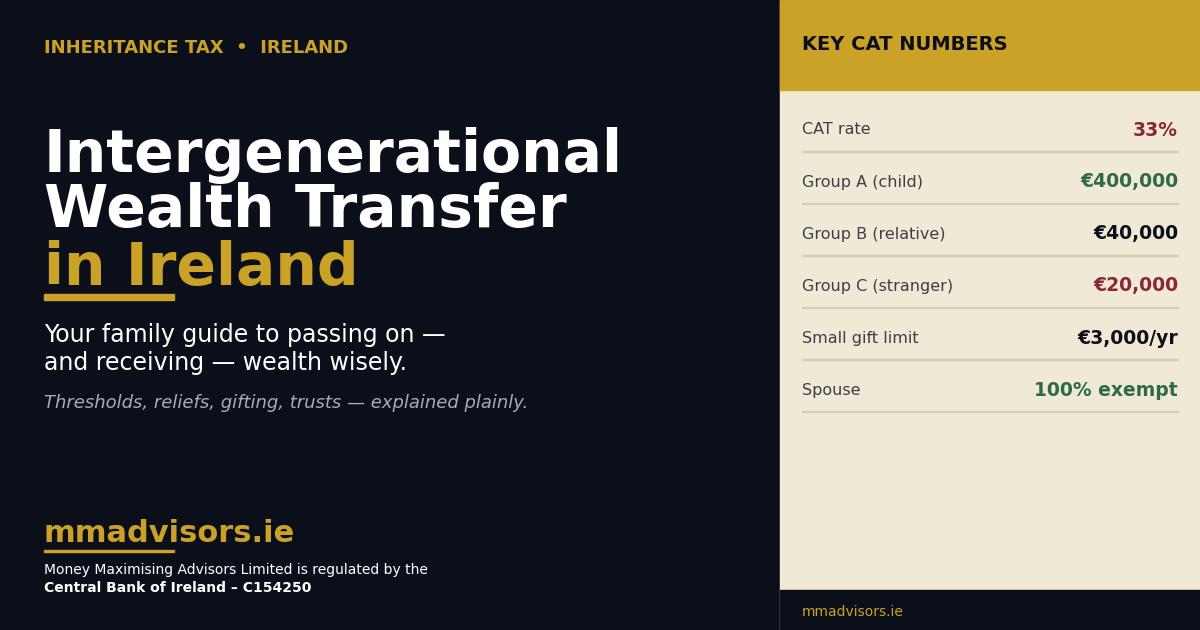
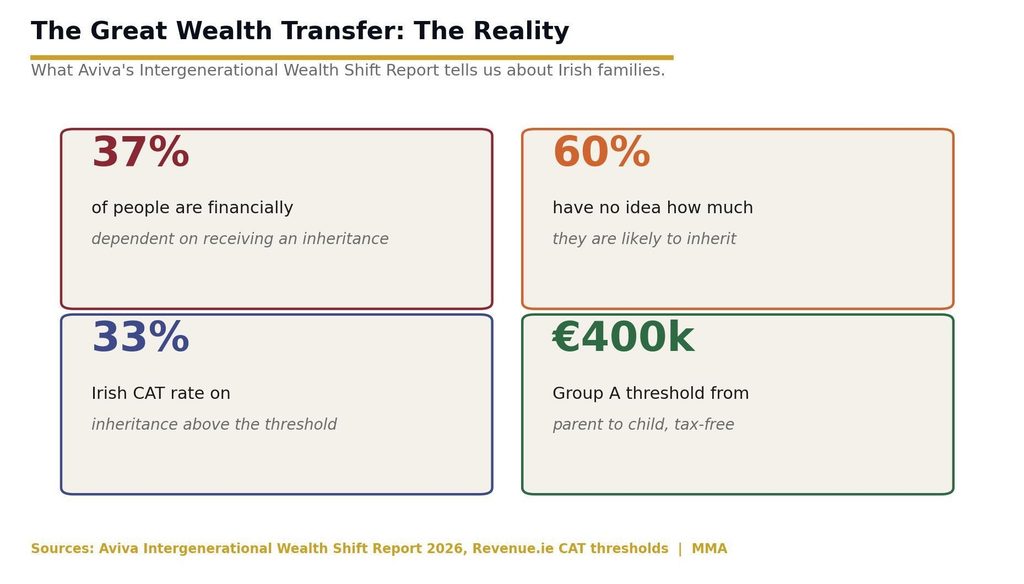
| QUICK ANSWER: Intergenerational wealth transfer is the movement of assets, property, savings, pensions, and businesses from one generation to the next. In Ireland, transfers above the Capital Acquisitions Tax (CAT) thresholds are taxed at 33%. The Group A parent-to-child threshold is €400,000. Group B (siblings, nieces, grandchildren) is €40,000. Group C (unrelated) is €20,000. The single most important step is not the tax planning; it’s the family conversation. 37% of Irish adults expect to rely on an inheritance; 60% have no idea how much they’ll receive. |
| This pillar connects Irish families to Section 72 Policies, the Section 73 Policy Savings Plan, the Small Gift Exemption Savings Plan and Whole Of Life Insurance. |
What is intergenerational wealth transfer?
Intergenerational wealth transfer is a simple idea. It’s the movement of money, property, pensions and other assets from one generation to the next.
Most people think of this as inheritance — assets that pass when someone dies. In reality, it happens in many forms.
Lifetime gifts. Parents helping a child with a house deposit. Grandparents contributing to a grandchild’s college fees.
Inheritance on death. Property, savings and investments passing through a will (or intestacy) after the giver dies.
Family business succession. A parent passing the family business to the next generation, often with specific tax reliefs.
All three fall under the same Revenue rules — Capital Acquisitions Tax (CAT). The tax treatment depends on the relationship and the value involved.
Why is this happening now?
Three big shifts are colliding at once.
An ageing population. Ireland’s older generation holds more wealth than any before it, thanks to decades of property price growth and pension accumulation.
Rising costs for younger generations. House prices, rents and living costs have made it harder than ever for people in their 20s and 30s to build wealth from earnings alone.
Longer lifespans. People live longer, so inheritance is arriving later, often when children are already in their 50s and 60s, and grandchildren need help getting on the ladder.
The result: many Irish families face a wealth transfer moment they haven’t planned for. The tax bill can be significant. The family dynamics can be more difficult still.
Ready to talk to our inheritance tax team?
Book a free 30-minute consultation, or send us your details and we’ll be in touch.
Money Maximising Advisors Limited is regulated by the Central Bank of Ireland – C154250
The Aviva research: what it means for Irish families
Aviva’s Intergenerational Wealth Shift Report highlights three findings every family should think about.
Finding 1: More than a third of adults expect to rely on inheritance
Aviva found that 37% of people say they are financially dependent on receiving an inheritance. For many of them, that inheritance is expected to help pay everyday living costs, clear debts, or fund their own retirement.
This is a fragile foundation to build a financial plan on. If the parent lives longer, needs long-term care, or is affected by market losses, the inheritance may not arrive when or in the amount expected.
Finding 2: Most don’t know how much they’ll receive
A striking 60% of adults admit they have no idea how much they are likely to inherit. They are making major life decisions, whether to buy a house, when to have children, when to retire, without a clear picture.
This is a communication problem. Parents don’t want to talk about death and money. Children don’t want to appear to be counting the days. The conversation gets postponed, and everyone assumes.
Finding 3: Younger generations face structural pressure
Housing costs, savings challenges and household pressure hit younger generations harder. Even where inheritance is coming, it often arrives too late, after the crucial house-buying and family-forming years.
This is why lifetime gifting has become such a powerful tool. Small, planned gifts during your working years can help your children when they most need it, while also reducing your future estate.
The three CAT thresholds you need to understand
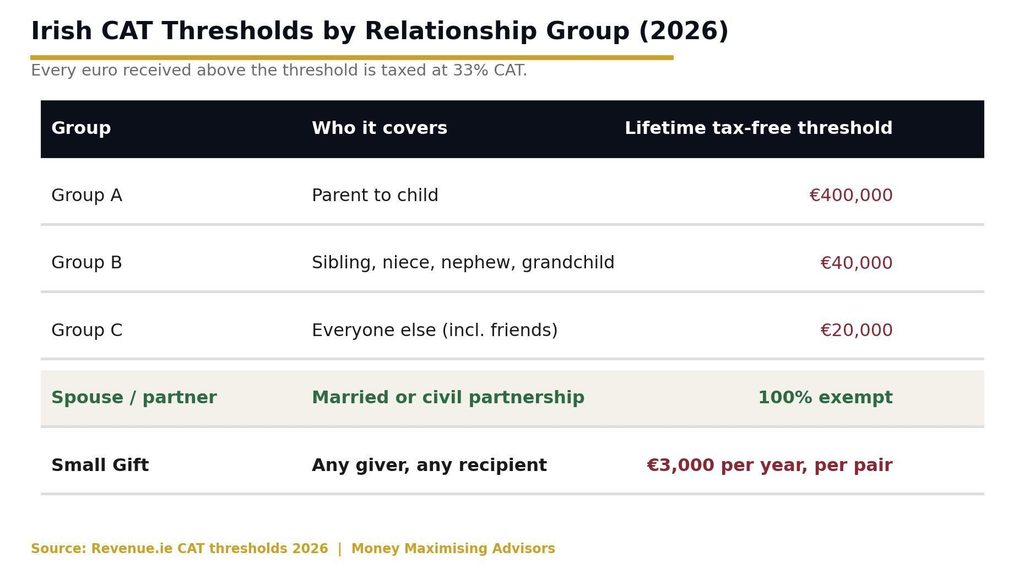
CAT applies at 33% on inheritance or gifts above your lifetime tax-free threshold. The threshold depends on your relationship to the person giving you the asset.
Group A: Parent to child
The most generous threshold: €400,000. This is the total amount a child can receive from both parents combined over their lifetime, tax-free.
Above €400,000, the excess is taxed at 33%. On a €600,000 inheritance from a parent, the CAT bill would be €66,000 (33% of the €200,000 excess).
Group B: Close relatives
Siblings, nieces, nephews, grandchildren and lineal ancestors have a €40,000 lifetime threshold. Everything above is taxed at 33%.
This threshold is significantly smaller. A niece inheriting €100,000 from an aunt would face CAT of roughly €19,800 on the €60,000 excess.
Group C: Everyone else
Friends, distant relatives, unmarried partners and everyone not in Group A or B face a €20,000 lifetime threshold.
The 33% rate applies to everything above. Unmarried partners are a particular concern here, the tax treatment is very different from a married or civil-partner couple.
Spouse and civil partner: 100% exempt
Transfers between spouses and civil partners are entirely exempt from CAT. There is no threshold. There is no tax.
This is the single biggest planning advantage of marriage in Irish tax law.
Legal ways to reduce inheritance tax
Tool 1: The Small Gift Exemption
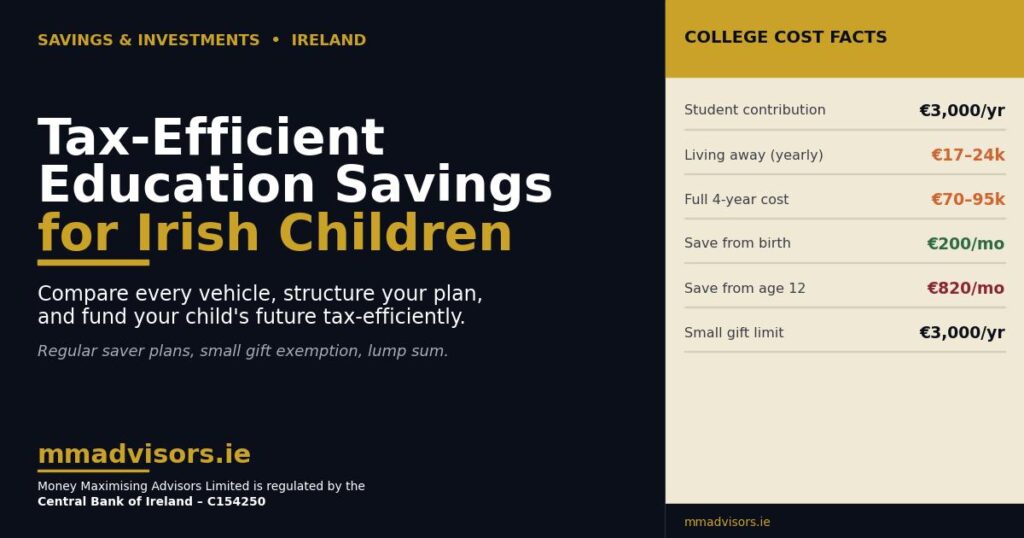
Every person can give any other person up to €3,000 per year, tax-free. This is separate from the lifetime CAT thresholds.
A couple can therefore give each of their children (or grandchildren) €6,000 every year. Over 20 years, that’s €120,000 per child, permanently outside the CAT threshold.
The Small Gift Exemption Savings Plan from MMA lets you invest these annual gifts to grow tax-efficiently until the child needs them.
Tool 2: Section 72 Life Insurance
A Section 72 policy is a whole-of-life insurance plan taken out specifically to cover a future CAT bill.
Here’s the key benefit: the payout is entirely tax-free when used to pay CAT. It doesn’t add to your estate. It doesn’t reduce the beneficiary’s other thresholds. It just clears the tax.
For families with a family home, business or investment portfolio worth well above the CAT threshold, Section 72 lets the assets pass intact, without a forced sale to raise the tax.
Tool 3: Dwelling House Exemption
A family home can pass tax-free to a beneficiary who has lived there as their main residence. Strict conditions apply.
The beneficiary must have lived in the property for at least 3 years before the inheritance. They must have no interest in any other dwelling. They must continue living there for at least 6 years after inheriting.
This exemption is powerful for adult children who have moved back home to care for elderly parents. It’s not available for holiday homes or investment properties.
Tool 4: Business Relief and Agricultural Relief
Qualifying business assets can pass with a 90% reduction in their taxable value. Farm assets have a similar 90% Agricultural Relief.
This is the mechanism that allows family businesses and family farms to pass through the generations without being sold to pay tax.
Conditions are strict: the beneficiary typically must actively work in the business or farm the land for a defined period after inheriting.
Tool 5: Trusts and structured plans
Discretionary trusts, life-interest trusts and other structures let families control the timing and shape of wealth transfer.
The Section 73 Policy Savings Plan is a specific Irish structure that allows regular savings to build a fund which can be used to pay a beneficiary’s future CAT bill, with the savings themselves taxed at a lower rate than a normal inheritance.
Trust structures are more complex and typically make sense for larger estates or where control over timing matters.
| Not sure which tools fit your family? Book Now for a free 30-minute inheritance tax review, or Enquire Now, we’ll come back within one working day. |
How to have the family conversation
This is the hardest part. Money and mortality are two things most families never talk about. Yet the Aviva research shows exactly why this silence is so costly.
For parents planning to pass on wealth
Start early. Waiting until your 80s to talk about your estate is leaving it too late. Family circumstances change. Children have their own financial pressures. The earlier the conversation, the more you can adapt.
Be specific where you can. Vague reassurances (“there’ll be enough”) leave children guessing. Ballpark numbers (“we’re planning for roughly X in the will”) let them plan realistically.
Explain your thinking. If the estate is split unequally between children, tell them why while you can still explain it. Estates settled without clear reasoning trigger the most family disputes.
For adult children expecting to inherit
Don’t rely on assumptions. Have a version of the conversation, tactfully, without pushing. “We want to plan our own finances properly. If there’s anything you’d like us to know about your plans, we’d rather hear it now.”
Understand your parents’ care needs. Long-term care can absorb significant assets quickly. If your parents don’t have care insurance or a plan, the inheritance you’re counting on may not arrive.
Never make major financial commitments assuming inheritance. Buying a house or having children based on an expected inheritance is high-risk planning. Base your decisions on what’s certain today.
If you’re expecting to inherit: what to plan for
If you know an inheritance is coming, or you receive one unexpectedly, there are specific steps to take before spending or investing the money.
Understand the tax first
Work out your remaining CAT threshold from previous gifts. Even small gifts from grandparents earlier in life may have used some of your allowance.
If the inheritance exceeds your threshold, plan for the tax bill immediately. It’s due within four months of the valuation date. Late payment triggers penalties and interest.
Don’t rush major decisions
Grief clouds judgement. Financial decisions made in the first three months after a bereavement often get regretted. Give yourself time.
Park the inheritance in a low-risk holding position (a deposit account or short-term treasury fund) until you have a plan. Growth can wait 6–12 months.
Consider your own household plan
Before any investment, ask what the inheritance should do. Clear the mortgage? Top up your pension? Fund your own children’s college? Our Money Management Advice service helps map the options.
Common mistakes Irish families make
Ignoring pension death benefits. Pensions typically pass outside the CAT system, but the treatment depends heavily on the pension type and the beneficiary nomination.
Leaving all planning until the parent is elderly. Tools like the Small Gift Exemption only work over years. Waiting until 80 leaves most of the value on the table.
Assuming spouses transfer everything to children automatically. Without a will, the intestacy rules divide the estate in ways many families would not choose.
Skipping Section 72 for large estates. A tax-free CAT-cover policy lets the family home and investments pass intact without a forced sale.
Not updating wills after major life changes. Marriage, divorce, births and property purchases all change the picture. Review every 5 years.
Forgetting unmarried partners. Long-term partners without a marriage or civil partnership face the harsh Group C threshold on shared assets.
Related Guides:
Frequently asked questions
What is intergenerational wealth transfer?
Intergenerational wealth transfer is the movement of assets from one generation to the next, typically parents or grandparents passing money, property, pensions or businesses to their children or grandchildren. It happens through lifetime gifts, inheritances on death, and family business succession.
How much can I give my child tax-free in Ireland?
A parent can give a child up to €400,000 total over their lifetime, tax-free (the Group A CAT threshold). Additionally, every year each parent can give the child a Small Gift Exemption of €3,000, fully tax-free and outside the €400,000 lifetime limit. A couple can therefore transfer €6,000 per year, per child, indefinitely.
What is the CAT rate in Ireland?
The Capital Acquisitions Tax rate on gifts and inheritances above the tax-free threshold is 33%. This has been the rate since 2012.
Do spouses pay CAT on inheritance?
No. Transfers between spouses and civil partners are entirely exempt from Capital Acquisitions Tax. There is no threshold and no tax.
What is a Section 72 policy?
A Section 72 policy is a whole-of-life insurance plan taken out specifically to cover a future CAT bill. When the giver dies and the CAT becomes payable, the policy pays out tax-free, provided the proceeds are used to pay the tax. It lets families pass on the family home or investments intact rather than forcing a sale.
How do I start the family conversation about inheritance?
Start with your own planning, then invite the conversation. “We’re doing our own financial plan and want to be realistic, anything you’d like us to know about yours?” is a low-pressure opener. Don’t push for numbers. Focus on shared clarity: what are the risks, who has decision-making authority, and what would you want us to know.
Can grandparents help fund a grandchild’s future tax-free?
Yes. Each grandparent can give each grandchild €3,000 per year under the Small Gift Exemption, tax-free and outside the lifetime CAT threshold. Two grandparents can give €6,000 per grandchild per year. Over 18–20 years, this alone can build a substantial fund permanently free of Irish inheritance tax.
Reviewed by our inheritance tax team
This guide was prepared and reviewed by the inheritance tax team at Money Maximising Advisors, drawing on the Aviva Intergenerational Wealth Shift Report, Revenue.ie CAT guidance, and daily inheritance planning work for Irish families. MMA is regulated by the Central Bank of Ireland (C154250).
Ready to plan? Let’s start the conversation.
Whether you’re planning to pass on the family home, funding a grandchild’s future, or trying to understand what you might inherit, our inheritance tax team maps every option and shows you the numbers. Book Now for your free consultation, or Enquire Now, we reply within one working day.
Ready to talk to our inheritance tax team?
Book a free 30-minute consultation, or send us your details and we’ll be in touch.
Money Maximising Advisors Limited is regulated by the Central Bank of Ireland – C154250
| Important information: Capital Acquisitions Tax thresholds, rates and reliefs referenced in this guide are those in force at the time of writing (2026) and are sourced from Revenue.ie. They are subject to change with each Finance Act. The Aviva Intergenerational Wealth Shift Report is referenced for context; individual family circumstances vary widely. Money Maximising Advisors Limited is regulated by the Central Bank of Ireland (C154250). This article is for general information only and does not constitute financial, tax or legal advice. You should seek personalised advice from a Qualified Financial Advisor and a tax specialist before making any inheritance planning decision. Life assurance products, including Section 72 policies, are subject to underwriting, terms, exclusions and conditions. |