
Quick answer
Property equity can sometimes help fund the deposit for another property. The route normally involves a top-up or remortgage secured on the existing property. The released funds do not remove the need to qualify for the new mortgage.
You must be able to support both the increased borrowing on the existing property and the mortgage on the new one. Lenders also assess the purpose, property type, rental income and total exposure.
How the structure can work
- Obtain a current valuation of the existing property.
- Subtract the existing secured borrowing to understand the equity position.
- Apply for a top-up or larger remortgage, subject to affordability and lender criteria.
- Use the approved net funds towards the deposit and purchase costs for the additional property.
- Apply separately for the mortgage on the new property and pass its lending tests.
The MMA landing page describes releasing equity from a principal home or one or more residential buy-to-let properties. It gives an investor scenario where released funds may contribute to the deposit for an additional property. The figures are illustrative and subject to valuation, affordability and lender criteria.
Understand equity and usable equity
Equity is the property value less the outstanding mortgage. Usable equity is the smaller amount a lender may allow you to borrow after applying its loan-to-value limit and underwriting rules.
For example, a property worth €400,000 with a €150,000 mortgage has €250,000 of equity. That does not mean €250,000 is available to withdraw. The lender sets a maximum total mortgage, then deducts the existing balance and relevant costs.
The 30% buy-to-let deposit rule
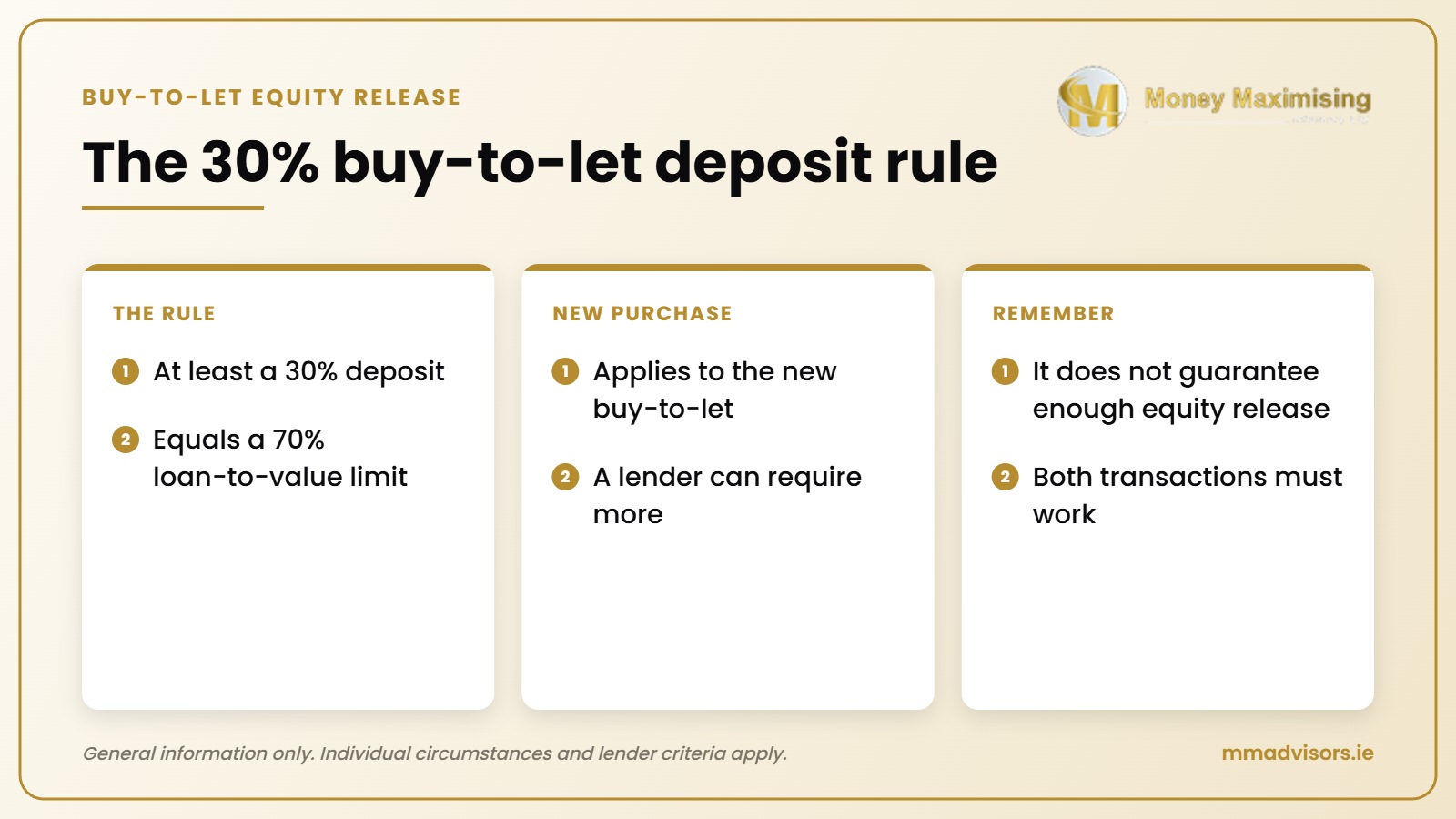
The Central Bank’s standard mortgage measures require buy-to-let buyers to provide at least a 30% deposit. This corresponds to a 70% loan-to-value limit. A lender can still require a larger deposit under its own credit policy.
The 30% rule applies to the new buy-to-let purchase. It does not guarantee that a lender will release enough equity from the existing property. Both transactions must work independently and together.
Two affordability tests, not one
The existing-property refinance
The lender reviews the higher balance secured on the existing property. For a principal home, income, expenditure and repayment capacity are central. For a rental property, the lender can also examine rent cover, leases, property condition and the wider portfolio.
The new-property mortgage
The new lender assesses the proposed purchase. For buy-to-let, expected rent does not remove all affordability checks. Vacancy, maintenance, insurance, tax and higher interest costs should be included in the investor’s cash-flow plan.
An illustrative portfolio example
Assume an investor owns rental properties worth €1 million with no mortgage. At a 70% loan-to-value, a theoretical maximum of €700,000 could be secured against the portfolio. The MMA landing page uses this simplified illustration to show how deposits might be funded.
It is not an entitlement or expected outcome. A lender may apply lower limits, property-level caps, rent-cover requirements and exposure limits. Legal, valuation and tax costs also reduce available funds. Each new purchase must be assessed on its own merits.

Costs that should appear in the plan
- Valuation and legal costs for the refinance.
- Any early repayment charge on the existing mortgage.
- Stamp duty and legal costs for the new purchase.
- Survey, insurance and mortgage-related fees.
- Repairs, furnishing and compliance costs before letting.
- Vacancy, maintenance, management fees and tax.
- A contingency for higher interest rates or lower rent.
Does it matter which property provides the equity?
Equity from a principal home
Releasing equity from a principal home increases the debt secured on the place where the household lives. The borrower should assess the new repayment without relying on rent from the proposed investment property. If the investment underperforms, the home mortgage still has to be paid.
Equity from a buy-to-let property
A refinance of a rental property is assessed using lender rules for investment lending. Expected rent, lease position, property type and portfolio exposure may affect the amount. The new borrowing also changes the cash flow and resilience of the existing rental asset.
Equity from several properties
A portfolio refinance can raise a larger amount, but it can also connect several assets to the same borrowing strategy. Ask whether security is cross-collateralised and how much must be repaid if one property is sold. Those details affect future flexibility.
Tax treatment needs its own review
Revenue states that Irish rental income is taxable. Qualifying expenses may be deductible, and mortgage interest may be allowed where the borrowed money is used to purchase, improve or repair the rental property and Revenue conditions are met.
The purpose and use of borrowed funds matters. Security over a rental property does not by itself make all interest deductible. Keep a clear evidence trail and obtain tax advice for the intended ownership and borrowing structure.
Main risks of using property equity
- More than one property may be exposed to mortgage repayment risk.
- Property values and rents can fall while loan balances remain.
- Vacant periods can reduce cash flow without reducing repayments.
- A long refinance term can increase total interest.
- Selling one property may require lender consent and partial repayment.
- Concentrating wealth in property can reduce diversification and liquidity.
Build an exit plan before increasing leverage
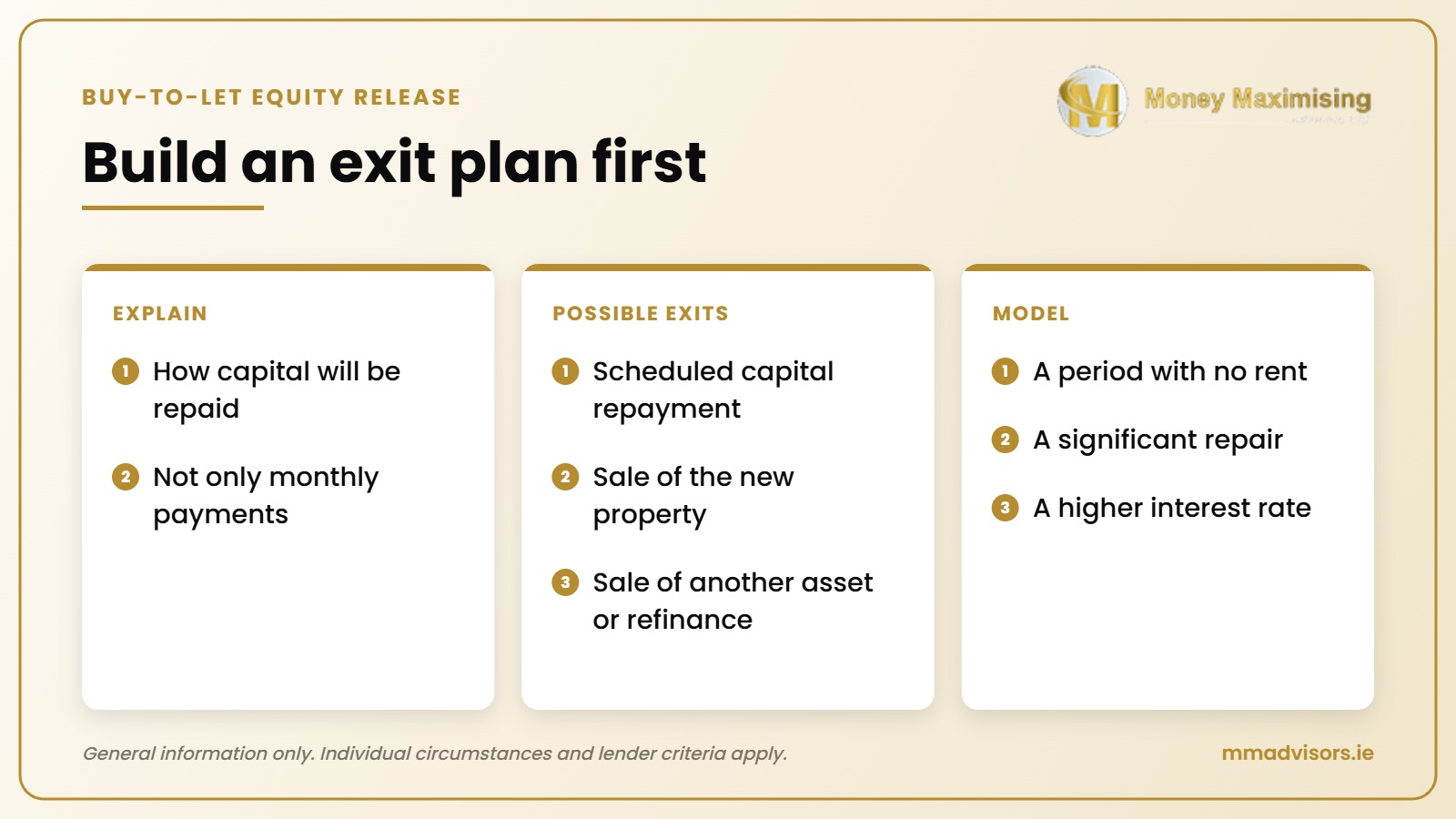
The plan should explain how capital will be repaid, not only how monthly interest or repayments will be met. Possible exits include scheduled capital repayment, sale of the new property, sale of another asset or refinance. Each route has market and timing risk.
Model a period with no rent, a significant repair and a higher interest rate. Also consider what happens if the investor wants to retire, move home or reduce the portfolio. A strategy that depends on rising prices is not a complete repayment plan.
Ownership and advice boundaries
Buying personally, through a company or through an eligible pension arrangement can produce different lending, tax, control and administration consequences. The mortgage decision should not be made before the ownership structure is reviewed with appropriate tax, legal and financial advisers.
Evidence for the source of deposit
The new-property lender will normally ask where the deposit came from. Keep the remortgage offer, solicitor correspondence and bank trail. Do not move funds through several accounts without a clear reason, as this can delay anti-money-laundering and underwriting checks.
If part of the deposit is a family gift, the lender may require a gift letter and confirmation that the donor has no interest in the property. Tax consequences can also arise for gifts, so separate tax advice may be needed.
Sequence and timing matter
Do not assume the refinance and purchase will complete on the same day. Mortgage offers, valuations and legal work can expire or be delayed. Agree the sequence with the broker and solicitor before signing a purchase contract or paying a non-refundable amount.
Questions for the lender or broker
- What maximum loan-to-value applies to each existing property?
- How is rental income stressed and what rent cover is required?
- Are properties cross-secured or assessed separately?
- What happens if one property is sold?
- What legal, valuation and early repayment costs apply?
- Is interest-only available, and what is the capital repayment plan?
- How does the application affect future borrowing capacity?
- What evidence is required for the source of the new deposit?
Frequently asked questions
Can I release equity from my home for a buy-to-let deposit?
The landing page states this may be an approved purpose. The existing refinance and new buy-to-let mortgage remain subject to lender approval.
Can I release equity from more than one rental property?
Some lenders may consider a portfolio, but property-level and total exposure limits apply.
Does released equity count as my deposit?
It can provide cash for a deposit where the lender accepts the source. It remains borrowed money and affects overall affordability.
Is the new rental income guaranteed to cover repayments?
No. Rent, occupancy and costs can change. Use conservative assumptions and maintain a contingency.
Is mortgage interest automatically tax deductible?
No. Revenue conditions and the use of borrowed funds matter. Obtain tax advice and keep records.
Map both loans before making an offer
A sound plan assesses the refinance, deposit, new mortgage, tax position and portfolio cash flow together. Money Maximising Advisors can discuss current equity release and buy-to-let criteria for the properties and applicants involved.
Sources
Important information
WARNING: If you do not meet the repayments on your loan, your account will go into arrears. This may affect your credit rating, which may limit your ability to access credit in the future.
WARNING: You may have to pay charges if you pay off a fixed-rate loan early.
WARNING: This new loan may take longer to pay off than your previous loans. This means you may pay more than if you paid over a shorter term.
General information only. Individual circumstances, lender criteria and eligibility requirements apply. This content does not constitute financial, tax or legal advice.
Money Maximising Advisors Ltd is regulated by the Central Bank of Ireland. C154250.