Buying a rental property in Ireland is not the same as buying your own home. The Central Bank rules are different. The deposit is bigger. The lender applies a specific rent-cover test on top of the standard affordability check. This complete guide from Money Maximising Advisors walks you through every rule, every rate and every structure Irish investors use to borrow for a buy-to-let in 2026.
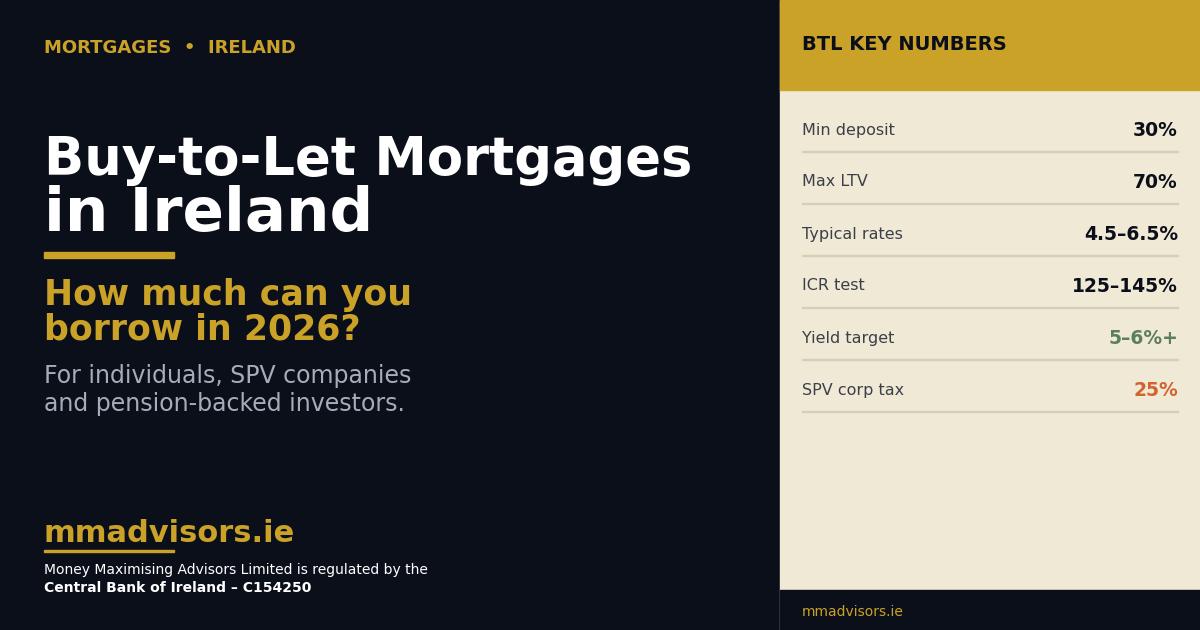
| QUICK ANSWER In Ireland, buy-to-let (BTL) mortgages cap at 70% loan-to-value you need a minimum 30% deposit. Lenders also apply an Interest Coverage Ratio (ICR) test of 125–145%, meaning the rent must comfortably exceed the mortgage interest at a stress-tested rate. Typical BTL rates in 2026 sit between 4.5% and 6.5%. Borrowing capacity depends on rental income, not primarily your salary. |
| This pillar connects Irish investors to the specific BTL products we arrange: Buy-to-let Mortgages, SPV Mortgages, Equity Release Mortgages and Irish Ex-pat Mortgages. |
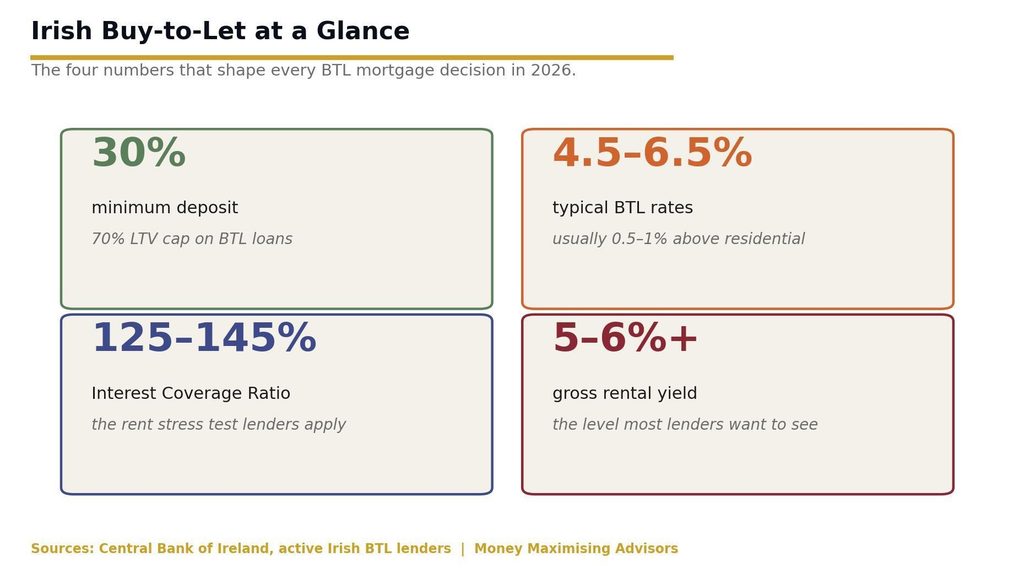
The four numbers that shape every Irish buy-to-let borrowing decision in 2026.
How much can you borrow for a buy-to-let in Ireland?
Your borrowing capacity on a buy-to-let is driven by three separate tests. Each one can independently cap the loan. A good broker looks at all three before shortlisting lenders.
The 70% loan-to-value (LTV) cap
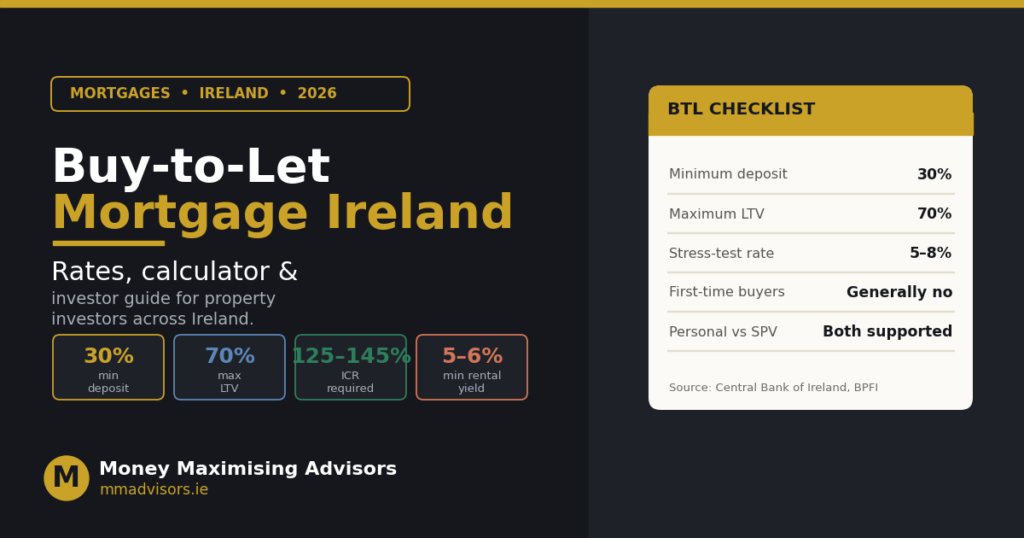
Under Central Bank of Ireland rules, buy-to-let mortgages are capped at a maximum 70% loan-to-value. That means the minimum deposit is 30% of the purchase price. On a €350,000 rental property, the maximum loan is €245,000, and the minimum deposit is €105,000.
This is the hard ceiling. No lender will exceed it. Some go slightly below it based on internal credit policy a specialist BTL lender may offer only 65% LTV on a portfolio of five or more properties, for example.
The Interest Coverage Ratio (ICR)
The ICR is the rent-cover test. It measures whether the expected rental income comfortably exceeds the mortgage interest cost at a stress-tested rate usually 5–8% depending on the lender.
Most Irish BTL lenders apply an ICR of 125% to 145%. This means:
- ICR of 125%. Rent must cover 125% of the stress-tested monthly interest. This is the minimum. Suits lower-rate taxpayers.
- ICR of 145%. Rent must cover 145% of stress-tested interest. Applied to higher-rate taxpayers whose real net rent is lower.
Failing the ICR test is the single most common reason BTL applications get downsized. The lender will often approve a smaller loan that passes the test.
The gross rental yield target
A gross rental yield is the annual rent divided by the property price. Most Irish BTL lenders want to see 5–6% or higher — partly because that’s what the ICR test tends to demand at typical stress rates.
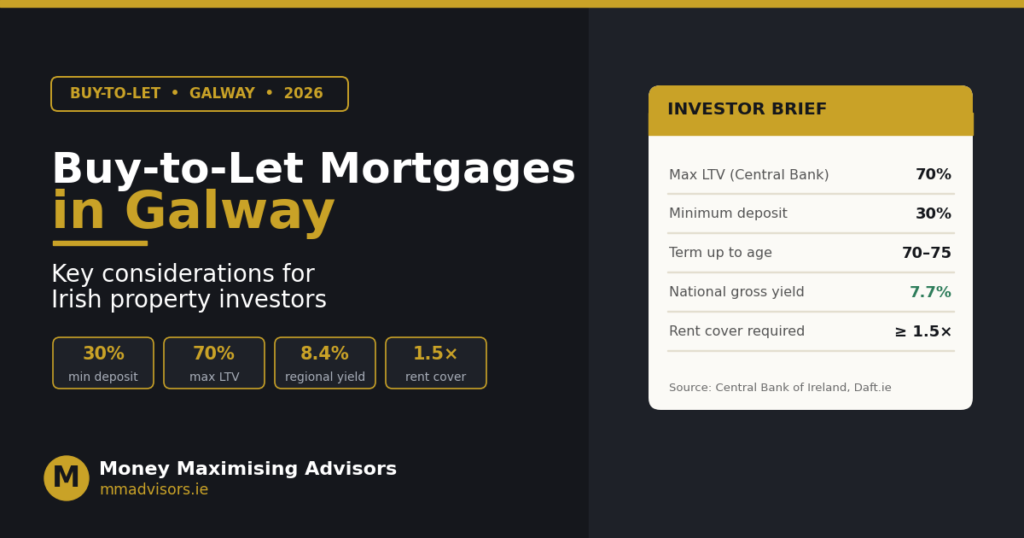
Yields in Ireland vary sharply by location. Regional cities (Cork, Galway, Limerick) and outer commuter towns often deliver 6–8% gross yields on smaller units. Prime Dublin postcodes may struggle to reach 4–5% — which is why many Dublin BTL applications fail the ICR test.
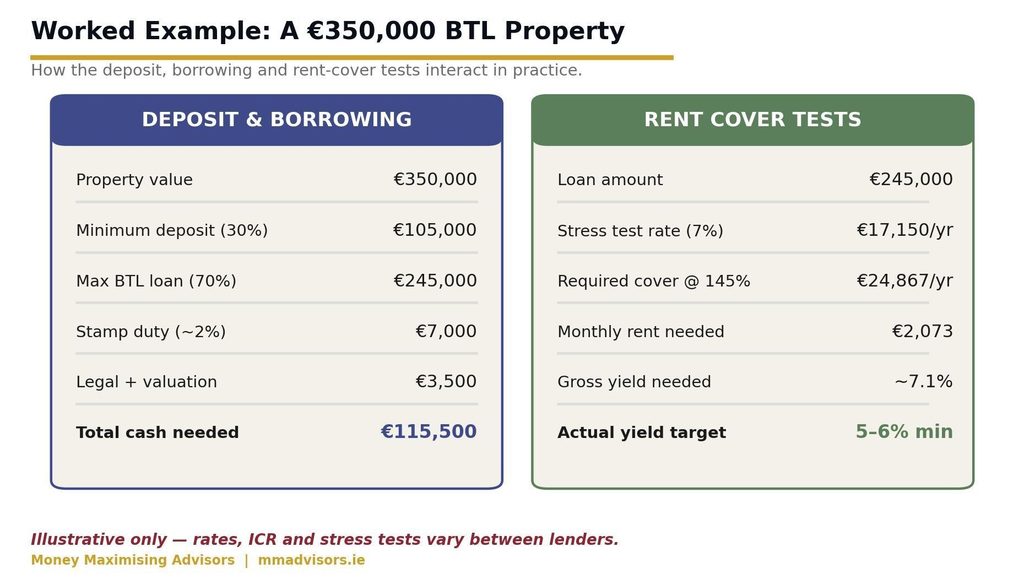
A worked example on a €350,000 BTL property how the deposit, borrowing and ICR interact.
What deposit do you need for a buy-to-let in Ireland?
The minimum deposit is set by the Central Bank at 30% for buy-to-let. However, the actual figure you need in cash at closing depends on the ownership structure.
Deposit for an individual buy-to-let
A 30% deposit of the purchase price. Plus stamp duty (1% on residential up to €1m, 2% above). Plus solicitor’s fees (typically €1,500–3,000). Plus valuation (€150–250) and any structural survey (€400–800). On a €350,000 property, expect total closing cash of roughly €115,000–€118,000.
Deposit for an SPV / limited company BTL
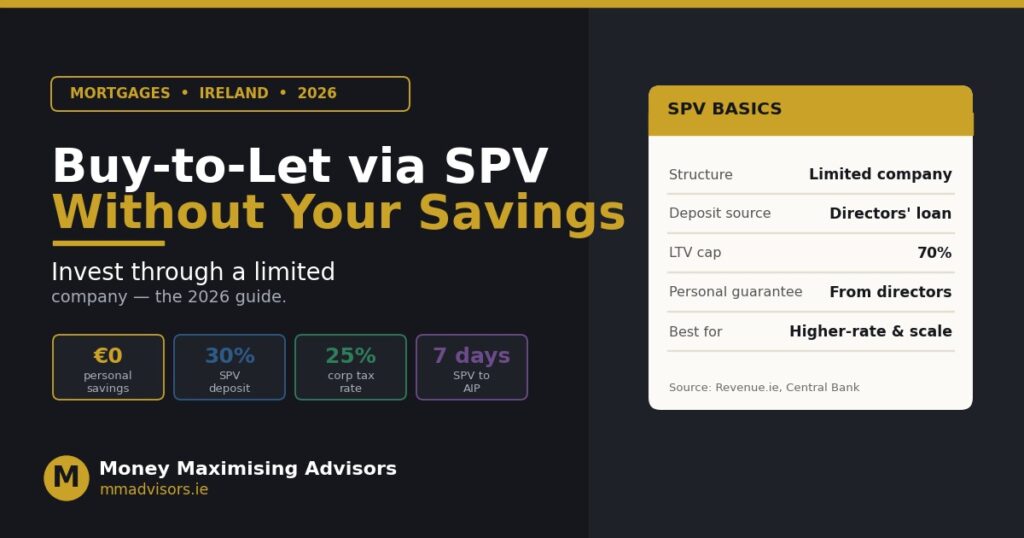
For SPV Mortgages where a limited company owns the property lenders often require a slightly higher deposit, sometimes 35–40%. In return, corporation tax on rental profits is much lower (25% for rental income vs marginal income tax rates up to 52% for individuals).
Deposit for a pension-backed BTL
A pension-backed BTL is held inside a self-administered pension trust. The deposit comes from the pension pot itself. There is no personal cash outlay. Rental income and capital gains grow tax-free until retirement drawdown. Suits directors and self-employed investors with existing Directors Pension pots of €300,000+.
What are current buy-to-let mortgage rates in Ireland?
BTL rates run 0.5–1 percentage point higher than residential rates. In 2026, that puts them roughly in the 4.5%–6.5% APR range depending on lender, LTV, ownership structure and the number of properties in your portfolio.
Individual investor rates
Rates for a first-time individual investor with a 70% LTV loan on a single property typically sit at the lower end — around 4.5–5.5%. Most lenders offer both fixed and variable options, with fixed periods of 2, 3, 5 or occasionally 7 years.
Portfolio landlord rates
If you own four or more rental properties, you become a “portfolio landlord” under most lenders’ criteria. Some lenders will decline you at this point. Specialist lenders will engage, but rates are typically 0.25–0.75% higher, and LTV caps may drop to 65%.
SPV and company rates
SPV rates run higher again — typically 5.5–6.5%. Setup fees and legal complexity are higher, but the tax treatment often justifies the maths for portfolios of two or more properties. For a full breakdown of the trade-offs, see our detailed Comparing the Best Buy-to-Let Mortgage Rates in Ireland.
Which lenders offer buy-to-let mortgages in Ireland?
The BTL market is smaller than the residential market. Not every lender participates. And many of the most competitive options are broker-only.
High-street bank lenders
A shrinking group of Irish retail banks still lend on BTL directly to individual investors. Criteria are tight, rates are middle-of-the-market, and portfolio landlords are typically declined. Bank of Ireland has historically been the most active mainstream lender.
Specialist and broker-only lenders
The majority of competitive BTL lending in Ireland now comes from specialist lenders, most of which are broker-only. These lenders build products specifically for investors higher LTVs on some cases, portfolio landlord acceptance, SPV structures, and interest-only options. Access to these lenders is one of the biggest reasons investors work with a broker.
What is the buy-to-let application process?
A BTL application runs through five stages. The paperwork is more extensive than a residential application — rental market evidence, tax returns and existing portfolio data all come into play.
Step 1: Preparation
Gather three years of Form 11 tax returns, six months of personal and business bank statements, an up-to-date list of your existing rental portfolio (if any), and evidence of your deposit source. If the deposit is from a gift or family loan, get that in writing.
Step 2: Approval in Principle (AIP)
Submit to a shortlisted lender through your broker. AIP typically issues in 2–4 weeks for a clean case. It is valid for 6 months and confirms the maximum loan the lender will support subject to the specific property and full underwriting.
Step 3: Property selection and offer
With AIP in hand, you can move quickly on suitable properties. Ensure the projected rent is realistic lenders will cross-check against Residential Tenancies Board (RTB) data and comparable listings in the area.
Step 4: Full application and valuation
Once you go sale-agreed, submit the full application with the valuation report and rental estimate. The lender re-runs the ICR test against the specific property’s expected rent.
Step 5: Formal loan offer and drawdown
The formal offer issues, your solicitor reviews it, and drawdown follows on the closing date. Life cover is optional on buy-to-let (unlike residential) but Life Insurance is worth considering particularly if the rental income covers a family’s cost of living.
How is buy-to-let taxed in Ireland?
The tax treatment of a BTL depends heavily on the ownership structure. This is one of the biggest reasons to plan the structure before you buy.
Individual investor: rental income and CGT
Rental income is taxed at your marginal income tax rate (20% or 40%), plus USC and PRSI. This can reach 52% for higher earners. Allowable deductions include 100% of mortgage interest (post-2019 rule), letting agent fees, insurance, repairs and depreciation on furniture. Capital gains tax (CGT) applies at 33% when the property sells.
SPV / limited company: 25% corporation tax
An SPV pays corporation tax on rental profits at 25% significantly lower than the individual marginal rate. However, extracting profits to yourself as a director or shareholder triggers a second layer of tax. The maths favours SPVs when profits are reinvested to grow the portfolio.
Pension-backed BTL: tax-free growth
The most tax-efficient structure of all. Rental income is entirely tax-free inside the pension. Capital gains on sale are tax-free. There is no CGT. The trade-off: you cannot access the rent as personal income until retirement, and Revenue rules place strict limits on who can be a tenant (arm’s length only).
| Weighing individual vs SPV vs pension-backed BTL? Book Now for a free structure review with our BTL team, or Enquire Now we’ll come back within one working day with a shortlist. |
Buy-to-let ownership structures compared
Individual name: simplest, highest personal tax
Best for one or two personal rental properties. Straightforward mortgage process. Most lender choice. Highest tax rate on rental profit for higher earners.
SPV / limited company: portfolio-friendly, lower profit tax
Best for portfolio investors reinvesting profits to grow the portfolio. Lower ongoing tax. Higher setup and compliance costs. Fewer lenders.
Pension-backed: fully tax-free, restricted access
Best for company directors and self-employed investors with substantial pension pots. Zero tax on income and gains. No personal cash outlay. But no personal access to the rental income until retirement. See our full Directors Pension walkthrough for how to build a pension pot capable of buying property.
Common buy-to-let mistakes Irish investors make
- Choosing the property first, the structure second. Ownership structure changes taxation dramatically. Decide before you buy.
- Ignoring the ICR test. A property that seems affordable on cashflow may still fail the lender’s stress test. Model the ICR before you shortlist.
- Understating running costs. Property management fees, RTB registration, repairs and vacancy periods can absorb 15–25% of gross rent.
- Skipping specialist advice on portfolio landlord thresholds. The move from three to four properties triggers a different lender pool.
- Not aligning with your existing pension plan. A pension-backed BTL is only viable with a substantial existing pension pot.
Frequently asked questions
How much can you borrow for a buy-to-let in Ireland?
Up to 70% of the property value under the Central Bank rules, subject to the lender’s Interest Coverage Ratio (ICR) test and rental yield criteria. Actual borrowing depends more on the rental income than on your salary. On a €350,000 property, the maximum loan is €245,000, provided the rent covers the stress-tested interest by 125–145%.
What is the minimum deposit for a buy-to-let mortgage in Ireland?
30% of the purchase price under Central Bank rules the loan-to-value cap on all BTL mortgages is 70%. Portfolio landlords and SPV structures may require a higher deposit at some lenders.
What is an Interest Coverage Ratio (ICR)?
The ICR is the rent-cover test all Irish BTL lenders apply. It measures whether the rental income covers the mortgage interest at a stress-tested rate. Typical requirements are 125–145% depending on lender and taxpayer status.
What rental yield do BTL lenders want to see?
Most Irish BTL lenders want a gross rental yield of at least 5–6% partly because that’s what the ICR test tends to demand at typical stress rates. Higher yields make the loan easier to approve.
Should I buy an Irish BTL personally or through a company?
For one or two properties, personal ownership is usually simplest. For portfolios of two or more properties where profits will be reinvested, an SPV company often wins on tax. For directors with existing pension pots, a pension-backed BTL delivers the strongest tax outcome. Our Mortgage Comparison Advice team runs the maths for your specific situation.
Can non-residents get a buy-to-let mortgage in Ireland?
Yes. Specialist lenders offer BTL mortgages to Irish citizens abroad and to non-resident foreign investors. Deposits are typically higher (35–45%). See our Ex-Pat Mortgages Ireland: A Complete Guide for the full picture.
Reviewed by our BTL mortgage team
This pillar was prepared and reviewed by the mortgage team at Money Maximising Advisors, drawing on Central Bank of Ireland rules, live lender criteria in 2026, and daily BTL applications we submit for individual, SPV and pension-backed investors. Money Maximising Advisors Limited is regulated by the Central Bank of Ireland (C154250).
Ready to buy? Let’s map your options.
Whether you are buying your first rental in Cork, adding to a portfolio in Galway, or setting up an SPV to acquire multiple Dublin properties, our BTL team maps your position against every active Irish lender and every ownership structure. Book Now for your free BTL consultation, or Enquire Now.
Important information
WARNING: If you do not keep up your repayments, you may lose your property or the security given for a loan.
WARNING: You may have to pay charges if you pay off a fixed-rate loan early.
Rates, thresholds and Central Bank rules are correct at the time of writing and are subject to change. Money Maximising Advisors Limited is regulated by the Central Bank of Ireland (C154250). This article is for general information only and does not constitute financial, tax or legal advice. Lending criteria, terms and conditions apply. You should seek personalised advice from a Qualified Financial Advisor before making any investment property decision.