Quick answer
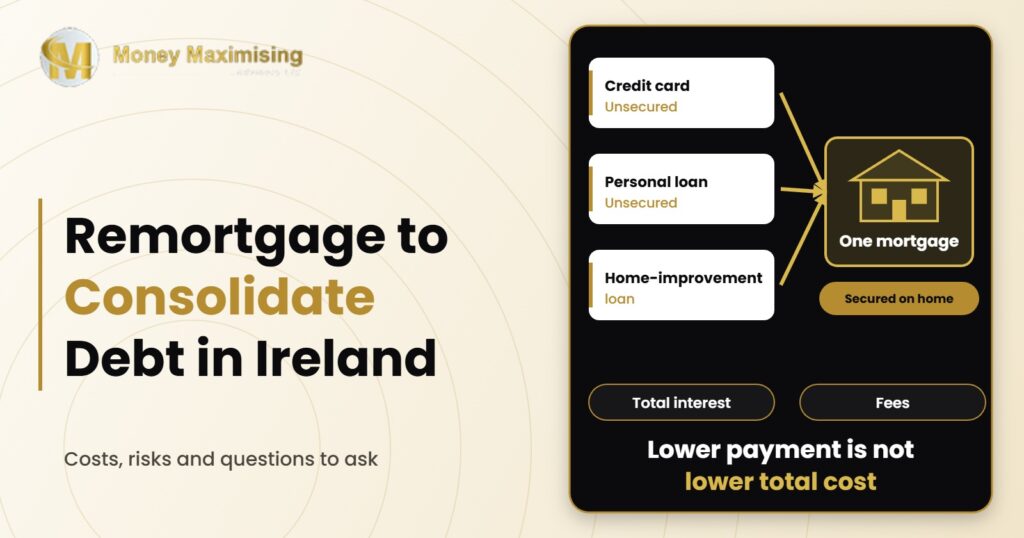
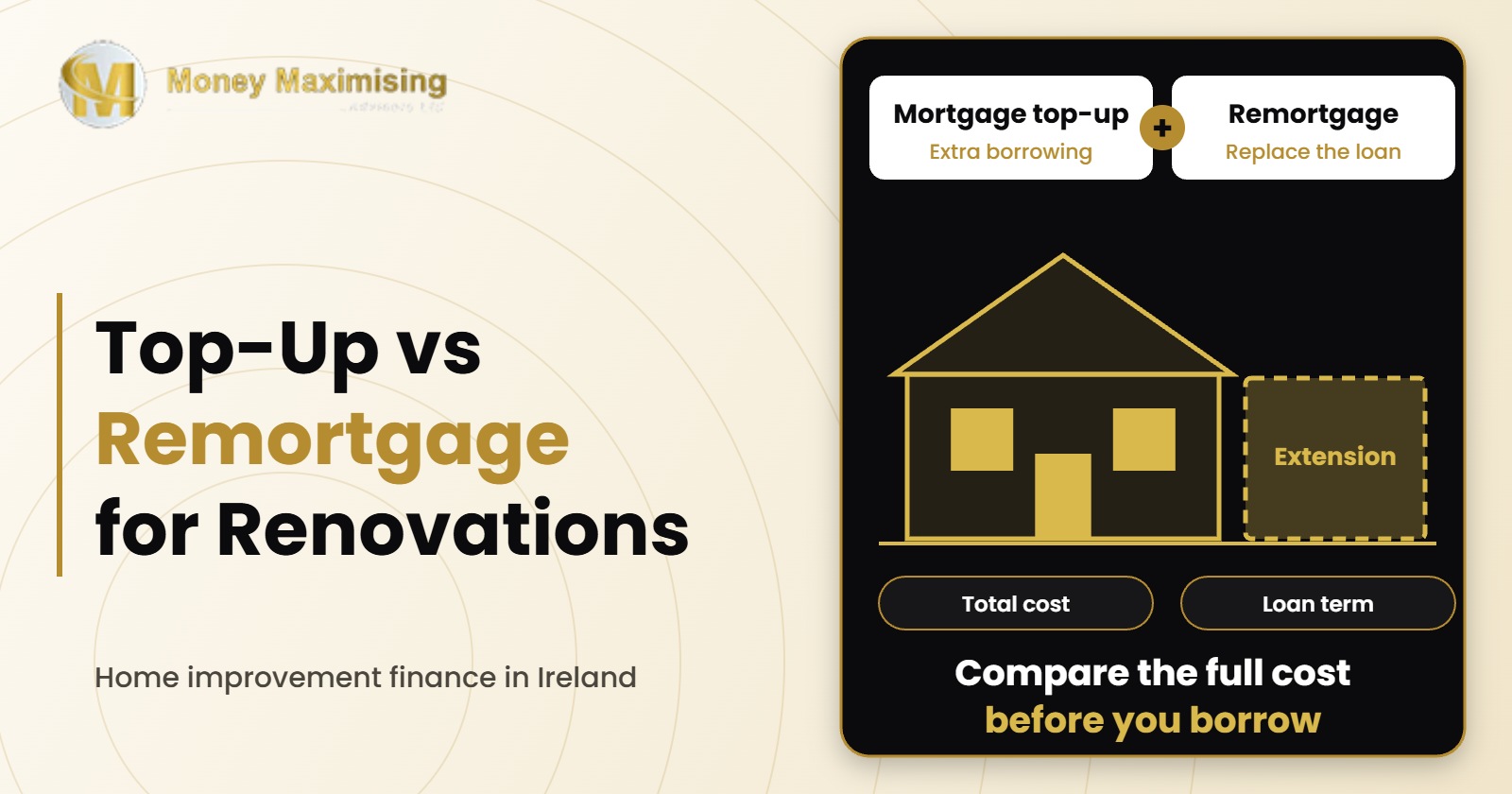
A mortgage top-up can look attractive when a renovation budget is larger than your savings. A remortgage can also release equity by replacing your existing mortgage with a larger loan. Both choices secure the extra borrowing against your home, so the lowest monthly repayment is not always the lowest overall cost.
This guide explains how a mortgage top-up, remortgage and personal loan differ in Ireland. It also shows the questions to ask before extending short-term building costs across a long mortgage term.
What is a mortgage top-up?
A mortgage top-up is additional borrowing from your existing mortgage lender. It uses the equity in your home as security. Your lender will still assess your income, credit history, property value and ability to repay.
The extra amount may sit in a separate loan account. It can have a different rate and term from your original mortgage. A top-up does not simply convert all of your property equity into cash. The lender decides how much it is willing to advance and what purposes it will accept.
The CCPC notes that a top-up can involve valuation, legal or administration costs. A breakage charge may also apply if changing a fixed-rate arrangement. These costs should be included in the comparison, not treated as an afterthought.
What does remortgaging to release equity mean?
A remortgage generally replaces your current mortgage with a new, larger mortgage. The new loan clears the old balance. The remaining approved amount is released for the agreed purpose, such as home improvements.
For example, assume a home is valued at €400,000 and the current mortgage is €180,000. A new mortgage of €240,000 would clear the €180,000 balance and leave €60,000 before fees and any other required deductions. This is only an illustration. Approval depends on affordability, valuation, credit history, age, term and lender policy.
The MMA equity release landing page states that standard remortgage options may be available for principal homes and residential buy-to-let properties. It also lists home improvements as an approved purpose. Product criteria and rates can change, so applicants should confirm the current position before relying on any headline figure.
How is a personal loan different?
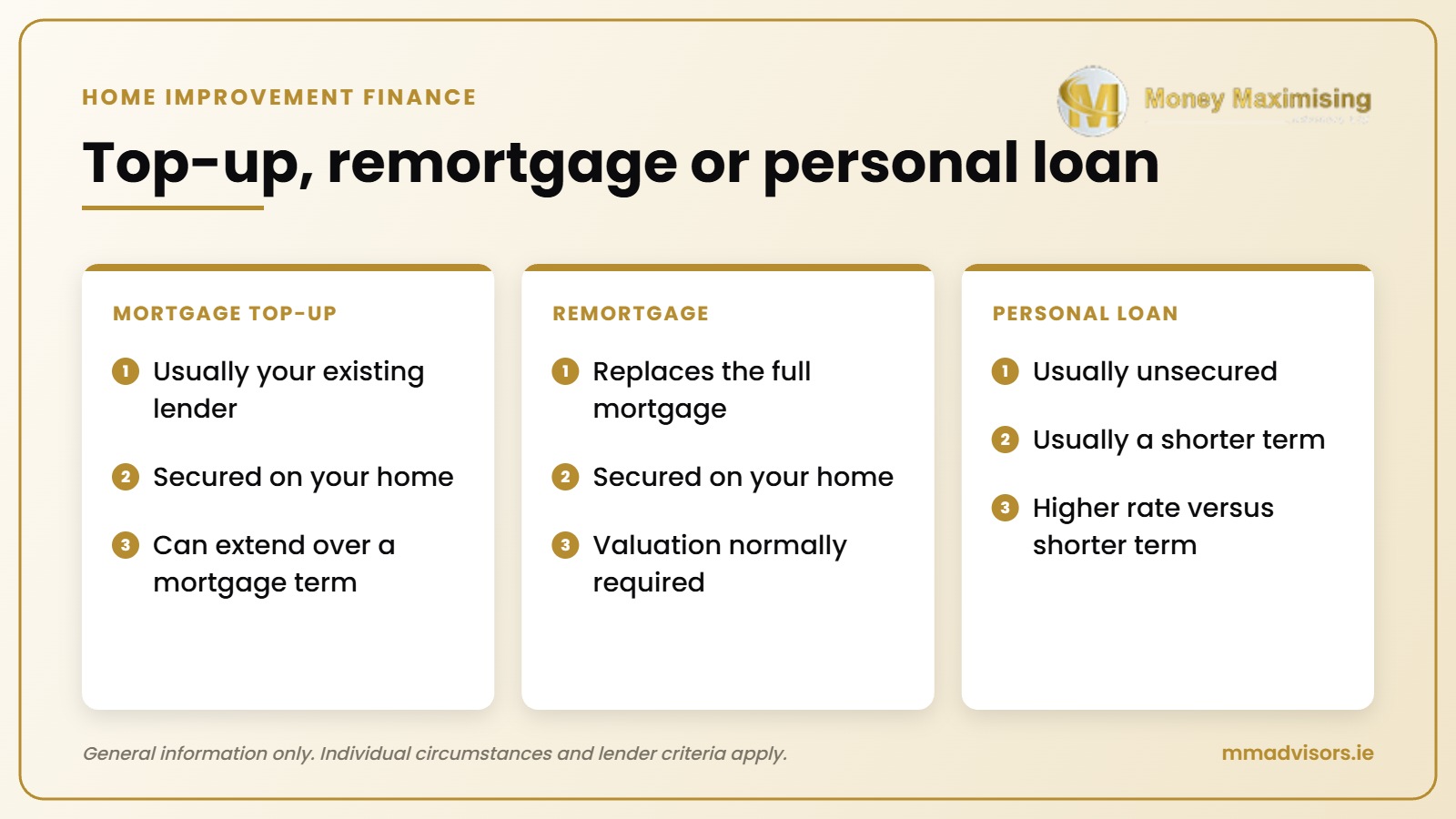
A personal loan is usually unsecured. Your home is not taken as security for that loan. The interest rate may be higher than a mortgage rate, but the term is normally shorter and the application may involve fewer property-related costs.
That shorter term matters. A lower mortgage rate applied over 20 years can cost more in total interest than a higher personal-loan rate over five years. Compare the total amount repayable, not just the rate or monthly payment.
Top-up, remortgage or personal loan: the practical comparison
| Question | Mortgage top-up | Remortgage with equity release | Personal loan |
|---|---|---|---|
| Who provides it? | Usually your existing mortgage lender | Your existing lender or a new lender | A bank, credit union or other lender |
| Security | Secured on your home | Secured on your home | Usually unsecured |
| Typical term | Can extend over a mortgage term | Can extend over a mortgage term | Usually shorter |
| Property valuation | May be required | Normally required | Usually not required |
| Legal work | May be limited or required | Usually required where security changes | Usually not required |
| Main comparison point | Cost of extra account and term | Cost of replacing the full mortgage | Higher rate versus shorter term |
Five calculations to make before choosing
1. Work out your usable equity
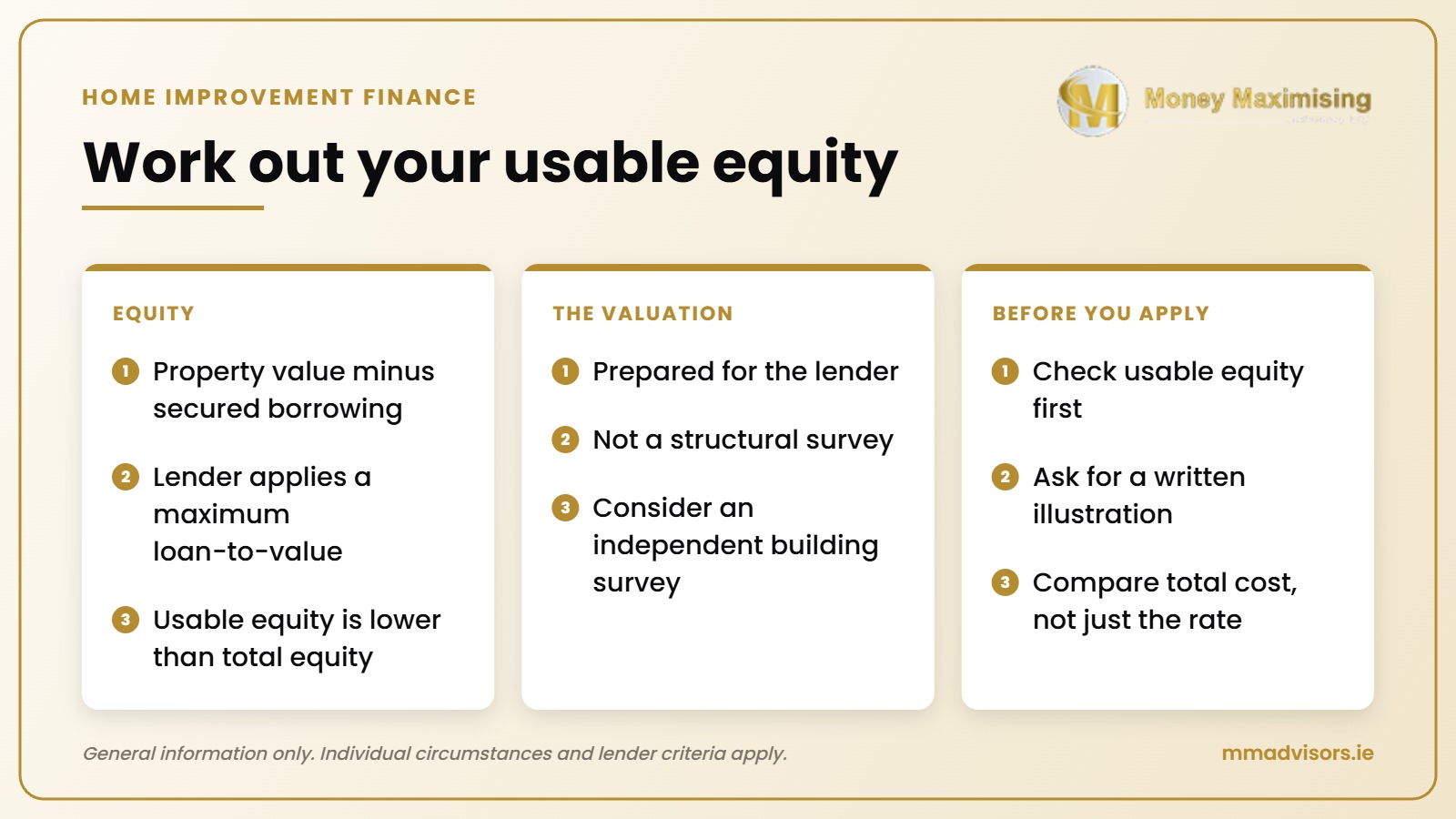
Equity is the property value minus secured borrowing. Usable equity is lower because a lender applies a maximum loan-to-value ratio and its own policy. A valuation for mortgage purposes is prepared for the lender. It is not the same as a structural survey.
2. Compare the full amount repayable
Request an illustration showing the repayment, term, rate, fees and total cost. Run the comparison over the same time period. If one option uses a longer term, also calculate the effect of voluntary overpayments where permitted.
3. Check the cost of disturbing your current mortgage
A competitive existing rate can be valuable. Replacing the whole balance at a higher rate may outweigh the benefit of a cheaper rate on the extra borrowing. A fixed-rate breakage charge, legal fees and valuation costs can change the result.
4. Match the loan term to the improvement
A long-lived extension is different from furniture or appliances that may need replacing within a few years. Avoid paying mortgage interest long after the item has reached the end of its useful life.
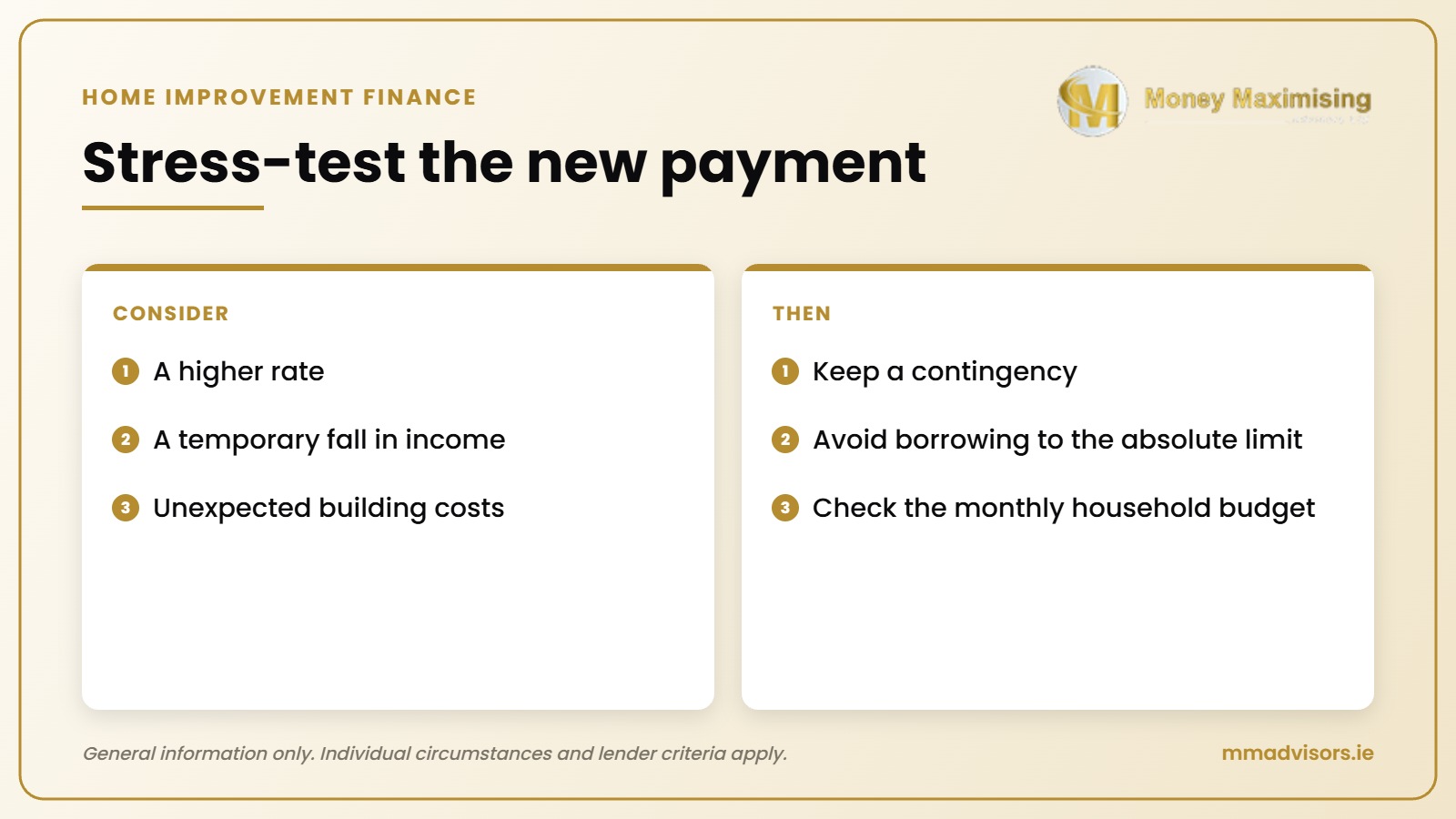
5. Stress-test the new payment
Consider a higher rate, a temporary fall in income and unexpected building costs. Keep a contingency rather than borrowing to the absolute limit. Lenders assess repayment capacity, but the household also needs a workable monthly budget.
What documents may a lender request?
- Proof of identity and address.
- Payslips, salary certificate and bank statements for PAYE applicants.
- Recent accounts and tax documentation for self-employed applicants.
- Details of loans, credit cards and other commitments.
- A property valuation from an approved valuer.
- Cost estimates, plans or planning permission for relevant structural work.
- Evidence of mortgage protection and home insurance where required.
How the application process usually unfolds
Set the budget and purpose
Start with a realistic schedule of works and a contingency. Separate structural work from finishes, furniture and appliances. Lenders can treat these categories differently, and short-lived items may not justify a long secured term.
Compare the existing lender and the wider market
Ask the current lender what a top-up would cost and whether the original mortgage remains unchanged. Then compare a remortgage using the same loan amount and repayment term. A fair comparison needs the full balance, not only the extra borrowing.
Prepare evidence before valuation
Gather income documents, bank statements, loan statements and building estimates early. Resolve unexplained account transactions before submitting an application. If planning permission or building control documentation applies, confirm what the lender needs and when it must be supplied.
Review the formal illustration
Check the rate type, monthly repayment, total amount repayable, fees and early repayment terms. Confirm whether funds are released in one payment or stages. A staged release may affect when interest begins and what certificates are needed.
Keep control of the building budget
Mortgage approval is not a guarantee that the project will stay on budget. Use a written contract, verify insurance and keep an emergency reserve. Avoid using every available euro of borrowing simply because the lender approves it.
A worked comparison without a promised outcome
Suppose a homeowner needs €60,000 for an extension. The household could ask its current lender about a top-up, compare a switch and larger remortgage, and price a shorter personal loan. The correct choice cannot be identified from the interest rate alone.
The homeowner should compare the total interest, fees and repayment term for each route. They should also check whether the current mortgage rate would be lost. The figures must come from current lender illustrations based on the actual application.
When might a mortgage top-up suit?
- You have sufficient equity and repayment capacity.
- Your existing lender offers suitable terms for the planned work.
- Keeping the existing mortgage avoids unnecessary switching costs.
- The borrowing term is sensible for the improvement being funded.
When might a remortgage deserve comparison?
- You want to compare a wider lender market.
- The existing mortgage and extra borrowing can be improved as one package.
- The savings exceed legal, valuation and early repayment costs.
- The new mortgage remains affordable under a realistic stress test.
When might neither be suitable?
Secured borrowing may not suit a small or short-lived expense. It may also be unsuitable where income is uncertain, the existing mortgage is already difficult to manage, or the proposed term creates a high total cost. If debt pressure is the underlying issue, free support from MABS can be more appropriate than taking on additional secured borrowing.
Questions to take into a mortgage meeting
- Will my existing mortgage rate and term remain unchanged?
- Is the extra borrowing a separate account, and can it have a shorter term?
- What valuation, legal, administration and early repayment costs apply?
- Can I make regular or lump-sum overpayments without charge?
- What evidence is needed for the works and how are funds released?
- What happens if the project costs more than expected?
- How does the proposal compare with an unsecured loan over a shorter term?
Frequently asked questions
Can I get a top-up while on a fixed rate?
It may be possible, but changing a fixed arrangement can involve a breakage charge. Ask the lender for a written figure before deciding.
Do I need planning permission?
That depends on the work. The landing page states that planning permission is needed where structural work requires it. Confirm the position with the local authority and lender.
Will a lender fund the whole renovation?
Not automatically. The amount depends on equity, affordability, property value, the purpose of funds and lender criteria.
Is a lower monthly payment always better?
No. A longer term can reduce the monthly payment while increasing total interest.
Does the bank valuation check the building condition?
A mortgage valuation is primarily for the lender. Consider an independent building survey where appropriate.
Discuss the numbers before choosing the structure
A useful comparison puts the existing mortgage, extra borrowing, fees, term and household budget on one page. Money Maximising Advisors can discuss current lender criteria and help you compare a top-up with a remortgage for home improvements.
Sources
Important information
WARNING: If you do not meet the repayments on your loan, your account will go into arrears. This may affect your credit rating, which may limit your ability to access credit in the future.
WARNING: You may have to pay charges if you pay off a fixed-rate loan early.
WARNING: This new loan may take longer to pay off than your previous loans. This means you may pay more than if you paid over a shorter term.
General information only. Individual circumstances, lender criteria and eligibility requirements apply. This content does not constitute financial, tax or legal advice.
Money Maximising Advisors Ltd is regulated by the Central Bank of Ireland. C154250.