Quick answer
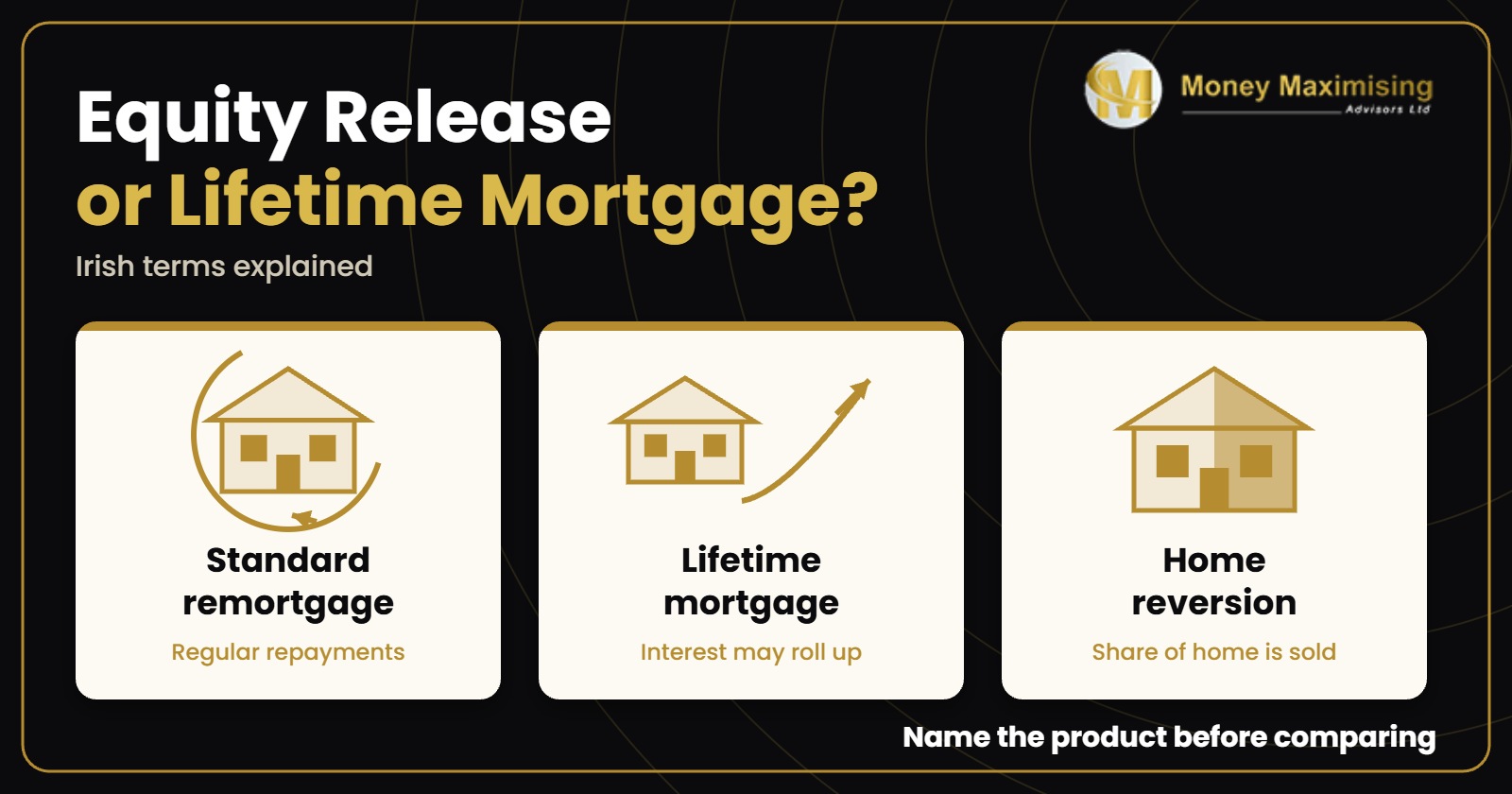
The phrase “equity release mortgage” is used for more than one type of borrowing in Ireland. It can describe a standard mortgage top-up or remortgage, where the borrower makes regular repayments. It can also describe a later-life lifetime mortgage, where interest may roll up and repayment is usually triggered by sale, death or permanent move.
Those products have different customers, costs and risks. Before comparing rates or eligibility, confirm which meaning is being used.
What the MMA product page describes
The MMA equity release landing page mainly describes a standard remortgage or top-up. A homeowner or property investor borrows more against a principal home or residential buy-to-let property. The borrower must show repayment ability, and the loan uses regular mortgage repayment structures.
The page lists purposes such as home improvements, education, debt consolidation, a family house deposit, separation costs and property investment. Each purpose and application remains subject to lender approval.
What the CCPC calls an equity release scheme
The CCPC uses “equity release” mainly for later-life products. Its two principal categories are lifetime mortgages and home reversion schemes. These are not the same as the standard remortgage described above.
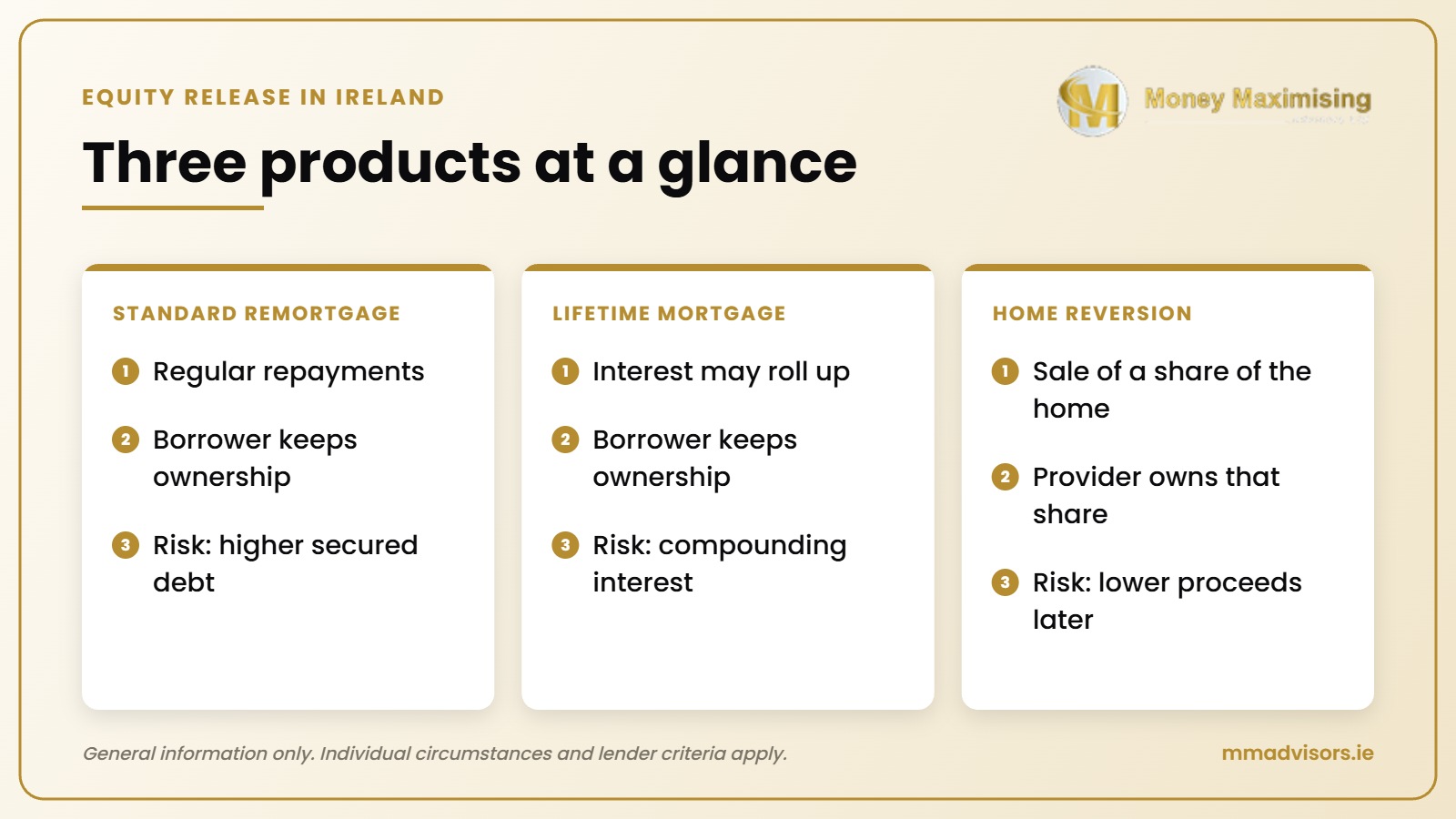
Three products at a glance
| Feature | Standard top-up or remortgage | Lifetime mortgage | Home reversion |
|---|---|---|---|
| Basic structure | Loan secured on property with regular repayment assessment | Loan secured on home, often with interest rolling up | Sale of a share of the home for cash |
| Ownership | Borrower keeps ownership | Borrower keeps ownership, lender holds a charge | Provider owns the purchased share |
| Repayment | Monthly capital and interest or approved interest-only terms | Usually from sale after a trigger event; terms vary | Provider receives its agreed share when the property is sold |
| Main assessment | Income, expenditure, credit, property and affordability | Age, property, product terms and advice requirements | Age, property value and scheme terms |
| Key risk | Higher secured debt and repayment burden | Compounding interest can reduce the estate | Selling a share below its future market value can reduce later proceeds |
Standard remortgage or top-up
This route is generally for borrowers who can support regular mortgage repayments. The amount available depends on property value, existing debt, income, expenditure, credit history and lender criteria.
A top-up increases borrowing with the existing lender. A remortgage normally replaces the current mortgage with a new loan, possibly from a new lender. Both can involve fees, and both place additional debt against the home.
Lifetime mortgage
A lifetime mortgage is a loan secured on a home. Interest may be added to the balance rather than paid monthly. Compounding means interest is charged on previous interest, so the balance can grow substantially over time.
Central Bank consumer protection rules require regulated firms to explain repayment terms, the interest rate, compounding, estimated repayment at maturity, early redemption costs, possible shortfall liability and other costs. Product-specific terms must be checked at the time of advice.
Home reversion agreement
Under a home reversion arrangement, the homeowner sells some or all of the property interest to a provider and receives money in return. The person can continue living in the property under the agreement, but no longer owns the share sold.
A home reversion agreement is a property transaction as well as a financial decision. Independent legal and financial advice is important. The Central Bank authorises and supervises retail credit firms and home reversion firms in the State.
How to identify which product a page means
- Does it require monthly repayments and an affordability assessment?
- Does interest roll up rather than being paid?
- Is the loan expected to be repaid after death, sale or permanent move?
- Does the homeowner keep 100% ownership?
- Is there a stated minimum age?
- What warning statements and legal advice requirements apply?
- Is the provider regulated and listed on the Central Bank register?
Why the distinction matters for searchers
Someone searching “equity release Ireland” may be a working homeowner planning an extension, an investor raising a deposit, or an older homeowner considering retirement income. Giving the wrong product explanation can lead to unsuitable assumptions about repayments, age, inheritance and ownership.
The first question should be the objective and repayment position, not the headline amount. A standard remortgage depends heavily on ongoing repayment capacity. A lifetime product raises different questions about compounding, future care, moving home and the estate.
Three short examples of the terminology
A working household funds an extension
The household has regular income and an existing mortgage. It compares a top-up with a larger remortgage and plans monthly repayments. This is standard secured borrowing, even if a provider uses the phrase “release equity”.
A landlord funds another deposit
The landlord refinances a rental property and uses approved funds towards another buy-to-let deposit. The existing property refinance and new purchase are both underwritten. This is investment mortgage lending, not a later-life lifetime loan.
An older homeowner wants cash without monthly repayments
The homeowner considers a lifetime mortgage where interest may be added to the balance. Advice must address compounding, moving home, long-term care, early repayment and estate impact. This has a different risk profile from a standard top-up.
Regulatory and advice safeguards
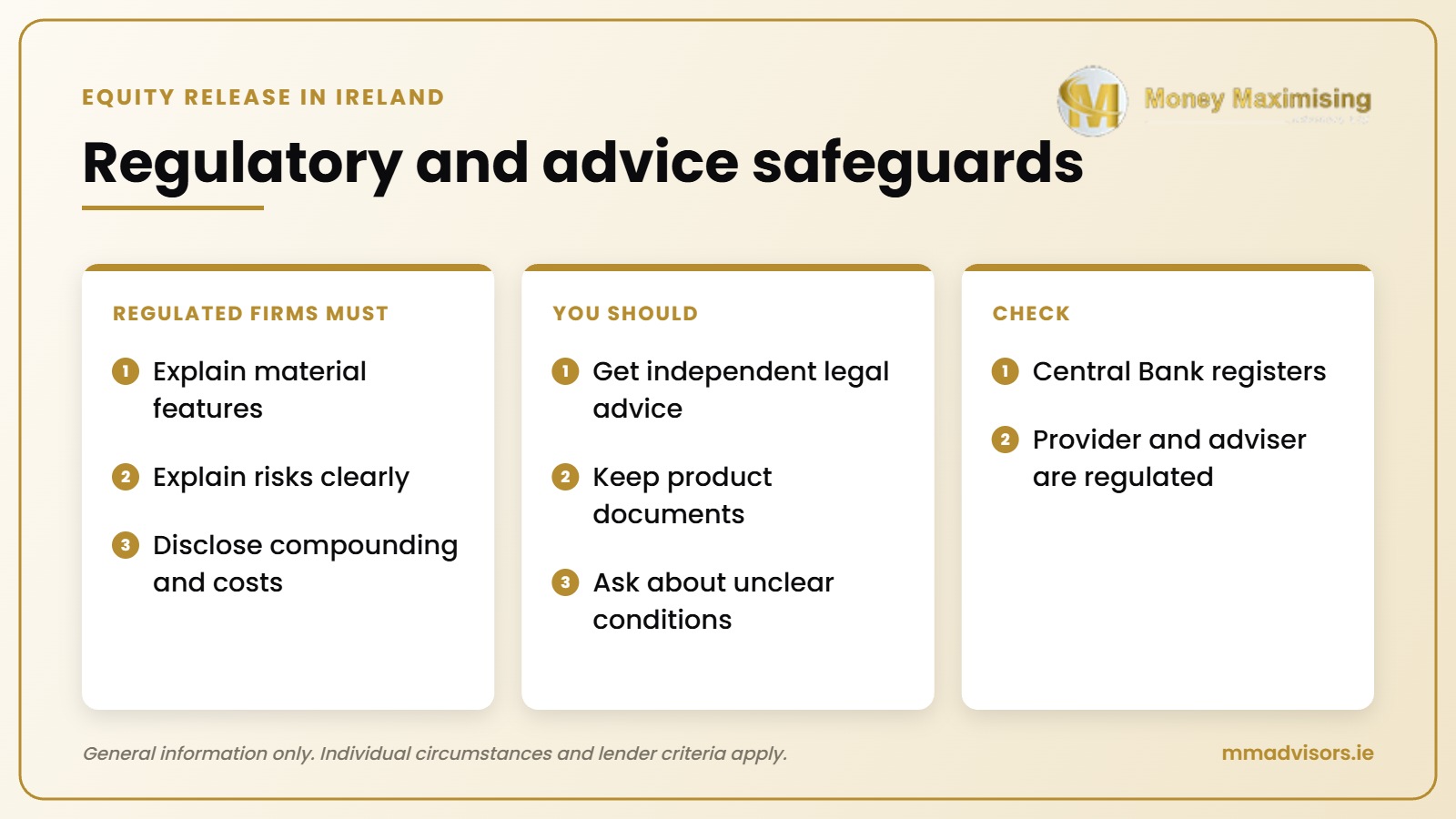
A regulated firm must explain material features and risks in a way the customer can understand. For lifetime mortgages, Central Bank rules require detailed information about repayment, interest, compounding, estimated maturity balance, early redemption costs and possible shortfall liability.
Independent legal advice is important where property security or ownership rights are changing. Customers should receive product documents on a durable medium, ask questions about any unclear condition and keep copies with their estate and financial records.
Regulation does not make every product suitable for every person. Suitability depends on objectives, repayment capacity, family position, alternatives and the long-term consequences of the chosen structure.
How costs behave differently
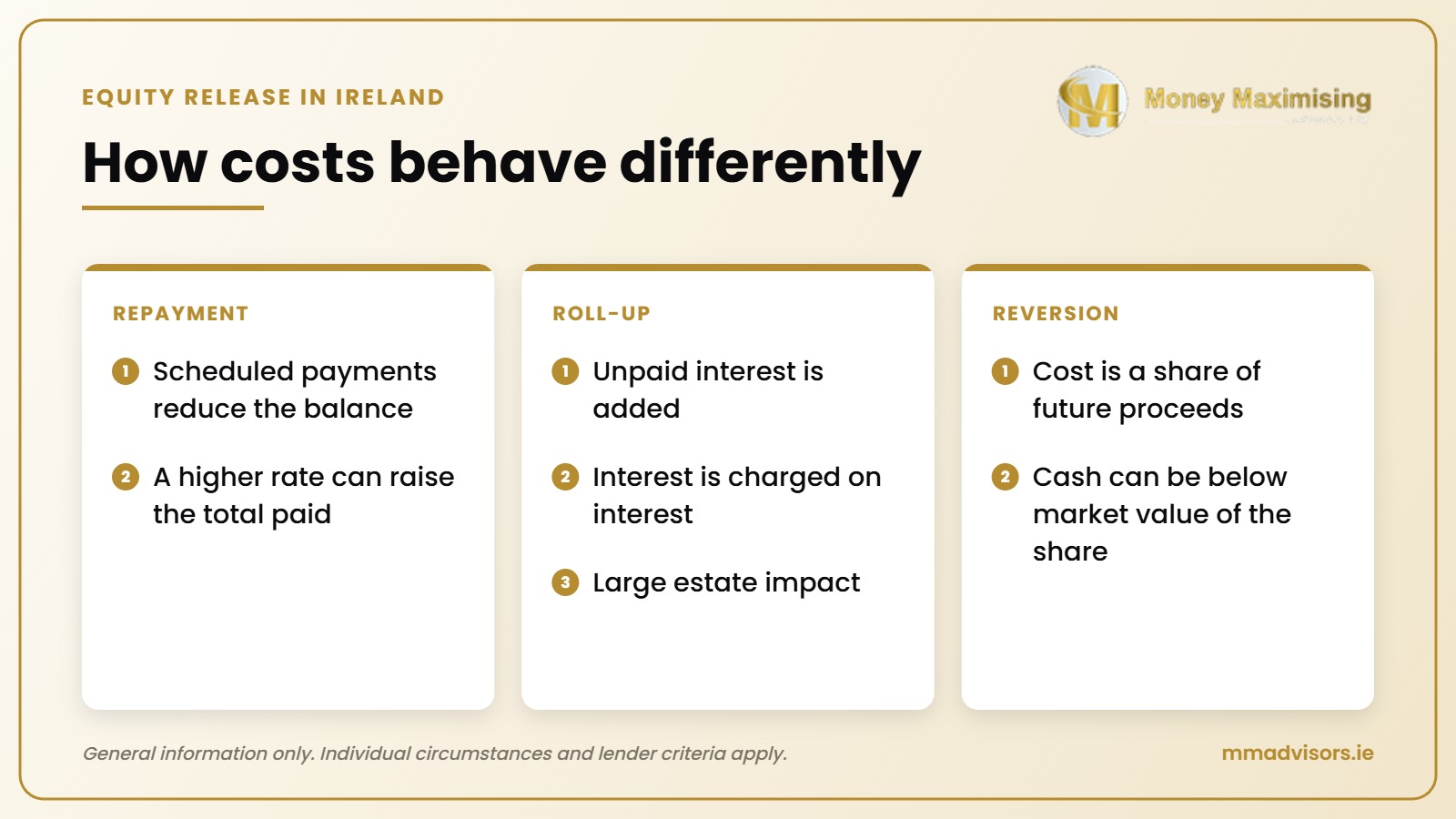
With a standard repayment mortgage, scheduled payments normally reduce interest and capital over the agreed term. The balance should fall if payments are maintained. A higher rate or longer term can still increase the total amount paid.
With a roll-up lifetime mortgage, unpaid interest is added to the balance. Future interest is then charged on that higher balance. The effect can become more pronounced over time, which is why a cash amount that appears modest at outset can have a large estate impact.
With home reversion, the cost is not expressed mainly as loan interest. The homeowner gives up a share of future sale proceeds in return for money now and the agreed right to remain. The amount received can be less than the current market value of the share because the provider may wait many years to realise it.
Family and future-housing considerations
A standard remortgage affects the household budget and future borrowing capacity. A lifetime mortgage or home reversion plan can also affect inheritance, the ability to move and the funds available for future care. Discuss these issues with relevant family members where appropriate, while keeping the customer’s own wishes central.
Ask what happens if a partner dies, a relative moves into the property, the home becomes unsuitable, or the owner wants to downsize. Product documents should explain the events that trigger repayment and any conditions for transferring the arrangement to another home.
Questions to ask before any equity release decision
- What exact product is being proposed?
- Will I make monthly repayments, and can they change?
- How will the balance develop over five, ten and fifteen years?
- What happens if I move, sell, die or enter long-term care?
- How could the arrangement affect my estate and beneficiaries?
- What fees, legal costs and early repayment charges apply?
- What alternatives were compared?
- Is the provider and adviser regulated for the relevant activity?
Alternatives worth comparing
- Using savings while retaining an emergency reserve.
- A shorter personal or home-improvement loan.
- A standard mortgage top-up or remortgage where affordable.
- Downsizing or selling another asset.
- Renting a room, subject to current tax and housing rules.
- Family support documented with legal and tax advice.
- For later life, reviewing pension income and care needs before borrowing.
Frequently asked questions
Is every equity release mortgage a lifetime mortgage?
No. In Ireland, the phrase can also describe a standard top-up or remortgage with regular repayments.
Do I keep ownership of my home?
With a standard mortgage or lifetime mortgage, the borrower generally remains the owner and the lender holds security. A home reversion plan involves selling a share.
Does equity release always have no monthly repayments?
No. Standard remortgages require repayment. Some lifetime structures roll up interest, while others may allow or require payments.
Can equity release reduce inheritance?
Any additional secured borrowing can reduce net property value. Compounding lifetime-mortgage interest can have a particularly significant long-term effect.
How do I check a provider?
Use the Central Bank of Ireland registers and obtain independent legal and financial advice appropriate to the product.
Start by naming the product correctly
MMA can help identify whether the enquiry concerns a standard mortgage top-up, a remortgage, a buy-to-let refinance or a later-life product. The advice and comparison should then match that exact structure and the borrower’s wider financial position.
Sources
Important information
WARNING: If you do not meet the repayments on your loan, your account will go into arrears. This may affect your credit rating, which may limit your ability to access credit in the future.
WARNING: You may have to pay charges if you pay off a fixed-rate loan early.
WARNING: This new loan may take longer to pay off than your previous loans. This means you may pay more than if you paid over a shorter term.
General information only. Individual circumstances, lender criteria and eligibility requirements apply. This content does not constitute financial, tax or legal advice.
Money Maximising Advisors Ltd is regulated by the Central Bank of Ireland. C154250.