Quick answer
A mortgage for teachers in Ireland follows the Central Bank rules: first time buyers can usually borrow up to 4 times gross income with a 10% deposit. Permanent and CID teachers have the simplest applications. Fixed term and substitute teachers can still be approved, but lenders look for a steady earnings history and supporting contracts.
Getting a mortgage for teachers in Ireland is usually more straightforward than for many private sector workers, because teaching pay is secure, follows a published salary scale and comes with a public sector pension. But contract type makes a big difference. Many teachers spend years on fixed term, part time or substitute contracts before getting a CID or permanent post, and that is exactly when they want to buy.
This guide explains how much a teacher can borrow, what each contract type means to a lender and how to prepare a stronger application. For a plan that links your mortgage to your pension, savings and retirement date, see our financial plan for teachers.
How much can a teacher borrow in Ireland?
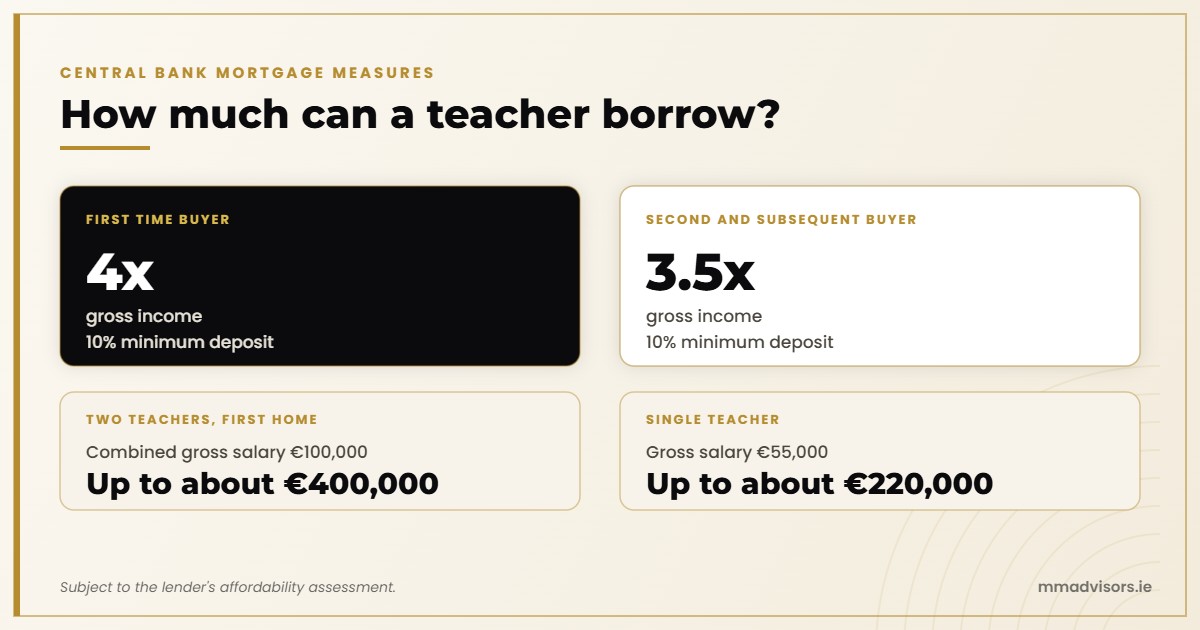
Every lender must follow the Central Bank of Ireland’s mortgage measures.
| Buyer type | Maximum loan to income | Minimum deposit |
|---|---|---|
| First time buyer | 4 times gross income | 10% |
| Second and subsequent buyer | 3.5 times gross income | 10% |
Lenders can grant a limited number of exceptions each year above these limits, but they are not guaranteed and are usually reserved for the strongest applications.
Example: two teachers buying their first home with a combined gross salary of €100,000 could borrow up to about €400,000 under the standard rule, subject to the lender’s affordability assessment. A single teacher earning €55,000 could borrow up to about €220,000.
Lenders also stress test repayments against your net income, existing loans and childcare costs, so the maximum on paper is not always what you will be offered.
How lenders view each teaching contract
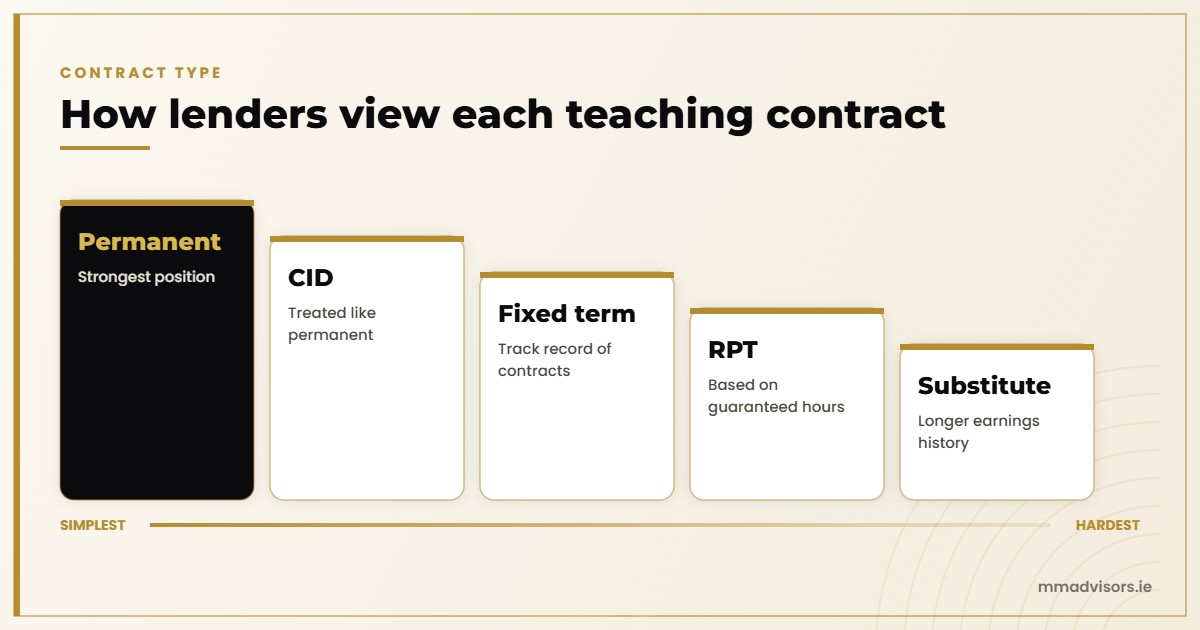
| Contract | How lenders usually see it |
|---|---|
| Permanent | Strongest position. Standard documents are normally enough. |
| CID (contract of indefinite duration) | Treated very similarly to permanent by most lenders. |
| Fixed term | Often accepted with a track record of continuous contracts, usually one to two years. |
| Regular part time (RPT) | Lenders assess the guaranteed hours, so borrowing is based on part time pay. |
| Substitute | Hardest case. Lenders want a longer earnings history and evidence that work is regular. |
Can a fixed term teacher get a mortgage?
Yes, many do. Lenders want to see that your contracts have run back to back, ideally in the same school or ETB, and that your income has been stable. A letter from your principal confirming your contract and the likelihood of renewal can help. If you are close to qualifying for a CID, it may be worth waiting a few months for a stronger application.
Can a substitute teacher get a mortgage?
It is possible but harder. Expect lenders to ask for a longer history of payslips and bank statements, and to base borrowing on an average of past earnings rather than a full time salary. Some lenders are more flexible than others, which is where a broker adds most value.
Do lenders count salary scale increments and allowances?
Teachers move up the salary scale each year, so future pay is fairly predictable. Some lenders will take a confirmed upcoming increment into account; others will only use your current basic pay. Allowances for posts of responsibility are often accepted if they are permanent. Supervision and substitution payments and other irregular income are usually only partly counted, if at all.
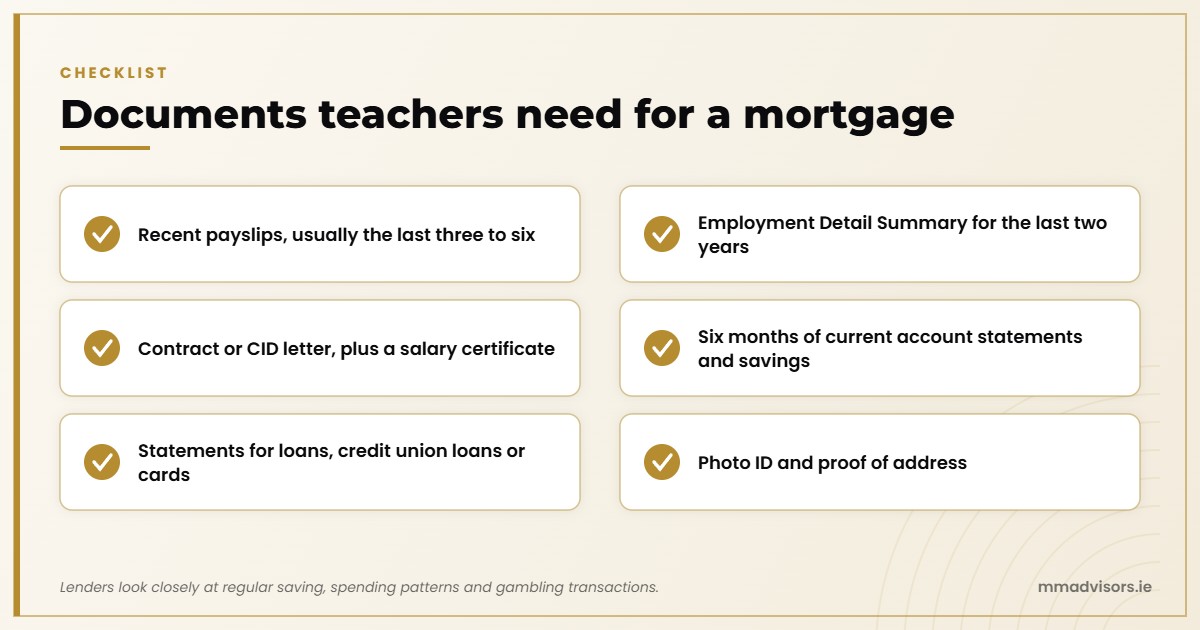
What documents do teachers need for a mortgage?
- Recent payslips, usually the last three to six
- Your Employment Detail Summary from Revenue for the last two years
- Contract of employment or CID letter, plus a salary certificate from your employer
- Six months of current account statements and evidence of savings
- Statements for any loans, credit union loans or credit cards
- Photo ID and proof of address
Lenders look closely at regular saving, spending patterns and gambling transactions in your bank statements. Our article on what you need to apply for a public sector mortgage covers the paperwork in more detail.
Can teachers use Help to Buy?
Teachers who are first time buyers can use the Help to Buy scheme on a newly built home or a self build. It refunds Income Tax and DIRT paid over the previous four years, up to €30,000 or 10% of the purchase price, whichever is lower. The property must cost no more than €500,000, and the scheme has been extended to the end of 2029. Check Revenue for the latest rules before relying on it.
Plan your mortgage term around your teaching pension
Many teachers take the longest term available to keep repayments low. That can be sensible early on, but check when the mortgage will end compared with your planned retirement date. A teacher in an older pension scheme may be able to retire at 55 or 60, while Single Scheme members have a pension age linked to the State Pension. Repayments running into retirement have to come from a smaller income. Our teachers pension in Ireland guide explains the retirement ages for each scheme.
Protect the mortgage once you have it
Most lenders require mortgage protection life cover before drawdown. It is also worth checking what would happen to repayments if you were off sick long term. Teachers’ paid sick leave is limited, and our guide to income protection for teachers explains where the gap appears. See also mortgage protection.
Already have a mortgage? Consider switching
Teachers who drew down a mortgage several years ago may be paying more than they need to. Switching lender can cut repayments, but check any fixed rate break fee and legal costs first. Our article comparing variable vs fixed rate mortgages for public sector workers can help you decide.
How MM Advisors helps teachers get a mortgage
Lenders differ on contract type, increments and allowances. When we help with a mortgage for teachers in Ireland, we:
- Assess borrowing capacity using each lender’s rules, your income, existing debt, deposit and household spending
- Check which income counts, since some lenders may consider documented salary scale increments, allowances or recurring additional teaching income, and others will not
- Organise your evidence, including payslips, salary scale details, contracts and bank statements, so a fixed term or substitute application is as strong as possible
- Compare available mortgage terms and test affordability if your income changes, for example if substitute work stops for a period
- Weigh switching costs, fixed rate break fees and the remaining term before recommending a switch
- Compare overpayments with AVCs and savings, because a planned early retirement can change the right repayment timetable
- Model your likely pension income before recommending a mortgage term that runs close to or into retirement
Our public sector mortgages and mortgage comparison advice services compare lenders on your behalf.
Example: a teacher with a mortgage and children.
A primary teacher in their forties, with a partner in the private sector, is paying a mortgage and saving for their children. They want to know whether AVCs or mortgage overpayments should come first. Their plan could project the teacher’s pension, review the partner’s workplace pension, compare the net cost of AVCs, set up accessible education savings and check family protection, with a cash flow forecast showing how each choice affects the household.
Illustrative example only, not a promise of eligibility, outcomes or tax savings. Advice depends on verified records and personal circumstances.
A mortgage is the biggest decision in most teachers’ financial lives. A financial plan for teachers shows how borrowing fits with your pension, AVCs, savings and retirement date before you commit. You can also read our wider financial advice for teachers in Ireland.
How the process works
- Understand: we discuss your teaching career, family finances and the decisions you want to make.
- Gather: we review your payslips, pension statements, service history, savings, debts and existing protection.
- Plan: we show practical forecasts, costs, assumptions and a clear action list.
- Implement: we arrange suitable products within our service scope and liaise with your pension administrator, accountant or solicitor when needed.
- Review: we revisit the plan when your income, career pattern, family situation or retirement date changes.
We explain any planning fees, product charges and commission before you proceed.
Financial planning for teachers
Book your teacher financial planning consultation
FAQs
How much can a teacher borrow for a mortgage in Ireland?
First time buyers can usually borrow up to 4 times gross income with a 10% deposit, and second time buyers up to 3.5 times. Lenders also assess affordability, existing debts and spending before confirming the final amount.
Can I get a mortgage on a fixed term teaching contract?
Yes, many lenders accept fixed term teachers with a record of continuous contracts, often one to two years. A letter from your principal and steady payslips strengthen the application. A CID or permanent contract makes approval easier.
Can a substitute teacher get a mortgage in Ireland?
It is possible but more difficult. Lenders usually want a longer earnings history and base borrowing on average past income rather than a full salary. Some lenders are more flexible, so comparing options through a broker helps.
Do mortgage lenders count teacher salary increments?
Some lenders consider a confirmed upcoming increment on the salary scale, while others use only current basic pay. Permanent allowances are often accepted, but irregular payments such as supervision and substitution are usually not fully counted.
Can teachers use the Help to Buy scheme?
Yes, if you are a first time buyer purchasing a new build or self build home costing €500,000 or less. You can claim back up to €30,000 or 10% of the price from tax paid over four years.
Sources
Money Maximising Advisors Ltd is regulated by the Central Bank of Ireland. C154250.