Every Irish mortgage applicant faces the same choice. Fix your rate, or ride the variable market? For public sector workers, the answer depends on specific things about your job and life stage. This guide from Money Maximising Advisors walks you through when each rate type wins.
| QUICK ANSWER: Fixed rate mortgages suit public sector workers who want payment certainty, are on tight monthly budgets, are starting a family, or expect rates to rise. Variable rates suit those planning to overpay from salary rises, expecting rates to fall, planning to move within 3–5 years, or coming out of a fixed term. The Central Bank rules and public sector employment advantages apply equally to both rate types. There is no single “best”, it depends on your specific situation. |
| Beyond rate choice, our team brokers Public Sector Mortgages, Mortgage Protection and Public Sector Salary Protection for public sector clients across Ireland. |
The core trade-off in one sentence
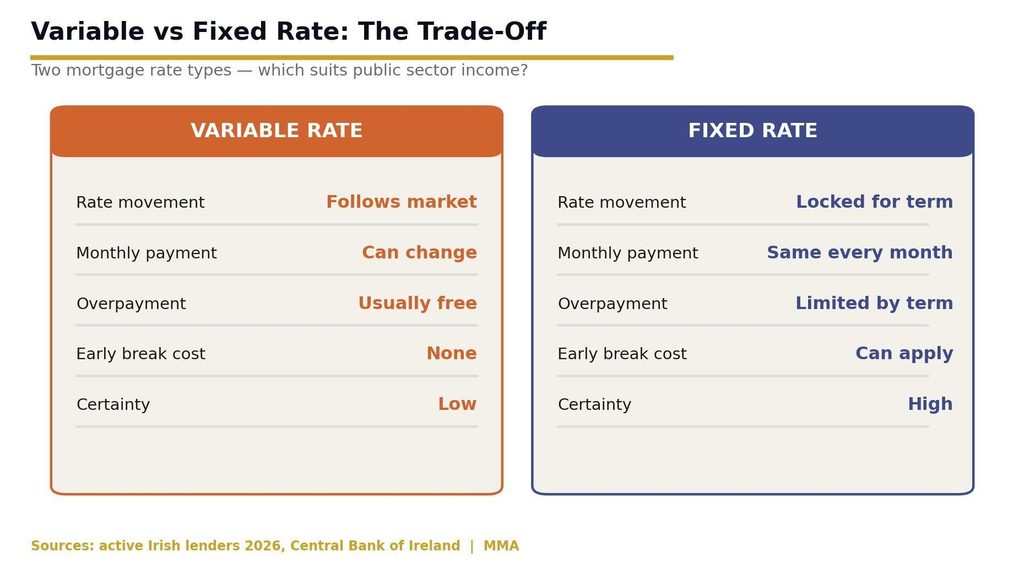
Fixed rates trade potential upside for certainty. Variable rates trade certainty for flexibility.
That’s it. Every argument about “which is best” reduces to that one line.
Your job as an applicant is to decide which of those two matters more for your specific situation.
How each rate type works
Fixed rate mortgages
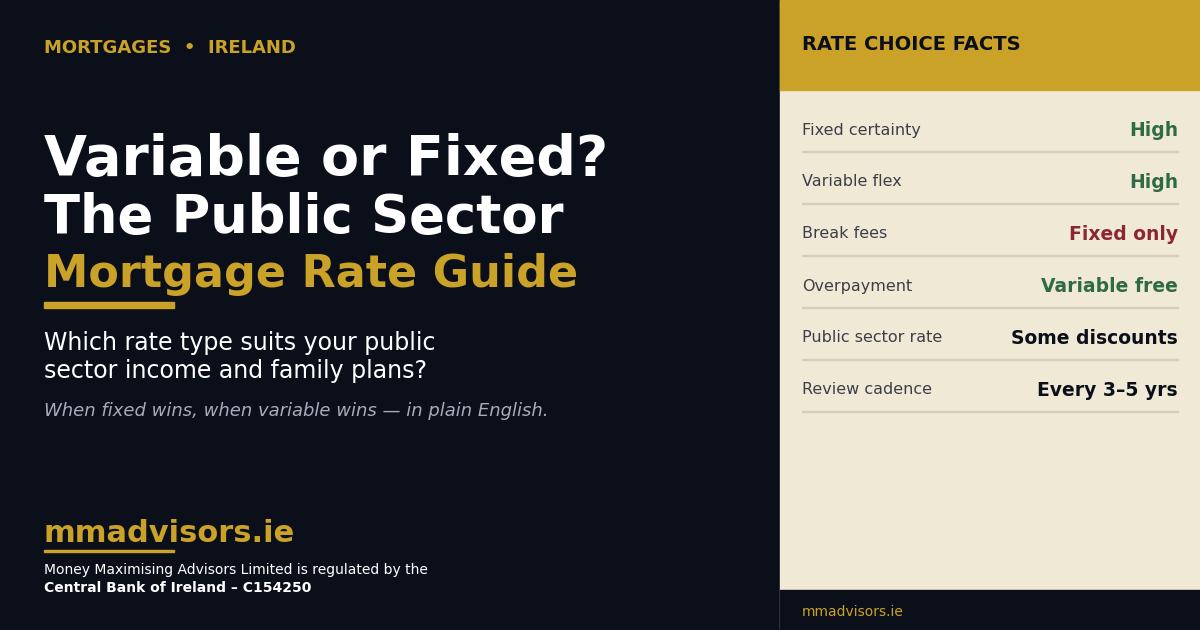
Your interest rate is locked for a set period. Usually 3, 5, 7, or 10 years.
Monthly payment stays the same for the whole fixed period. It cannot change.
The trade-off: you may pay a break fee if you exit the fixed rate early. Overpayments are usually limited.
Variable rate mortgages
Your interest rate can move up or down. It typically follows the lender’s cost of funds and ECB rate decisions.
Monthly payment changes when the rate changes. Sometimes up. Sometimes down.
The trade-off: no break fees. You can overpay freely. You can switch to a better rate any time.
When fixed wins for public sector applicants
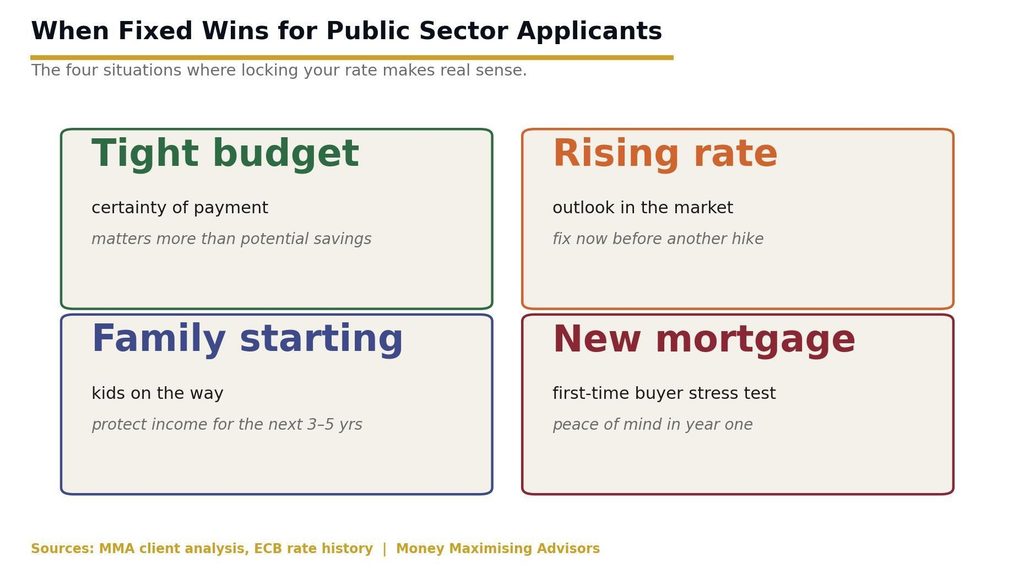
Win 1: Tight monthly budget
A public sector salary is predictable. So are your monthly costs, childcare, car, groceries, savings.
If your budget doesn’t have room for a rate rise, fix. Certainty of payment beats potential savings.
Win 2: Rising rate outlook
When the ECB is signalling further rate hikes, locking in today’s rate protects you from tomorrow’s.
You give up potential downside movement. But you cap your maximum monthly payment for the fixed period.
Win 3: Starting a family
Maternity leave. Paternity leave. Childcare costs. All hit the household budget at the same time.
Fixed rates protect you during the 3–5 years when your family costs are highest and least flexible.
Win 4: First-time buyer with a stress-tested budget
The Central Bank affordability stress test assumes 2% higher rates than today.
If your affordability is right at the stress test limit, fix. It removes the risk that the stress-tested rate actually happens.
When variable wins for public sector applicants
Win 1: Falling rate environment
When the ECB is signalling rate cuts, variable rates fall alongside them.
A fixed rate locks you in at yesterday’s higher level while variable rates ride down.
Win 2: Planning to overpay
Salary rises are known in advance in the public sector. Increments, promotions, allowance changes.
If you plan to funnel salary rises into mortgage overpayments, variable rates typically win. No break fees. No overpayment limits.
Win 3: Short-horizon plan
If you plan to move house within 3–5 years, avoid a long fixed rate.
Break fees on early exit from a fixed rate can run into thousands. Variable rates have no break fees.
Win 4: Switching soon
Coming out of a fixed term? Variable gives you time to shop the market properly.
You can stay on variable for 6–12 months while you compare every active Irish lender for the best next rate.
Ready to lock in your best rate?
Book a free 30-minute mortgage rate review, or send us your details and we'll be in touch.
Money Maximising Advisors Limited is regulated by the Central Bank of Ireland – C154250
What about split-rate mortgages?
Some public sector applicants split their mortgage. Part fixed. Part variable.
The fixed portion gives payment certainty. The variable portion gives flexibility for overpayment.
When a split makes sense
You have some monthly certainty needs (fixed portion covers your core payment). You also expect to overpay from bonuses or salary rises (variable portion soaks up the extra).
What to watch for
Not every Irish lender offers split rates. Availability varies year to year.
Fees on setup can be higher. Your broker will show you whether the split is genuinely better than one rate type in your specific case.
Break fees explained
If you exit a fixed rate early, by switching lender, selling, or paying off the mortgage, a break fee may apply.
The fee compensates the lender for the difference between your fixed rate and today’s market rate.
When break fees are small (or zero)
If interest rates today are higher than the rate you fixed at, the break fee is usually zero.
If your fixed term has less than a year to run, the fee is typically small.
When break fees are large
If interest rates have fallen significantly since you fixed, the break fee can be substantial.
Always request a written break fee quote from your lender before making the switch decision.
How rate choice affects total interest paid
A €300,000 mortgage over 25 years
At 4% fixed, total interest paid over 25 years is roughly €175,000.
At 4.5% fixed, total interest paid is roughly €200,000.
A 0.5% difference in rate = €25,000 over the life of the loan.
Why switching matters
Even a 0.20% saving by switching to a better rate is worth around €10,000 over 25 years.
Public sector switchers often save €2,000+ per year moving to a better rate. Multiply by remaining term.
Common rate-choice mistakes
- Fixing for the longest term available. A 10-year fixed sounds safe. But it also locks in break fees for 10 years. Match the term to your life horizon.
- Ignoring green rate discounts. A B3+ BER property unlocks additional 0.10–0.20% discounts on both fixed and variable rates.
- Not asking about public sector deals. Some Irish lenders offer specific public sector rate discounts. Not every lender does. Compare.
- Choosing based on the current rate alone. A slightly higher rate with better overpayment terms often wins over the life of the loan.
- Not reviewing at the end of fixed term. Rolling into the lender’s standard variable rate is almost always the most expensive option.
Frequently asked questions
Which is better for public sector workers: variable or fixed?
Neither is universally better, the right choice depends on your budget flexibility, life stage, and rate outlook. Fixed wins when you need payment certainty (young family, tight budget, rising rate environment). Variable wins when you value flexibility (plan to overpay, moving soon, expect rates to fall).
Do public sector workers get different rates on fixed vs variable?
Public sector rate discounts (typically 0.10–0.20%) can apply to both fixed and variable rates, depending on the lender. Some lenders offer public sector discounts on fixed rates only. Others offer them on both. Comparing across all active lenders is essential.
What are typical Irish mortgage rates in 2026?
Fixed rates typically range from 3.5% to 5% depending on term, LTV, BER and lender. Variable rates typically range from 4% to 5.5%. Public sector and green rate discounts of 0.10–0.20% can apply on top.
Can I switch from fixed to variable mid-term?
Yes, but a break fee may apply. The fee depends on the difference between your fixed rate and the current market rate. If current rates are equal to or higher than your fixed rate, the break fee is typically zero. Always request a written break fee quote before deciding.
Can I overpay a fixed rate mortgage in Ireland?
Most Irish lenders permit some overpayment on fixed rate mortgages, typically 10% of the balance per year. Above that, break fee rules can apply. Variable rate mortgages typically allow unlimited overpayment with no fees.
How often should I review my mortgage rate?
At minimum every 3 years, and always at the end of any fixed rate term. Public sector switchers routinely save €2,000+ per year by moving to a better rate. A free review takes 30 minutes and costs nothing.
Reviewed by our mortgage team
This guide was prepared and reviewed by the mortgage team at Money Maximising Advisors, drawing on Central Bank of Ireland rules, live lender rate cards, and daily public sector mortgage applications and switch reviews. MMA is regulated by the Central Bank of Ireland (C154250).
Ready to lock in your best rate?
Whether you’re a first-time buyer choosing between fixed and variable, or an existing public sector borrower deciding whether to switch, our team models both options against your specific situation.
Ready to lock in your best rate?
Book a free 30-minute mortgage rate review, or send us your details and we'll be in touch.
Money Maximising Advisors Limited is regulated by the Central Bank of Ireland – C154250
| Important information WARNING: Your home is at risk if you do not keep up payments on a mortgage or any other loan secured on it. WARNING: You may have to pay charges if you pay off a fixed-rate loan early. WARNING: If you do not meet the repayments on your loan, your account will go into arrears. This may affect your credit rating, which may limit your ability to access credit in the future. Rates, thresholds and lender criteria are those in force at time of writing and are subject to change. Rates, thresholds and rules referenced are correct at time of writing and are subject to change. Money Maximising Advisors Limited is regulated by the Central Bank of Ireland (C154250). This article is for general information only and does not constitute personalised financial, tax or legal advice. You should always speak to a Qualified Financial Advisor before making any decision. |