
Quick answer
The best financial advice for teachers in Ireland starts with knowing which pension scheme you are in, then claiming every tax relief you are owed, checking what your sick pay actually covers, building accessible savings and only then deciding on AVCs or overpaying your mortgage. Each step depends on your contract, service and family situation.
Good financial advice for teachers in Ireland looks different from generic money tips. Your pay follows a public sector salary scale, your pension is a defined benefit scheme set by legislation, and your sick pay, career breaks and job sharing options all follow Department of Education rules. Advice written for private sector workers, or for teachers in the US or UK, often gets these details wrong.
Below are ten money moves that make the biggest difference for primary and post primary teachers, whether you are newly qualified, mid career with a mortgage, or counting down to retirement. If you want them joined up into one plan, our financial plan for teachers brings your pension, AVCs, mortgage and protection together.
1. Find out exactly which teachers’ pension scheme you are in
Your pension is likely your biggest financial asset, and the rules depend on when you first entered pensionable public service.
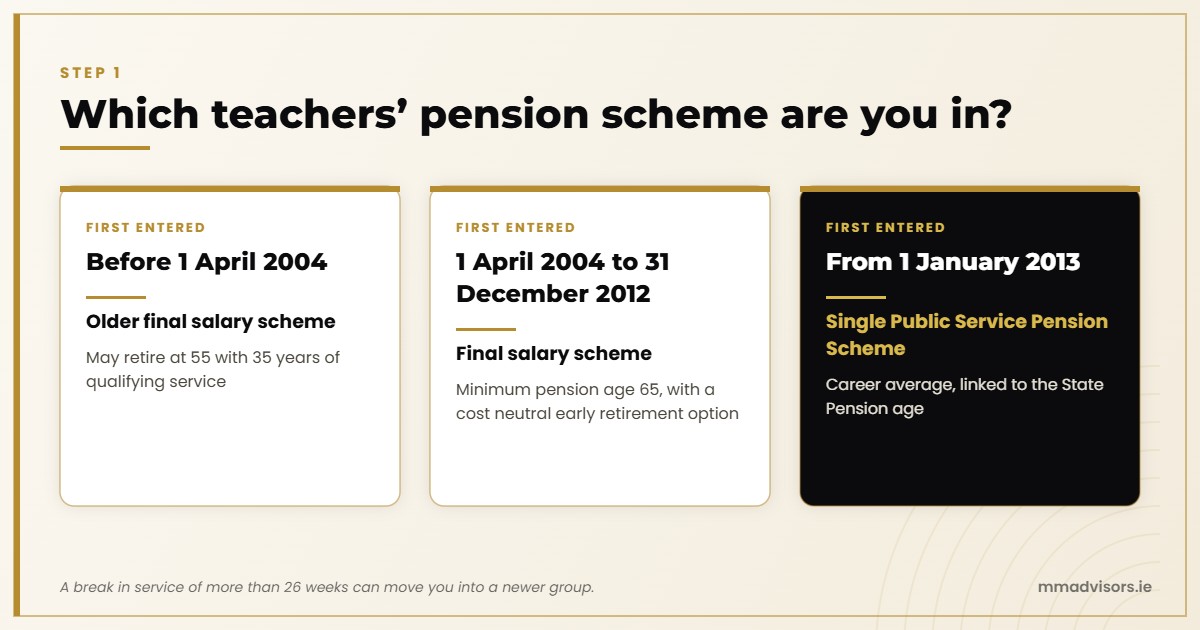
- Before 1 April 2004: older final salary scheme. Teachers in this group may be able to retire at 55 with 35 years of qualifying service.
- 1 April 2004 to 31 December 2012: final salary scheme with a minimum pension age of 65, plus a cost neutral early retirement option with reduced benefits.
- From 1 January 2013: the Single Public Service Pension Scheme, which is career average and linked to the State Pension age.
A break in service of more than 26 weeks can move you into a newer group, so do not assume your start date tells the whole story. Our guide to the teachers pension in Ireland explains each scheme in detail.
2. Read your annual benefit statement properly
Single Scheme members receive an annual benefit statement showing pension and lump sum built up to date. Teachers in older schemes can request a service history and pension estimate from the Department of Education or their ETB. Check for missing service, part time periods recorded incorrectly, and any probationary or substitute years that were never counted. Errors are far easier to fix ten years before retirement than ten weeks before.
3. Claim your flat rate expenses every year
Revenue publishes a flat rate expense allowance for teachers: €518 for teachers and €608 for principals in recent years. Since 2025, this must be claimed each year through myAccount rather than carrying forward automatically. You can also claim relief on your Teaching Council registration fee and go back up to four years for anything missed. Our guide to flat rate expenses for teachers shows how to claim.
4. Know what your sick pay really covers
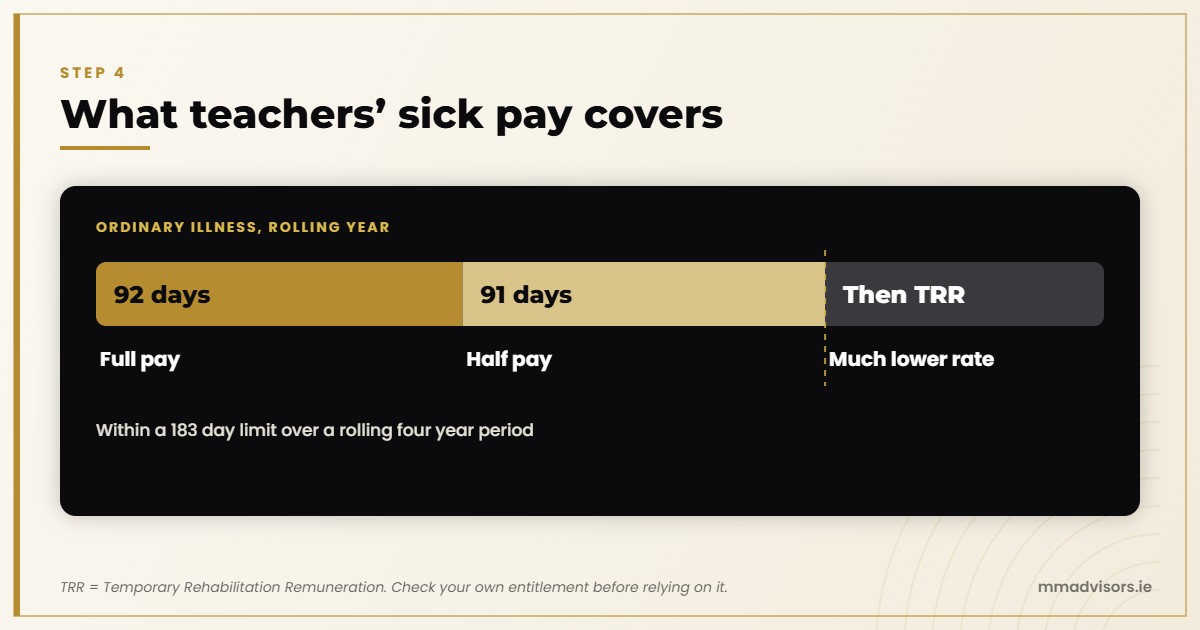
Teachers have generous sick leave compared with many private sector jobs, but it is not unlimited. For an ordinary illness, the scheme allows up to 92 days on full pay in a rolling year, followed by up to 91 days on half pay, within a 183 day limit over a rolling four year period. After that, Temporary Rehabilitation Remuneration (TRR) may apply at a much lower rate.
That gap is where long term illness can damage household finances, especially with a mortgage. Read our guide to income protection for teachers before you buy, cancel or replace any cover.
5. Build an emergency fund before investing
A common rule is three to six months of essential spending in an accessible account. Teachers on fixed term, substitute or part time contracts may want the higher end, since income can stop between contracts or over the summer. Keep this money separate from your everyday account so it does not quietly fund holidays. If you want help setting up a budget and savings structure, our money management advice service can help.
6. Clear expensive debt early
Credit cards, overdrafts and car finance at high interest rates usually cost more than any tax relief or investment return you could earn. List each debt with its balance and rate, and target the most expensive first. Teacher credit unions can be a lower cost option for borrowing, but compare the total cost rather than the monthly repayment.
7. Decide on AVCs with a clear reason
Additional Voluntary Contributions (AVCs) are one of the most tax efficient ways for a teacher to save for retirement. Contributions receive income tax relief at your marginal rate, within age related limits of 15% to 40% of earnings, capped at earnings of €115,000. AVCs are not automatically right for everyone, though. A teacher with full service in an older scheme may need them less than a Single Scheme member or someone who joined teaching later in life. Our guide to AVCs for teachers compares AVCs with buying back service, and you can read more about public sector AVCs.
8. Plan your mortgage around your teaching income
Lenders assess teachers on contract type, payslips and continuity of earnings. Permanent and CID teachers usually have the simplest applications, while fixed term or substitute teachers may need a longer earnings history. Think about the mortgage term too: a term that runs past your planned retirement date can squeeze your pension income later. Our guide to getting a mortgage for teachers in Ireland explains what lenders need for each contract type, and our public sector mortgages team works with teachers at every contract stage.
9. Plan for career breaks, job sharing and family leave
Career breaks, unpaid leave and job sharing can all reduce pensionable service or pension accrual. Before you apply, ask your employer or pension administrator how the leave will be treated and whether you can buy back the missing service. Then build a short budget for the period of lower income so savings and protection policies are not cancelled in a hurry.
10. Get advice from someone who knows public sector pensions
Teachers’ pensions, AVCs, notional service purchase and abatement after retirement are specialist areas. Look for a Central Bank of Ireland regulated adviser who explains their fees and commission up front and who will check your actual scheme records. Our public sector superannuation advice service is built for exactly this.
Financial advice for teachers at each career stage
| Career stage | Main priorities |
|---|---|
| Newly qualified | Confirm pension scheme, claim flat rate expenses, build an emergency fund, clear expensive debt |
| Mid career with family | Mortgage plan, family protection, education savings, start or review AVCs |
| Ten years from retirement | Verify service record, request pension estimates, increase AVCs within tax limits, plan mortgage payoff |
| Final years | Compare retirement dates, lump sum options, AVC access and abatement rules on returning to work |
Teachers approaching their final years should also read our retirement planning advice page.
How MM Advisors helps teachers turn this financial advice into a plan
Each of these ten steps affects the others. Paying more into AVCs changes your take home pay, which changes what you can borrow, which changes when you can afford to retire. Our financial plan for teachers brings your public service pension, AVCs, take home pay, savings, mortgage, insurance and retirement goals into one plan, and it includes your spouse or partner.
We work with permanent, CID, fixed term, substitute and part time teachers, as well as principals and assistant principals, and teachers with previous private sector or overseas pensions. We start from the circumstances you actually have, rather than assuming every teacher has the same pension or retirement age.
What your plan should give you
- An estimate of retirement income based on your actual pension scheme and service record
- An informed choice about AVCs, any available purchase of pension benefits and other savings
- A household budget that accounts for salary deductions, variable pay and planned time off
- A mortgage plan that considers qualifying teacher pay, increments and affordability
- A review of existing sick pay benefits, income protection and family cover
- A plan for children’s costs, investments and retirement dates for both partners
How the process works
- Understand: we discuss your teaching career, family finances and the decisions you want to make.
- Gather: we review your payslips, pension statements, service history, savings, debts and existing protection.
- Plan: we show practical forecasts, costs, assumptions and a clear action list.
- Implement: we arrange suitable products within our service scope and liaise with your pension administrator, accountant or solicitor when needed.
- Review: we revisit the plan when your income, career pattern, family situation or retirement date changes.
We explain any planning fees, product charges and commission before you proceed.
Financial planning for teachers
Book your teacher financial planning consultation
FAQs
Do teachers in Ireland need a financial adviser?
Not always, but teachers’ pensions have rules that general advice often misses, including scheme dates, notional service and abatement. A regulated adviser who checks your actual records can help you avoid costly mistakes with AVCs and retirement timing.
What is the best way for a teacher to save for retirement in Ireland?
For most teachers, the starting point is the occupational pension scheme itself. After that, AVCs often offer the most tax efficient extra savings, subject to age related limits. Accessible savings outside a pension also matter for earlier goals.
Can teachers in Ireland retire at 55?
Teachers who joined before April 2004 may retire at 55 with 35 years of qualifying service under the 55/35 arrangement. Later entrants can usually retire early only with reduced benefits. Always confirm eligibility with your pension administrator.
How much can a teacher claim in flat rate expenses?
Revenue has published €518 for teachers and €608 for principals in recent years. From 2025 the allowance must be claimed every year through myAccount, and missed years can usually be claimed back for up to four years.
Is income protection worth it for teachers?
It depends on your sick pay entitlement, existing union scheme cover and household commitments. Paid sick leave is limited, and TRR pays far less than full salary, so long illness can create a serious income gap for some teachers.
Sources
- Revenue: tax relief limits on pension contributions
- INTO: sick leave guidance
- ASTI: flat rate expense allowances notice (January 2025)
- singlepensionscheme.gov.ie: Single Scheme member information
Money Maximising Advisors Ltd is regulated by the Central Bank of Ireland. C154250.