Saving for a mortgage while paying rent feels impossible. Half your income goes on housing before you’ve saved a euro. And the dep,osit target keeps climbing.
It’s still possible. Thousands of Irish renters make the jump every year. This guide from Money Maximising Advisors shows you the numbers, the tax credits, the government schemes, and the step-by-step plan that actually works.
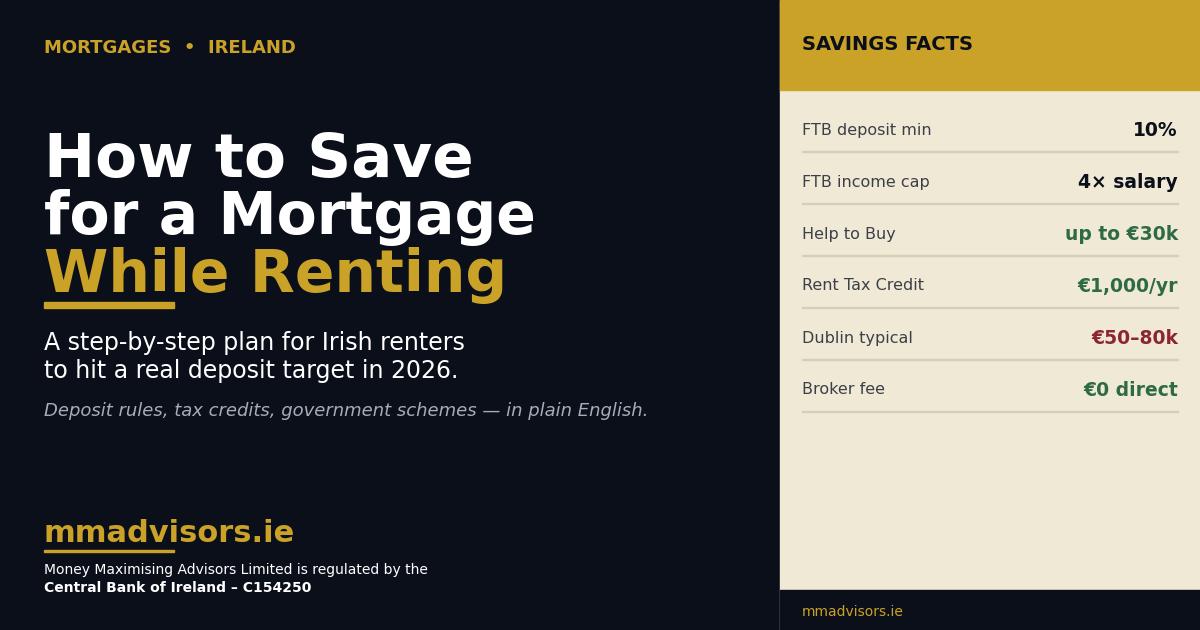
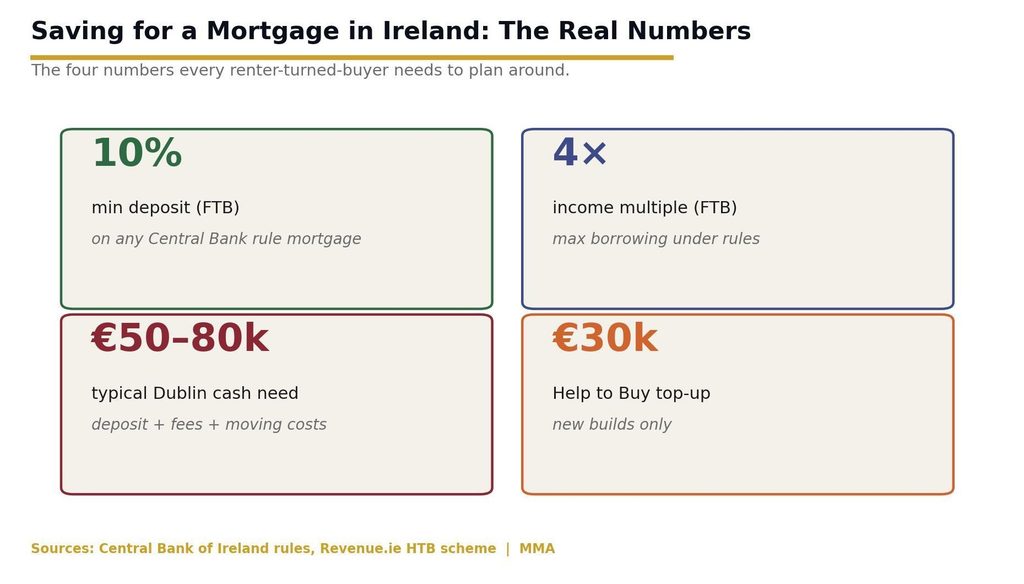
| QUICK ANSWER: You can save for a mortgage while renting in Ireland by combining five things: a fixed monthly savings amount transferred by standing order the day your salary lands; the Rent Tax Credit (up to €1,000 per year in 2026); tax-efficient savings vehicles like regular saver accounts and State Savings; the Help to Buy scheme (up to €30,000 back for first-time buyers of new builds); and the First Home Scheme (equity share of up to 30% on qualifying new builds). Central Bank rules require a 10% minimum deposit on any first-time buyer mortgage, with borrowing capped at 4× income. A realistic Dublin cash requirement is €50,000–€80,000 including fees. |
The Central Bank rules that shape your deposit target
Every Irish mortgage runs under the same Central Bank of Ireland rules. Understanding them tells you exactly what you need to save.
First-time buyer: 10% minimum deposit
You need at least 10% of the purchase price as a deposit. A €400,000 starter home requires a minimum €40,000 cash deposit.
Most first-time buyers save closer to 12–15%, the extra buffer covers fees and gives lender flexibility.
Mover: 20% minimum deposit
If you already own a home, the deposit required jumps to 20%. Same rule, different number.
Borrowing limits at 4× income
First-time buyers can borrow up to 4× combined income. Movers are capped at 3.5×.
Two people earning €45,000 each can borrow up to €360,000. That opens a very different market than a single applicant on €45,000 (who can borrow only €180,000).
What you actually need in cash
The 10% deposit is not the whole cash requirement. Add fees, stamp duty, and moving costs to get the real number.
Stamp duty
On a €400,000 home, stamp duty is 1% = €4,000. Rate rises above €1 million.
Legal fees
Typically €2,000–€3,000 for a straightforward FTB purchase in Ireland.
Valuation and structural survey
Around €500 combined. Both are near-mandatory before drawdown.
Moving costs
Anywhere from €500 for a small van and DIY, up to €3,000 for full-service removal from a family home.
Realistic total on a €400k Dublin home
Deposit €40,000 + stamp duty €4,000 + legals €2,500 + survey €500 + moving €1,500 = €48,500 minimum.
Most FTBs target €55,000–€70,000 to have a comfortable buffer plus first months of homeowner costs.
The 5-step renter’s savings plan
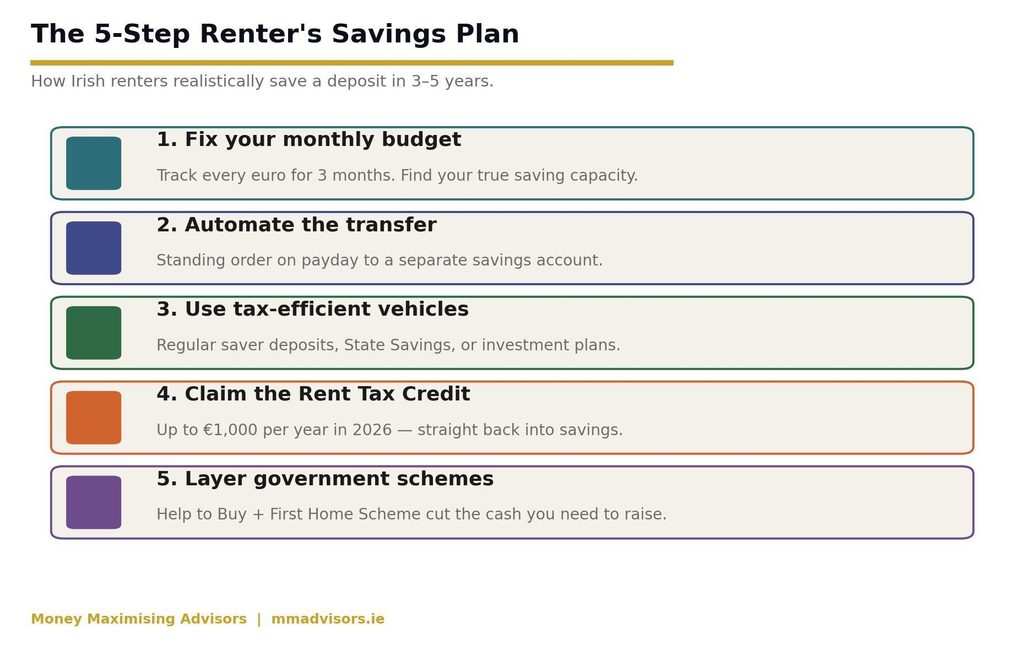
Step 1: Fix your monthly budget
Track every euro spent for three months. Bank apps make this simple now, Revolut, N26, and your Irish bank’s spending analytics all categorise transactions automatically.
The result almost always surprises people. There’s typically €300–€500 per month of “leakage” that isn’t intentional spending.
Cut half of that. Direct it into savings. This alone builds €10,000–€18,000 over 3 years.
Step 2: Automate the transfer
Set up a standing order for the day after payday. Move the savings amount to a separate account before you have a chance to spend it.
The account should be different from your everyday current account. Ideally a different bank. Friction beats willpower every time.
Step 3: Use tax-efficient vehicles
For the first 2–3 years of saving, a regular saver deposit account works well. You get a bonus rate for committing to a monthly amount.
For longer-horizon savings (4+ years), a Regular Saver Investment Plan can grow faster than a deposit account. The trade-off is investment risk, not appropriate for the last 12 months before purchase.
State Savings products (Prize Bonds, Savings Certificates, Instalment Savings) offer tax-free returns backed by the Irish government.
Step 4: Claim the Rent Tax Credit
The Rent Tax Credit gives Irish renters up to €1,000 per year (€2,000 for jointly assessed couples) directly off their tax bill.
Claim it through myAccount on Revenue.ie. Most renters can claim retrospectively for 2022, 2023, 2024, and 2025 if they haven’t already.
A couple who has never claimed could get €8,000+ back, straight into the deposit fund.
Step 5: Layer the government schemes
The Help to Buy (HTB) scheme gives first-time buyers up to €30,000 back on the purchase of a new build. It’s a tax refund based on your income tax paid over the previous 4 years.
The First Home Scheme (FHS) provides an equity share of up to 30% on qualifying new builds, reducing the mortgage you need to raise.
Both schemes stack with a standard mortgage. Combined, they can turn a €55,000 personal cash target into a €25,000 personal cash target for a new build.
How much you need to save each month
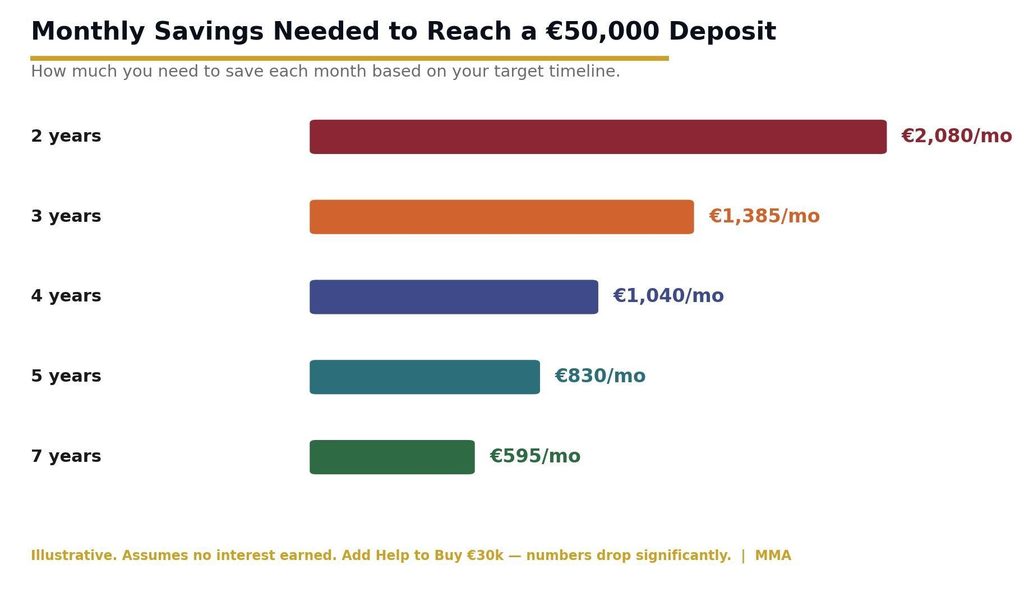
Assume a target of €50,000. Here’s what you need to put away each month, before any investment growth.
2-year target
€2,080 per month. Realistic only for higher-income households, dual-earner couples, or those with existing partial savings.
3-year target
€1,385 per month. Achievable for many dual-income couples in professional roles, especially outside Dublin.
4-year target
€1,040 per month. This is a realistic target for many young professionals in Ireland.
5-year target
€830 per month. Comfortable for most working couples.
7-year target
€595 per month. Achievable for single savers on average incomes.
Any monthly figure looks doable when spread over 5–7 years. That’s the point, start early, and the pressure drops.
Government schemes explained in detail
Help to Buy (HTB)
A tax refund of up to €30,000, or 10% of the property value (whichever is less), for first-time buyers of new builds.
You must have paid at least €30,000 in income tax over the previous 4 years for the full refund. You must be buying a new build under €500,000.
The refund goes directly toward your deposit. Your builder or developer processes the claim on your behalf.
First Home Scheme (FHS)
A shared equity scheme. The State takes an equity share of up to 30% of the property value on qualifying new builds.
You don’t pay it back until you sell (or you can buy it back over time).
FHS stacks with HTB and with a standard mortgage. Combined, they can dramatically reduce the personal cash required.
Local Authority Home Loan
For first-time buyers who cannot get a standard bank mortgage. Provided by local councils.
Income limits apply: single applicants must earn under €70,000, couples under €85,000 (higher in some cities).
Loan up to €360,000 depending on location. Fixed low rates.
Where renters commonly go wrong
- Waiting to “start properly” later. Every year of delay adds thousands to your monthly commitment. Start with €100/month if you must, anything is better than nothing.
- Not claiming the Rent Tax Credit. This is free money. Every year missed is €1,000–€2,000 lost permanently.
- Mixing savings and current account. Once savings are visible, they get spent. Separate account. Different bank. Standing order.
- Investing near-term deposit money. If you plan to buy within 12–18 months, keep the money in cash. A 15% market fall could delay purchase by a year.
- Ignoring Help to Buy eligibility. Many buyers assume they don’t qualify. Check with your builder or an advisor, the criteria are often easier than expected.
- Forgetting the fees. Stamp duty, legals, survey, and moving push the real cash requirement to 12–15% of purchase price, not the 10% headline deposit.
- Not getting mortgage-ready in advance. Bank statements should show clear savings pattern and no unusual activity for 6 months before applying.
Ready to build your deposit plan?
Book a free 30-minute mortgage consultation, or send us your details and we'll be in touch.
Money Maximising Advisors Limited is regulated by the Central Bank of Ireland – C154250
Six months before you apply
Lenders look closely at your bank statements. Six months of clean records makes an application much smoother.
What lenders want to see
Consistent savings pattern month-on-month. No unexplained large deposits. No gambling transactions or short-term loan activity.
Rent paid consistently, on time, from the same account each month. This proves you can handle mortgage-sized outgoings.
What to clean up
Cancel subscriptions you don’t use. Pay off small credit card balances. Avoid taking any new credit in the 6 months before applying.
If you’re using Buy Now Pay Later services, close them and pay off any balance.
Where MMA fits in
Money Maximising Advisors is a Central Bank regulated financial broker based in Galway. On the mortgage journey, we help renters at two stages:
First, our advice services are delivered directly. Money Management Advice helps you build a savings plan tailored to your income and target. Mortgage Comparison Advice prepares you for the eventual application.
Second, when you’re ready to apply, we’re a multi-agency broker for the mortgage itself. We compare every active Irish lender and help you access the best rate for your specific situation, including preferential terms not always visible when applying direct.
The result: an informed savings journey and a competitive mortgage at the end of it.
Frequently asked questions
How can I save for a mortgage while renting in Ireland?
Combine five approaches: fix a monthly savings amount automated by standing order, claim the Rent Tax Credit (up to €1,000/year or €2,000 for couples), use tax-efficient savings vehicles like regular saver accounts or State Savings, layer government schemes (Help to Buy up to €30k, First Home Scheme up to 30% equity), and get bank statements mortgage-ready 6 months before applying.
How much should I save each month for a mortgage in Ireland?
Depends on your deposit target and timeline. For a €50,000 target: €830/month over 5 years, €1,040/month over 4 years, or €1,385/month over 3 years. Government schemes (Help to Buy, FHS) can dramatically reduce the personal cash you need to raise for new builds.
How much deposit do I need for a first-time buyer mortgage in Ireland?
Central Bank rules require a minimum 10% deposit on any first-time buyer mortgage. On a €400,000 home that’s €40,000 minimum. Add stamp duty (1%), legal fees, valuation, and moving costs, realistic total cash required is typically 12–15% of purchase price.
Can I claim the Rent Tax Credit and save for a mortgage?
Yes. The Rent Tax Credit is a straight income tax reduction of up to €1,000 per year (or €2,000 for jointly assessed couples). Claim through Revenue’s myAccount portal. You can claim retrospectively for tax years 2022 onwards if you haven’t already.
What is the Help to Buy scheme?
Help to Buy is a tax refund of up to €30,000 (or 10% of property value, whichever is less) for first-time buyers of new builds under €500,000. You must have paid enough income tax in the previous 4 years to fund the refund. The money goes directly toward your deposit, processed by your builder.
Should I invest my mortgage deposit savings?
Only for money you won’t need within 4–5 years. Investment funds can grow faster than deposits over the long term but can also fall in value in the short term. For any money needed within 12–18 months, keep it in cash. A market dip just before you’re ready to buy can delay purchase by a year or more.
Reviewed by our mortgage team
This guide was prepared and reviewed by the mortgage team at Money Maximising Advisors, drawing on Central Bank of Ireland macroprudential rules, Revenue.ie tax credit guidance, and daily first-time buyer casework. MMA is regulated by the Central Bank of Ireland (C154250).
Ready to build your deposit plan?
Whether you’re 6 months into saving or just starting, our team maps a realistic timeline, checks your government scheme eligibility, and prepares you for the eventual mortgage application.
Ready to build your deposit plan?
Book a free 30-minute mortgage consultation, or send us your details and we'll be in touch.
Money Maximising Advisors Limited is regulated by the Central Bank of Ireland – C154250
| Important information WARNING: Your home is at risk if you do not keep up payments on a mortgage or any other loan secured on it. Rates, deposit rules, and scheme limits are those in force at time of writing (2026) and are subject to change. Rent Tax Credit rates and eligibility criteria are set by Revenue and can change with each Finance Act. Rates, thresholds and rules referenced are correct at time of writing and are subject to change. Money Maximising Advisors Limited is regulated by the Central Bank of Ireland (C154250). This article is for general information only and does not constitute personalised financial, tax or legal advice. You should always speak to a Qualified Financial Advisor before making any decision. |