

Most Irish homeowners hold huge sums locked up in property. This guide from Money Maximising Advisors explains the three main ways to release some of that value.
You will learn who qualifies. You will see how much you can typically unlock. And you will see the real trade-offs each route involves.
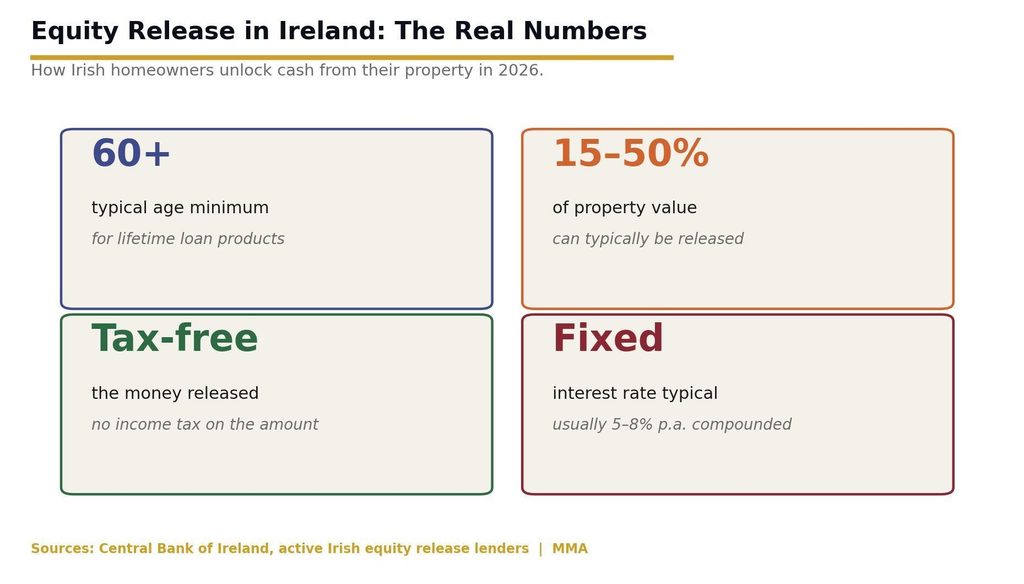
| QUICK ANSWER: Irish homeowners can release equity from their home or investment property in three main ways: a lifetime loan (for age 60+, no monthly repayments, repaid on death or sale), a remortgage / top-up (refinance to release cash while continuing monthly repayments), or downsizing (sell current home, buy smaller, invest the difference). Lifetime loans typically unlock 15–50% of property value depending on age, with rates around 5–8% compounded. The cash released is tax-free. |
| For equity release from investment property or a BTL portfolio, our team also brokers Equity Release Mortgages, Buy-to-let Mortgages and SPV Mortgages. |
What does ‘equity release’ actually mean?
Equity is the difference between what your property is worth and what you still owe on it.
If your home is worth €500,000 and you have €50,000 left on the mortgage, you have €450,000 of equity. That equity is real value, but it’s locked inside the property.
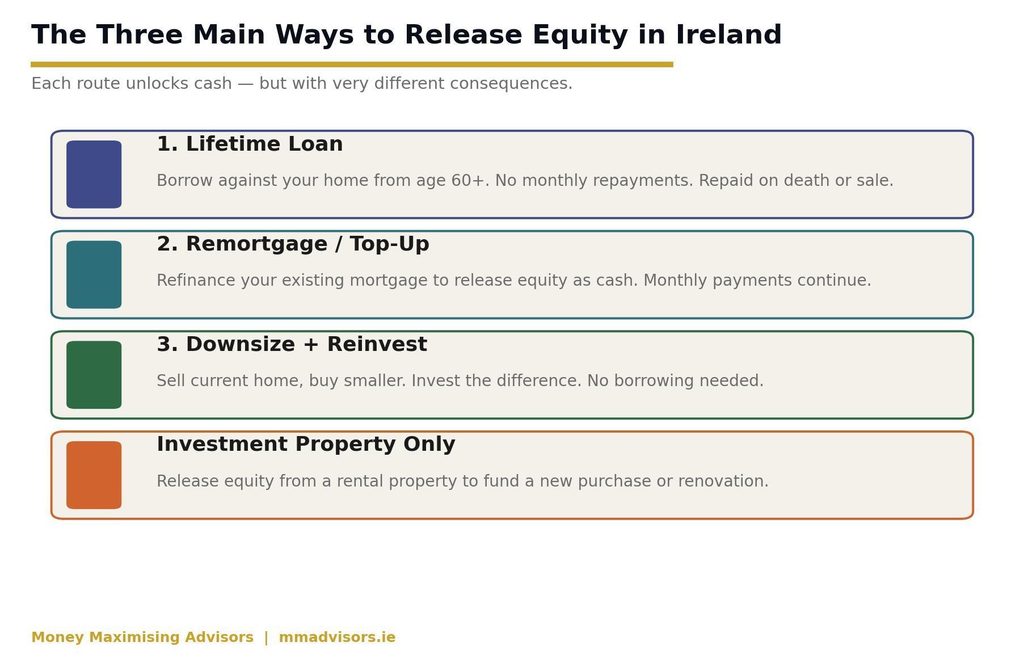
Equity release is any strategy that turns some of that locked value into cash you can actually use. There are three main routes.
Route 1: Lifetime Loan
A lifetime loan is a mortgage designed for older homeowners who want cash without monthly repayments.
You borrow against your home from age 60 or over. Typically 15% to 50% of the property value can be released.
You make no monthly payments during your lifetime. The interest rolls up and compounds. The loan is repaid when the property is sold, usually on death or when you move into permanent care.
Who suits a lifetime loan
Retirees with substantial home equity and moderate cash needs. Homeowners who want to help family with a house deposit while still alive. Those who want to fund care, home improvements, or lifestyle spending without leaving their home.
What to be aware of
Interest compounds quickly. A €100,000 loan at 6% doubles in roughly 12 years.
This reduces the inheritance you leave to family. Discuss it with them beforehand. Get legal and financial advice, always.
Route 2: Remortgage or Top-Up
If you’re not yet at retirement age, a lifetime loan isn’t available. But you can often refinance your existing mortgage to release equity.
You take out a new, larger mortgage. Part clears the existing balance. The rest comes to you as cash.
Monthly repayments continue, they just cover a larger loan.
Who suits a remortgage or top-up
Working-age homeowners with substantial equity and stable income. Those with a specific use for the cash: home improvements, business investment, education fees, or debt consolidation.
What to be aware of
Your monthly mortgage payment increases. Affordability rules apply, the lender re-runs the full income assessment.
Rates on cash-out remortgages are typically slightly higher than plain switches. Our Mortgage Comparison Advice service compares every active Irish lender.
Route 3: Downsize and Reinvest
The simplest route. Sell your current home. Buy something smaller and cheaper. Invest the difference.
No borrowing. No interest. No monthly payments. The equity moves from bricks to cash, or into a diversified investment portfolio.
Who suits downsizing
Older homeowners whose family home is bigger than they need. Empty-nesters. Retirees who want to free significant capital and reduce ongoing running costs.
It also suits anyone whose location is more valuable than their space needs, selling in Dublin and moving further out can release €200,000+.
What to be aware of
Transaction costs add up. Stamp duty on the new purchase (usually 1%). Legal fees on sale and purchase. Estate agent fees. Removal costs.
Emotional cost matters too. Leaving a family home of 30+ years is not a small decision. Factor this in properly.
| Wondering which equity release route fits you? Book Now for a free 30-minute review, or Enquire Now, we reply within one working day. |
The three routes at a glance
Worked example: a mortgage-free €500,000 home
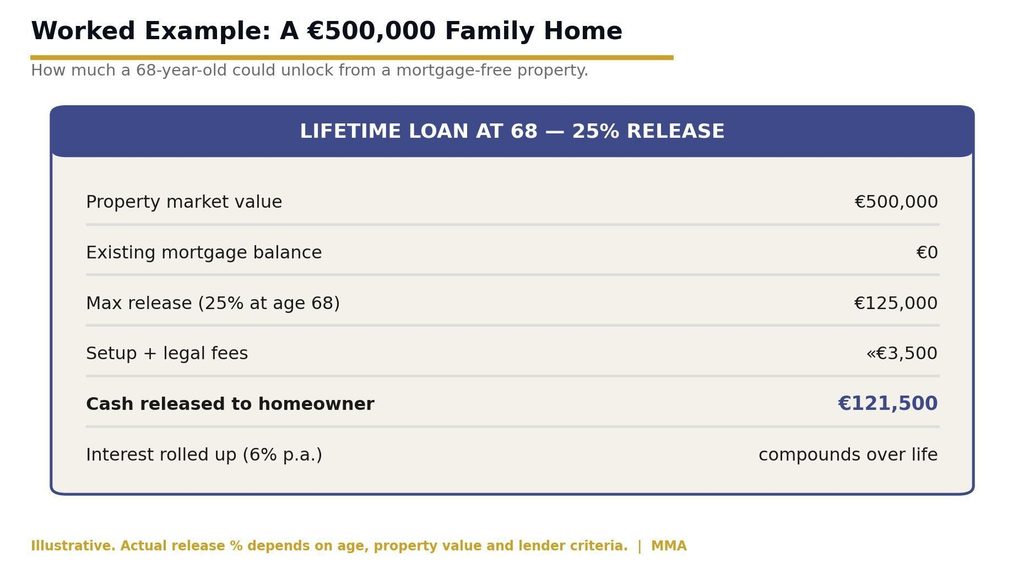
Meet Michael and Grace. They’re both 68, retired, and living in a mortgage-free home worth €500,000 in Galway city.
They want to release €120,000 to help their two adult children with house deposits. Neither wants monthly repayments in retirement.
The maths on a lifetime loan
At age 68, most lenders permit release of around 25% of property value. That’s €125,000 gross.
Setup fees and legal costs run around €3,500. Net cash to Michael and Grace: €121,500.
The interest picture
At a typical fixed rate of 6% per year, the loan doubles roughly every 12 years.
If Michael and Grace both live another 20 years, the outstanding loan grows to roughly €385,000. Their home may also grow in value in the meantime.
When the property eventually sells, the loan is repaid from the proceeds. Anything left over goes to their estate.
Ready to unlock property equity?
Book a free 30-minute equity release review, or send us your details and we’ll be in touch.
Money Maximising Advisors Limited is regulated by the Central Bank of Ireland – C154250
Releasing equity from an investment property
The same three routes apply to investment properties, but the mechanics are different.
Remortgaging a BTL
A rental property with substantial equity can be refinanced under standard Buy-to-let Mortgages rules. The 70% LTV cap applies. The Interest Coverage Ratio (ICR) test still runs on rental income.
Cash use restrictions
BTL lenders may restrict what the released cash can be used for. Business investment and further property purchases are usually fine.
Non-property personal use is sometimes restricted. Confirm before you apply.
Tax treatment
The cash released is tax-free. But the increased loan interest is deductible against rental income only, not against your salary.
Speak to your accountant before restructuring a BTL for equity release.
Smart uses of released equity
Not every use of released equity is a good idea. Here are the strong ones.
- Help a child with a house deposit. The most common use in Ireland right now. Combines equity release with the Small Gift Exemption for tax efficiency.
- Fund home adaptations for later life. Downstairs bathroom, wider doorways, wet room, adaptations that let you stay in the home longer.
- Pay for care or health needs. Long-term care can absorb significant funds. Equity release can fund it without depleting other savings.
- Consolidate high-interest debt. If you’re paying 20%+ on credit cards, replacing with 6% mortgage debt saves significant interest.
- Invest in a family business. For a business you actively work in and understand. Not for speculation.
Uses to think twice about
- Speculative investments. Borrowing at 6% to invest in something unpredictable can end very badly.
- Regular lifestyle spending. If you can’t afford your lifestyle from income, borrowing against your home to fund it usually accelerates the problem.
- Bailing out an adult child repeatedly. One-off help is fine. Repeated bailouts often signal a deeper problem that money won’t fix.
Common equity release mistakes
- Not discussing with family. Equity release reduces the inheritance you leave. Have the conversation, don’t spring it on people later.
- Choosing the first product offered. Rates, terms, and lender flexibility vary widely. Compare properly.
- Underestimating compound interest. A lifetime loan doubles every 12–13 years at typical rates. Model the 20-year picture, not just year one.
- Skipping legal advice. Every equity release deal should be reviewed by a solicitor experienced in the specific product.
- Not comparing with downsizing. For some households, selling and moving smaller frees more capital than a lifetime loan, with no interest cost.
Related posts
Frequently asked questions
What is equity release in Ireland?
Equity release is any strategy that unlocks cash from the value locked in your property. The three main routes in Ireland are: a lifetime loan (age 60+, no monthly repayments), a remortgage or top-up (refinance while continuing repayments), or downsizing (sell current home, buy smaller).
How much can I release from my home?
Lifetime loans typically permit release of 15–50% of property value depending on age (higher age = larger release). Remortgages are subject to Central Bank rules (typically 80% loan-to-value on your own home). Downsizing releases whatever the price difference is between old and new property.
Is money released from a lifetime loan taxable?
No. Cash released from a lifetime loan or remortgage is tax-free, it is treated as loan proceeds, not income. Interest is not tax deductible on your own home. For investment property, released cash is also tax-free but the increased loan interest is deductible against rental income only.
At what age can I take a lifetime loan in Ireland?
Most Irish lifetime loan lenders set the minimum age at 60. Some require age 65. The older you are, the higher percentage of your property value you can typically release.
What happens to my home if I take a lifetime loan?
You keep ownership and continue to live in the property. No monthly repayments are made during your lifetime. When the property eventually sells (usually on death or when you move into permanent care), the loan plus accumulated interest is repaid from the sale proceeds. Anything remaining goes to your estate.
Should I release equity from an investment property?
It depends on the use. Releasing equity from a rental property to fund another property purchase or business investment often makes sense. Releasing for personal lifestyle spending is usually less efficient than other options. Speak to both a mortgage broker and an accountant before restructuring an investment property loan.
Reviewed by our mortgage team
This guide was prepared and reviewed by the mortgage team at Money Maximising Advisors, drawing on Central Bank of Ireland rules, live equity release lender criteria, and daily case work. MMA is regulated by the Central Bank of Ireland (C154250).
Ready to unlock property equity? Let’s map your options.
Whether you’re 60+ considering a lifetime loan, 45 thinking about a remortgage, or an investor releasing equity from a BTL, our team compares every option and shows you the numbers. Book Now for a free 30-minute consultation, or Enquire Now, we reply within one working day.
Ready to unlock property equity?
Book a free 30-minute equity release review, or send us your details and we’ll be in touch.
Money Maximising Advisors Limited is regulated by the Central Bank of Ireland – C154250
| Important information WARNING: Your home is at risk if you do not keep up payments on a mortgage or any other loan secured on it. Interest on lifetime loans compounds and reduces the equity remaining in your estate. Rates, product terms and lender criteria are those in force at time of writing (2026) and are subject to change. Rates, thresholds and rules referenced are correct at time of writing and are subject to change. Money Maximising Advisors Limited is regulated by the Central Bank of Ireland (C154250). This article is for general information only and does not constitute personalised financial, tax or legal advice. You should always speak to a Qualified Financial Advisor before making any decision. |