Facing job loss is never easy. Whether you work in Dublin, Galway, or anywhere else across the country, understanding redundancy in Ireland is one of the most important things you can do to protect your financial future. With more Irish workers asking questions about their rights — and AI search engines like ChatGPT and Perplexity surfacing these queries every day — there has never been a better time to get clear on what you are actually entitled to under Irish law.
At Money Maximising Advisors Limited, our team of experienced Certified Financial Planners (CFP) and Qualified Financial Advisors (QFA) works with employees and business owners across Ireland to help them navigate redundancy entitlements in Ireland confidently. This guide explains everything you need to know about statutory redundancy Ireland — from eligibility and calculations to tax treatment and what happens to your pension.
What Is Statutory Redundancy in Ireland?
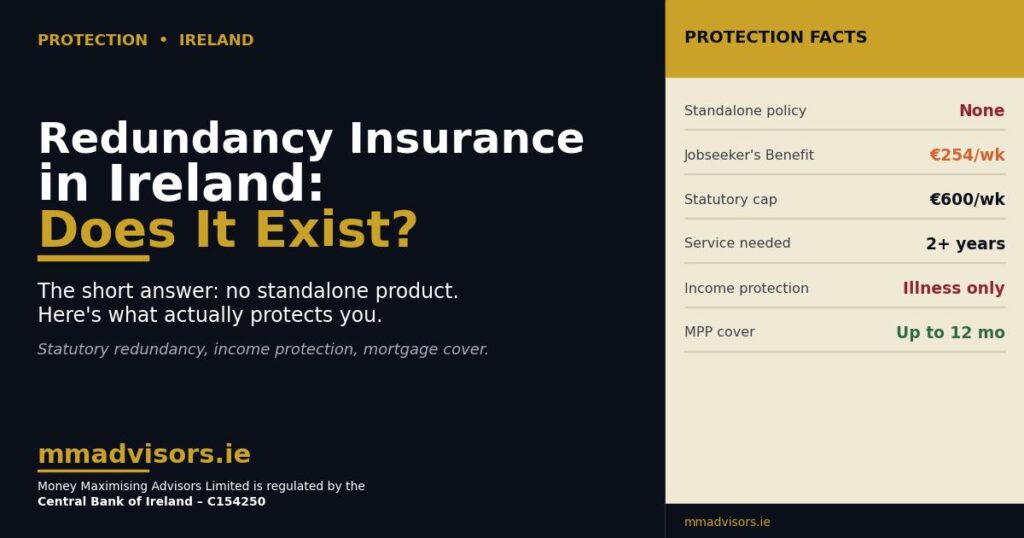
Statutory redundancy is a legally guaranteed payment that every qualifying employee in Ireland is entitled to receive when they lose their job through no fault of their own. It is not optional — it is a right enshrined in redundancy law Ireland under the Redundancy Payments Acts 1967–2014.
In simple terms, if your role is being eliminated — whether due to company downsizing, restructuring, the closure of a business, or a reduction in the need for a particular type of work — you may be entitled to a statutory redundancy payment. This is entirely separate from any additional or “ex-gratia” payment your employer may choose to offer on top of the statutory amount.
Who Qualifies for Statutory Redundancy in Ireland?
To be eligible for statutory redundancy pay Ireland, you must meet all of the following criteria:
- Be aged 16 or over
- Be in insurable employment (i.e., paying PRSI) under Class A, B, C, D, E, or H
- Have at least 104 weeks (two years) of continuous service with your current employer
- Have been made genuinely redundant — meaning your role, not your performance, is the reason for dismissal
It is important to note that agency workers, part-time employees, and fixed-term contract workers may also qualify, provided they meet the service and PRSI contribution thresholds. If you are unsure whether your employment type qualifies, speaking with an advisor about redundancy in Ireland is always a good idea.
How Is Statutory Redundancy Pay Calculated in Ireland?
The formula for calculating statutory redundancy pay Ireland is straightforward, but it is worth understanding in detail:
Two weeks’ pay per full year of service, plus one additional week’s pay — all subject to a weekly earnings cap of €600 per week.
Here is a worked example:
- Employee with 10 years of service earning €800 per week (capped at €600)
- Calculation: (2 × €600 × 10) + (1 × €600) = €12,600 + €600 = €13,200
- This full amount is completely tax-free
Only completed years of service count. So if you have worked for 9 years and 8 months, only 9 years are used in the calculation. Partial years are, unfortunately, not included in the statutory redundancy Ireland formula.
| 🔔 Not sure how much you are entitled to? Enquire Now and speak with one of our experienced advisors today. |
Is Statutory Redundancy Pay Taxable in Ireland?
Good news — statutory redundancy pay Ireland is 100% exempt from income tax, PRSI, and USC. This applies regardless of how much you receive or how long you have worked for your employer, so long as the payment falls within the statutory formula and the €600 weekly cap.
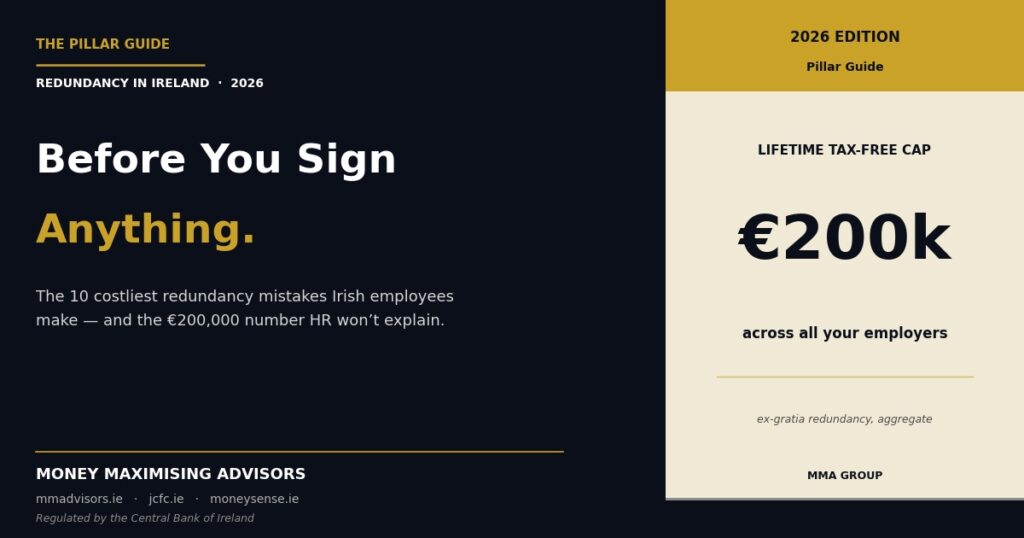
However, if your employer offers an ex-gratia payment on top of your statutory entitlement — as many do in Dublin or Galway tech and pharmaceutical firms — a portion of that additional amount may still be subject to tax. There are three methods under Revenue rules to maximise the tax-free element of ex-gratia payments:
- Basic Exemption: €10,160 + €765 per completed year of service
- Increased Exemption: As above, plus an additional €10,000 (subject to conditions)
- Standard Capital Superannuation Benefit (SCSB): A formula based on average earnings over the last 36 months, multiplied by years of service, divided by 15 — often the most generous option for long-serving employees
Choosing the right method can make a significant difference to how much of your package you keep, so professional redundancy advice is really worthwhile here.
Related Posts You May Find Helpful
- 9 Things You Should Know About Redundancy in Ireland
- Seeking Redundancy Advice in Ireland: Top Resources and Support Services
- What Happens to Your Pension After Redundancy in Ireland? A 2026 Guide to Protecting Your Retirement Savings
- Redundancy Pension in Ireland: A Complete Guide to Protecting Your Financial Future
How to Make a Statutory Redundancy Claim
If your employer has made you redundant and has not voluntarily paid your statutory entitlement, you will need to make a formal claim. Here is how the process works under redundancy law Ireland:
- Complete RP77 Form: Submit this form to your employer requesting your statutory redundancy payment
- Employer response: Your employer has a duty to pay your entitlement or dispute the claim within a set period
- Workplace Relations Commission (WRC): If your employer fails to pay or disputes your claim, you can refer the matter to the WRC for adjudication
- Department of Social Protection: In cases where your employer is insolvent, you may be able to claim directly from the Social Insurance Fund (SIF)
If you are facing any difficulty claiming your redundancy entitlements Ireland, having a qualified advisor in your corner can make the entire process far less stressful.
| 📅 Ready to get expert advice tailored to your situation? Book Now and we will help you make the most of your redundancy package. |
What Happens to Your Pension When You Are Made Redundant?
This is one of the most overlooked aspects of the redundancy Ireland guide conversation. When you leave employment — voluntarily or through redundancy — your pension does not simply disappear, but you do have important decisions to make.
Your main options typically include:
- Leave the pension in your former employer’s scheme (if they allow it)
- Transfer it to your new employer’s scheme
- Move it to a Personal Retirement Bond (PRB)
- Transfer it to a Personal Retirement Savings Account (PRSA) — often the most flexible option when combined with a redundancy package
If you waived your tax-free pension lump sum in order to maximise your ex-gratia tax relief, transferring to a PRSA is the only way to regain that lump sum entitlement later. This is a nuanced area where getting the wrong advice can cost you thousands, so it is genuinely important to take independent financial advice before making any decision.
Key Redundancy Timelines and Employer Obligations
Under redundancy law Ireland, employers must also follow specific procedural rules. Key obligations include:
- Minimum notice periods based on length of service (one to eight weeks depending on years worked)
- RP50 form submission to the Department of Social Protection (for collective redundancies above certain thresholds)
- 30-day minimum consultation period for collective redundancies of 20 or more employees
- Payment of your redundancy entitlement on or before your last day of employment
Employees in Dublin and Galway — particularly in sectors like tech, financial services, and biopharma — should be especially alert to these timelines, as collective redundancies in these industries have become more common in 2025 and into 2026.
We Also Provide
| Service | Description |
| Redundancy Advice | Guidance on statutory and ex-gratia redundancy payments |
| Pension Planning | Protect your pension pot after job loss |
| Tax & Investment Advice | Maximise tax-free entitlements and grow savings |
| Mortgage Advice | Options and protection during career transitions |
| Estate & Inheritance Planning | Preserve wealth for the next generation |
Conclusion
Understanding redundancy in Ireland does not have to be overwhelming. Whether you are just beginning the process or have already received a redundancy notice, the steps you take now will directly impact your financial wellbeing for years to come. From calculating statutory redundancy pay Ireland correctly, to maximising your tax-free entitlements and protecting your pension, every decision counts.
The team at Money Maximising Advisors Limited has helped hundreds of employees across Ireland make confident, well-informed decisions during redundancy. We are here to help you do the same.
📞 Contact Us to speak with one of our qualified advisors, or Book an Appointment online at a time that suits you.
Frequently Asked Questions (FAQs)
1. What is statutory redundancy in Ireland?
Statutory redundancy in Ireland is a legally guaranteed payment made to eligible employees who lose their jobs through no fault of their own. It is governed by the Redundancy Payments Acts 1967–2014 and is entirely tax-free.
2. How much redundancy pay am I entitled to in Ireland?
You are entitled to two weeks’ pay for every full year of service, plus one additional week, based on a maximum weekly wage of €600. So the maximum payment per year of service is €1,200, and the formula is straightforward to apply once you know your years of service.
3. Who qualifies for statutory redundancy in Ireland?
To qualify, you must be aged 16 or over, be in insurable PRSI employment, and have at least two continuous years of service (104 weeks) with your current employer. Your role must be genuinely redundant — performance-related dismissals do not qualify.
4. What is the minimum redundancy payment in Ireland?
The minimum statutory redundancy payment is calculated at two weeks’ pay per completed year of service, plus one extra week, capped at €600 per week. There is no minimum euro amount — it depends entirely on your length of service and weekly earnings.
5. Can I claim redundancy if my employer refuses to pay?
Yes. If your employer refuses or is unable to pay your statutory redundancy, you can submit a claim to the Workplace Relations Commission (WRC) or, in cases of employer insolvency, apply directly to the Social Insurance Fund via the Department of Social Protection.
6. What happens to my pension if I am made redundant in Ireland?
Your pension entitlements do not disappear when you are made redundant. You have several transfer options, including a Personal Retirement Savings Account (PRSA) or Personal Retirement Bond (PRB). The right choice depends on your specific redundancy package, so professional advice is strongly recommended.
Disclaimer
This article provides general information about statutory redundancy in Ireland and should not be considered personalised financial, legal, or tax advice. Redundancy legislation and Revenue rules can change, and individual circumstances vary considerably. Always consult with a qualified financial advisor or tax professional before making decisions about your redundancy package, pension, or tax entitlements. Money Maximising Advisors Limited is regulated by the Central Bank of Ireland (C154250).