
Every parent wants the best for their child. And in Ireland, that often means thinking ahead — well ahead — about how to cover the rising cost of third-level education. Between registration fees, accommodation, books, and living expenses, sending a child to college in Dublin or Galway can cost anywhere from €10,000 to €20,000 or more per year. That’s a significant financial commitment, and one that catches many families off guard.
The good news? With the right education savings plan Ireland families put in place early, funding your child’s future doesn’t have to feel overwhelming. At Money Maximising Advisors Limited, we work with parents across Ireland every day to build realistic, tax-efficient savings strategies that take the stress out of college planning.
This guide walks you through everything you need to know about saving for your child’s education in Ireland — from when to start, to which options work best.
Why Education Planning Matters More Than Ever in 2026
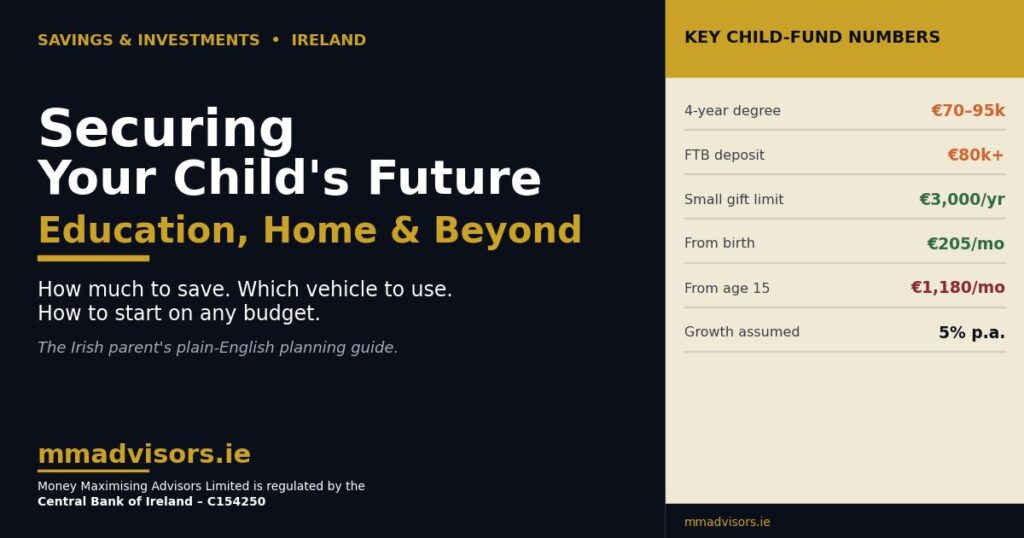
College costs in Ireland have been climbing steadily. While the Student Contribution Charge currently sits at €3,000 per year for most full-time undergraduate courses, the real expense goes far beyond that. Rent in Dublin alone can swallow €1,000 to €1,500 a month for a student. Add transport, utilities, food, and course materials, and the total cost of a four-year degree can easily exceed €60,000 to €80,000 for families covering full expenses.
Without a structured child education fund Ireland, many parents are left scrambling — taking on debt, dipping into retirement savings, or asking their child to work excessive hours while studying.
Starting to plan early changes everything.
When Should You Start Saving for Your Child’s Education?
The short answer: as early as possible.
If you start saving when your child is a baby, you have 17 to 18 years for your money to grow. Even modest monthly contributions, invested consistently, can accumulate into a substantial fund over that time.
If your child is already 8 or 10 years old, don’t panic — there is still time to build a meaningful pot. But the window is shorter, which means you may need to save more aggressively or explore different vehicles.
For long-term savings for children in Ireland, time in the market genuinely matters. The earlier you begin, the less strain you place on your monthly budget.
The Best Ways to Save for College in Ireland
There is no single “perfect” product. The best way to save for college in Ireland depends on your timeline, risk tolerance, income, and tax situation. Here are the main options families consider:
Regular Savings Accounts
A straightforward bank savings account is simple and low-risk. However, interest rates in Ireland remain modest, and DIRT (Deposit Interest Retention Tax) at 33% applies to interest earned. For long-term college savings Ireland, a savings account alone is rarely the most efficient route.
State Savings (An Post)
An Post State Savings products are government-backed, DIRT-free, and relatively secure. Products like the 10-Year National Solidarity Bond or Instalment Savings offer guaranteed returns without tax on interest. For cautious savers with a longer horizon, this can form a solid part of an education fund planning Ireland strategy.
Investment Funds and Unit-Linked Policies
For parents with 10 or more years before college begins, investing through a unit-linked savings plan or a regular premium investment bond can offer much stronger growth potential than cash savings. Returns are not guaranteed, but over longer timeframes, equity-based funds have historically outpaced inflation by a considerable margin.
This is one of the most popular ways to invest for your child’s education in Ireland, particularly when structured through a qualified financial advisor who can align the fund to your timeline and gradually de-risk as college approaches.
Children’s Allowance (Child Benefit)
Many Irish parents choose to redirect some or all of their monthly Child Benefit payment — currently €140 per child per month — into a dedicated savings or investment account. Over 18 years, that alone adds up to over €30,000 before any investment growth. It’s one of the simplest habits you can adopt for saving for your child’s education Ireland.
Tax Considerations for Education Savings in Ireland
Unlike some other countries, Ireland does not offer a dedicated tax-relieved education savings account (like a 529 plan in the US). However, there are still tax-efficient approaches worth exploring:
- Gifts to children: Under the Small Gift Exemption, you can give a child up to €3,000 per year free of Capital Acquisitions Tax (CAT). Grandparents, aunts, uncles — anyone — can each contribute €3,000 per year per child without triggering a tax liability.
- Investment structure: Choosing the right investment wrapper can affect how returns are taxed. A qualified advisor can help you select structures that minimise your tax exposure over time.
- Exit tax on investments: Gains on most investment funds are subject to Exit Tax at 41% in Ireland, applied on encashment or every 8 years. Understanding this is critical when building a child education fund Ireland.
If you’d like to explore your options in more detail, enquire now and one of our advisors will be in touch.
How Much Should You Save?
A rough rule of thumb: aim to cover at least 50% of your child’s estimated college costs from savings, with the remainder potentially covered by part-time work, student loans, or other income.
If you estimate four years of college will cost €60,000 in today’s money, targeting a savings fund of €30,000 or more is a reasonable starting point. Broken down:
- Starting at birth: roughly €80–€100 per month in a growth-oriented fund could reach that target.
- Starting at age 5: you may need €130–€160 per month.
- Starting at age 10: contributions would need to be more aggressive, likely €250 or more per month depending on the vehicle.
These are illustrative figures only. A personalised education savings plan Ireland projection will take into account your specific timeline, contribution capacity, and chosen investment approach.
Want a plan built around your family’s exact situation? Book now for a no-obligation consultation with one of our Certified Financial Planners.
Related Reading
If you’re exploring this topic further, here are some resources our team has put together for Irish families:
- College Education Savings Plan Ireland: Strategies to Save for Your Child’s College Education
- College Education Savings in Ireland 2026: Your Complete Guide to Funding Your Child’s Future
- Which College Education Savings Plan in Ireland Should Parents Choose?
- Families Feeling the Pressure as College Costs Continue to Rise
- The Real Cost of College in 2025 and How to Save for It
Common Mistakes to Avoid
Even the most well-intentioned parents can fall into traps when it comes to education fund planning Ireland. Here are a few to watch out for:
- Leaving it too late: The single biggest mistake. Every year you delay, you either need to save more or accept a smaller fund.
- Keeping it all in cash: Inflation erodes the value of cash savings over long periods. A diversified investment approach typically performs better over 10+ years.
- Not reviewing regularly: Your circumstances change. A savings strategy you set up five years ago may no longer be optimal.
- Ignoring tax: Paying 41% exit tax on a large investment fund can come as a nasty shock. Structuring correctly from the outset saves money.
How Money Maximising Advisors Can Help
At Money Maximising Advisors Limited, our team of Certified Financial Planners (CFP) and Qualified Financial Advisors (QFA) specialises in helping Irish families build practical, tax-efficient savings strategies. Whether you’re just starting out or looking to review an existing education savings plan Ireland, we can provide clear, jargon-free advice tailored to your situation.
We work with families in Dublin, Galway, and across Ireland — and we understand the real financial pressures that come with raising children in this country.
Contact us today to find out how we can help you get on track.
Or, if you’re ready to sit down with an advisor and start building your plan, book an appointment at a time that suits you.
Frequently Asked Questions
- How do I start saving for my child’s education in Ireland?
The best first step is to open a dedicated savings account or investment plan and commit to a regular monthly contribution. Speaking with a qualified financial advisor helps you choose the right vehicle — whether that’s a State Savings product, an investment fund, or a combination — based on your child’s age and your financial situation.
2. What is the best way to fund a child’s education?
There’s no one-size-fits-all answer, but for most families in Ireland, a combination of regular invested savings, redirected Child Benefit payments, and structured gifts from family members (using the €3,000 Small Gift Exemption) tends to be the most effective approach. An education savings plan Ireland built with professional advice will be more efficient than a generic savings account alone.
3. How much should I save for my child’s college in Ireland?
Aim to cover at least half the expected cost of a four-year degree. With college costing between €40,000 and €80,000 in total for many families, a target fund of €20,000 to €40,000 is a reasonable starting point. The earlier you begin, the smaller your monthly contributions need to be.
4. When should I start saving for my child’s education?
Ideally, from birth or even during pregnancy. Starting early gives your money the most time to grow, and keeps monthly contributions manageable. That said, even if your child is already in primary school, starting now is far better than waiting.
5. Is there a tax-free education savings account in Ireland?
Ireland does not currently have a dedicated tax-relieved education savings account. However, there are tax-efficient strategies available — including using the Small Gift Exemption, selecting appropriate investment structures, and careful timing of withdrawals — that can significantly reduce your overall tax burden. A qualified advisor can walk you through how to pay for university in Ireland in the most tax-efficient way.
6. Can grandparents contribute to a child’s education fund in Ireland?
Yes, and this is an excellent and often underused strategy. Each grandparent can give up to €3,000 per year per grandchild under the Small Gift Exemption, completely free of CAT. Over a child’s lifetime, this can add up to a substantial contribution towards college savings Ireland without triggering any tax liability.
Conclusion
The cost of third-level education in Ireland is not going down anytime soon. But with the right education savings plan Ireland in place — started early, structured efficiently, and reviewed regularly — funding your child’s future is absolutely achievable.
Money Maximising Advisors Limited is here to help you every step of the way. Our experienced team provides personalised advice that cuts through the complexity and gives you a clear, actionable plan. Whether you’re in Dublin, Galway, or anywhere across Ireland, we’re ready to help you give your child the best possible start in life.
Don’t leave it to chance. Start planning today.
Disclaimer: This article provides general information and should not be considered personalised financial or tax advice. Irish tax laws change periodically, and individual circumstances vary. The figures and strategies mentioned are illustrative only. Always consult with a qualified financial advisor or tax professional before making significant financial decisions regarding education savings or investment planning.