Facing job loss is never easy. Whether you work in Dublin, Galway, or anywhere else across the island, understanding your rights when the worst happens is absolutely essential. If you have recently been told your role is at risk, or you simply want to be prepared, knowing the key facts about redundancy in Ireland could make a significant difference to your financial future.
In this guide, the team at Money Maximising Advisors Limited walks you through nine things every worker in Ireland needs to know — from statutory entitlements and redundancy pay Ireland rules, to notice periods and what to do with your pension when your job ends.
1. What Is Redundancy in Ireland?
Redundancy in Ireland occurs when an employer reduces or eliminates a position because the role is no longer required. Crucially, it is the position — not the person — that becomes redundant. Under redundancy law Ireland (primarily the Redundancy Payments Acts 1967–2014), a genuine redundancy can arise due to:
- Business closure or relocation
- A reduction in the number of employees needed
- The introduction of new technology or automation
- A reorganisation of how work is carried out
It is important to note that if your employer replaces you with another person doing the same job, this does not qualify as a genuine redundancy under redundancy rules Ireland.
2. You Must Meet Certain Eligibility Criteria
Not every worker is automatically entitled to a redundancy payment Ireland. Under redundancy rights Ireland, you must meet the following conditions:
- You must be aged 16 or over
- You must be in continuous employment with the same employer for at least two years (104 weeks)
- Your employment must be insurable under the Social Welfare Acts (i.e. you pay PRSI)
- You must have been genuinely made redundant — not dismissed for misconduct or poor performance
Part-time workers who meet the two-year service threshold are equally entitled to statutory redundancy Ireland — a protection that was significantly strengthened by Irish employment law reforms in recent years.
3. How Statutory Redundancy Pay Is Calculated
Statutory redundancy Ireland is calculated using a straightforward formula based on your length of service and weekly pay:
Two weeks’ pay for every year of service, plus one additional bonus week.
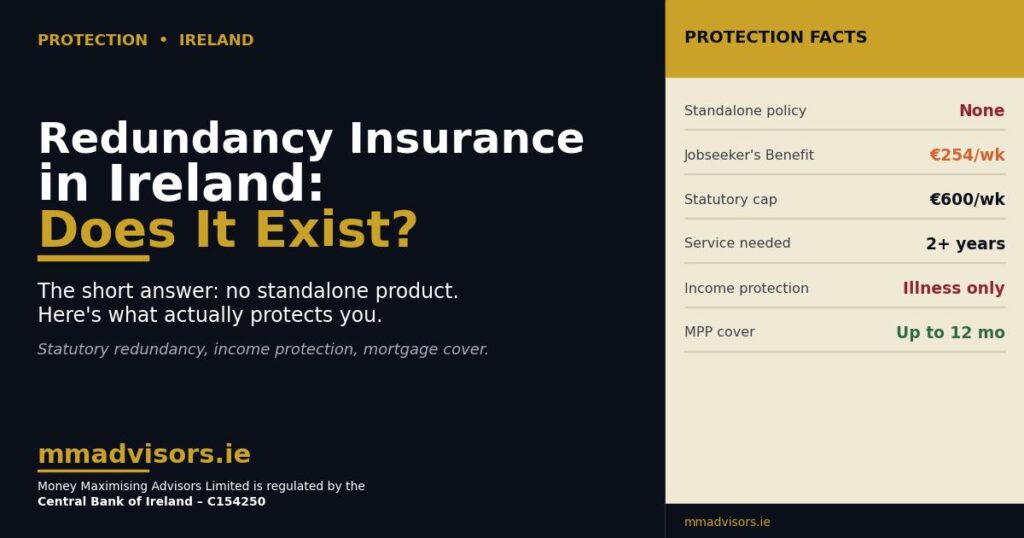
Weekly pay is capped at €600 per week (as of 2025–2026). So, if your actual salary is higher, the calculation still uses the €600 ceiling. Here’s a quick example:
- 10 years of service × 2 weeks × €600 = €12,000
- Plus 1 bonus week × €600 = €600
- Total statutory redundancy payment: €12,600
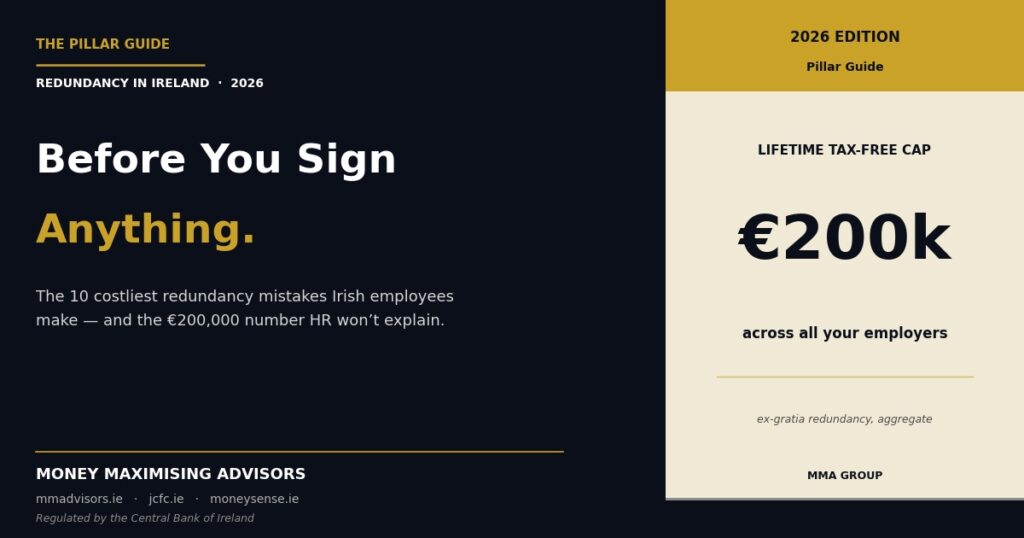
It is worth noting that redundancy pay Ireland is tax-free up to certain limits under Revenue rules. Any amount above the basic exemption (currently €10,160 plus €765 per year of service) may be subject to tax, depending on your circumstances.
Want to understand exactly how your redundancy entitlement Ireland is calculated? Enquire Now and speak with one of our qualified advisors.
Related Reading:
What Happens to Your Pension After Redundancy in Ireland? A 2026 Guide
Redundancy Pension in Ireland: A Complete Guide to Protecting Your Financial Future
Understanding Redundancy Payment Options in Ireland
4. You Are Entitled to a Minimum Notice Period
Under redundancy law Ireland, your employer must give you a minimum statutory notice period before your employment ends. The minimum notice depends on your length of service:
- 1 week — if you have worked 13 weeks to 2 years
- 2 weeks — 2 to 5 years’ service
- 4 weeks — 5 to 10 years’ service
- 6 weeks — 10 to 15 years’ service
- 8 weeks — 15 or more years’ service
Your contract of employment may provide for a longer notice period than the statutory minimum — in which case, your employer must honour the contractual terms. If you are not given adequate notice, you may have grounds to bring a claim under the Minimum Notice and Terms of Employment Acts.
5. Your Employer Must Serve You With Form RP50
Under redundancy rules Ireland, your employer is legally required to give you written notice of redundancy using Form RP50 (or an equivalent written notice). This document confirms the redundancy and sets out the lump sum you are owed.
If your employer refuses or fails to pay your redundancy entitlement Ireland, you can apply to the Social Insurance Fund administered by the Department of Social Protection, which may pay the statutory amount directly to you. Your employer will then be pursued for the money owed.
Not sure if your RP50 or notice is correct? Book a consultation today with our expert financial advisors.
6. Voluntary Redundancy and Enhanced Packages
Many employers — particularly larger organisations and public sector bodies — offer voluntary redundancy schemes that go beyond the statutory minimum. An enhanced redundancy payment Ireland package might include:
- A multiplier on your statutory entitlement (e.g. 3–4 weeks per year of service)
- Payment in lieu of notice
- Retention of private health insurance for a period
- Career support or outplacement services
Before you sign anything, it is vital to understand the full financial and tax implications of an enhanced package. Some elements may be partially or fully taxable, and you could inadvertently waive your right to claim unfair dismissal or other workplace claims by signing a settlement agreement.
7. What Happens to Your Pension?
One of the most overlooked aspects of redundancy in Ireland is the impact on your pension. When your employment ends, several pension options are available, including:
- Leaving your pension pot preserved with your former employer’s scheme
- Transferring your pension to a Personal Retirement Bond (PRB)
- Transferring to your new employer’s scheme (if applicable)
- Taking an early retirement pension — depending on scheme rules and your age
The right choice will depend on your age, the type of pension scheme you were in (defined benefit vs defined contribution), and your future financial plans. Getting this decision right is crucial — and that is precisely where our team at Money Maximising Advisors Limited can provide genuine value.
Related Reading:
Step-by-Step Redundancy Advice Ireland for Employers
Redundancy in Ireland: Implications and Entitlement
8. Tax on Redundancy Payments — What You Need to Know
While statutory redundancy Ireland payments are entirely tax-free, any amount above your basic exemption may be subject to income tax. There are two main exemptions that can shelter part of your package:
- Basic Exemption: €10,160 + €765 per completed year of service
- Increased Exemption: A further €10,000 can be sheltered if you have not claimed this relief in the past ten years
- Standard Capital Superannuation Benefit (SCSB): A more complex calculation that can benefit higher earners with long service — often the most generous option
Navigating the tax treatment of a redundancy lump sum is genuinely complex. Our advisors can carry out a tailored calculation to ensure you take the exemption most advantageous to your situation, potentially saving you thousands of euros.
How Much Money Can You Gift to a Family Member Tax-Free in Ireland?
9. You Have Rights If You Disagree With Your Redundancy
If you believe your redundancy in Ireland was not genuine — perhaps you were selected unfairly, or the process was not followed properly — you have the right to bring a complaint to the Workplace Relations Commission (WRC). Claims must generally be lodged within six months of the date of dismissal (extendable to 12 months in exceptional circumstances).
Common grounds for dispute include:
- Your role was not genuinely made redundant
- An unfair selection process was used (e.g. discrimination)
- Proper consultation procedures were not followed
- You were not given adequate notice or the correct RP50 form
Even where a redundancy is genuine, issues around process, notice, or payment levels can often be resolved through early professional guidance.
Conclusion: Get Expert Advice Before You Sign Anything
Whether you are facing redundancy in Ireland for the first time or navigating a complex enhanced package, the decisions you make in the coming weeks could have a lasting impact on your financial wellbeing. From understanding your redundancy entitlement Ireland and tax position to protecting your pension and planning your next steps, professional advice is not a luxury — it is a necessity.
At Money Maximising Advisors Limited, our team of Certified Financial Planners (CFP) and Qualified Financial Advisors (QFA) are here to help you navigate every aspect of redundancy with confidence. Based in Dublin and Galway, we provide clear, personalised guidance so you can make informed decisions and protect what matters most.
Contact Us today to speak with our team, or Book an Appointment at a time that suits you. We are here to help.
Frequently Asked Questions (FAQs)
1. What qualifies as redundancy in Ireland?
A genuine redundancy in Ireland occurs when an employer no longer requires a particular role to exist — due to business closure, reorganisation, or reduced workforce needs. The position itself must cease; the employer cannot simply replace the worker with someone else doing the same job.
2. Who is eligible for redundancy pay in Ireland?
To qualify for redundancy pay Ireland, you must be aged 16 or over, have at least two years of continuous service with the same employer, and pay PRSI contributions. Part-time workers who meet the service threshold are equally entitled.
3. How much statutory redundancy do you get in Ireland?
Statutory redundancy Ireland is calculated as two weeks’ pay for every year of service, plus one additional bonus week. Weekly pay is currently capped at €600. The payment is entirely tax-free.
4. How long must you work to get redundancy in Ireland?
Under redundancy rules Ireland, you must have completed at least 104 weeks (two years) of continuous employment with the same employer before you are entitled to a statutory redundancy payment Ireland.
5. What is the redundancy notice period in Ireland?
Under redundancy law Ireland, the minimum notice ranges from one week (for 13 weeks to 2 years’ service) up to eight weeks (for 15 or more years’ service). Your contract may stipulate a longer notice period, which your employer must honour.
6. Can I appeal if I think my redundancy was unfair?
Yes. If you believe your redundancy rights Ireland were not respected — for example, due to an unfair selection process or a non-genuine redundancy — you can bring a claim to the Workplace Relations Commission (WRC) within six months of dismissal.
Disclaimer
This article provides general information and should not be considered personalised financial or tax advice. Irish tax laws change periodically, and individual circumstances vary. The redundancy payment thresholds, tax exemptions, and legal provisions mentioned are based on current rules and are subject to change. Always consult with our qualified financial advisors or tax professionals before making significant financial decisions regarding redundancy, pensions, or employment matters.