
When it comes to managing your wealth and supporting loved ones financially, understanding Ireland’s tax rules can make a significant difference to your bottom line. One of the most valuable yet underutilised tax-planning tools available to Irish families is the small gift exemption. At Money Maximising Advisors Limited, we’ve seen countless families benefit from this straightforward yet powerful exemption, and in 2026, it remains one of the most effective ways to transfer wealth without triggering Capital Acquisitions Tax (CAT).
Whether you’re a parent wanting to help your children financially, grandparents looking to support grandchildren, or simply someone who enjoys giving to family and friends, understanding the small gift exemption could save you thousands in tax whilst keeping your financial gifting strategy both legal and efficient.
What Exactly Is the Small Gift Exemption in Ireland?
The small gift exemption is a provision under Irish tax law that allows any person to give up to €3,000 per year to another individual completely free of CAT. This exemption operates independently of the main CAT thresholds and doesn’t reduce the lifetime tax-free allowances that beneficiaries can receive from parents, relatives, or others.
What makes this exemption particularly attractive is its simplicity and flexibility. The small gifts tax Ireland rules don’t require any paperwork, tax returns, or formal documentation with Revenue, provided you stay within the annual limit. It’s a clean, straightforward way to help loved ones financially whilst remaining fully compliant with Irish tax regulations.
The beauty of the Revenue small gift exemption CAT lies in its annual nature—every calendar year, the exemption resets, allowing you to continue gifting €3,000 tax-free year after year. Over time, this can add up to substantial financial support without any tax implications.
How Does the CAT Small Gift Rule Ireland Actually Work?
Understanding the mechanics of gifting money tax free Ireland is essential to maximise its benefits whilst staying within the rules. Here’s what you need to know:
The €3,000 Annual Limit
Each person can receive up to €3,000 from any individual donor in a single calendar year without incurring CAT. The key word here is “any individual”—this means you can receive €3,000 from multiple different people in the same year, and each gift remains tax-free under the small gift exemption threshold.
For example, if you have three children, you could give each of them €3,000 annually, totalling €9,000 in gifts per year, all completely tax-free. Similarly, your spouse could do the same, effectively allowing your family to transfer €18,000 annually to your children without any CAT implications.
Multiple Donors and the Small Gift Exemption
One of the most frequently asked questions concerns whether the multiple donors small gift CAT rule allows someone to receive €3,000 from several different people. The answer is yes—and this is where strategic family planning becomes particularly valuable.
A child could potentially receive €3,000 from each parent (€6,000 total), €3,000 from each grandparent, and €3,000 from other relatives or family friends, all in the same year, with none of these gifts subject to CAT. This makes the tax-free gifts Ireland CAT system exceptionally generous for families who plan carefully.
Enquire now to discover how your family can structure gifts to maximise these benefits.
Independence from CAT Lifetime Thresholds
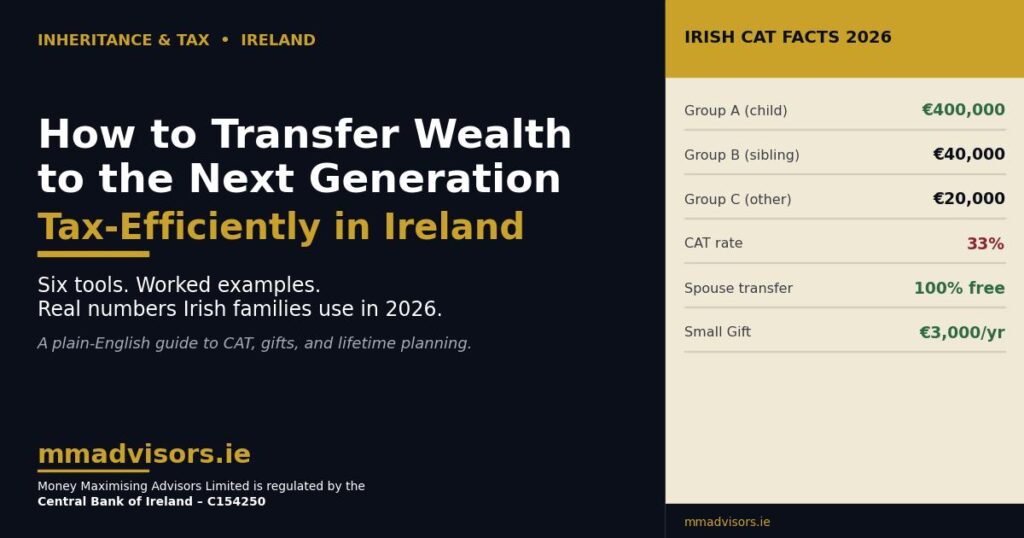
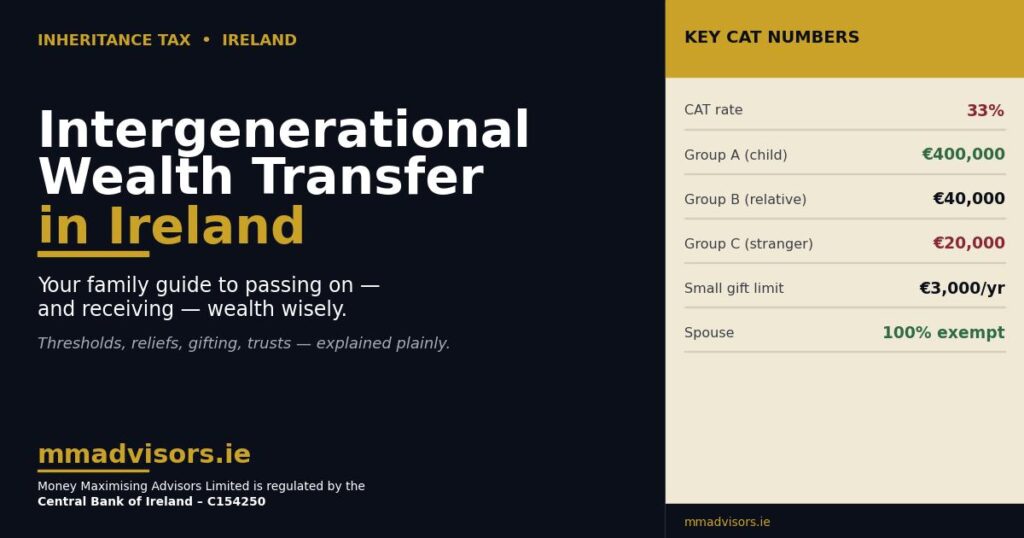
A critical advantage of the Ireland gift tax rules is that the small gift exemption doesn’t reduce your lifetime CAT thresholds. Ireland operates three main CAT threshold groups:
- Group A: €400,000 (typically parent to child)
- Group B: €40,000 (typically between relatives)
- Group C: €20,000 (typically between unrelated individuals)
Gifts under the small gift exemption don’t count towards these thresholds, meaning you preserve the full value of these allowances for larger transfers, such as inheritance or substantial lifetime gifts.
If you’re considering larger financial transfers to family members, it’s worth exploring how the small gift exemption fits into your broader estate planning strategy. Book now for a consultation to create a comprehensive wealth transfer plan.
Practical Applications: Making the Small Gift Exemption Work for You
The gift tax exemptions Ireland system offers numerous practical applications for families at different life stages.
Supporting Adult Children
Many parents in Dublin, Galway, and across Ireland are helping adult children with housing deposits, wedding costs, or career investments. By using the small gift exemption consistently, parents can provide meaningful financial support without triggering tax liabilities.
A couple gifting €6,000 annually to a child (€3,000 each) will transfer €60,000 over ten years—all tax-free. This can make a real difference when saving for a house deposit in Ireland’s competitive property market.
Helping Grandchildren Build Savings
Grandparents can establish tax-efficient savings plans for grandchildren by gifting €3,000 annually. Over 18 years, a single grandparent could gift €54,000 tax-free, whilst a couple could contribute €108,000 towards their grandchild’s education or future.
For families interested in structured savings approaches, our article on Maximising Your Wealth in 2026: A Complete Guide to Ireland’s Small Gift Exemption provides detailed strategies.
Wedding and Special Occasion Gifts
Many Irish families wonder whether wedding gifts fall under different rules. The answer is that wedding gifts follow the same small gift exemption rules—up to €3,000 per donor remains tax-free, regardless of the occasion.
Supporting Siblings or Extended Family
The exemption isn’t limited to parent-child relationships. You can gift €3,000 annually to siblings, nieces, nephews, or friends without any CAT implications, making it an excellent tool for broader family support.
Common Misconceptions About Small Gifts Tax Ireland
Despite its straightforward nature, several misconceptions surround the CAT small gift rule Ireland:
Misconception 1: The €3,000 limit is per recipient per year total Reality: The limit is €3,000 per donor per recipient per year. Multiple people can each give €3,000 to the same recipient.
Misconception 2: Small gifts reduce your CAT thresholds Reality: The small gift exemption is completely separate from lifetime CAT thresholds and doesn’t reduce them.
Misconception 3: You need to report gifts under €3,000 to Revenue Reality: Gifts within the exemption don’t require reporting or tax returns.
Misconception 4: The exemption applies to inheritances Reality: The small gift exemption only applies to gifts during a person’s lifetime, not to inheritances received after death.
For clarity on related tax benefits for businesses, read our guide on How to Use the Small Benefit Exemption Scheme for Your Business.
What Happens If You Exceed the Small Gift Exemption?
Understanding what occurs when gifts exceed the small gift exemption threshold is crucial for tax planning.
If you receive more than €3,000 from a single person in a calendar year, the entire amount becomes subject to CAT rules—not just the excess. For example, if someone gives you €5,000, the full €5,000 (not just €2,000) counts towards your relevant CAT threshold.
This is why timing matters. If someone wishes to give you €6,000, it’s far more tax-efficient to receive €3,000 in December and €3,000 in January of the following year, rather than €6,000 in a single year.
For comprehensive guidance on managing larger family gifts, see our article on How Much Money Can You Gift to a Family Member Tax-Free in Ireland?
Strategic Planning: Maximising Tax Efficiency
Smart financial planning involves using all available tools to their fullest potential. Here are strategies our advisors at Money Maximising Advisors Limited recommend:
1. Coordinate Family Gifting
Families should coordinate their gifting strategies to maximise tax efficiency. If multiple family members want to support the same person, spreading gifts across donors ensures all contributions remain within individual exemption limits.
2. Time Gifts Strategically
The small gift exemption is based on the calendar year. Strategic timing—especially gifts made in late December and early January—can effectively double the immediate benefit.
3. Combine with Other Exemptions
The small gift exemption works alongside other tax reliefs. For instance, employers can also benefit from schemes like the Small Benefit Exemption. Our article Small Benefit Exemption 2025 Explained: How Employers in Ireland Can Save on Tax explains how businesses can benefit.
4. Document Larger Gifts Properly
Whilst gifts under €3,000 don’t require documentation, if you’re making multiple gifts or larger transfers, maintaining clear records protects both donor and recipient. This includes noting dates, amounts, and the nature of the gift.
5. Consider Annual Consistency
Rather than sporadic large gifts, consistent annual gifts under the exemption threshold provide reliable support whilst maintaining tax efficiency over the long term.
If you’re ready to develop a comprehensive gifting and estate planning strategy, contact us for expert guidance tailored to your family’s specific circumstances.
The Small Gift Exemption and Estate Planning
The Revenue small gift exemption CAT plays a valuable role in broader estate planning. By making regular tax-free gifts during your lifetime, you can:
- Reduce the size of your estate, potentially reducing inheritance tax for your beneficiaries
- See your loved ones benefit from your generosity whilst you’re alive
- Preserve your CAT thresholds for larger transfers
- Create a structured approach to wealth transfer across generations
For Irish families concerned about inheritance tax planning, combining the small gift exemption with other strategies—such as business relief, agricultural relief, and dwelling house exemption—can significantly reduce overall tax burdens.
Our comprehensive guide Are You Making the Most of the Small Annual Gift Exemption? explores how this exemption integrates with broader wealth management strategies.
Important Considerations and Professional Advice
Whilst the small gifts tax Ireland rules are relatively straightforward, individual circumstances vary considerably. Here are situations where professional advice becomes particularly valuable:
- High-net-worth families planning significant wealth transfers
- Complex family structures with multiple beneficiaries
- Individuals approaching or exceeding CAT thresholds
- Non-resident donors or recipients with cross-border considerations
- Business owners considering succession planning
At Money Maximising Advisors Limited, our Certified Financial Planners (CFP) and Qualified Financial Advisors (QFA) provide expert guidance on inheritance tax planning, estate planning, and strategic wealth transfer. We work with families across Dublin, Galway, and throughout Ireland to create tailored financial strategies that maximise tax efficiency whilst achieving your family’s goals.
Book an appointment today to discuss how the small gift exemption can fit into your comprehensive financial plan.
Conclusion
The small gift exemption remains one of Ireland’s most valuable yet underutilised tax planning tools in 2026. By understanding and strategically applying the CAT small gift rule Ireland, families can transfer substantial wealth over time without triggering tax liabilities, whilst preserving lifetime CAT thresholds for larger transfers.
Whether you’re supporting children, helping grandchildren build their futures, or simply wanting to share your wealth with loved ones, the €3,000 annual exemption per donor offers flexibility, simplicity, and significant tax savings.
At Money Maximising Advisors Limited, we’re committed to helping Irish families navigate the complexities of tax planning and wealth management. Our experienced team of Tax Advisors and Financial Planners can help you develop a comprehensive strategy that makes the most of available exemptions and reliefs whilst ensuring full compliance with Revenue requirements.
Don’t let valuable tax benefits go unused—start maximising your wealth transfer strategy today.
Frequently Asked Questions
1. What is the small gift exemption in Ireland?
The small gift exemption allows any person to give up to €3,000 per year to another individual free of Capital Acquisitions Tax (CAT). This exemption is separate from lifetime CAT thresholds and doesn’t require tax returns or documentation with Revenue.
2. How much can you gift tax-free in Ireland under the small gift exemption?
You can gift up to €3,000 per person per year completely tax-free. Each donor can give this amount to multiple recipients, and each recipient can receive €3,000 from multiple donors, all without triggering CAT.
3. Does the small gift exemption apply to multiple donors?
Yes, the €3,000 limit is per donor, not per recipient. This means someone can receive €3,000 from multiple different people in the same year, with each gift remaining tax-free under the exemption.
4. Is the small gift exemption separate from CAT lifetime thresholds?
Yes, gifts made under the small gift exemption don’t reduce your lifetime CAT thresholds (Group A, B, or C). This preserves these thresholds for larger transfers such as inheritances or substantial lifetime gifts.
5. Can a parent give more than €3,000 tax-free per year?
A parent can give €3,000 per year under the small gift exemption. However, parents can also make larger gifts that count towards the Group A threshold (currently €335,000 lifetime), and both parents can each give €3,000 separately to the same child.
6. Does the small gift exemption apply to inheritances?
No, the small gift exemption only applies to gifts made during a person’s lifetime. Inheritances received after someone passes away are subject to the standard CAT rules and thresholds, not the small gift exemption.
7. Do I need to file a tax return if I use the small gift exemption?
No, gifts within the €3,000 annual limit don’t require any tax returns or documentation with Revenue. However, it’s wise to keep personal records of gifts made, especially if you’re making multiple gifts or larger transfers.
8. What happens if a gift exceeds the small gift exemption?
If a gift exceeds €3,000 in a calendar year, the entire amount (not just the excess) becomes subject to CAT and counts towards the relevant lifetime threshold. This is why strategic timing across calendar years can be beneficial.
( Disclaimer: This article provides general information and should not be considered personalised financial or tax advice. Irish tax laws and exemption thresholds may change, and individual circumstances vary significantly. The small gift exemption rules outlined are current as of 2026 but are subject to change through future legislation or Revenue guidance. Always consult with qualified financial advisors or tax professionals at Money Maximising Advisors Limited before making significant financial decisions or implementing gifting strategies. Professional advice ensures compliance with current regulations and optimal outcomes for your specific situation.)