

Money is one of the biggest sources of stress in a relationship. It’s also one of the biggest opportunities for couples to build something real together. This guide from Money Maximising Advisors walks you through how Irish couples can build a joint financial plan that actually works.
You will see the tax advantages available only to married couples and civil partners. You will see the six conversations every couple should have. And you will see how to build a shared plan step by step.
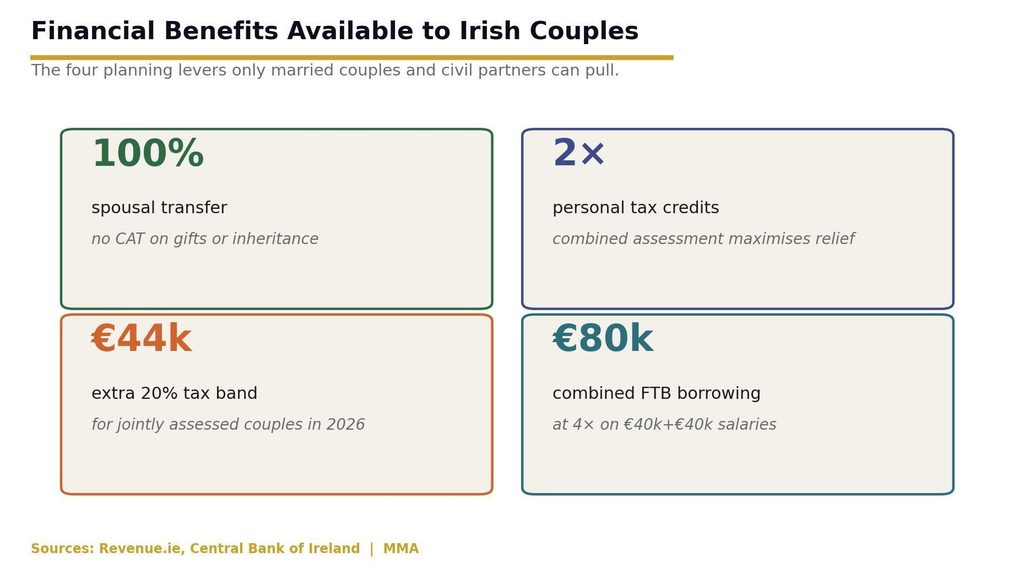
| QUICK ANSWER: Irish couples can jointly plan their financial future by combining four advantages: 100% CAT-free spousal asset transfers, joint tax assessment (which increases the 20% tax band by up to €44,000), combined mortgage borrowing (typically 4× combined income for FTBs), and paired protection cover. The most important step is not any single tax choice, it’s having honest conversations about debts, goals, and inheritance intentions before you make major decisions. |
Why couples should plan together
Two incomes are more powerful than one. Two people planning together are far more powerful than two people planning apart.
Joint planning unlocks tax advantages that don’t exist for single filers. It aligns spending decisions with shared goals. And it prevents the biggest cause of financial regret: two people making decisions that unintentionally cancel each other out.
Couples who plan together typically retire earlier, own more assets, and report less money-related stress. This is not marketing spin. It’s what the research consistently shows.
The four financial advantages of being an Irish couple
Advantage 1: 100% CAT-free asset transfers
Transfers between spouses and civil partners are completely exempt from Capital Acquisitions Tax. There is no threshold. There is no tax.
This is the single biggest tax planning advantage in Irish law. It applies to gifts during your lifetime and to inheritance on death. Assets move freely between you without ever triggering CAT.
Advantage 2: Joint tax assessment
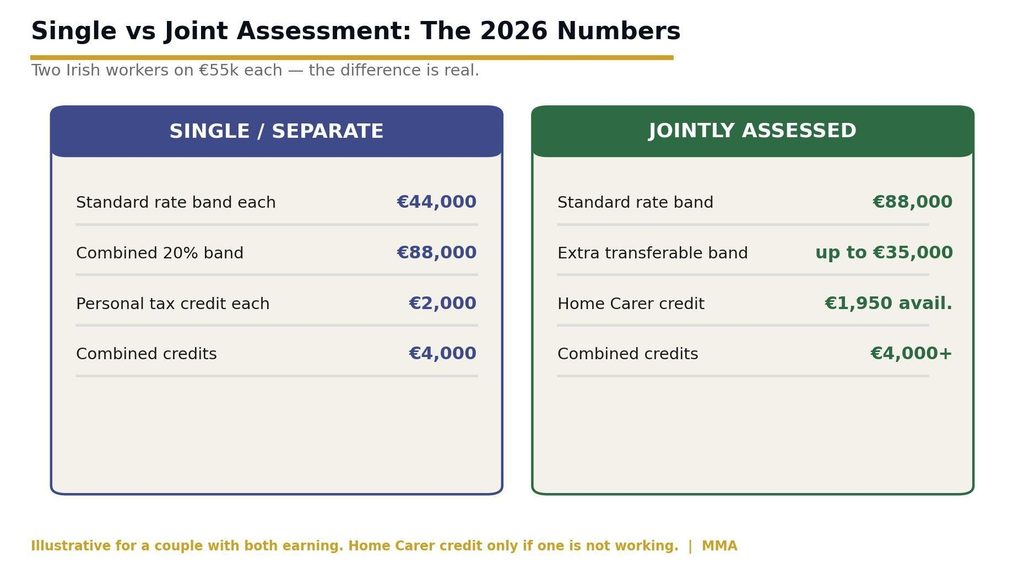
Married couples and civil partners can choose joint assessment. This combines both partners’ tax bands and credits.
The 20% standard rate band can extend by up to €44,000 when both partners have income. That means significantly more income taxed at 20% instead of 40%.
On average, joint assessment saves an Irish two-income household €1,500 to €5,000 per year. Over a working life, that’s a house deposit.
Advantage 3: Combined mortgage borrowing
Central Bank rules cap borrowing at 4× income for first-time buyers. As a couple, that 4× applies to your combined income.
Two people earning €45,000 each can borrow up to €360,000. That opens a very different property market compared to €180,000 as a single applicant.
Advantage 4: Paired protection cover
Joint life insurance policies, dual mortgage protection, and shared income protection typically cost less than two separate policies. Our Life Insurance and Mortgage Protection comparisons show real numbers for your specific situation.
The six conversations every Irish couple should have
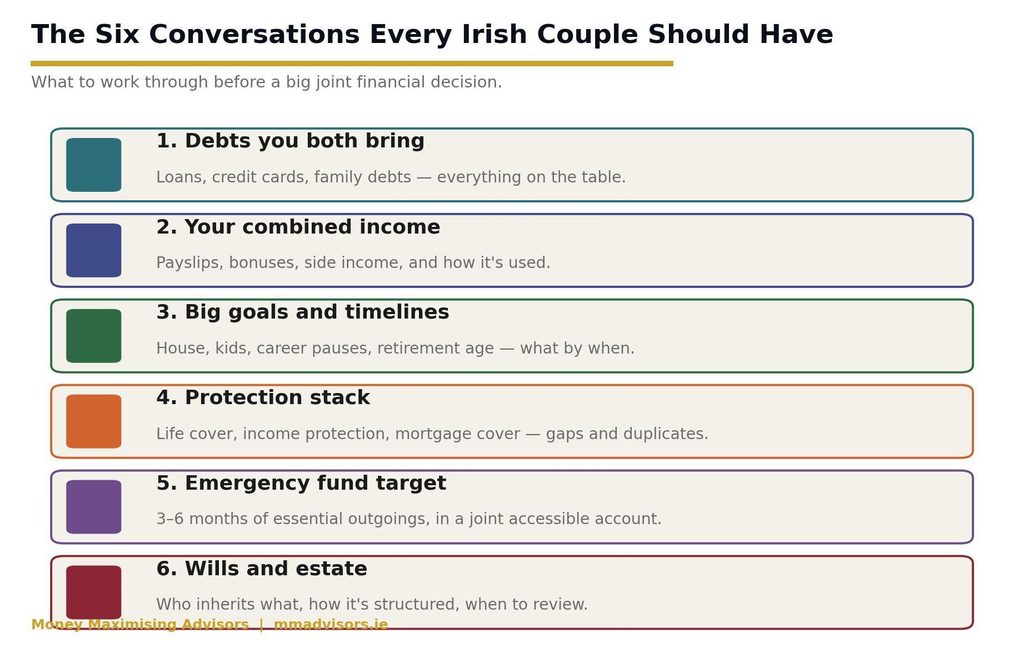
Conversation 1: What debts do you both bring in?
Personal loans. Credit card balances. Family debts. Student loans. Everything on the table.
This is where most couples get uncomfortable. Do it anyway. Understanding your combined starting position is the foundation of every plan.
Conversation 2: What’s your combined income and how do you use it?
Payslips, bonuses, side income, rental income. All of it.
Then look at how the money moves. Which account does each salary land in? Who pays which bills? Where does the surplus go?
Conversation 3: What are your big goals and timelines?
House by when. Kids by when. Career breaks. Business start-up. Retirement age target. Travel plans.
You don’t need to agree on everything. You do need to know what’s on each other’s list. Surprises here derail plans.
Conversation 4: What’s your protection stack?
Existing life cover, income protection, mortgage protection, illness cover. Employer-provided benefits from either job.
Most couples have gaps and duplicates. A review typically consolidates both to save money and improve coverage.
Conversation 5: What’s your emergency fund target?
Three to six months of essential outgoings, held in a joint accessible savings account.
Agree the target. Agree how it’s held. Agree what qualifies as “essential”.
Conversation 6: What about wills and estate plans?
This is the conversation nobody wants to have. It’s also the one that matters most if the worst happens.
Who inherits what. How assets are held. When to review. Whether to set up trusts for children.
Ready to build your joint financial plan?
Book a free 30-minute couples' consultation, or send us your details and we'll be in touch.
Money Maximising Advisors Limited is regulated by the Central Bank of Ireland – C154250
How to structure your joint plan
Every couple is different. But a good joint plan usually has three layers.
Layer 1: Protection and emergency reserve
Life cover, income protection, mortgage protection, and an emergency fund. This layer protects the plan from shocks.
Layer 2: Short and medium-term savings
Savings for a house deposit, wedding, career break, or planned kids. Held in a mix of deposit accounts and low-risk investments.
Layer 3: Long-term investments and pensions
Two pensions, running in parallel. Additional Voluntary Contributions (AVCs) for maximum tax relief. Long-term Regular Saver Investment Plans for goals beyond retirement.
Joint accounts vs separate accounts
There is no single right answer. Different couples make different setups work.
The joint model
Both salaries land in one joint account. All bills paid from there. Both partners have equal access. Simple, transparent.
Works well for couples with similar incomes and shared spending priorities.
The shared expenses model
Each partner keeps their salary in a personal account. Both transfer an agreed amount each month to a joint account that covers shared expenses.
Works well for couples with different incomes or spending habits.
The hybrid model
Salaries land in personal accounts. A joint account covers rent/mortgage and household bills. Each partner keeps discretionary spending in their own account.
Most common structure for Irish couples we see today.
Common joint planning mistakes
- Not reviewing tax assessment status. Joint assessment can be chosen or changed at any time. Every couple should review at least annually.
- Duplicating protection cover. Two identical life policies typically waste money. A single joint policy usually works better.
- Skipping wills. Intestacy rules do not always match how a couple would want assets split, especially with prior children or complex family structures.
- Assuming both incomes will always be there. Career breaks, redundancy, illness, family choices all change the picture. Plan for both scenarios.
- Not talking about inheritance expectations. Whether inheritance is coming and roughly when affects planning for house purchases and retirement.
- Waiting until marriage or civil partnership. Cohabiting couples don’t get the CAT-free spousal transfer. Start the conversation about legal status now.
Also Read,
Frequently asked questions
How do Irish couples benefit from joint tax assessment?
Joint assessment combines both partners’ tax bands and credits. The 20% standard rate band can extend by up to €44,000 for a two-income couple, saving typically €1,500 to €5,000 per year compared to separate assessment. Both partners’ personal tax credits combine, and a Home Carer credit is available if one partner is not working.
Do cohabiting couples get the same tax benefits as married couples?
No. Cohabiting couples (not married or in a civil partnership) do not qualify for joint tax assessment, the CAT-free spousal transfer, or automatic inheritance succession. This is one of the biggest financial planning differences between cohabiting and married couples in Ireland.
How much can an Irish couple borrow for a mortgage?
Up to 4× combined income as first-time buyers, or 3.5× combined income as movers. Two people earning €45,000 each can borrow up to €360,000 as FTBs. Actual approved amount depends on affordability and Central Bank stress testing.
Should couples have joint or separate bank accounts?
Neither is universally right. Common Irish setups include full joint (both salaries into one account), shared expenses (personal accounts + a joint account for bills), or hybrid (personal salaries, joint mortgage account). Choose what fits your relationship.
Do Irish couples need separate wills?
Yes. Each partner needs their own will. Mirror wills (leaving assets to each other, then to children) are common, but each spouse still needs an individual will document. Review every 5 years or after major life events.
Should couples combine their pensions?
You cannot legally combine pensions between two individuals. Each partner has their own pension pot. However, joint planning helps: coordinating contribution levels, fund choice, retirement timing, and use of the tax-free lump sum. A qualified adviser can model both pensions together.
Reviewed by our planning team
This guide was prepared and reviewed by the planning team at Money Maximising Advisors, drawing on Revenue.ie joint assessment rules, Central Bank of Ireland mortgage rules, and daily couples’ planning work. MMA is regulated by the Central Bank of Ireland (C154250).
Ready to build your joint plan?
Whether you’re newly engaged, recently married, or 20 years in, our team will map every joint planning opportunity, tax, mortgage, protection, retirement, inheritance, into one integrated plan.
Ready to build your joint financial plan?
Book a free 30-minute couples' consultation, or send us your details and we'll be in touch.
Money Maximising Advisors Limited is regulated by the Central Bank of Ireland – C154250
| Important information Tax bands, credits, and Central Bank mortgage rules referenced are those in force in Ireland at time of writing (2026) and are subject to change. Rates, thresholds and rules referenced are correct at time of writing and are subject to change. Money Maximising Advisors Limited is regulated by the Central Bank of Ireland (C154250). This article is for general information only and does not constitute personalised financial, tax or legal advice. You should always speak to a Qualified Financial Advisor before making any decision. |