Quick answer
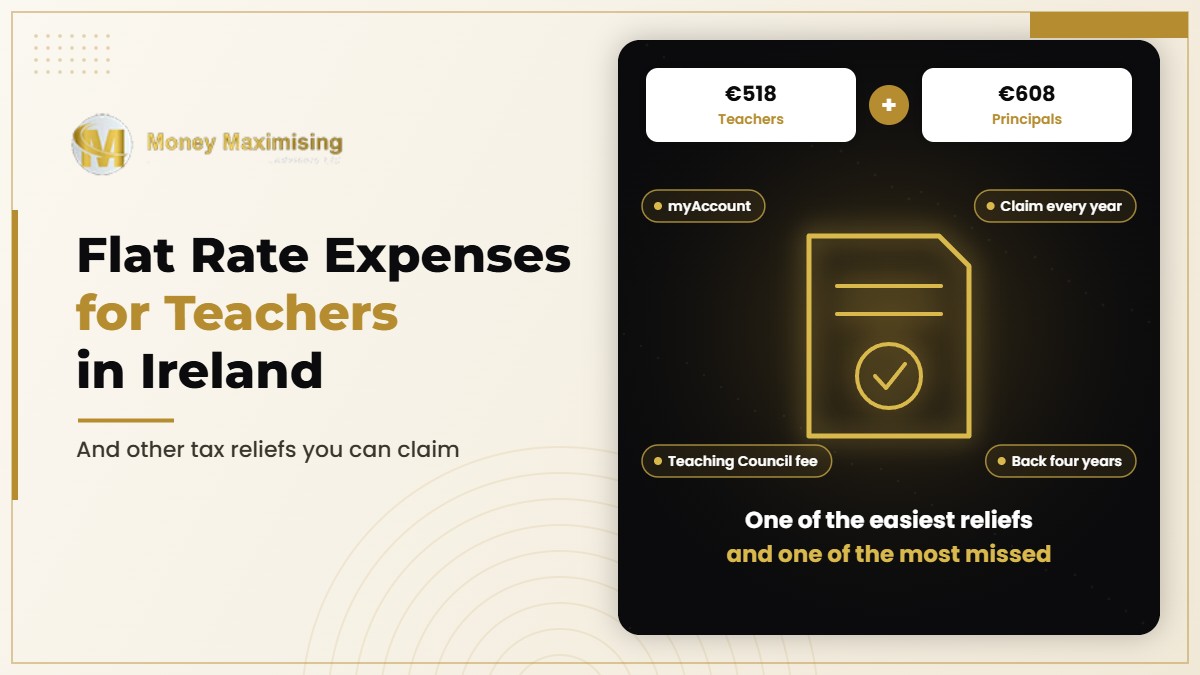
Flat rate expenses for teachers are a fixed tax deduction agreed between Revenue and the teacher unions. Recent rates are €518 for teachers and €608 for principals. Since 2025 you must claim them every year through Revenue myAccount, and you can claim back up to four previous years.
Flat rate expenses for teachers are one of the easiest tax reliefs to claim and one of the most often missed. The amount is small on its own, but combined with Teaching Council fee relief, pension relief and a four year backdated claim, it can add up to a useful refund. This guide shows what you can claim, how to do it and which other reliefs matter most for teachers.
Tax relief is only one part of managing your money well. Our financial plan for teachers looks at your take home pay, pension and savings together.
What are flat rate expenses?
Flat rate expenses (FRE) are a fixed deduction for work related costs that your employer does not reimburse, such as books, stationery and teaching materials. Revenue agrees the rate with representative bodies, in this case the INTO, ASTI and TUI. Because it is a flat rate, you do not need receipts.
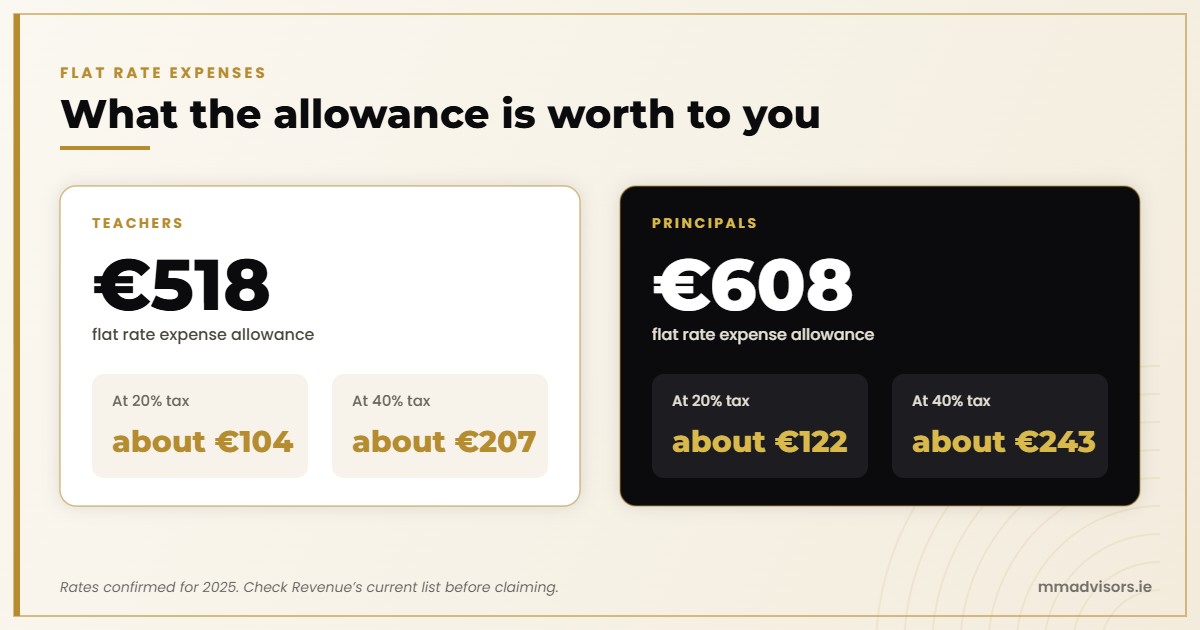
The allowance reduces your taxable income, so the value to you depends on your tax rate.
How much are flat rate expenses for teachers?
| Role | Flat rate expense | Value at 20% tax | Value at 40% tax |
|---|---|---|---|
| Teachers | €518 | about €104 | about €207 |
| Principals | €608 | about €122 | about €243 |
These are the rates confirmed for 2025. Check Revenue’s flat rate expenses list for the current year before claiming, as rates can be reviewed. Some part time and specialist roles have different amounts.
What changed in 2025?
Until 2024, many teachers had their flat rate expenses carried forward automatically each year. From 2025, Revenue requires every eligible teacher to make a claim each year. If you have not claimed for 2025 or 2026, you may be missing the allowance.
How to claim flat rate expenses as a teacher
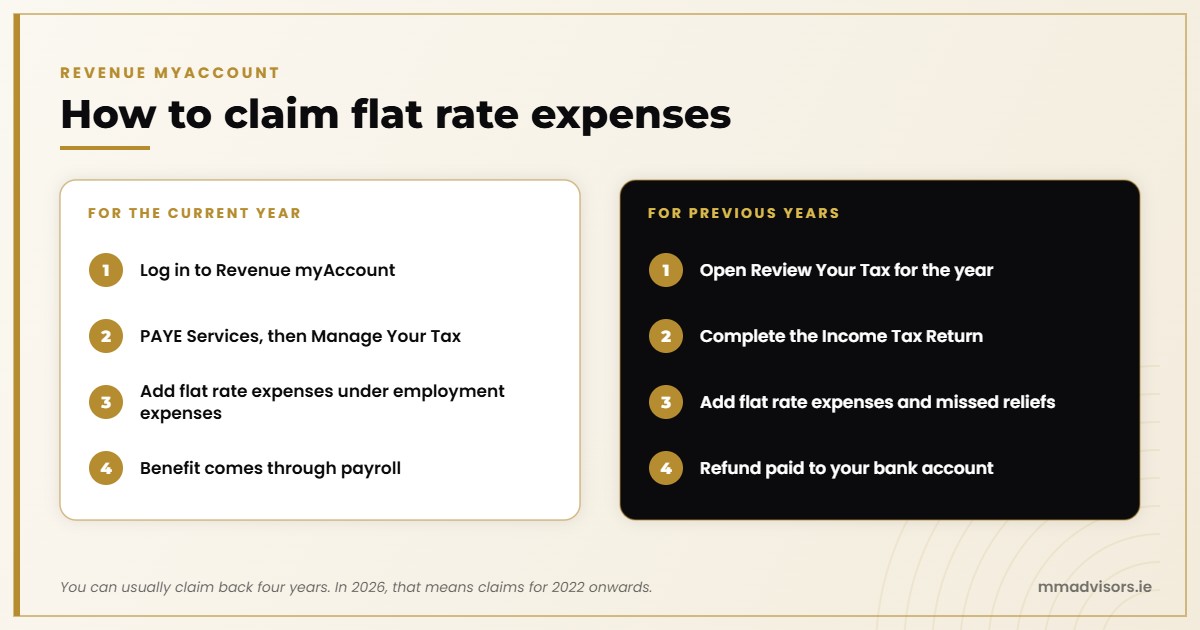
For the current year:
- Log in to Revenue myAccount.
- Open PAYE Services and choose Manage Your Tax.
- Select the current year and add “Flat rate expenses” under employment expenses.
- Revenue updates your Tax Credit Certificate and you receive the benefit through payroll.
For previous years:
- In myAccount, open Review Your Tax for the year you want to claim.
- Complete the Income Tax Return for that year.
- Add flat rate expenses and any other reliefs you missed.
- Any refund is paid directly to your bank account.
You can usually claim back four years. In 2026, that means claims for 2022 onwards.
Claim relief on your Teaching Council fee
Teachers who must be registered with the Teaching Council to be paid can also claim tax relief on the annual registration fee. This is separate from and in addition to flat rate expenses. Add it in the same myAccount claim.
Other tax credits and reliefs for teachers in Ireland
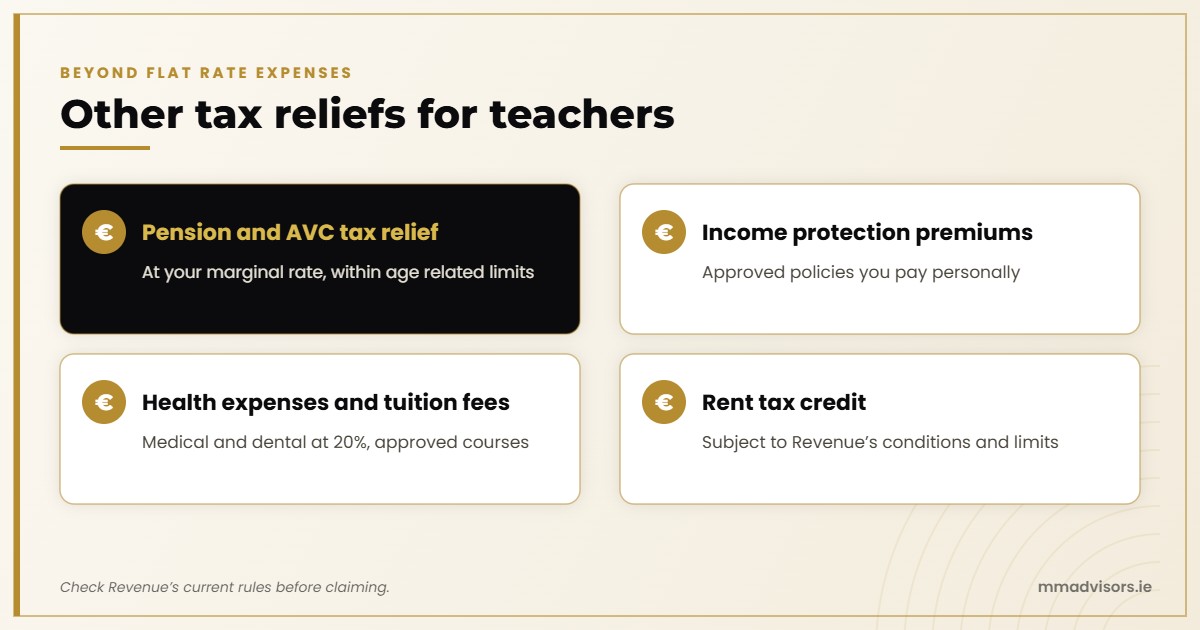
Flat rate expenses are the teacher specific relief, but several general reliefs are often more valuable.
Pension and AVC tax relief
Your compulsory superannuation is deducted before tax. Additional Voluntary Contributions also get income tax relief at your marginal rate, within age related limits from 15% of earnings under age 30 to 40% from age 60, on earnings up to €115,000. For a higher rate taxpayer, this is one of the most valuable reliefs available. Read our guide to AVCs for teachers and see how pension contributions on your tax return are handled.
Income protection premiums
Premiums for approved income protection policies you pay personally can qualify for income tax relief. Group salary protection deducted through payroll may already receive relief at source. See our guide to income protection for teachers.
Health expenses and tuition fees
Qualifying medical and dental costs can get relief at 20%. Fees for approved third level courses, including some postgraduate education courses, may also qualify for relief above a set threshold. Check Revenue’s current rules before claiming.
Rent tax credit
Teachers renting their home may be able to claim the rent tax credit, subject to Revenue’s conditions and the current year’s limits.
Should you use a tax refund agent?
Most teachers can claim flat rate expenses and common reliefs themselves in myAccount in a few minutes. Refund agents charge a fee or percentage for the same claim. If your situation is more complex, such as rental income alongside your teaching salary, see our article on AVCs and rental income tax for employees or speak to an adviser.
How MM Advisors helps teachers make the most of their pay
Claiming flat rate expenses for teachers is a quick win. The bigger gains come from planning around your real take home pay. As part of a financial plan for teachers, we:
- Plan from reliable net pay, not gross salary, allowing for PAYE, PRSI, USC, pension contributions, the Additional Superannuation Contribution (ASC) where it applies, union subscriptions and any insurance or AVC deductions
- Build a conservative budget that reflects increments, posts of responsibility and less predictable income such as substitute work, extra hours or allowances
- Set up a simple account structure: a salary account, a bills account, an annual expenses account for holidays, car costs and Christmas, emergency savings, goal savings, and long term pension and investment contributions once essentials are covered
- Compare the after tax cost of AVCs with your other priorities, and check pension contributions already paid in the tax year
- Test your plans against real changes, such as parental leave, reduced hours or a gap between contracts
You keep control of all your accounts and payment instructions. If you want help with budgeting alone, our money management advice service can help, and our financial advice for teachers in Ireland guide shows where a tax refund fits.
How the process works
- Understand: we discuss your teaching career, family finances and the decisions you want to make.
- Gather: we review your payslips, pension statements, service history, savings, debts and existing protection.
- Plan: we show practical forecasts, costs, assumptions and a clear action list.
- Implement: we arrange suitable products within our service scope and liaise with your pension administrator, accountant or solicitor when needed.
- Review: we revisit the plan when your income, career pattern, family situation or retirement date changes.
We explain any planning fees, product charges and commission before you proceed.
Financial planning for teachers
Discuss your pension and family finances
FAQs
How much are flat rate expenses for teachers in Ireland?
Revenue’s recent rates are €518 for teachers and €608 for principals. The allowance reduces taxable income, so it is worth about €104 a year at the 20% rate and about €207 at the 40% rate.
Do teachers have to claim flat rate expenses every year?
Yes. From 2025, Revenue requires teachers to claim flat rate expenses each year through myAccount. The allowance is no longer carried forward automatically, so check your Tax Credit Certificate to confirm it is included.
Can teachers claim back flat rate expenses for previous years?
Yes. You can usually claim for the previous four years by completing an Income Tax Return for each year in Revenue myAccount. Any refund due is paid directly into your bank account.
Can teachers claim tax relief on the Teaching Council fee?
Yes. Teachers who must be registered with the Teaching Council to be paid can claim relief on the annual registration fee. This is in addition to flat rate expenses and can be claimed in myAccount.
What tax credits can teachers claim in Ireland?
Teachers can claim flat rate expenses, Teaching Council fee relief, pension and AVC relief, health expenses and, where eligible, the rent tax credit and tuition fee relief, alongside the standard personal and employee tax credits.
Sources
- Revenue: flat rate expenses list and how to claim
- INTO: Important Notice re Flat Rate Expenses, 3 January 2025
- ASTI: Flat Rate Expense Allowances, 22 January 2025
- Revenue: tax relief limits on pension contributions
Money Maximising Advisors Ltd is regulated by the Central Bank of Ireland. C154250.