Quick answer
AVCs for teachers are extra pension contributions that get income tax relief at your marginal rate, up to 40% for higher rate taxpayers. They suit teachers with gaps in service, Single Scheme members and those who want a bigger retirement lump sum. They are less useful if your scheme already gives you full benefits.
AVCs for teachers are one of the most talked about topics in Irish staff rooms, and for good reason. Additional Voluntary Contributions can turn every €100 you save into a much larger pension pot after tax relief. But they are not automatically the best use of spare money, and some teachers pay into them for years without knowing what they are buying.
This guide explains how AVCs work for teachers, how they compare with buying back pension years, and how to decide what is right for you. For a full review of your pension and household finances, see our financial plan for teachers.
What are AVCs for teachers?
An AVC is a contribution you make on top of your compulsory superannuation. It is invested in a separate fund in your name, usually through a scheme arranged for teachers or through an AVC PRSA. The fund grows (or falls) with investment markets until you retire. Unlike your main teachers pension, the value of an AVC is not guaranteed.
Teachers can usually pay AVCs through payroll, so tax relief is given at source. You can read more about how they work on our Additional Voluntary Contributions and public sector AVCs pages.
How much tax relief do teachers get on AVCs?
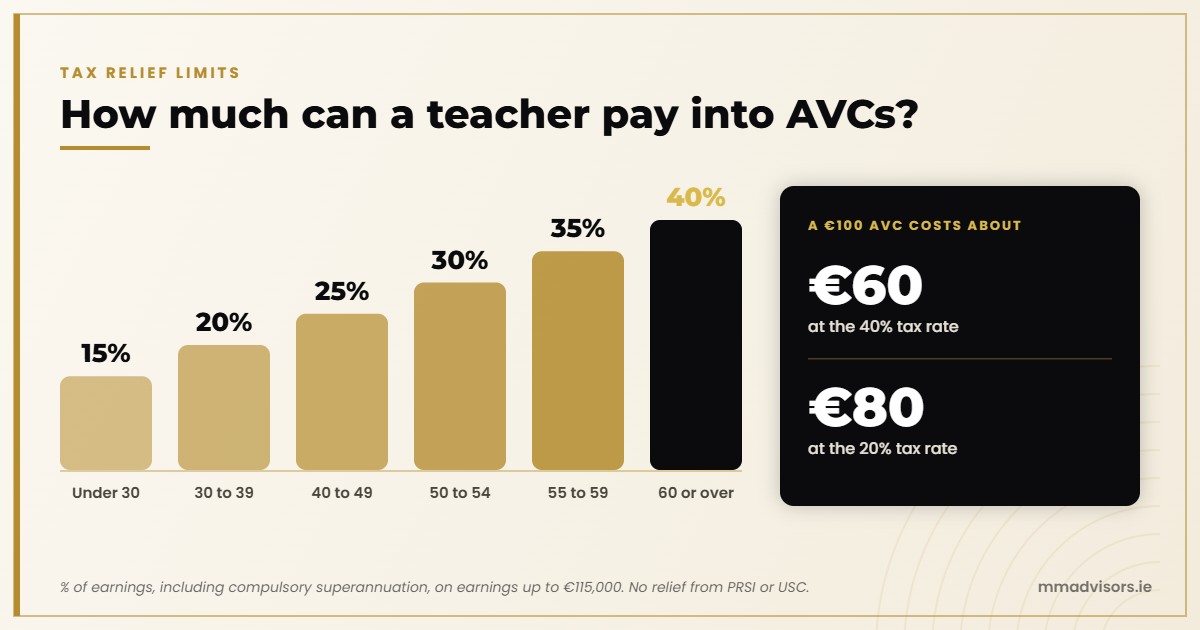
AVCs get income tax relief at your marginal rate. They do not get relief from PRSI or USC. The maximum you can contribute with tax relief depends on your age:
| Age | Maximum % of earnings |
|---|---|
| Under 30 | 15% |
| 30 to 39 | 20% |
| 40 to 49 | 25% |
| 50 to 54 | 30% |
| 55 to 59 | 35% |
| 60 or over | 40% |
These limits include your compulsory superannuation contributions and apply to earnings up to €115,000. A 42 year old teacher earning €60,000 could get relief on total contributions of up to €15,000 a year, less what they already pay into the main scheme.
For a teacher paying 40% tax, a €100 AVC costs about €60 in take home pay. For a teacher paying 20%, it costs about €80. That difference matters when deciding whether AVCs are the right move early in your career.
Are AVCs worth it for teachers?
AVCs tend to make most sense when:
- You have gaps in service from career breaks, job sharing, late entry or years abroad
- You are in the Single Scheme, where career average benefits are often lower than older final salary schemes
- You pay tax at 40% and have spare income after your emergency fund and expensive debt
- You want a larger tax free lump sum at retirement, within the overall lump sum limits
They may be less valuable when:
- You will already reach 40 years of service in an older scheme
- You are on the 20% tax rate and still building savings for a house deposit
- You need access to the money before retirement, since AVC funds are normally locked until you retire
AVCs vs buying back pension years
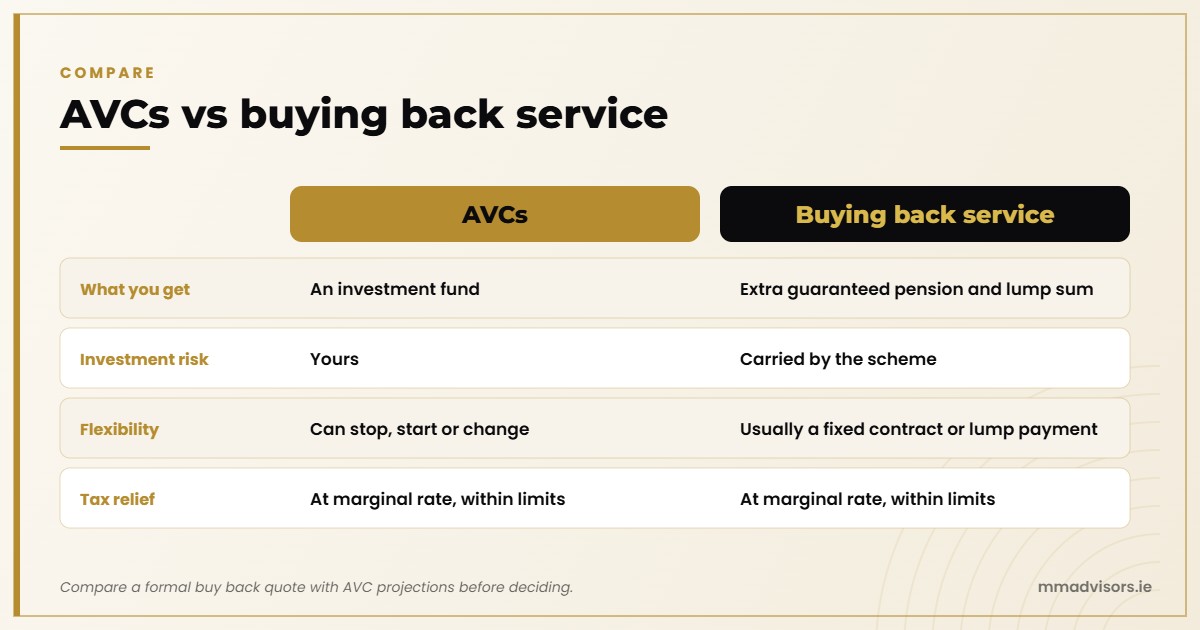
Teachers often ask whether it is better to buy back years or pay AVCs. They are very different products.
| AVCs | Buying back service | |
|---|---|---|
| Who can use it | Most teachers | Eligible members, depending on scheme |
| What you get | An investment fund | Extra guaranteed pension and lump sum |
| Investment risk | Yours | Carried by the scheme |
| Flexibility | Can stop, start or change | Usually a fixed contract or lump payment |
| Tax relief | At marginal rate, within limits | At marginal rate, within limits |
Teachers in older schemes may be able to buy notional service, which adds years to your pension calculation. Single Scheme members cannot buy notional years, but they can buy additional pension or lump sum under the Single Scheme’s own rules.
Buying back service gives certainty, which some teachers value highly. AVCs give flexibility and the potential for higher growth, with the risk of lower returns. The right answer depends on the quote you receive and your attitude to risk. Our guide to the teachers pension in Ireland explains how service affects your benefits.
What happens to AVCs when a teacher retires?
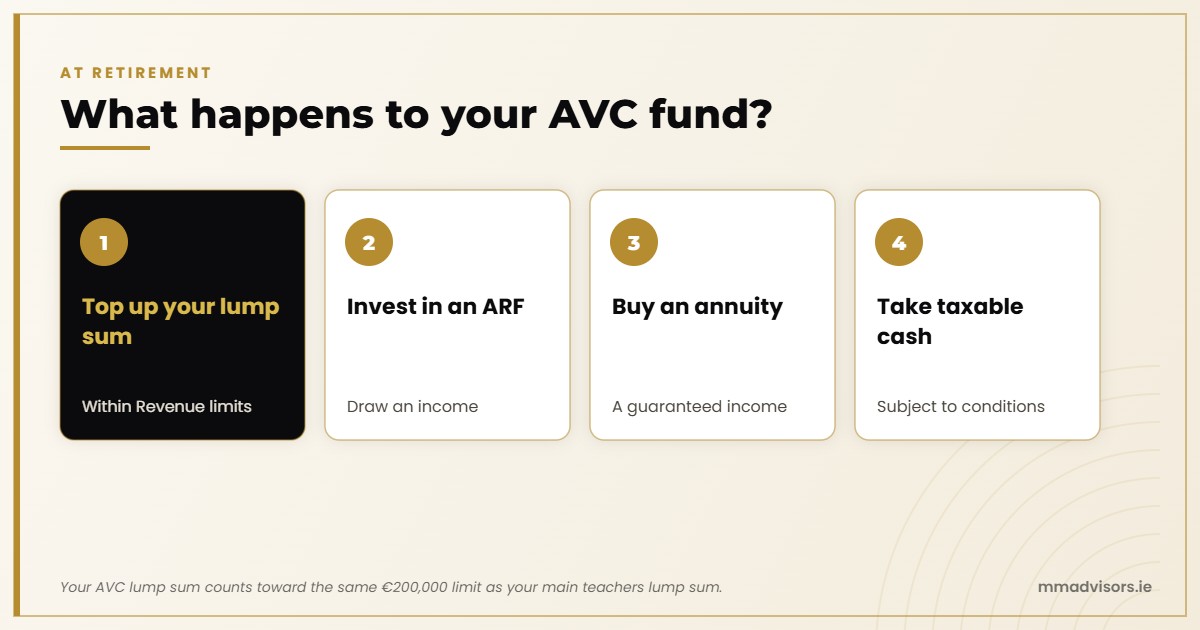
At retirement you can usually use your AVC fund to:
- Top up your retirement lump sum, within Revenue limits
- Invest the balance in an Approved Retirement Fund (ARF) and draw an income
- Buy an annuity for a guaranteed income
- Take part of it as taxable cash, subject to conditions
Remember that your AVC lump sum counts toward the same €200,000 tax free limit as your main teachers lump sum.
The last minute AVC option for teachers near retirement
Teachers close to retirement who have spare savings sometimes make a large AVC in their final year. Because tax relief rises to 40% of earnings from age 60, this can give a sizeable tax refund before the money comes straight back as a lump sum. It must be done carefully and before you leave service. Read more on the last minute AVC.
Check before you start, stop or switch your AVC
- Confirm your pension scheme and service record.
- Get an estimate of your retirement benefits.
- Check charges and investment choices in any existing AVC.
- Compare any buy back quote with AVCs on the same terms.
- Check you are within the age related tax relief limits.
Our public sector superannuation advice service does this review using your actual records.
How MM Advisors helps teachers decide on AVCs
An AVC is not automatically the best next use of your disposable income. When we review AVCs for teachers, we:
- Assess the contribution level you can afford, along with investment risk, fees and when you can access the money
- Check how AVC benefits interact with your occupational scheme and your overall pension tax limits
- Compare the after tax cost with your other priorities, and check contributions already paid in the current tax year
- Compare any purchase quotation, such as notional service or additional Single Scheme benefits, with AVCs and accessible savings, rather than assuming one route suits everyone
- Bring previous pensions into the projection before any transfer is proposed, reviewing charges, guarantees, benefits and risks
- Keep money accessible where you need it, since savings outside a pension may suit a house deposit, parental leave or a career break better
Example: a teacher approaching retirement.
A teacher in their late fifties has an older pension arrangement, some previous pension benefits and an outstanding mortgage. They want to know whether retiring in the next few years is realistic. Their plan could verify service and scheme eligibility, request formal retirement estimates, assess AVC benefits and available savings, compare pension income with household costs, and decide whether to reduce the mortgage balance before leaving work.
Illustrative example only, not a promise of eligibility, outcomes or tax savings. Advice depends on verified records and personal circumstances.
AVCs work best inside a plan that also covers your mortgage, savings and family protection. A financial plan for teachers shows how much to contribute, when, and what it means for your take home pay today.
How the process works
- Understand: we discuss your teaching career, family finances and the decisions you want to make.
- Gather: we review your payslips, pension statements, service history, savings, debts and existing protection.
- Plan: we show practical forecasts, costs, assumptions and a clear action list.
- Implement: we arrange suitable products within our service scope and liaise with your pension administrator, accountant or solicitor when needed.
- Review: we revisit the plan when your income, career pattern, family situation or retirement date changes.
We explain any planning fees, product charges and commission before you proceed.
Teachers’ pensions and AVCs
Review your teachers’ pension and AVC options
FAQs
Are AVCs worth it for teachers in Ireland?
They often are for teachers with service gaps, Single Scheme members and higher rate taxpayers. They may add less value if you will already reach full service. Your scheme, tax rate and need for access all affect the answer.
How much can a teacher pay into an AVC?
The tax relief limit depends on age, from 15% of earnings under 30 up to 40% from age 60. The limit includes compulsory superannuation and applies to earnings up to €115,000 per year.
Is it better to buy back years or pay AVCs?
Buying back service gives a guaranteed increase in pension and lump sum. AVCs offer flexibility and potential growth but carry investment risk. Compare a formal buy back quote with AVC projections before deciding.
Can I access my AVC before I retire?
Generally no. AVC funds are designed for retirement and are normally only accessible when you retire or leave service, subject to scheme rules and Revenue conditions. Keep separate accessible savings for earlier goals.
Can Single Scheme teachers buy back pension years?
Single Scheme members cannot buy notional years of service like older scheme members. They can, however, purchase additional pension or lump sum benefits under the Single Scheme’s own rules, subject to eligibility and cost.
Sources
- Revenue: tax relief limits on pension contributions
- singlepensionscheme.gov.ie: Circular 15/2019, purchase and transfer of retirement benefits
- TUI: Notional Service Purchase Scheme
Money Maximising Advisors Ltd is regulated by the Central Bank of Ireland. C154250.