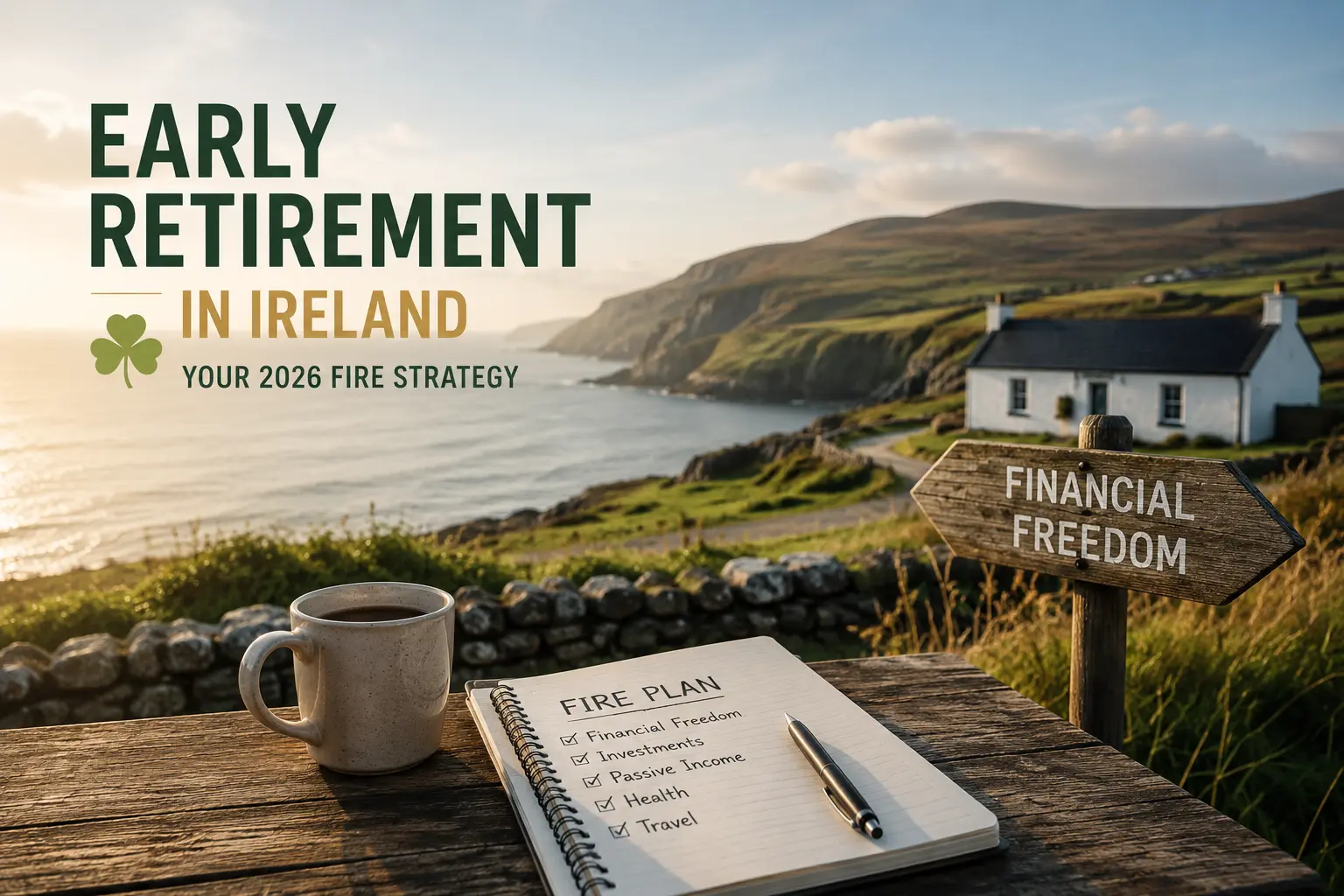
Is retiring in your 40s or even your 30s really possible in Ireland? More Irish people than ever are asking this question — and for good reason. The FIRE movement (Financial Independence, Retire Early) is gaining serious momentum across the country, and in 2026 it has never been more relevant. With rising living costs, shifting pension rules, and a growing awareness of work-life balance, thousands of people in Dublin, Galway, and beyond are rethinking what retirement plan in Ireland actually means to them.
At Money Maximising Advisors Limited, we work with individuals across Ireland every day who want to take control of their financial future. Whether you are just starting out or are already well on your way, this guide will walk you through exactly how early retirement Ireland works, what the FIRE strategy involves, and how you can make it a realistic goal in an Irish context.
What Is the FIRE Movement in Ireland?
The FIRE movement Ireland is built on one central idea: achieve financial independence for Ireland as quickly as possible so that paid work becomes a choice rather than a necessity. FIRE stands for Financial Independence, Retire Early, and it combines aggressive saving, smart investing, and deliberate lifestyle design.
There are a few distinct versions of FIRE that people in Ireland are pursuing:
- Lean FIRE: Living on a very modest budget post-retirement, typically under €25,000 per year.
- Fat FIRE: Retiring with a comfortable lifestyle that may require €50,000 or more annually.
- Barista FIRE: Reaching partial financial independence and supplementing with part-time or flexible work.
- Coast FIRE: Saving enough early on so that compound growth does the heavy lifting over time.
Each variation of the FIRE strategy Ireland has its own trade-offs, and the right one depends on your personal goals, family situation, and income level.
How Does FIRE Work in Ireland?
At its core, the FIRE movement Ireland relies on three pillars: spending less, saving more, and investing wisely. The mathematical foundation is straightforward: if you can save a large proportion of your income and invest it in assets that grow over time, your savings will eventually generate enough passive income to cover your living costs indefinitely.
The most widely used benchmark in FIRE strategy Ireland is the 4% rule for retirement. This rule suggests that if you withdraw no more than 4% of your portfolio each year, your savings should theoretically last for 30 years or more. In practical terms, if you want to live on €40,000 per year in retirement, you would need a portfolio of approximately €1 million (€40,000 divided by 0.04).
How Much Money Do You Need to Retire Early in Ireland?
This is one of the most common questions we hear at Money Maximising Advisors Limited. The honest answer: it depends. Your target number is shaped by your expected annual spending in retirement, your projected investment returns, your tax situation, your age at retirement, and whether you will have a pension pot running alongside your FIRE fund.
Here is a rough guide based on annual expenditure and the 4% rule:
| Annual Spending | FIRE Number (25x) | Notes |
| €25,000 | €625,000 | Lean FIRE lifestyle |
| €40,000 | €1,000,000 | Comfortable middle ground |
| €60,000 | €1,500,000 | Fat FIRE / family lifestyle |
| €80,000+ | €2,000,000+ | High-income earner target |
Keep in mind that a retirement plan in Ireland rarely relies on investment portfolios alone. State pension entitlements, Approved Retirement Funds (ARFs), and property income can all reduce the amount you need to save yourself. A qualified financial advisor can help you model exactly what your target number should be.
Further Reading
You may also find these related guides helpful:
- Pension Plan in Ireland: How Much Will My Pension Pay Me If I Retire at 60?
- Section 72 Pension Ireland: A Smart Guide to Tax-Efficient Retirement Planning in 2026
- Your Complete Guide to Pension Planning in Ireland 2026: Why Now Is the Time to Secure Your Retirement
- What Happens to Your Pension After Redundancy in Ireland? A 2026 Guide to Protecting Your Retirement Savings
- Saving Pension Plan in Ireland: The 2026 Expert Guide to Building a Secure Retirement
FIRE and the Irish Tax Landscape: What You Need to Know
One of the biggest challenges for anyone pursuing financial independence Ireland is navigating the Irish tax system. Unlike some other countries, Ireland has specific rules around investment returns and early access to pension funds that you need to factor into your planning.
Exit Tax on Investment Funds
In Ireland, gains from investment funds — including many ETFs — are subject to Exit Tax at 41%. This tax applies every eight years (the deemed disposal rule), even if you have not sold your investment. This is a significant consideration for anyone building a FIRE strategy Ireland portfolio, as it can erode returns compared to what FIRE calculators from the UK or US might suggest.
Pension Access Age Rules
Under current Irish pension legislation, you generally cannot access an occupational pension before age 50, and for personal pensions it is typically age 60. For those pursuing early retirement Ireland, this means your FIRE savings and your pension pot must be treated as two separate pots — with different timelines for access.
Capital Gains Tax (CGT)
Profits from selling shares or property are subject to CGT at 33% in Ireland. However, you benefit from an annual CGT exemption of €1,270 per person. Couples can double this to €2,540 annually — a small but useful tool in your retirement planning Ireland strategy.
Want to understand how Irish tax rules apply to your specific FIRE plan? Enquire Now and one of our expert advisors will be in touch.
How to Build Your FIRE Plan in Ireland: A Step-by-Step Approach
Achieving how to retire early in Ireland is not about luck — it is about putting a disciplined plan in place and sticking to it. Here is a practical framework used by real people pursuing early retirement Ireland:
Step 1: Calculate Your FIRE Number
Work out your expected annual spending in retirement, then multiply it by 25. This gives you your target portfolio size based on the 4% withdrawal rule. Remember to account for inflation, healthcare costs, and potential family expenses.
Step 2: Maximise Pension Contributions
Even if you plan to retire early Ireland, your pension is still one of the most tax-efficient savings tools available. In Ireland, pension contributions attract income tax relief at your marginal rate — 40% for higher earners. Think of it as the Government effectively topping up your retirement savings.
Step 3: Build a Bridge Fund
Because you cannot access your Irish pension until at least age 50–60, you will need a separate bridge fund to cover living costs from your retirement date until pension access age. This is typically invested in a mix of equities, bonds, and cash. The exact structure depends on your timeline and risk appetite.
Step 4: Reduce Spending Without Sacrificing Quality of Life
Every euro you save and invest instead of spending moves your FIRE date closer. The most impactful areas to address are usually housing costs, car expenses, and lifestyle inflation. That said, FIRE is not about suffering — it is about intentional spending aligned with your values.
Step 5: Increase Your Income
Higher savings rates accelerate the FIRE timeline dramatically. Whether through salary negotiation, a side business, rental income, or career progression, increasing your income gives you more capital to invest and compounds over time.
Ready to get a personalised retirement plan in Ireland? Book Now to speak with one of our Certified Financial Planners.
Is FIRE Realistic in Ireland in 2026?
The honest answer is: yes, but it requires serious planning. The FIRE movement in Ireland is absolutely achievable, but the Irish context — high housing costs, unfavourable ETF taxation, and later pension access ages — means that a direct copy-paste of strategies from the US or UK will not work. You need an approach tailored to Ireland.
Despite these hurdles, many Irish people are successfully pursuing financial independence in Ireland by combining their pension pot, a well-structured bridge fund, and consistent investing in diversified assets. The key is a retirement plan in Ireland that is built specifically for the Irish tax and regulatory environment.
Our Retirement Planning Services
| Service | How We Help |
| FIRE & Retirement Planning | Personalised strategy aligned to Irish tax law and your timeline |
| Pension Advice | Maximise tax-relieved contributions and plan access timing |
| Investment Portfolio Review | Build an Irish-compliant portfolio for your bridge fund |
| Tax Planning | Navigate Exit Tax, CGT, and marginal relief efficiently |
| Life Insurance & Protection | Safeguard your plan against the unexpected |
Conclusion
The FIRE movement Ireland is not just a trend — it is a genuine, achievable path to financial independence for those who plan carefully and act consistently. Whether you want to retire early in Ireland at 45 or simply have the option to work on your own terms by 55, the principles of FIRE can work for you.
The key is getting the foundations right: a solid retirement plan in Ireland, a tax-efficient pension structure, a well-funded bridge account, and a clear investment strategy built for Irish tax law. None of that needs to be complicated — it just needs expert guidance.
At Money Maximising Advisors Limited, our team of Certified Financial Planners and Qualified Financial Advisors can help you design a retirement planning Ireland strategy that fits your life, your income, and your ambitions. We work with clients across Dublin, Galway, and throughout Ireland to turn financial independence from a dream into a concrete plan.
Contact Us today to start your journey, or Book an Appointment with one of our advisors at a time that suits you.
Frequently Asked Questions (FAQs)
1. What is the FIRE movement in Ireland?
FIRE stands for Financial Independence, Retire Early. It is a lifestyle and financial strategy that focuses on aggressive saving and investing to reach financial independence well before the traditional retirement age. In Ireland, it requires careful planning around pension rules, Exit Tax, and the high cost of living in cities like Dublin and Galway.
2. How does FIRE work in Ireland?
The FIRE strategy Ireland works by building a portfolio large enough to generate passive income that covers your living costs, typically using the 4% withdrawal rule. Irish practitioners need to account for two separate pots — a bridge fund for early years and a pension for later access — due to the minimum pension access age in Ireland.
3. Is FIRE realistic in Ireland?
Yes, FIRE movement Ireland is realistic, but it requires a strategy tailored to the Irish tax environment. Factors such as Exit Tax on ETFs, CGT at 33%, and pension access restrictions mean that generic FIRE advice from the US or UK needs significant adaptation for Irish residents.
4. How much money do you need to retire early in Ireland?
Using the 4% rule, you need 25 times your expected annual expenses. For example, if you plan to spend €40,000 per year, you would need a portfolio of approximately €1,000,000. However, State Pension entitlements and other income sources in later years can meaningfully reduce this figure. A personalised retirement plan in Ireland can give you a precise number.
5. What is the 4% rule for retirement?
The 4% rule is a guideline suggesting that if you withdraw 4% of your portfolio in year one of retirement and adjust for inflation each year thereafter, your portfolio should theoretically last 30 or more years. It is the most commonly used benchmark in FIRE planning globally, though Irish investors should factor in Exit Tax and local inflation when applying it.
6. Can I access my pension early in Ireland?
In most cases, the earliest you can access an occupational pension in Ireland is age 50, and personal pensions are typically accessible from age 60. This is why building a separate bridge fund is essential for anyone pursuing early retirement Ireland before pension access age.
Disclaimer
This article provides general information and should not be considered personalised financial, investment, or tax advice. The FIRE strategy involves significant financial decisions and the information above does not take your individual circumstances into account. Irish tax laws, pension rules, and investment regulations change periodically. Always consult with a qualified financial advisor or tax professional before making significant financial decisions related to early retirement, pension planning, or investment strategies. Money Maximising Advisors Limited is regulated by the Central Bank of Ireland.