Ireland’s new auto-enrolment pension scheme, My Future Fund, went live on 1 January 2026. If you work in Galway and earn over €20,000 a year, you may already be enrolled. This guide explains what that means for your pay packet, your retirement pot, and your options.
You’ll see exactly how much goes in each year. You’ll see how the numbers stack up over ten years. And you’ll see whether staying in beats a private pension for your situation. Written by the pension team at Money Maximising Advisors, based in Galway.
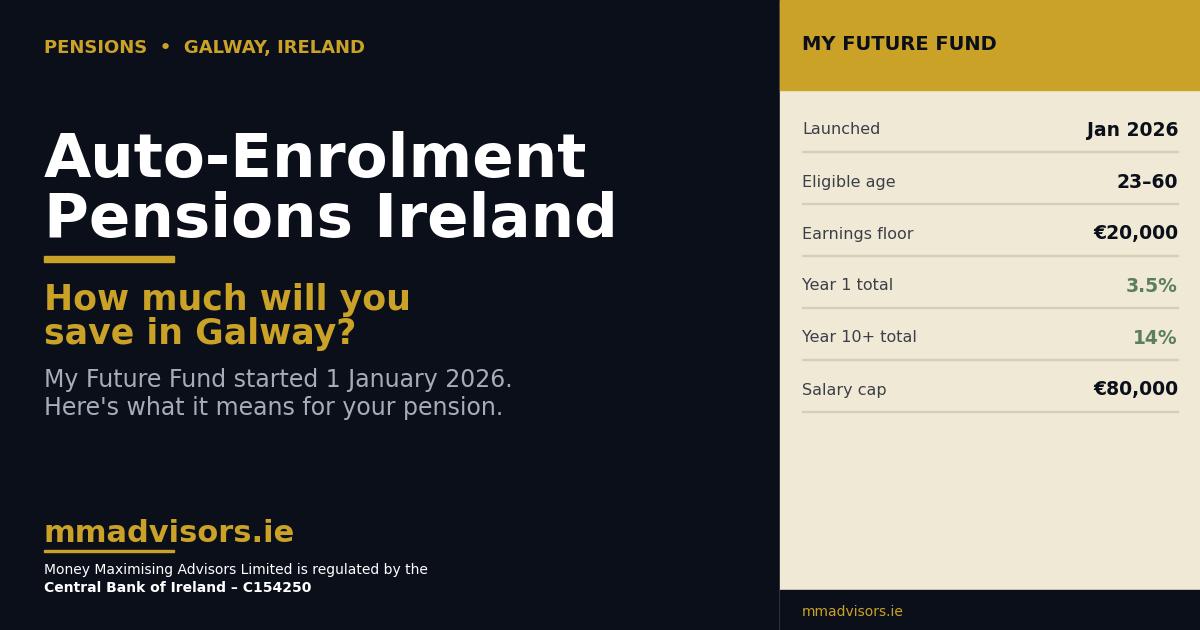
| QUICK ANSWER My Future Fund enrols eligible Galway workers aged 23–60 who earn over €20,000 per year and are not already in a workplace pension. In Year 1 you contribute 1.5% of your salary. Your employer matches 1.5%. The State adds another 0.5%. Total: 3.5% of your gross pay goes into your pension every year. By Year 10, that total rises to 14%. |
| This guide sits within our Pensions hub and connects Galway workers to Occupational Pensions, Additional Voluntary Contributions (AVCs), Pensions For The Self Employed and Retirement Planning Advice. |
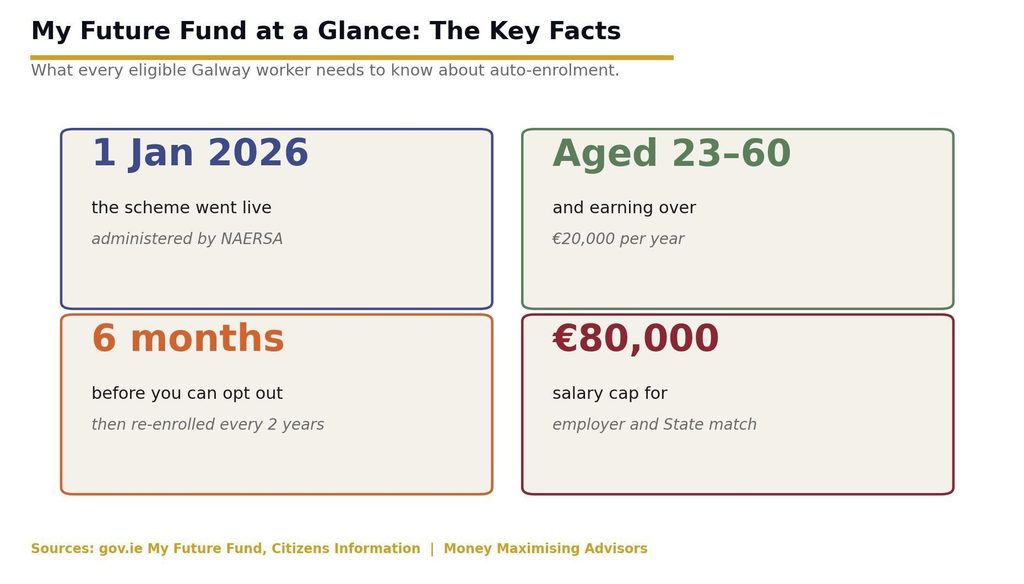
The four numbers every Galway worker should know about My Future Fund.
What is auto-enrolment in simple terms?
Auto-enrolment means the pension signs you up automatically. You don’t fill in forms. You don’t opt in. Your employer just starts deducting a small amount from your pay each month.
That money goes into My Future Fund. Your employer adds a matching amount. The State adds a top-up too. The total sits in a pension pot for you until retirement.
The scheme is run by NAERSA, the National Automatic Enrolment Retirement Savings Authority. It’s independent, and it started operating on 1 January 2026.
When did auto-enrolment start in Ireland?
Auto-enrolment went live on 1 January 2026. This was after two delays. The scheme was first planned for January 2025, then September 2025. It finally launched on the first day of the 2026 tax year.
Ireland was the last OECD country to introduce workplace pension auto-enrolment. That gap is now closed.
Who qualifies for auto-enrolment in Galway?
You are enrolled automatically if all three apply:
- Age. You are aged between 23 and 60.
- Earnings. You earn €20,000 or more per year from your employment.
- No existing pension. You are not already paying into a workplace pension through payroll.
If you have a PRSA that is not deducted through payroll, you may still be enrolled. If you already contribute through work — to an occupational pension or a payroll PRSA, you are not enrolled.
Workers under 23, over 60, or earning under €20,000 can opt in if they want to. This is a great option for lower earners or younger workers who want to start saving early.
How much do you contribute to auto-enrolment?
Your contribution starts small. It rises every three years. This gives your payslip time to adjust.
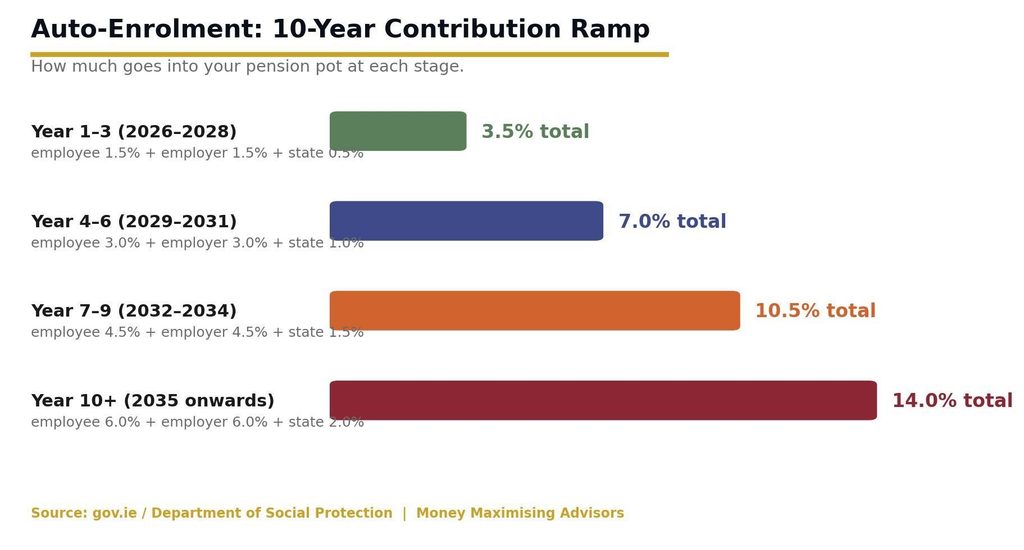
The contribution rates rise every three years until they reach the target 14% total in 2035.
The full ramp works like this:
- Year 1–3 (2026–2028). 1.5% employee + 1.5% employer + 0.5% State = 3.5% total.
- Year 4–6 (2029–2031). 3% + 3% + 1% = 7% total.
- Year 7–9 (2032–2034). 4.5% + 4.5% + 1.5% = 10.5% total.
- Year 10+ (from 2035). 6% + 6% + 2% = 14% total.
The employer and State contributions are capped. They only apply on the first €80,000 of gross salary. If you earn more, you can still contribute yourself, but your employer and the State won’t match the excess.
What does your employer contribute?
Your employer must match every contribution you make. This is a legal requirement. In Year 1, your employer pays 1.5% of your salary into your pension pot alongside your own contribution.
Think of it as free money. You would not turn down a 1.5% pay rise. Auto-enrolment gives you exactly that, paid into your pension rather than your bank account.
How does the government top-up work?
The State adds €1 for every €3 you contribute. This is the same as 33% tax relief. In Year 1, when you contribute 1.5% of salary, the State adds 0.5%.
Important detail: this is not tax relief. It is a direct State top-up. Your contribution is made from post-tax income. The State just adds extra on top.
This matters for higher earners. A PRSA or occupational pension gives income tax relief at your marginal rate. If you pay 40% tax, that relief is worth more than the 33% State top-up. We explain how to compare below.
What will you actually save by retirement? A Galway example
Meet Aoife. She works for a med-tech company in Ballybrit and earns €50,000 per year. She was enrolled automatically in January 2026.
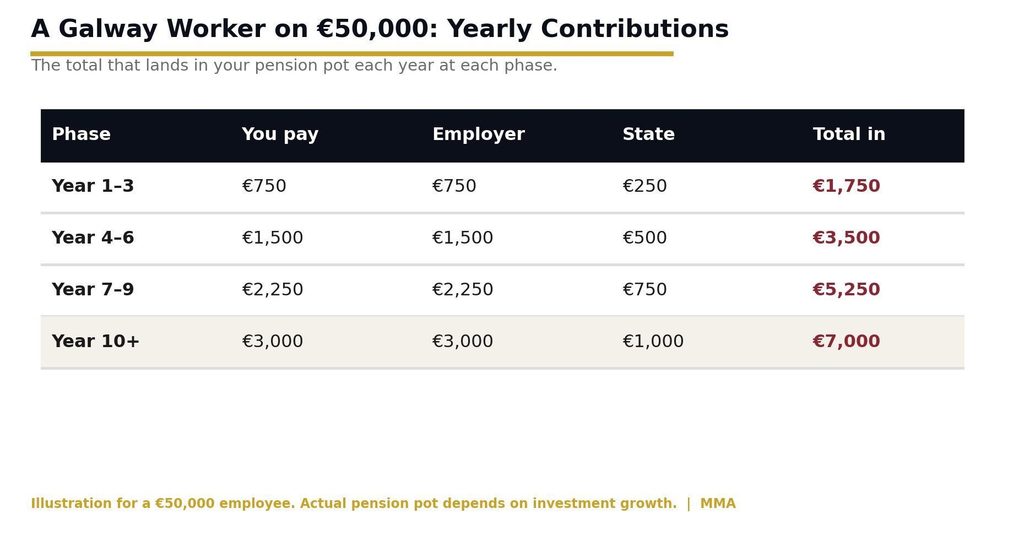
Aoife’s contributions build over time and the total that lands in her pension pot each year rises with the phased rates.
In Year 1, Aoife contributes €750. Her employer adds €750. The State adds €250. Total in: €1,750 for the year.
By Year 10, when the rates hit their target, the numbers get much bigger. Aoife pays in €3,000. Her employer pays in €3,000. The State adds €1,000. Total in for that year: €7,000.
Assuming a 5% average annual investment return and 30 years to retirement, that pattern could build a pension pot of over €280,000. That’s before including any private top-ups. If Aoife also makes Additional Voluntary Contributions (AVCs), the number climbs much higher.
| Not sure if auto-enrolment is best for you? Book Now for a free 30-minute review with a Galway pension advisor, or Enquire Now and we’ll be in touch within one working day. |
Can you opt out of auto-enrolment?
Yes — but not straight away. You cannot opt out during the first six months. After that, you can leave the scheme in months 7 or 8.
If you opt out during that two-month window, you get your contributions refunded. You keep the money. Your employer and the State contributions do not come back to you.
There’s a catch. Every two years, you are re-enrolled automatically — unless you have joined another pension scheme in the meantime. This is a deliberate design. It nudges you back in.
Auto-enrolment vs a private pension: which is better?
Both build a retirement pot. But the tax treatment is different. This matters a lot for higher earners.
For lower-rate taxpayers
Auto-enrolment is often the better option. The State’s 33% top-up beats the 20% income tax relief on a PRSA.
For higher-rate taxpayers
A PRSA or occupational pension often wins. The 40% marginal-rate income tax relief is worth more than the 33% State top-up.
The employer match is what tips the balance. If your employer already contributes to a workplace pension at a higher rate than they would through auto-enrolment, stay in the workplace pension. If they only contribute the auto-enrolment minimum, you may be better off in a separate PRSA.
For the self-employed
Auto-enrolment does not apply. You need a PRSA or Personal Pension. Contribution limits are much higher, and tax relief is at your marginal rate up to age-related caps.
What Galway employers should know
If you run a business in Galway, you have legal duties under auto-enrolment. You must set up a My Future Fund profile as an employer. You must identify eligible workers. You must remit contributions through payroll.
Larger Galway employers — in med-tech, pharma, IT, tourism, retail and hospitality — have mostly prepared. Smaller employers are still catching up. If you need to review your obligations, our Corporate Financial Wellness Advice service can help.
Common auto-enrolment mistakes to avoid
- Opting out too quickly. You lose your employer’s match and the State top-up. That’s often a 4× return on your own contribution.
- Not checking if it beats a PRSA. For higher-rate taxpayers, a PRSA may deliver a better outcome. Get advice before deciding.
- Ignoring your existing pension. If you already have a workplace pension, you are not enrolled. Check with your HR team.
- Assuming the State top-up is tax relief. It is not. Your contribution is post-tax. The maths is different from a PRSA.
- Waiting to review. A quick review now can add tens of thousands to your retirement pot over 20–30 years.
Related posts
Frequently asked questions
What is auto-enrolment in Ireland?
Auto-enrolment is a State-run pension scheme called My Future Fund. It automatically signs up employees aged 23–60 earning over €20,000 per year, if they are not already in a workplace pension. Contributions come from the employee, the employer, and the State.
When did My Future Fund start?
My Future Fund started on 1 January 2026. Eligible employees have been enrolled through their payroll since then.
How much does auto-enrolment cost me each month?
In Year 1 you contribute 1.5% of your gross pay. On a €50,000 salary, that’s about €62 per month. Your employer adds another €62. The State adds around €21 per month on top of that.
Can I opt out of My Future Fund?
Yes, but only after the first six months. You can opt out during months 7 and 8. If you do, your contributions are refunded. You lose the employer and State top-ups. You are automatically re-enrolled after two years unless you join another pension.
Is auto-enrolment better than a PRSA?
It depends on your income tax band and your employer’s contribution. For lower-rate taxpayers, auto-enrolment often wins. For higher-rate taxpayers, a PRSA typically gives a better outcome. Our team runs the numbers for your specific situation.
What if I earn over €80,000?
The employer match and State top-up are capped at €80,000 of salary. You can still contribute yourself on income above that, but your employer and the State will not match it.
Reviewed by our Galway pension team
This guide was prepared and reviewed by the pension team at Money Maximising Advisors, using gov.ie My Future Fund rules, Department of Social Protection publications, and NAERSA guidance current at January 2026. Watch our video breakdowns on the Money Maximising Advisors YouTube channel. Money Maximising Advisors Limited is regulated by the Central Bank of Ireland (C154250).
Galway worker? Let’s build your plan.
Whether you have just been auto-enrolled, want to top up with AVCs, or are weighing up a PRSA instead, our Galway pension team will show you the numbers side by side and help you pick the best route. Book Now for your free 30-minute consultation, or Enquire Now — we reply within one working day.
Important information
My Future Fund contribution rates, salary caps and eligibility criteria are those in force under the Automatic Enrolment Retirement Savings System Act 2024 as commenced on 1 January 2026. Money Maximising Advisors Limited is regulated by the Central Bank of Ireland (C154250). This article is for general information only and does not constitute financial, tax or legal advice. The value of pension investments can fall as well as rise, and past performance is not a reliable indicator of future returns. Speak to a Qualified Financial Advisor before making any pension decision.