What Does Backdating Pension Tax Relief Mean?
If you are reviewing your finances before filing your Income Tax return, you may be able to make a qualifying pension contribution and elect to claim tax relief against your income for the previous tax year.
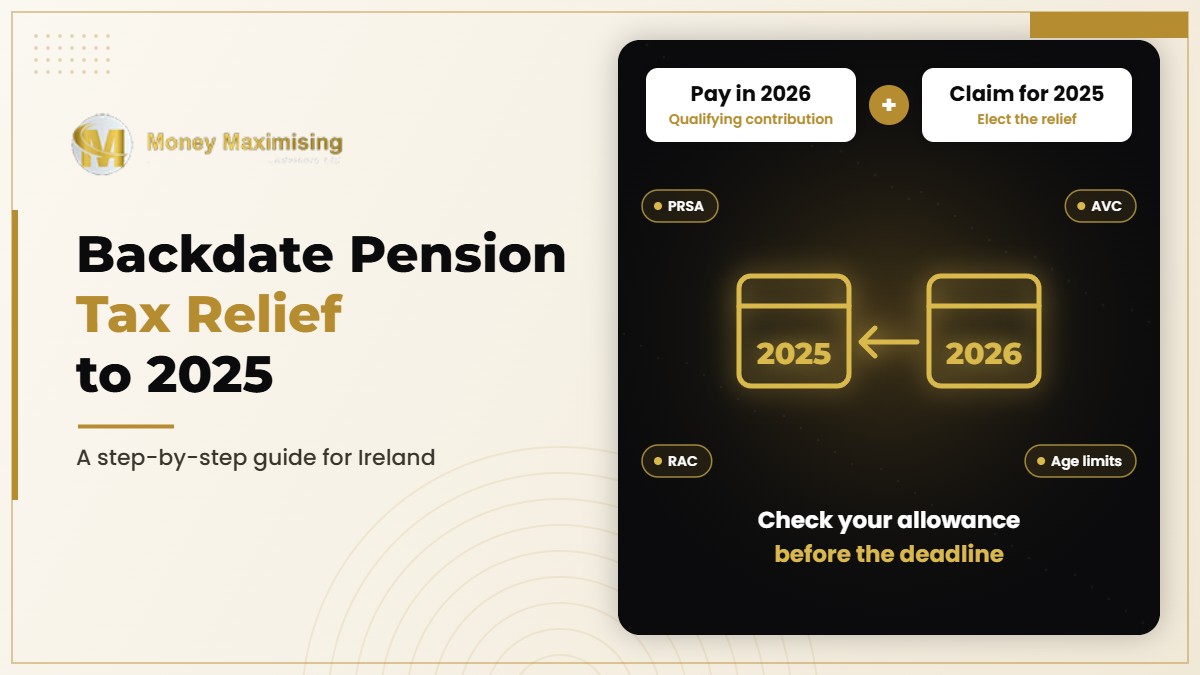
This is commonly known as backdating pension tax relief. The contribution is made after the tax year ends, but eligible taxpayers may elect to have the available Income Tax relief applied to the earlier year, subject to Revenue’s conditions and deadlines.
For example
An eligible individual who makes a qualifying pension contribution in 2026 may be able to claim relief against their 2025 income.
This can be particularly relevant if you have not used your full pension contribution allowance for 2025 and want to increase your retirement savings while making use of available tax relief.
However, backdating is not automatic. You must meet the eligibility requirements, stay within the applicable contribution limits and complete the necessary steps before the relevant deadline.
If you are self-employed, you may also want to read our guide to pension tax relief for sole traders in Ireland, which explains the contribution limits and potential tax benefits for self-employed individuals.
Who Can Claim Pension Tax Relief Against 2025 Income?
Your eligibility depends on your employment status, pension arrangement, earnings and existing contributions.
Qualifying pension arrangements may include:
- Personal Retirement Savings Accounts (PRSAs): Personal pension arrangements available to eligible employees and self-employed individuals.
- Additional Voluntary Contributions (AVCs): Additional contributions that eligible members of occupational pension schemes can make to increase their retirement benefits.
- Retirement Annuity Contracts (RACs): Personal pension arrangements commonly used by self-employed individuals and people in non-pensionable employment.
- Other qualifying pension arrangements: These may be subject to different rules depending on the scheme and contribution type.
The process for claiming relief can differ depending on your pension arrangement and how you file your tax return.
If you are a PAYE employee, pension contributions deducted through payroll may already receive tax relief. If you make an eligible contribution outside payroll, you may need to claim the relief separately.
Self-employed individuals generally claim eligible personal pension contribution relief through Revenue Online Service (ROS).
For more information, read our guide on how pension contributions affect your tax return in Ireland.
You can also consult Revenue’s official guidance on pension tax relief.
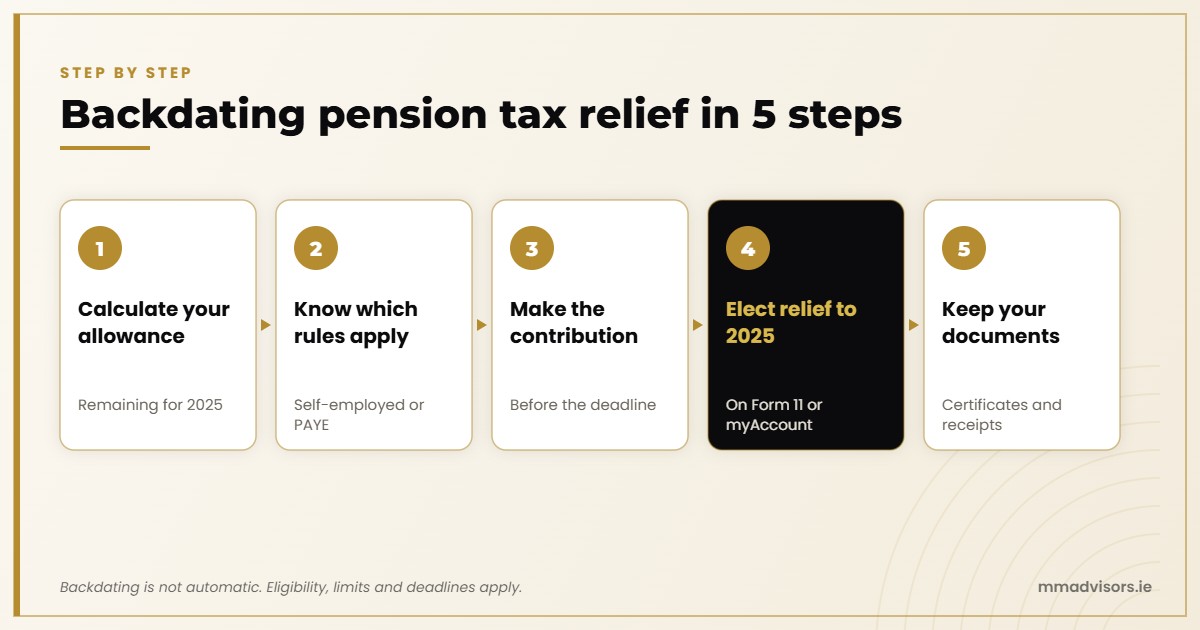
Step 1: Calculate Your Remaining Pension Contribution Allowance
Before making an additional contribution, calculate how much of your available allowance remains for 2025.
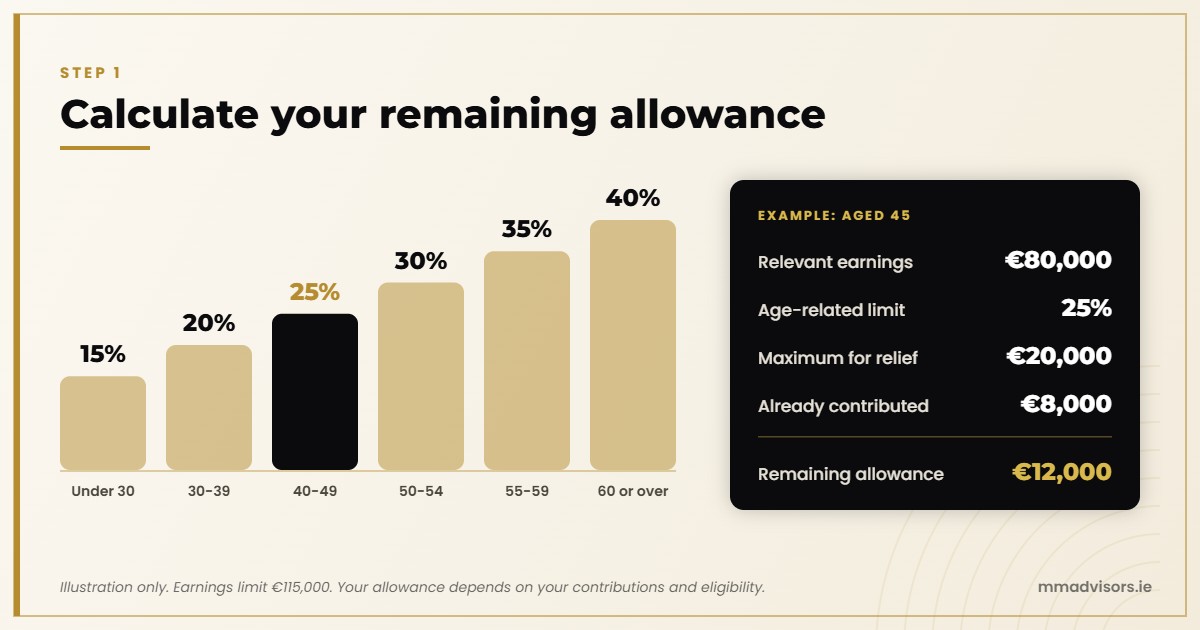
For personal pension contributions eligible for age-related relief, the maximum percentage of relevant earnings depends on your age.
| Age | Maximum percentage of relevant earnings |
|---|---|
| Under 30 | 15% |
| 30-39 | 20% |
| 40-49 | 25% |
| 50-54 | 30% |
| 55-59 | 35% |
| 60 or over | 40% |
The annual earnings limit used to calculate this relief is €115,000.
Your available allowance may be lower after accounting for qualifying contributions already made. Different rules may apply depending on the pension arrangement and your circumstances.
Example: Calculating Your Remaining Allowance
Suppose you are aged 45 and had relevant earnings of €80,000 in 2025.
Your age-related limit is 25% of relevant earnings.
| Relevant earnings | €80,000 |
| Age-related percentage | 25% |
| Maximum contribution potentially eligible for relief | €20,000 |
If you have already made €8,000 in qualifying contributions that count towards the same limit, your remaining allowance could be €12,000.
This is an illustration. Your actual allowance depends on the contributions already made, the relevant pension rules and your eligibility.
It is important to calculate your remaining allowance before making a payment. Contributing more than the amount eligible for relief does not guarantee additional tax benefits.
Step 2: Understand Which Tax Relief Rules Apply to You
The process for claiming relief depends on your employment status and pension arrangement.
If You Are Self-Employed
Self-employed individuals generally claim relief on eligible personal pension contributions through ROS when completing their Income Tax return.
Before making an additional payment, review your relevant earnings for 2025, your age-related limit and the contributions already made.
Our guide to pension tax relief for sole traders explains how these limits may affect your tax planning.
You can also explore the MM Advisors sole trader pension page to learn more about pension planning options.
If You Are a PAYE Employee
If your pension contributions are deducted directly from your salary, your employer will generally apply the available tax relief through payroll.
If you made eligible contributions outside payroll and relief has not already been granted, you may be able to claim it through Revenue’s myAccount service.
Revenue’s general process includes:
- Sign in to myAccount.
- Open PAYE Services and select the option to review your tax for the previous four years.
- Request a Statement of Liability.
- Complete the relevant Income Tax Return.
- Enter qualifying AVC or PRSA contribution details under the appropriate section.
- Submit the return and any supporting documents required.
The exact process depends on your circumstances and the type of contribution. Follow Revenue’s current instructions rather than assuming all pension payments are treated in the same way.
If you are a public sector employee with additional rental income, read our article on AVCs and rental income tax relief for employees in Ireland.
For further guidance, visit Revenue’s instructions on claiming pension tax relief.
Step 3: Make the Qualifying Pension Contribution
Once you have confirmed your eligibility and remaining allowance, contact your pension provider or financial adviser to establish how to make the contribution.
Before paying, confirm the following:
- Your pension arrangement qualifies for the intended tax relief.
- The contribution amount falls within your available allowance.
- The payment will be made before the applicable deadline.
- The contribution can be elected for relief against 2025 income.
- You know what documentation will be issued as proof of payment.
Keep the payment confirmation and any pension contribution certificate or receipt.
A payment alone does not guarantee that relief will be granted against 2025 income. The relevant conditions and election requirements must also be met.
If you are considering a contribution close to the deadline, contact your provider early. Provider processing times and documentation requirements may affect how quickly your payment can be completed.
Step 4: Elect to Claim Relief Against 2025 Income
If you make a qualifying pension contribution after the end of the tax year, you may be able to elect to claim the available relief against your 2025 income.
You must follow the process applicable to your pension arrangement and tax return.
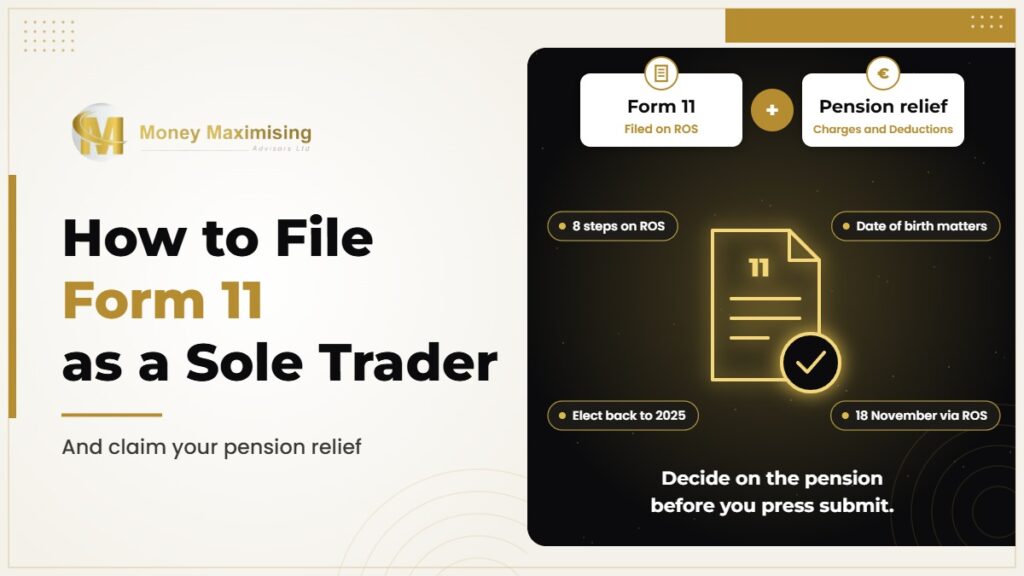
For eligible self-assessed taxpayers, this generally involves declaring the contribution and making the appropriate election when completing Form 11 through ROS.
PAYE employees may need to claim relief through myAccount, depending on their circumstances and the contribution involved.
When completing your return:
- Enter the correct pension contribution details.
- Identify the appropriate pension arrangement.
- Account for contributions already made.
- Follow the instructions for claiming relief against the intended tax year.
- Submit any supporting documentation required by Revenue.
Do not assume that every pension contribution can automatically be carried back to the previous tax year. Confirm the rules for your specific arrangement before submitting the return.
You can find further information in Revenue’s guide to claiming pension tax relief.
Step 5: Keep Your Pension and Tax Documents
Good record-keeping can help you demonstrate that the contribution was made and support your tax relief claim.
Keep copies of the following, where applicable:
- Pension provider contribution certificates.
- Receipts showing the contribution amount and payment date.
- Bank transfer confirmations or other proof of payment.
- Pension policy or account details.
- Records of contributions already made during 2025.
- Your submitted Income Tax return and relevant Revenue correspondence.
For AVC claims, Revenue may require a copy of the certificate or a detailed receipt. If the certificate is unavailable, Revenue provides guidance on the alternative information and proof of payment that may be submitted.
Keeping these documents organised before completing your return can help reduce delays and make it easier to verify the amount claimed.
What Are the Pension Tax Relief Deadlines for 2025?
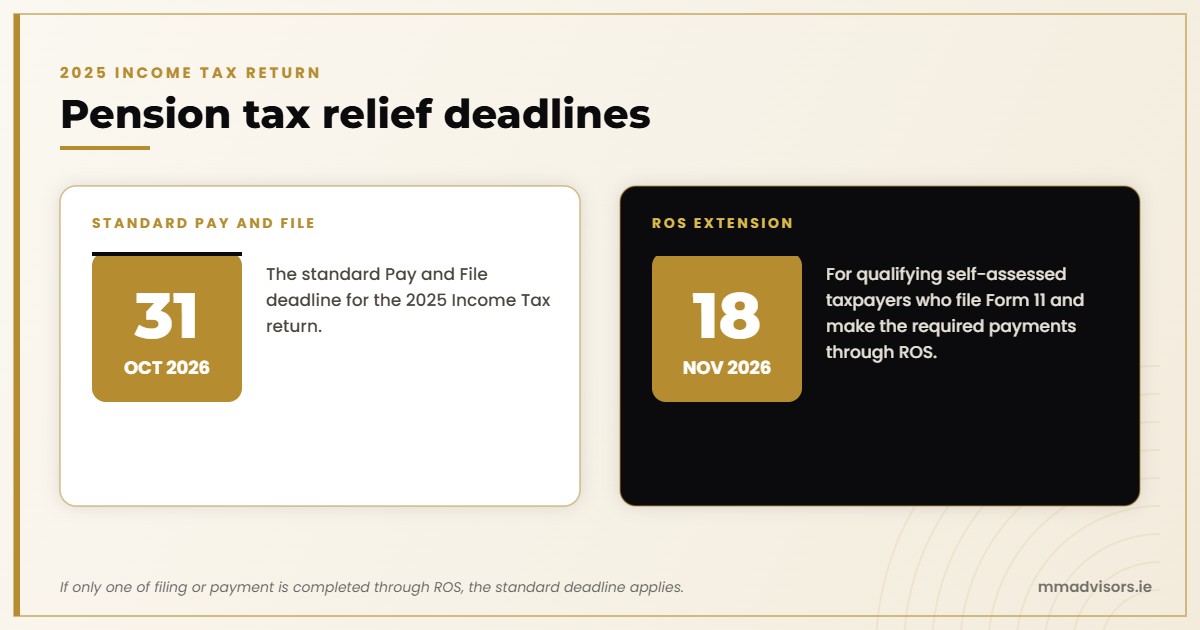
The standard Pay and File deadline for the 2025 Income Tax return is 31 October 2026.
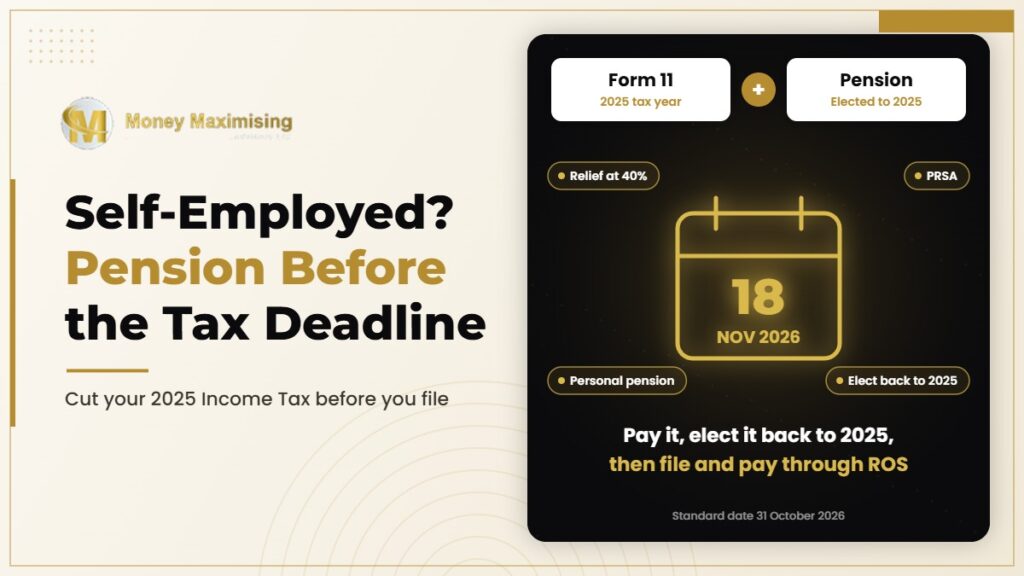
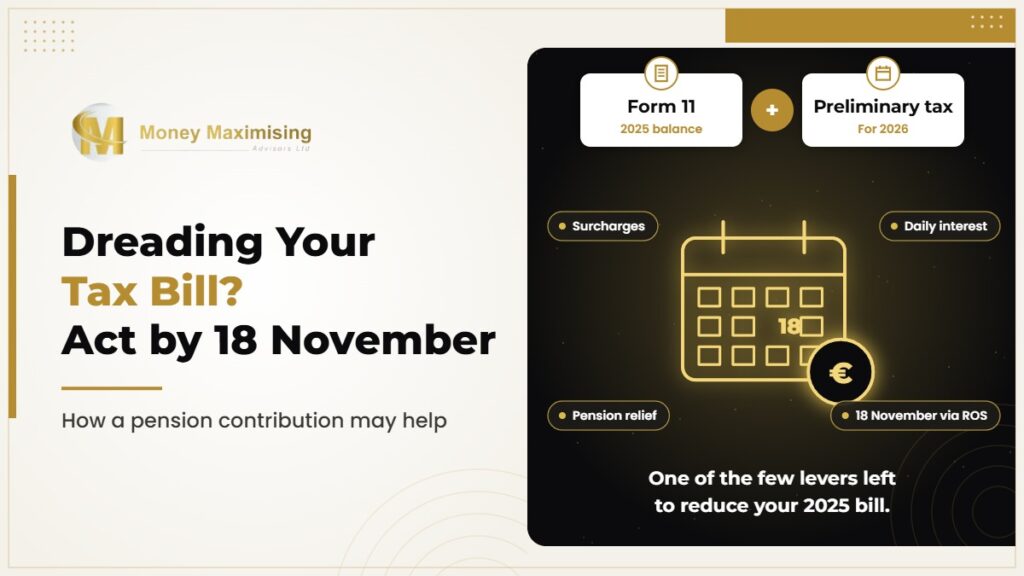
Revenue has extended the deadline to 18 November 2026 for qualifying self-assessed taxpayers who file their 2025 Form 11 and make the required payments through ROS.
The extension is conditional. To qualify, the taxpayer must meet Revenue’s requirements for both filing and payment through ROS. If only one is completed through ROS, the standard deadline applies.
The deadline for a pension contribution and the election to claim relief against the previous tax year must also be checked against the rules applicable to the particular pension arrangement.
If you are relying on the extended deadline, confirm your eligibility and allow sufficient time for your pension provider to process the payment.
For more information about the October tax deadline and pension planning, read our related article: October Tax Deadline in Ireland: Pension Tax Relief.
You can also consult Revenue’s official Pay and File guidance.
Common Mistakes to Avoid
Assuming Every Pension Contribution Can Be Backdated
Eligibility depends on the pension arrangement, contribution date and applicable Revenue rules. Confirm that your contribution qualifies before relying on relief against 2025 income.
Overlooking Existing Contributions
Your remaining allowance may be reduced by qualifying contributions already made. Review your pension records before calculating an additional contribution.
Missing the Applicable Deadline
A qualifying contribution does not automatically mean relief will be applied to the previous tax year. The required payment and election must meet the relevant deadline.
Claiming Relief Twice
If relief has already been granted through payroll or another process, make sure you account for it correctly when preparing your return.
Confusing Income Tax Relief With USC and PRSI Relief
The personal pension contribution relief discussed in this article applies to Income Tax. It does not provide relief from USC or PRSI on employee pension contributions.
Making a Contribution Without Reviewing Your Finances
Although pension contributions can offer tax benefits, you should also consider your immediate financial commitments, business costs and emergency savings before deciding how much to contribute.
Frequently Asked Questions
Can I claim pension tax relief for 2025 if I contribute in 2026?
In eligible circumstances, yes. You may be able to make a qualifying contribution after the end of 2025 and elect to claim relief against your 2025 income, provided the applicable payment and election requirements are met.
Can I backdate an AVC contribution?
Certain qualifying AVC contributions may be eligible for relief against the previous tax year, subject to the applicable conditions, contribution limits and deadlines. Confirm the rules for your specific pension arrangement before making a payment.
Do I need to submit proof of my pension contribution?
Revenue may require a pension certificate, detailed receipt or other supporting information. Keep your payment confirmation and follow the documentation requirements for the type of contribution you are claiming.
Is the ROS deadline available to everyone?
No. The extended deadline of 18 November 2026 applies to qualifying taxpayers who meet Revenue’s requirements for filing and making the required payments through ROS. Confirm your position before relying on the extension.
Can I claim relief if I have already used my full pension allowance?
You cannot automatically claim additional relief beyond the applicable limits. Review your contributions and eligibility before making another payment.
Does pension tax relief reduce USC and PRSI?
No. The personal pension contribution relief discussed in this article applies to Income Tax. It does not reduce USC or PRSI.
Plan Your Pension Contributions With MM Advisors
Understanding pension contribution limits and tax relief rules can help you make more informed decisions about your finances and retirement planning.
Whether you are self-employed, a PAYE employee or a member of a public sector pension scheme, reviewing your pension arrangements can help you understand your options and make better-informed decisions.
MM Advisors can help you review your pension planning needs and consider how retirement savings fit into your wider financial goals.
Book a consultation with MM Advisors to discuss your pension arrangements and plan your next steps.
Important information: This article is for general educational purposes and does not constitute personalised financial or tax advice. Tax relief depends on eligibility, pension type, contribution limits and compliance with Revenue requirements. Confirm your circumstances with Revenue, your tax adviser or a qualified financial adviser before making a pension contribution.
Official Resources
Money Maximising Advisors Ltd is regulated by the Central Bank of Ireland. C154250.