PENSIONS FOR THE SELF-EMPLOYED | TAX DEADLINE 2026
Quick answer
If you are a sole trader facing a sizeable Income Tax payment this October or November, a pension contribution could turn part of that tax cost into long-term retirement savings.
Why the tax deadline matters
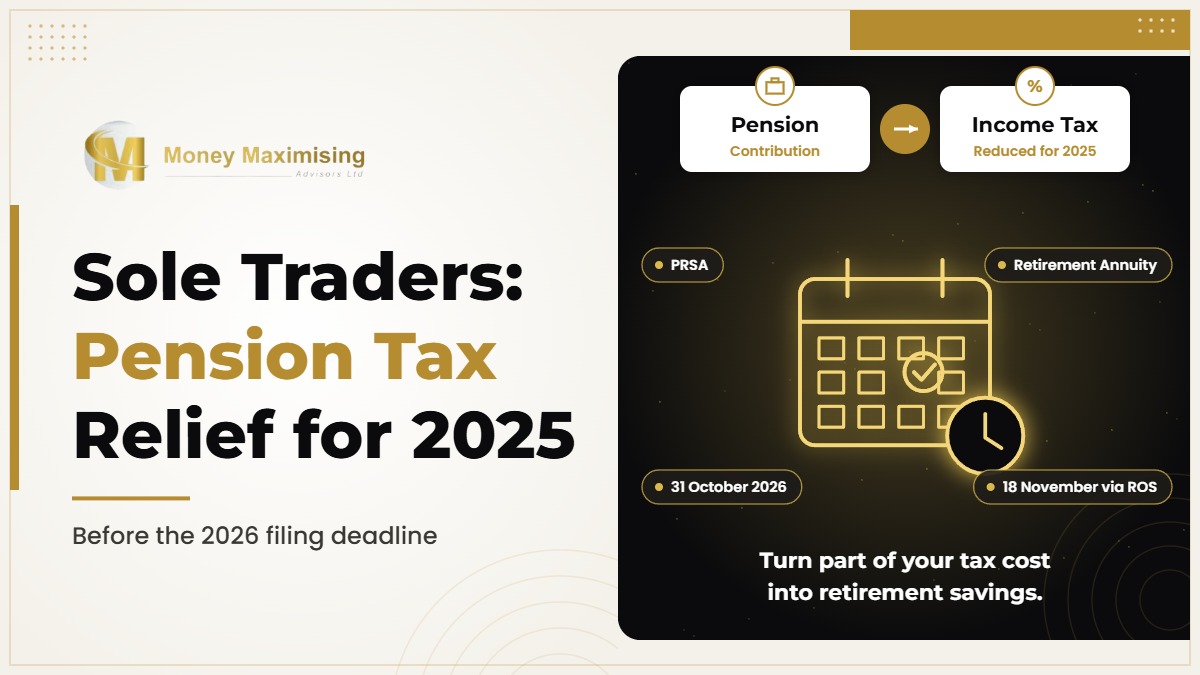
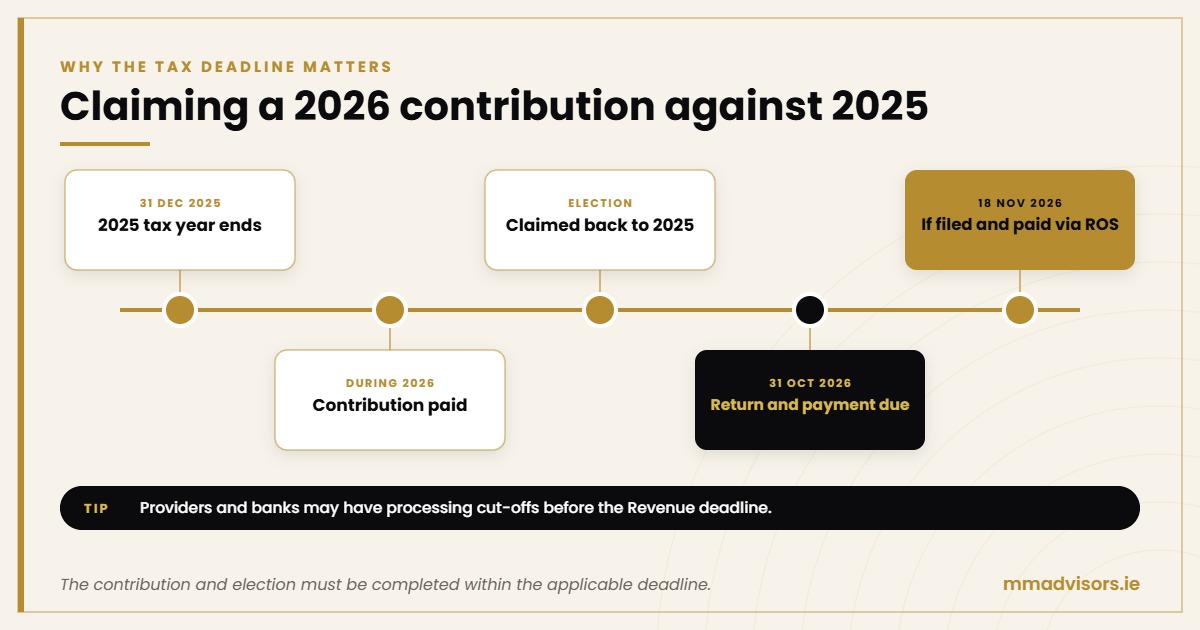
Self-employed people generally file their 2025 Income Tax return and pay the balance due by 31 October 2026. Where both the return and payment are completed through ROS, Revenue has confirmed an extended deadline of 18 November 2026.
A qualifying personal pension contribution paid before the applicable deadline may be elected back to 2025. This can reduce the Income Tax payable for that year while moving money into a pension for retirement.
Do not leave the pension payment until filing day
A pension must be established, the contribution must clear and the required election must be made on time. Providers and banks may have processing cut-offs before the Revenue deadline.
How pension tax relief works for a sole trader
Tax relief is available on qualifying personal contributions to arrangements such as a PRSA or Retirement Annuity Contract, subject to Revenue limits. The relief is linked to net relevant earnings from your trade or profession.
The contribution can reduce income that is subject to Income Tax. Relief is normally given at the marginal Income Tax rate that applies to you. It does not reduce USC or PRSI, so a €10,000 contribution does not necessarily reduce the total tax bill by €4,000 in every case.
The age-related pension contribution limits
The percentage is applied to the lower of your qualifying earnings and the annual earnings cap of €115,000. Existing personal or employee pension contributions can use part of the available allowance.
| Age at end of tax year | Maximum qualifying percentage |
|---|---|
| Under 30 | 15% |
| 30-39 | 20% |
| 40-49 | 25% |
| 50-54 | 30% |
| 55-59 | 35% |
| 60 or over | 40% |
Worked example: a €20,000 contribution
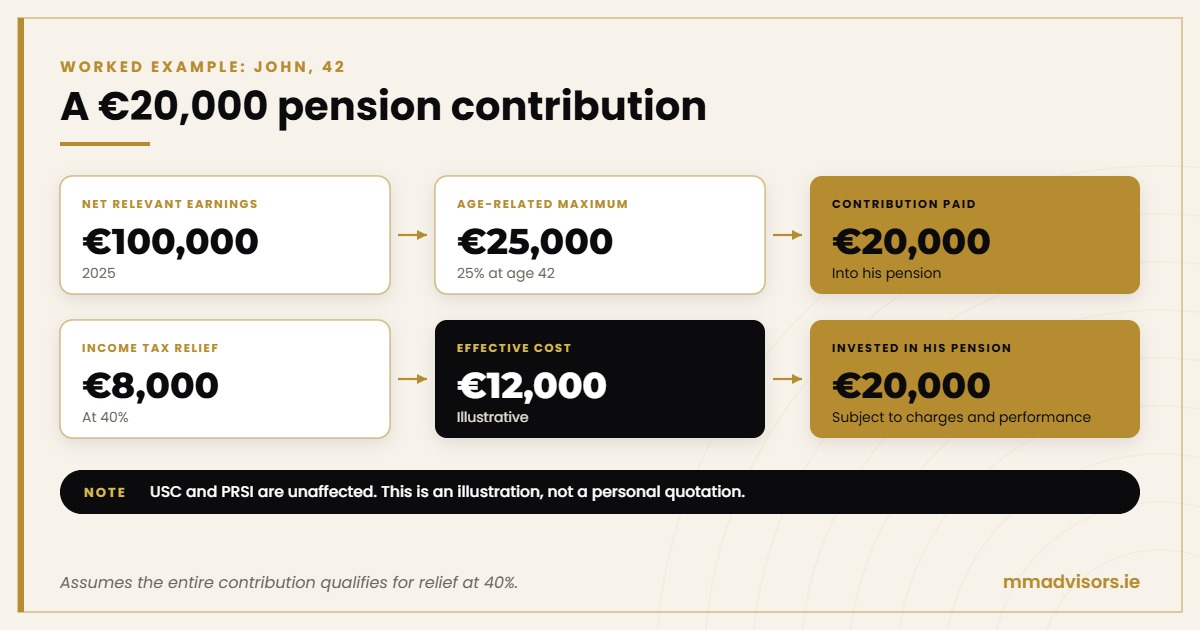
John is a 42-year-old self-employed consultant. His net relevant earnings for 2025 are €100,000. He has not made any other personal pension contributions for the year and pays Income Tax at the 40% marginal rate.
| Net relevant earnings | €100,000 |
| Age-related maximum at 25% | €25,000 |
| Pension contribution paid | €20,000 |
| Potential Income Tax relief at 40% | €8,000 |
| Illustrative effective cost of the contribution | €12,000 |
John places €20,000 into his pension. If the entire contribution qualifies for relief at 40%, his Income Tax is reduced by €8,000. USC and PRSI are unaffected. This is an illustration, not a personal quotation.
What happens to the tax bill?
Without the pension contribution, John pays Income Tax based on his taxable trading income, subject to the normal tax bands, credits and deductions. The qualifying €20,000 pension contribution creates an Income Tax deduction. If all of that deduction is relieved at 40%, the Income Tax calculation falls by €8,000.
The key point is that John has not simply “spent” €20,000. He has exchanged an effective €12,000 after-tax cost for €20,000 invested inside his pension, subject to pension charges, investment performance and retirement rules.
Ready to speak with an advisor?
Or
Call us now (9am to 5pm, Mon to Fri)
Which pension can a sole trader use?
The most common options are a Personal Retirement Savings Account (PRSA) or a personal pension, often called a Retirement Annuity Contract. The appropriate structure depends on charges, investment choice, contribution flexibility, existing pensions and retirement objectives.
- A PRSA can accept regular and once-off contributions and is portable between employments.
- A personal pension may offer a different charging or investment structure.
- Existing pension contributions must be included when checking the annual relief limit.
- Contributing more than the tax-relievable maximum does not automatically create additional relief for that year.
How to claim the relief
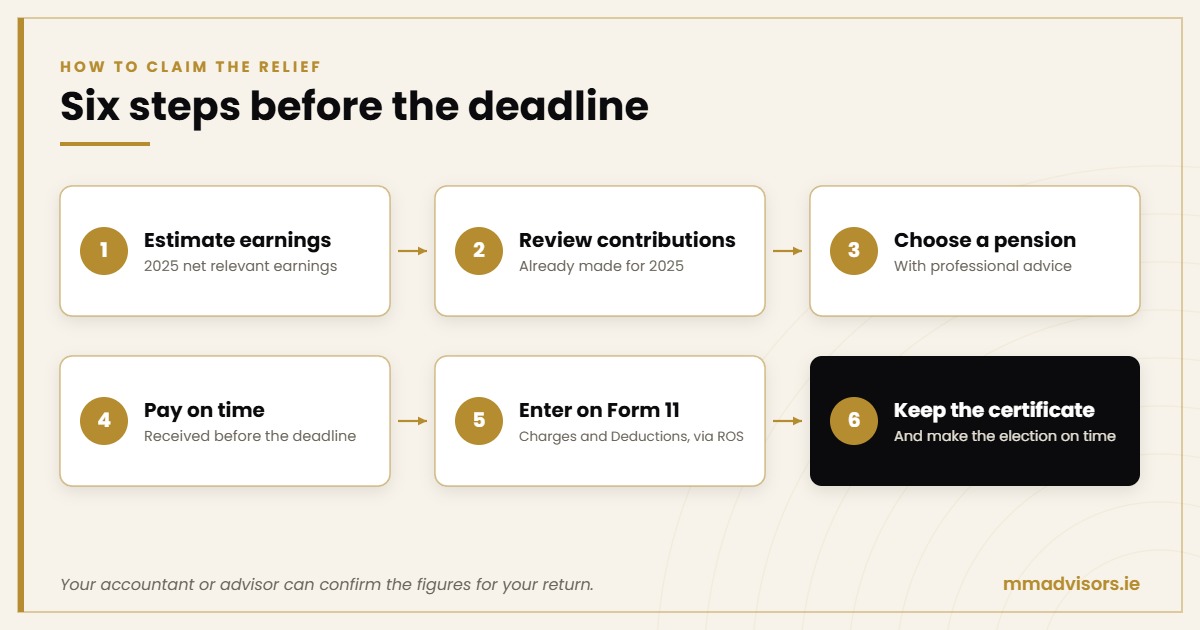
- Estimate your 2025 net relevant earnings and confirm your age-related limit.
- Review any pension contributions already made for 2025.
- Choose an appropriate pension and investment approach with professional advice.
- Make sure the contribution is received before the applicable filing deadline.
- Enter the PRSA or personal pension contribution in the relevant Charges and Deductions section of Form 11 through ROS.
- Retain the contribution certificate and make the election to claim the payment for 2025 on time.
Common mistakes to avoid
- Calculating the limit using turnover instead of net relevant earnings.
- Assuming that every euro of the contribution receives relief at 40%.
- Ignoring existing pension contributions or the €115,000 earnings cap.
- Believing that pension contributions reduce USC or PRSI.
- Waiting until the filing deadline to begin setting up the pension.
- Choosing an investment solely for tax reasons without considering risk, charges and retirement access.
Frequently asked questions
Can I make a contribution in 2026 and claim it for 2025?
Potentially, yes. A qualifying contribution paid before the 2026 filing deadline may be elected back to 2025, provided the contribution and election are completed within the applicable Revenue deadline.
Does a contribution reduce USC and PRSI?
No. Personal pension relief reduces Income Tax only. USC and PRSI are calculated without deducting the personal pension contribution.
Can I contribute more than the age-related limit?
You may be able to contribute more, but the excess may not qualify for immediate tax relief. Obtain advice before exceeding the available relief limit.
What if my final profit is lower than expected?
Your tax-relievable limit is based on final qualifying earnings. Overestimating profit may mean part of the contribution does not receive the relief expected for that year.
Is a pension worthwhile if I only pay Income Tax at 20%?
Relief may still be available at 20%, and pension growth and retirement planning can remain valuable. The decision should consider affordability, access, charges, risk and long-term objectives rather than tax relief alone.
Free initial consultation
Find out what you can contribute before the deadline
Book a free initial consultation with Money Maximising Advisors. We can help estimate your available relief, select an appropriate pension and complete the process before the deadline.
Sources and important information
Revenue guidance accessed September 2026:
Important: This article is general information, not tax, legal or investment advice. Tax relief depends on individual circumstances, Revenue rules and limits. Tax treatment may change. Pension investments can fall as well as rise, and retirement access rules apply.