Quick answer
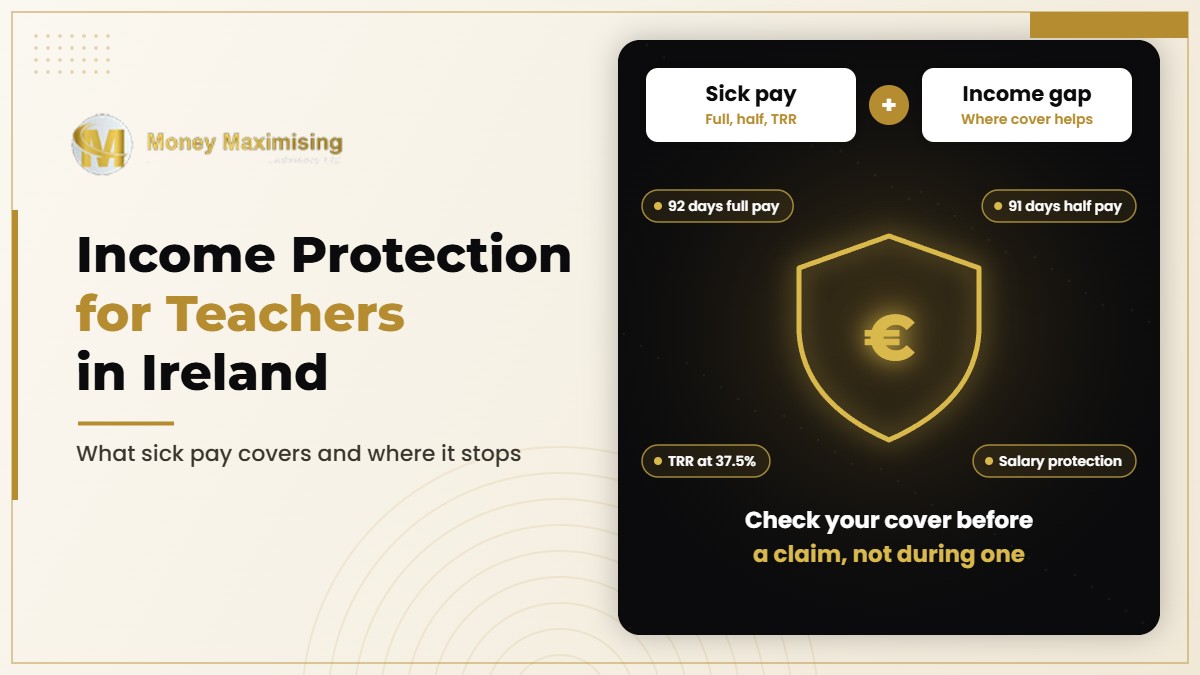
Income protection for teachers pays a replacement income if long illness stops you working after your paid sick leave runs out. Teachers get up to 92 days on full pay and 91 days on half pay for an ordinary illness, then TRR at 37.5% of pay. Income protection is designed to fill the gap that follows.
Income protection for teachers is often bought early in a career through a union linked scheme and then forgotten about. Other teachers assume their sick pay is so generous that they do not need any cover at all. Both approaches can leave a family exposed, because the teachers’ sick leave scheme has firm limits that only matter once you hit them.
This guide explains exactly what teachers’ sick pay covers, where the income gap appears and how to decide whether you need salary protection. For a full review of your protection alongside your pension and mortgage, see our financial plan for teachers.
How teachers’ sick leave works in Ireland
The sick leave scheme for registered teachers in recognised primary and post primary schools sets out how much paid sick leave you can receive. Permanent, CID, fixed term and non casual substitute teachers are covered.
Ordinary illness
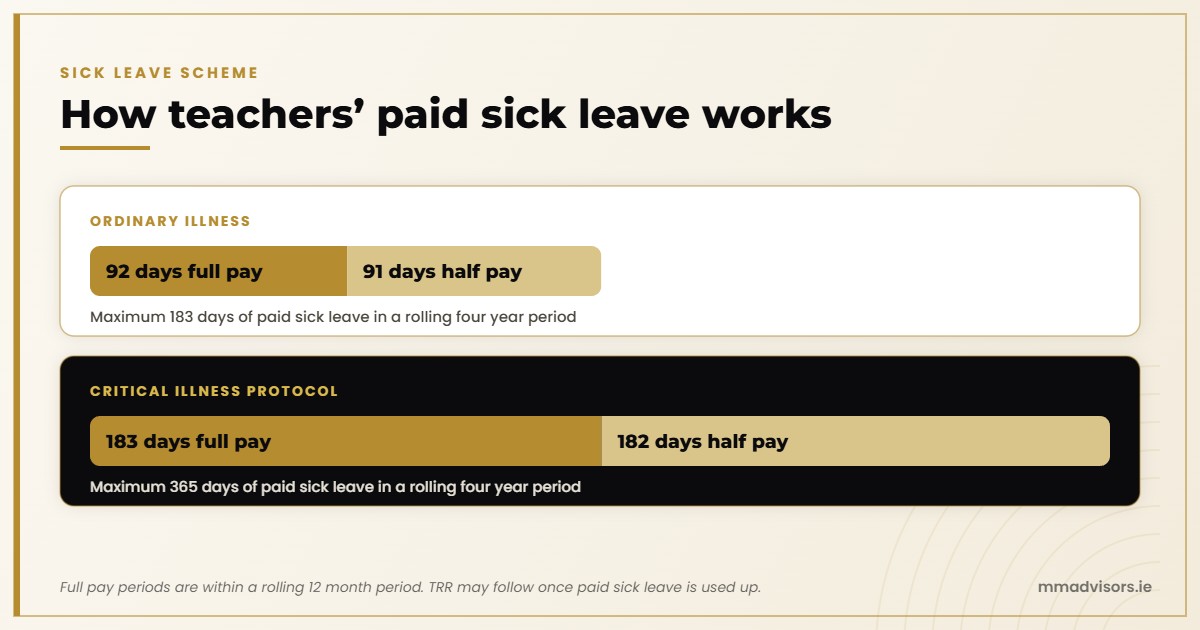
- Up to 92 days on full pay in a rolling 12 month period
- Followed by up to 91 days on half pay
- Subject to a maximum of 183 days of paid sick leave in a rolling four year period
Critical illness protocol
For serious illness approved under the critical illness protocol:
- Up to 183 days on full pay in a rolling 12 month period
- Followed by up to 182 days on half pay
- Subject to a maximum of 365 days of paid sick leave in a rolling four year period
Temporary Rehabilitation Remuneration (TRR)
Once paid sick leave is used up, a teacher may receive TRR. It is paid at 37.5% of the remuneration you would otherwise receive, and is normally limited to a set period, usually up to 18 months for ordinary illness. Certain conditions apply, including a reasonable prospect of returning to work.
Where the income gap appears
The rolling four year look back is the key detail many teachers miss. Sick leave you took two or three years ago still counts. A teacher who had a long absence in the past may move to half pay or TRR much sooner than expected if they become ill again.
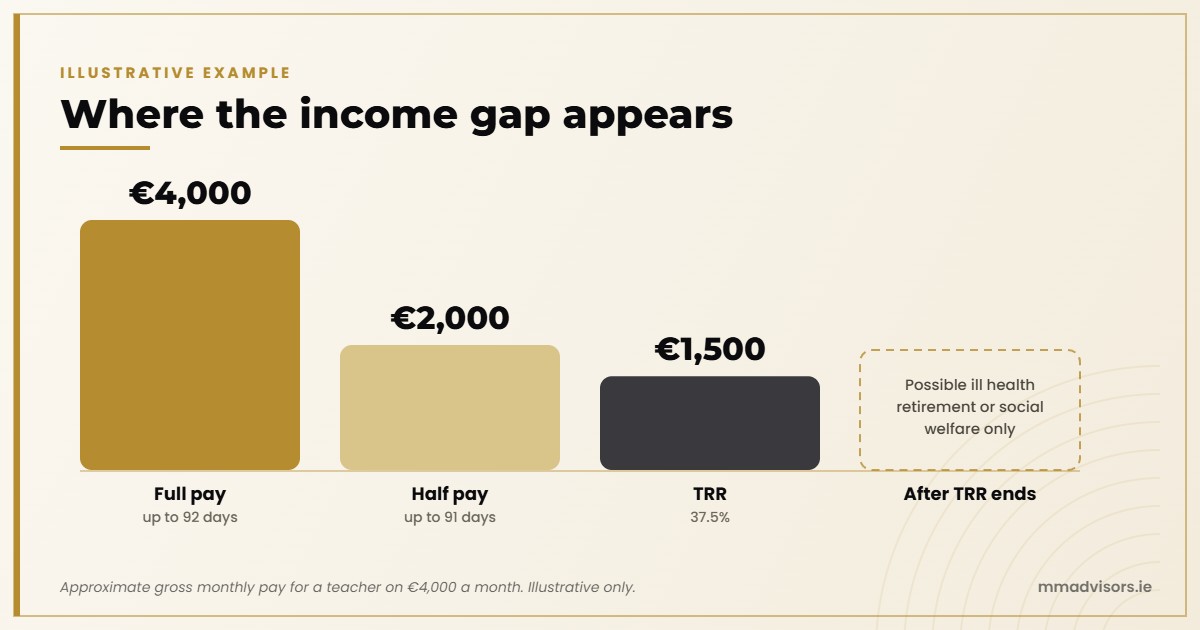
Here is how monthly income could change for a teacher on €4,000 gross a month during an ordinary long illness:
| Stage | Approximate gross monthly pay |
|---|---|
| Full pay (up to 92 days) | €4,000 |
| Half pay (up to 91 days) | €2,000 |
| TRR (37.5%) | €1,500 |
| After TRR ends | Possible ill health retirement or social welfare only |
Illustrative only. Actual payments depend on your service, sick leave record and the scheme rules.
Mortgage repayments, childcare and household bills do not fall when your pay does. That is the gap income protection is designed to fill.
What income protection for teachers actually pays
An income protection or salary protection policy pays a regular income if illness or injury prevents you from working, after a waiting period called the deferred period. Most policies:
- Pay up to a set percentage of salary, less any sick pay, TRR or other benefits you still receive
- Start paying after your deferred period, which teachers often align with the end of full or half pay
- Continue until you return to work, reach the policy end age, or the policy terms end the claim
- Qualify for income tax relief on premiums, within limits, with benefits taxed as income
Read more on our income protection and public sector salary protection pages.
Union salary protection schemes vs individual policies
The INTO, ASTI and TUI each have a salary protection or income continuance scheme available to members through a group arrangement. Group schemes can be simple to join and are paid through payroll. Individual policies are underwritten for you personally and can sometimes offer fixed premiums or different terms.
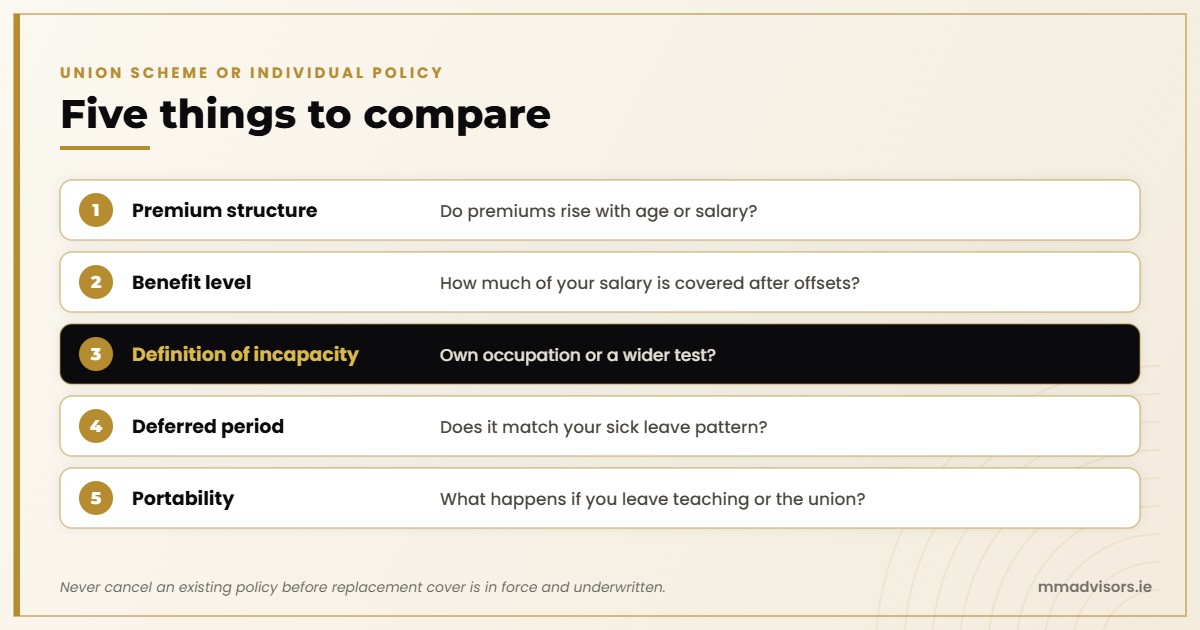
Neither is automatically better. When comparing, look at:
- Premium structure: do premiums rise with age or salary?
- Benefit level: how much of your salary is covered after offsets?
- Definition of incapacity: own occupation or a wider test?
- Deferred period: does it match your sick leave pattern?
- Portability: what happens if you leave teaching or the union?
Never cancel an existing policy before replacement cover is in force and underwritten. Health changes since you first joined can affect new cover.
Do all teachers need income protection?
Not necessarily. You may need less cover if your household has a second stable income, low fixed costs and good savings. Cover is usually more important when:
- You are the main or only earner in your household
- You have a mortgage, especially in the early years. See also mortgage protection
- You are on a fixed term or substitute contract with limited sick pay history
- You have already used a significant part of your four year sick leave entitlement
Income protection is only one part of protection planning. Life insurance and serious illness cover protect against different risks and pay out in different ways.
How MM Advisors helps teachers review income protection
The best time to check your income protection for teachers is before a claim, not during one. When we review your protection, we:
- Review your actual sick pay entitlement first, including any TRR, so the same benefit is not counted twice as extra income
- Check existing salary protection and union linked cover, including death benefits and specified illness cover you may already have
- Read the policy documents: waiting periods, offsets, maximum benefit, exclusions, underwriting and premium costs, before considering any replacement or extra cover
- Look at the whole household, including what would happen to mortgage repayments, family expenses and children’s needs if either partner died or became seriously ill
- Check death in service benefits, which can be valuable but may not fully meet your family’s needs or continue after you leave teaching
Any additional policy should complement verified existing cover. Our financial protection advice service carries out this review.
Example: a teacher thinking about job sharing.
A post primary teacher is considering a reduced timetable for family reasons. Their plan could compare take home pay and long term pension accrual, assess any permitted benefit purchase, review income protection so cover still matches the reduced salary, and adjust regular saving before the change takes effect.
Illustrative example only, not a promise of eligibility, outcomes or tax savings. Advice depends on verified records and personal circumstances.
A financial plan for teachers brings protection together with your pension, savings and mortgage, so every policy has a clear purpose. You can also read our wider financial advice for teachers in Ireland.
How the process works
- Understand: we discuss your teaching career, family finances and the decisions you want to make.
- Gather: we review your payslips, pension statements, service history, savings, debts and existing protection.
- Plan: we show practical forecasts, costs, assumptions and a clear action list.
- Implement: we arrange suitable products within our service scope and liaise with your pension administrator, accountant or solicitor when needed.
- Review: we revisit the plan when your income, career pattern, family situation or retirement date changes.
We explain any planning fees, product charges and commission before you proceed.
Financial planning for teachers
Book your teacher financial planning consultation
FAQs
Do teachers in Ireland need income protection?
Many do. Paid sick leave is limited to 92 days on full pay and 91 on half pay for ordinary illness within four years. After that, TRR pays 37.5% of pay, which can leave a large income gap.
How long do teachers get full pay when sick in Ireland?
For an ordinary illness, up to 92 days on full pay in a rolling 12 months, then up to 91 days on half pay, within a 183 day limit over a rolling four year period.
What is TRR for teachers?
Temporary Rehabilitation Remuneration is a payment teachers may receive after paid sick leave runs out. It is paid at 37.5% of normal remuneration for a limited period, subject to conditions including a prospect of returning to work.
Is salary protection the same as income protection?
They work in a similar way. Salary protection usually refers to group schemes for public sector workers, while income protection often means an individual policy. Both replace part of your income during long term illness after a waiting period.
Is income protection tax deductible for teachers?
Premiums paid personally for approved income protection usually qualify for income tax relief at your marginal rate, within limits. Benefits paid out are taxed as income. Check the policy and current Revenue rules.
Sources
- Department of Education Circular 0053/2015 and Circular 13/2024, Sick Leave Scheme for Registered Teachers
- ASTI: Sick Leave guide (TRR rate 37.5%)
- INTO: Sick Leave guidance
- Oireachtas written answers on the Public Service Sick Leave Scheme
Money Maximising Advisors Ltd is regulated by the Central Bank of Ireland. C154250.