Claim income tax relief
Qualifying personal contributions can reduce the income on which you pay income tax, subject to Revenue’s age-related and earnings limits.
For Irish sole traders
A pension contribution made before you file may reduce the income tax due on your 2025 profits—while putting that money to work for your retirement.
A quick illustration based on your planned contribution and marginal income tax rate.
One contribution. Two benefits.
For a sole trader, a personal pension or PRSA contribution can be one of the most effective ways to use a profitable year more tax-efficiently.
Qualifying personal contributions can reduce the income on which you pay income tax, subject to Revenue’s age-related and earnings limits.
A contribution paid before the filing deadline may be claimed against the previous tax year when the required election is made on time.
Instead of simply paying more tax, direct eligible money into a pension designed around your retirement goals and attitude to investment risk.
Revenue contribution limits
The maximum personal pension contribution eligible for relief is generally calculated using your age at the end of the tax year and your qualifying earnings.
| Age | Maximum percentage |
|---|---|
| Under 30 | 15% |
| 30–39 | 20% |
| 40–49 | 25% |
| 50–54 | 30% |
| 55–59 | 35% |
| 60 or over | 40% |
Percentages apply to the lower of qualifying earnings and €115,000. Existing employee, AVC or personal pension contributions may use part of the available limit. Special rules can apply to certain professional sportspersons.
Worked example: sole trader
John is 42, has net relevant earnings of €100,000 and pays income tax at the 40% marginal rate. He has no other pension contributions.
The €20,000 contribution could have an effective net cost of €12,000 after €8,000 of income-tax relief, reducing John’s overall income-tax bill by the same amount. USC and PRSI are not reduced. The actual result depends on his final income, tax rate, pension history and available relief limit.
Employees with rental income
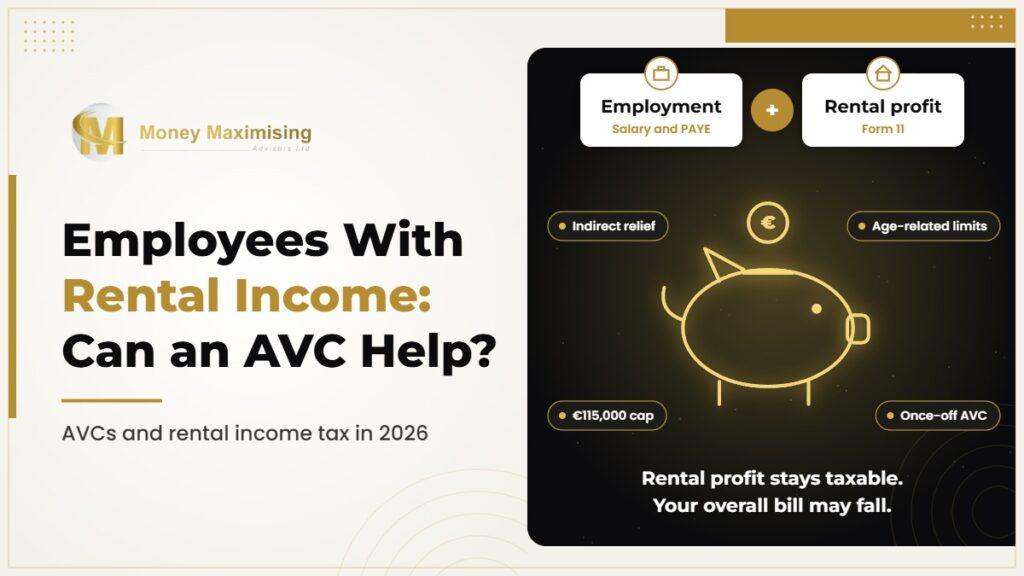
This can be particularly relevant if you are an employee—such as a public-sector employee—with residential property income and a Form 11 liability. A once-off Additional Voluntary Contribution may qualify for income-tax relief and reduce your overall income-tax bill.
The AVC relief is linked to your earnings from the employment and your occupational pension scheme. Rental income does not increase the amount you can contribute with tax relief, and an AVC is not deducted from the taxable rental profit itself.
Illustrative figures only. The employee is aged 45 and pays income tax at the 40% marginal rate.
Important: The €20,000 rental profit remains taxable. The €4,000 relief arises from the employee’s qualifying employment earnings and may reduce the overall income-tax balance payable. It does not reduce USC or PRSI. Existing scheme contributions use part of the age-related limit.
Act before the deadline
We’ll help you establish what you can contribute, choose an appropriate pension and complete the process in time.
Check my pension optionsShare your age, estimated relevant earnings, current pension arrangements and the contribution you are considering.
We’ll illustrate the potential income tax relief and check the contribution against the applicable Revenue limits.
We’ll recommend a suitable structure and investment approach based on your needs, timeframe and risk profile.
Make the contribution and ensure the claim or election is dealt with before the relevant self-assessment deadline.
Useful answers
The maximum qualifying personal contribution is generally limited by an age-related percentage of relevant earnings. The percentage ranges from 15% if you are under 30 to 40% from age 60, and the earnings cap is €115,000. Other pension contributions may also use part of your limit.
No. Personal pension contribution relief applies to income tax, but not to USC or PRSI. The actual value of relief therefore depends on the income tax rate that applies to you.
A qualifying contribution paid in 2026 before the filing deadline may be claimed for 2025 if you make the required election by the same deadline. Your accountant or tax adviser should confirm the treatment on your return.
A PRSA or personal pension may be suitable. The right choice depends on factors such as flexibility, charges, investment range, existing benefits and your longer-term retirement plan.
You may still be able to top up an existing plan or contribute to another suitable arrangement, but your total tax-relievable personal contributions remain subject to the relevant limits.
Indirectly, yes. The AVC relief is granted against qualifying earnings from the relevant employment—not against rental income. However, the resulting income-tax relief or credit forms part of your overall tax calculation and may reduce the Form 11 balance payable, including a balance caused by rental profits.
No. Rental income is not employment earnings for this purpose. An employee’s AVC limit is based on the income from the employment linked to the pension arrangement, subject to the age-related percentage and €115,000 earnings cap.
Start with the applicable age-related percentage of eligible employment earnings, subject to the earnings cap. Employee pension contributions already made to the public-sector scheme—and any existing AVCs—generally use part of that allowance. A personalised calculation is important because contribution structures can vary by scheme and date of entry.
Potentially. Revenue permits a qualifying once-off contribution paid before the following filing deadline to be elected back to the earlier tax year. The contribution and the election must both be completed by the applicable deadline; the ROS extension can apply where the relevant online requirements are met.
Revenue’s Form 11 guidance directs taxpayers to claim AVC relief through the “PAYE/BIK/Pensions” panel. Keep the pension provider’s contribution certificate and confirm the entry with your accountant or tax adviser.
MORE HELPFUL GUIDES & ADVICE
CLIENT TESTIMONIALS
Trustindex verifies that the original source of the review is Google. Excellent thorough service provided by Lorna.Posted on GoogleTrustindex verifies that the original source of the review is Google. MMA team made my mortgage application to approval easy and possible. They are efficient and swift with responses. The level of professionalism is second to none and special thanks to Cris for her support. At some point I was the one delaying the process yet you were very patient with me, guide me through every process and arrange meetings for clarity. Surely this is the best mortgage adviser I have encountered and I strongly recommend them cause they don’t disappoint. Thanks team ElizabethPosted on GoogleTrustindex verifies that the original source of the review is Google. Great company! My advisors, Jack and Maricris, were very attentive, very professional. No advanced fees charged and as advertised, if you don’t close a deal, if you don’t draw down, there’s no charge, which unfortunately was my case, so after being helped through the process, they didn’t charge me anything.Posted on GoogleTrustindex verifies that the original source of the review is Google. Cris and Sean were excellent and couldn’t do enough to help me in getting the keys to my first home. Sean is incredibly knowledgeable and very personable. I highly recommend them.Posted on GoogleTrustindex verifies that the original source of the review is Google. I'd like to thank everyone at MM Advisors especially Sean and Cris. They were amazing throughout the whole process. Extremely professional and always on hand to help us along the way.
Don’t leave it until filing day
Book a free consultation with a qualified MMA adviser. We’ll give you a clear, personalised view of your pension options and potential tax relief.
Money Maximising Advisors Limited
Unit 3, Office 6, Liosban Business Park, Tuam Road, Galway, H91 85A0. Money Maximising Advisors Limited is regulated by the Central Bank of Ireland – C154250.
This page is for general information only and does not constitute tax, legal or investment advice. Pension benefits and tax relief depend on individual circumstances, Revenue rules and limits. Tax treatment may change. Investment values can fall as well as rise.