For most Irish retirees, the pension tax-free lump sum is the single biggest cash payment they’ll ever receive. Getting the amount right is important. Deciding what to do with it matters even more. This guide from Money Maximising Advisors walks you through the current Irish lump sum rules and shows you the five smartest ways retirees actually use the money.
You will see exactly how the tax bands work. You will see a worked example on a real Irish pension pot. And you will see how to make sure the lump sum funds a genuinely comfortable retirement.
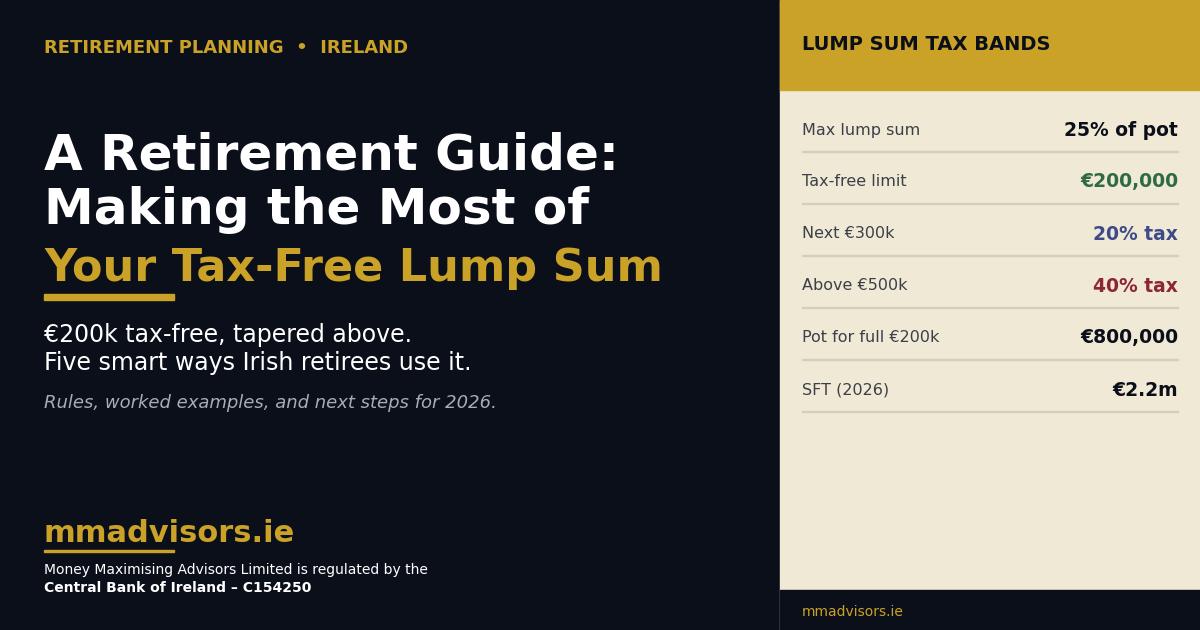
| QUICK ANSWER: In Ireland you can take up to 25% of your pension pot as a lump sum at retirement, capped at a lifetime tax-free limit of €200,000. Amounts between €200,000 and €500,000 are taxed at 20%. Anything above €500,000 is taxed at your marginal rate (up to 40%). A pension pot of €800,000 exactly maxes out the tax-free portion (€800k × 25% = €200k). Common smart uses include clearing the mortgage, topping up an Approved Retirement Fund (ARF), home improvements, tax-efficient family gifts, and building an emergency reserve. |
| This pillar connects Irish retirees to Approved Retirement Funds (ARF), Additional Voluntary Contributions (AVCs), Directors Pension and Lump Sum Investments. |
How the Irish tax-free lump sum works
Every Irish pension scheme lets you take part of your pension as a lump sum at retirement. The tax treatment depends on the amount, and there is a clear ladder of tax bands.
The 25% cap
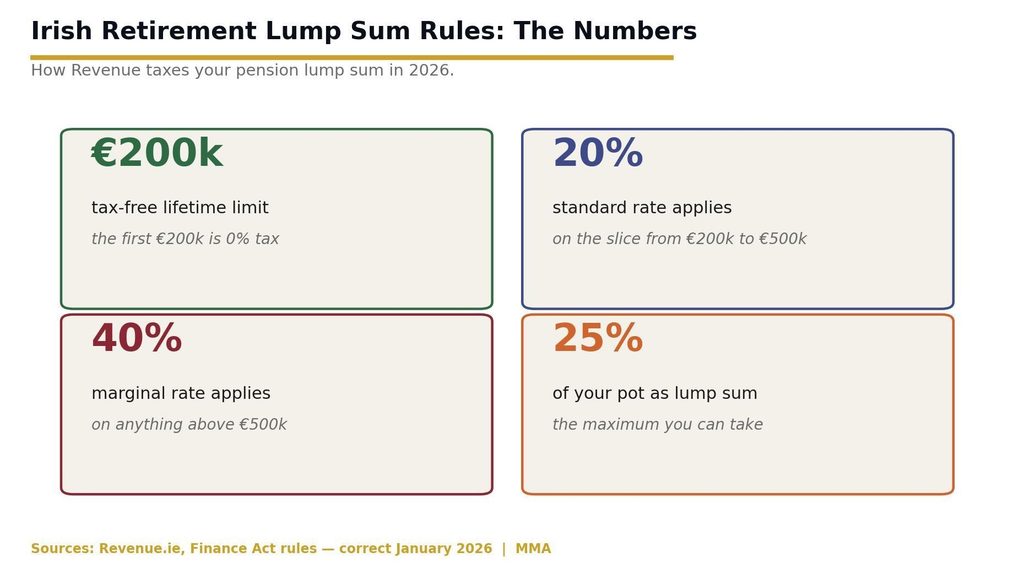
You can take up to 25% of your pension pot as a lump sum. Not more. This is the maximum, you can always take less.
On a €400,000 pot, that’s €100,000. On a €1,000,000 pot, that’s €250,000. Simple percentage calculation.
The €200,000 tax-free lifetime limit
The first €200,000 of your combined lifetime lump sums is completely tax-free. This applies across all your pensions, you don’t get a fresh €200,000 for each scheme.
A €800,000 pension pot is the sweet spot: 25% of €800k equals €200k, which uses the full tax-free allowance without tipping into taxable territory.
The 20% tax band (€200k–€500k)
The next €300,000 of lump sum, the slice from €200k to €500k, is taxed at 20%. That’s still favourable compared to your normal income tax rate.
On a lump sum in this band, tax of €60,000 applies to the full €300k slice (€300k × 20%). Your net kept in this band is €240,000.
The 40% band (above €500k)
Any lump sum above €500,000 is taxed at your marginal rate, up to 40% for higher earners, plus USC and PRSI where applicable.
For very large pension pots, this makes the case for taking less than the maximum lump sum. Above €500k, most of every extra euro is going to tax.
Worked example: an €800,000 pension pot
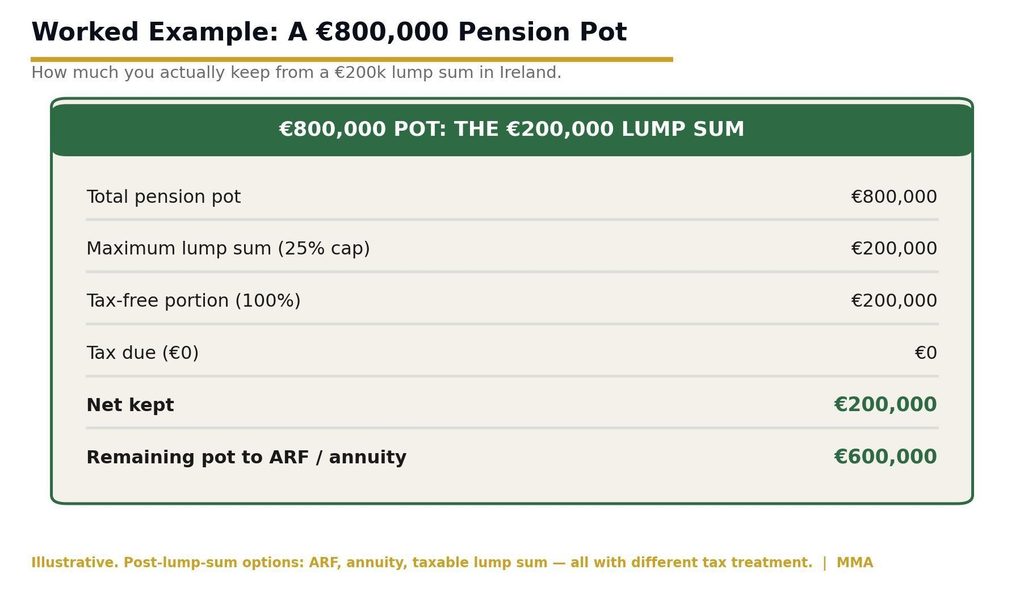
Meet Sinead. She’s retiring at 66 with a pension pot of €800,000. She’s built this through a mix of occupational pension and top-up AVCs across her career.
At retirement, Sinead can take up to 25% = €200,000 as a lump sum. Because this hits the tax-free lifetime limit exactly, she pays zero tax on the lump sum.
The remaining €600,000 is her ongoing retirement pot. She can move it into an Approved Retirement Fund (ARF), buy an annuity for guaranteed income, or take it as a taxable lump sum. Each option has different tax consequences.
What if the pot is bigger than €800,000?
Take Cian, retiring with €1,600,000. His maximum lump sum is 25% = €400,000. The first €200,000 is tax-free. The next €200,000 (the band from €200k to €400k, all below the €500k threshold) is taxed at 20%. Tax bill: €40,000. Net kept: €360,000.
What if the pot is smaller?
Take Aisling, retiring with €400,000. Her maximum lump sum is 25% = €100,000. All of it is under the €200,000 lifetime limit, so it’s all tax-free. Straightforward.
Retiring soon? Let's map your lump sum options.
Book a free 30-minute retirement lump sum review, or send us your details and we'll be in touch.
Money Maximising Advisors Limited is regulated by the Central Bank of Ireland – C154250
Should you always take the maximum lump sum?
Not necessarily. Whether you take the full 25% depends on your circumstances.
Reasons to take the maximum
You have a specific plan for the money, clearing the mortgage, home improvements, a family gift. You have other retirement income sources (State Pension, DB pension, rental income) that will cover ongoing needs. You want the flexibility of tax-free cash rather than locking value into an ARF or annuity.
Reasons to take less than the maximum
Your pot is above €500,000 and you’d be taxed at 40% on the top slice. You have limited other retirement income and want to maximise the size of your ARF or annuity. You are risk-averse and prefer guaranteed monthly income.
For most retirees, the answer is somewhere in between. Take enough to fund specific needs and use the rest for ongoing income.
| Working out how much to take? Book Now for a free 30-minute retirement lump sum review, or Enquire Now, we’ll come back within one working day. |
Five smart ways to use your tax-free lump sum
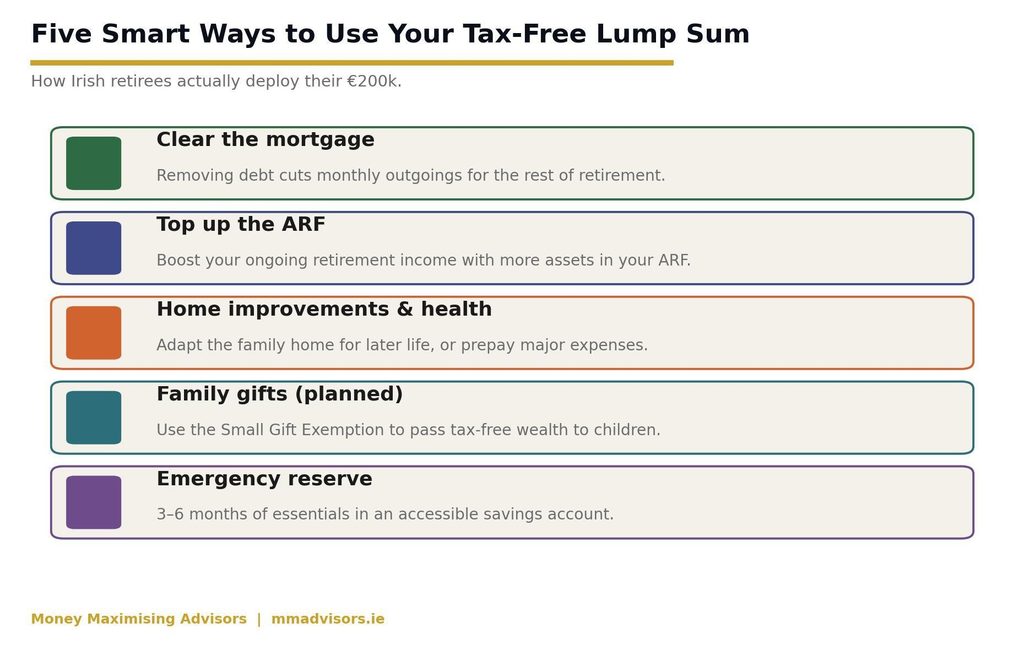
Way 1: Clear the mortgage
Entering retirement mortgage-free removes a large monthly outgoing for the rest of your life. If your remaining mortgage is under your lump sum, clearing it typically saves €500–€1,500 per month for 5–10 more years.
The maths gets more nuanced if your mortgage rate is very low. In that case, investing the lump sum may beat paying down debt. But for most retirees with a normal mortgage rate, clearing the debt is a strong choice.
Way 2: Top up your ARF
You can direct part of your lump sum into an Approved Retirement Fund (ARF) for ongoing income. This keeps the money invested and generates a regular retirement drawdown.
ARF drawdowns are taxed as income at your marginal rate. For most retirees, that rate is lower than during their working years, so the effective tax hit is smaller than expected.
Way 3: Home improvements and health-proofing
Retirement is the moment to make the family home fit for later life. Downstairs bathroom, wet room, wider doorways, better insulation, solar panels, all significantly improve quality of life.
Investment in health also matters. Pre-paying dental work, hearing aids, or joint-replacement waiting-list bypass can materially improve your first 10 years of retirement.
Way 4: Tax-efficient family gifting
The Small Gift Exemption allows every person to give any other person €3,000 per year completely tax-free. A retiring couple with 3 adult children can pass €18,000 per year to the next generation, tax-free.
Combined with the larger CAT thresholds, this lets you use part of the lump sum to help children with house deposits or grandchildren with education, while you’re alive and can see the impact. See our companion guide on Intergenerational Wealth Transfer for more.
Way 5: Emergency reserve
A 3–6 month emergency reserve in an accessible savings account gives you the ability to handle car repairs, home repairs, medical bills, or supporting adult children through a difficult period.
For most retirees, this is €15,000–€30,000 depending on essential monthly outgoings. Cash is the right home for this money, not investment funds.
The Standard Fund Threshold in 2026
The Standard Fund Threshold (SFT) is the maximum pension pot Revenue will let you accumulate tax-efficiently. On 1 January 2026, it increased from €2 million to €2.2 million for the first time in a decade. It will rise further each year to €2.8 million by 2029.
Pension pots that exceed the SFT face a punitive tax charge on the excess. If your pot is approaching this level, specialist advice becomes essential. For most Irish retirees, this is not a concern.
Common lump sum mistakes to avoid
- Not knowing your combined pension pot value. If you have multiple pensions from previous employers, all of them count toward the €200k lifetime limit.
- Taking the maximum lump sum out of habit. On very large pots, the top slice is taxed at 40%, sometimes it’s smarter to leave more in the ARF.
- Spending the tax-free portion without a plan. Retirees who spend €200k in the first 3 years of retirement often regret it by year 10.
- Ignoring the ARF options. The choice between an ARF, annuity, or taxable lump sum for the rest of the pot has major long-term implications.
- Not reviewing existing pensions from previous employers. Consolidation or transfer can significantly improve investment choice and reduce fees before you retire.
Where MMA fits in
Money Maximising Advisors is a Central Bank regulated financial broker based in Galway. When it comes to retirement lump sum decisions, that means two things for you:
First, our advice services are delivered directly by our qualified team. Our Retirement Planning Advice and Pensions From Previous Employments services map every option, lump sum size, ARF vs annuity, existing pension consolidation, to your specific situation.
Second, we are a multi-agency broker for the retirement products themselves. We don’t manufacture ARFs, annuities, or investment funds, we compare products from Ireland’s leading providers and help you access the ones that fit your goals.
The result: independent advice, wide product access, and no fee to you for the arrangement of the product itself.
Frequently asked questions
How much of my pension can I take tax-free in Ireland?
Up to 25% of your pension pot as a lump sum, with the first €200,000 completely tax-free (lifetime limit). A pension pot of €800,000 exactly maxes out the tax-free €200k. Above the €200k lifetime limit, tax applies: 20% on the slice from €200k to €500k, and 40% on anything above €500k.
Is the €200,000 pension lump sum tax-free in Ireland?
Yes. The first €200,000 of your combined lifetime pension lump sums is completely tax-free. This applies once across all your pensions, not €200,000 per scheme. Amounts above €200,000 are taxable.
How is a retirement lump sum taxed in Ireland?
Three bands apply. The first €200,000 is tax-free. The next €300,000 (from €200k to €500k) is taxed at the standard rate of 20%. Anything above €500,000 is taxed at your marginal rate (up to 40%), plus USC and PRSI where applicable.
Can I take my entire pension as a lump sum in Ireland?
Not typically. The maximum lump sum is 25% of your pension pot. The remaining 75% must be used for ongoing retirement income, through an Approved Retirement Fund (ARF), an annuity, or a taxable lump sum. Very small pension pots (under €30,000) may qualify for the trivial pension provision and full lump sum treatment.
What happens to my pension after I take the lump sum?
The remaining 75% of your pension pot moves into a retirement vehicle of your choice. Most Irish retirees use an Approved Retirement Fund (ARF) for flexibility, an annuity for guaranteed income, or a mix. A qualified pensions adviser can map the trade-offs based on your income needs and risk tolerance.
Reviewed by our retirement team
This guide was prepared and reviewed by the retirement planning team at Money Maximising Advisors, drawing on Revenue.ie current tax rules, the Finance Act adjustments to the Standard Fund Threshold, and daily retirement lump sum applications we complete.
Retiring soon? Let’s map your lump sum options.
Whether you’re 5 years, 12 months, or a few weeks away from retirement, our team maps every lump sum option, tax implications, ARF vs annuity trade-off, and how the money can genuinely fund the retirement you want.
Retiring soon? Let's map your lump sum options.
Book a free 30-minute retirement lump sum review, or send us your details and we'll be in touch.
Money Maximising Advisors Limited is regulated by the Central Bank of Ireland – C154250
| Important information Pension tax bands, the Standard Fund Threshold, and Small Gift Exemption values referenced in this guide are those in force in Ireland at time of writing and are subject to change with each Finance Act. Worked examples are illustrative and simplified, individual pension calculations depend on scheme type, existing lump sums taken, and personal tax circumstances. Money Maximising Advisors Limited is regulated by the Central Bank of Ireland (C154250). This article is for general information only and does not constitute personalised financial, tax or legal advice. You should always speak to a Qualified Financial Advisor before making any retirement or pension decision. |