
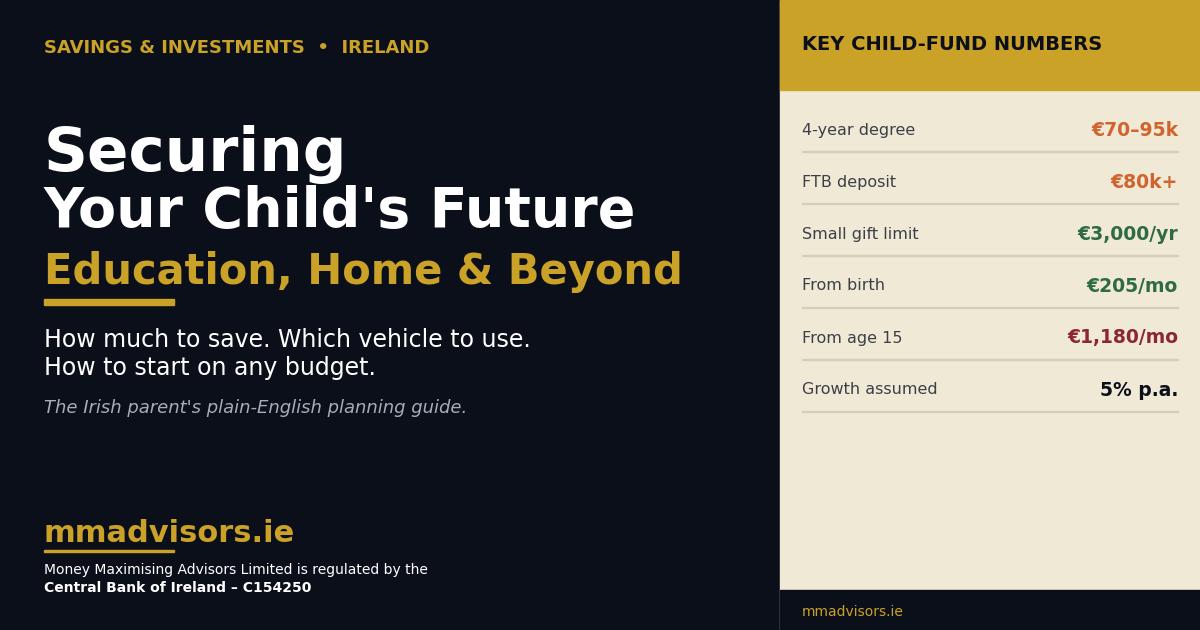
Every Irish parent wants to give their child the best possible start in adult life. That usually means three big things: help with college, help with a first home, and a financial cushion for whatever comes next. This guide from Money Maximising Advisors shows you how much to save, when to start, and which vehicles Irish families use to build a proper fund for their children.
You will see the real cost of the three big milestones. You will see how much you need to save each month. And you will see how to combine tax-efficient tools to build a fund that works on any income.
| QUICK ANSWER: The three big financial milestones Irish parents help fund are: education (€70–95k for a 4-year degree away from home), a first-home deposit (€80,000+ in Dublin, less elsewhere), and setting a child up for adult life (weddings, business start-up, safety net). Starting from birth, roughly €205 per month builds €100,000 by age 21 (assuming 5% growth). Starting at age 10 needs €575/month for the same target. Combine a Regular Saver Investment Plan with the €3,000 annual Small Gift Exemption from grandparents to maximise tax efficiency. |
| This pillar connects Irish families to the vehicles we can broker on their behalf: College Education Savings, Regular Saver Investment Plans, Lump Sum Investments and the Small Gift Exemption Savings Plan. |
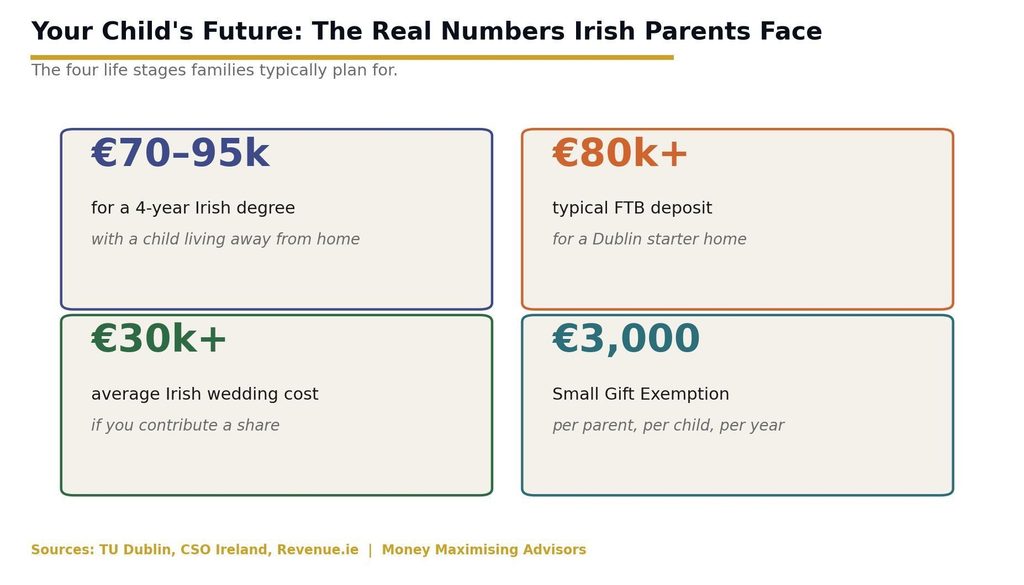
The three big financial milestones your child will face
Milestone 1: Third-level education
Every college student in Ireland pays a €3,000 student contribution charge per year. That’s the easy bit.
The bigger cost is living away from home. Accommodation, food, transport and books add €14,000–€21,000 per year for a Dublin student. A commuter student saves a lot of this, typically €10,000–€12,000 per year still needed.
Across a standard 4-year degree, expect a total cost of €70,000–€95,000 for a child living away from home. That’s for one child. Multiple children multiply the challenge.
Milestone 2: A first-home deposit
Central Bank rules require Irish first-time buyers to have at least a 10% deposit of the purchase price.
On a €400,000 Dublin starter home, that’s €40,000. Add stamp duty, legal fees and moving costs, and the real cash requirement is closer to €50,000–€80,000.
Many Irish parents contribute part or all of the deposit. Even a €15,000–€20,000 contribution can bridge the gap between renting for another 5 years and getting on the property ladder.
Milestone 3: Setting them up for adult life
Beyond college and a home, there’s everything else. Weddings averaging €30,000+. Business start-up capital. A safety net when a job is lost or a relationship ends.
Not every parent funds all of these. But having a fund in place gives you the option to help when it matters most, and gives your child the confidence to take opportunities they might otherwise pass up.
How much do you need to save each month?
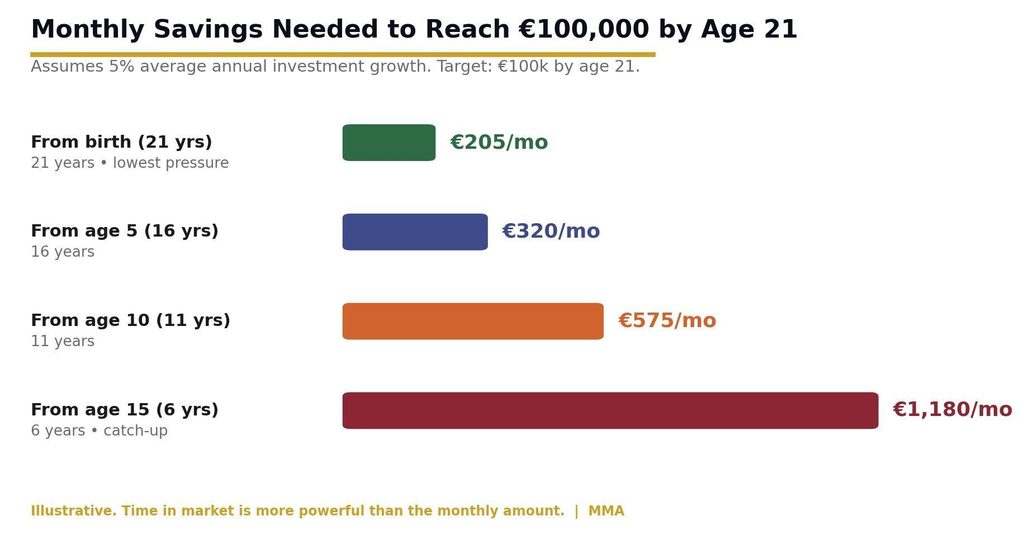
Time in the market matters far more than the monthly amount. The compounding effect of an extra decade is remarkable.
Starting from birth (21 years)
Roughly €205 per month, at an assumed 5% average annual return, builds a fund of €100,000 by age 21. This is realistic for most Irish family budgets.
Starting at age 5 (16 years)
You now need €320 per month for the same target. Still manageable for most households.
Starting at age 10 (11 years)
The requirement climbs to €575 per month. This is where family cashflow starts to feel the pressure.
Starting at age 15 (6 years)
You now need €1,180 per month to hit €100k by age 21. For most Irish households, this is not realistic. The lesson is stark: start early, even if the monthly amount is small.
Even €50 per month started at birth builds €25,000 by age 21. That’s meaningful money, and it costs the family less than €13,000 over 21 years.
The vehicles Irish families use to save
Regular Saver Investment Plan
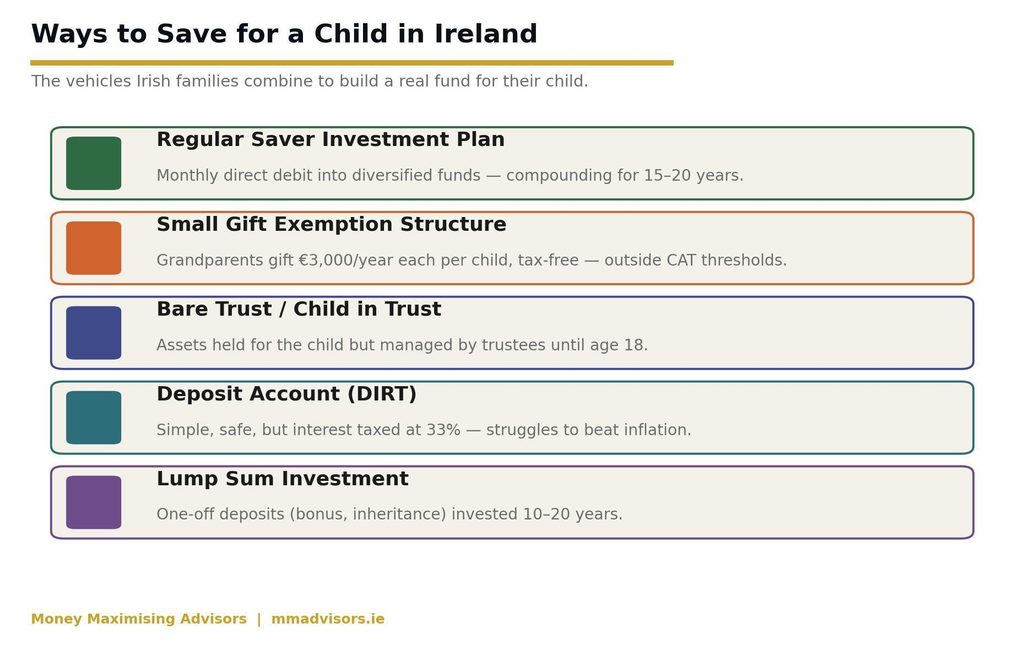
A monthly direct debit into a diversified investment fund. This is our most-recommended starting point for parents with 10+ years to go. Compounding does the heavy lifting. Our Regular Saver Investment Plans are brokered across Ireland’s leading providers to find the best fit for your goals and risk profile.
Small Gift Exemption strategy
Every grandparent can gift each grandchild €3,000 per year completely tax-free. Two grandparents can give €6,000 per grandchild per year.
Over 18 years, this alone builds a substantial fund. The Small Gift Exemption Savings Plan lets you invest these annual gifts to grow tax-efficiently, permanently outside the Capital Acquisitions Tax threshold.
Bare Trust (child in trust)
Assets held for the child but managed by trustees (usually parents) until the child turns 18. Legally the child’s money, which affects tax treatment favourably, but under parental control until adulthood.
Deposit account (DIRT)
The simplest option. Money sits in a deposit account earning a low rate. Interest is taxed at 33% DIRT. Rarely keeps pace with inflation over 15+ years, but has a role for the final 2–3 years before you need the money.
Lump Sum Investments
One-off deposits invested for the long term. Suits parents receiving a bonus, inheritance or redundancy payment. Our Lump Sum Investments service brokers the placement across leading Irish providers.
Ready to start your family savings plan?
Book a free 30-minute consultation, or send us your details and we'll be in touch.
Money Maximising Advisors Limited is regulated by the Central Bank of Ireland – C154250
The tax-efficient combination that works
Most successful Irish family savings plans combine two or three vehicles. Here’s a structure that works for a wide range of families.
Parents open a Regular Saver Investment Plan from the child’s birth. €150–€300 per month depending on family budget. Growing tax-efficiently for 18–21 years.
Grandparents use the Small Gift Exemption annually. Up to €3,000 per grandparent per grandchild, paid into the same investment or a separate child-name account. Over 18 years, this builds €50,000–€100,000+ completely tax-free.
Windfalls go into a Lump Sum Investment. A tax refund, bonus, inheritance or redundancy top-up gives the fund a boost every few years.
This three-layer approach can build €150,000–€250,000 by the time the child hits 21. Enough for college, a deposit contribution, and a start-up fund.
What if the fund is not enough?
Not every family can save the target amounts. That’s fine, anything is better than nothing. Here’s what fills the gap.
SUSI grants for college
The Student Universal Support Ireland (SUSI) grant is means-tested. The full non-adjacent maintenance rate is roughly €7,500 per year in 2026. Additional support is available for the student contribution charge.
Help to Buy and First Home Scheme
Irish first-time buyers can access up to €30,000 through the Help to Buy scheme, plus additional support through the First Home Scheme on many new builds. These schemes materially reduce the deposit gap.
Part-time work and student jobs
Most Irish college students work part-time. Typical earnings of €5,000–€8,000 per year cover a meaningful portion of living costs.
Common mistakes Irish parents make
- Waiting until the child is a teenager. Every year delayed adds 15–25% to the monthly commitment needed to hit the same target.
- Using deposit accounts for the entire journey. DIRT-taxed interest rarely beats inflation over 15+ years. Cash has a role for the final years, not the whole plan.
- Not using the Small Gift Exemption. Every year not used is €3,000+ of tax-free capacity permanently lost.
- Putting everything in one place. Diversification across cash, bonds and equities protects the fund from sequence-of-returns risk.
- Only planning for college. A home deposit and a start-up fund are just as valuable, arguably more so.
- Skipping professional advice. A one-hour review can identify the right vehicle mix for your specific budget and family size.
Where MMA fits in
Money Maximising Advisors is a Central Bank regulated financial broker based in Galway. When it comes to family savings, that means two things for you:
First, our advice services are delivered directly by our qualified team. Our Money Management Advice service builds you a family savings plan tailored to your income and goals.
Second, we are a multi-agency broker for the savings products themselves. We don’t manufacture regular saver plans, PRSAs, or gift-exemption accounts, we compare products from Ireland’s leading providers and help you access the one that fits.
The result: independent advice, wide product access, and no fee to you for the arrangement of the product itself.
Related posts
Frequently asked questions
How much should I save for my child’s future in Ireland?
A reasonable target is €100,000–€150,000 by age 21 to cover college and a meaningful contribution to a first-home deposit. Starting from birth, this requires roughly €205–€310 per month at 5% assumed growth. Higher targets support wider goals (business start-up, wedding, safety net).
How much should I save each month for my child’s education?
If starting from birth and targeting €70,000 for college costs, roughly €145 per month at 5% growth. If starting at age 5, roughly €220 per month. If starting at age 10, roughly €400 per month. The earlier you start, the smaller the monthly commitment.
What is the best way to save for a child in Ireland?
The most tax-efficient combination is a Regular Saver Investment Plan funded monthly by parents, topped up annually by grandparents using the €3,000 Small Gift Exemption. Windfalls (bonuses, inheritances) can go into a Lump Sum Investment to boost the fund every few years.
When should I start saving for my child?
The moment they are born. Every year of delay adds materially to the required monthly amount. €50/month started at birth builds €25,000 by age 21, the same target requires over €300/month if you start at age 15.
Can grandparents help save for a child tax-free?
Yes. Each grandparent can give each grandchild €3,000 per year completely tax-free under the Small Gift Exemption. Two grandparents can give €6,000 per grandchild per year, indefinitely. This is outside the Capital Acquisitions Tax lifetime thresholds.
What if I cannot afford to save much?
Anything is better than nothing. Even €50 per month started at birth builds €25,000 by age 21 at 5% growth. SUSI grants, the Help to Buy scheme, and part-time student jobs all fill remaining gaps.
Reviewed by our savings team
This guide was prepared and reviewed by Money Maximising Advisors, drawing on Revenue.ie guidance on the Small Gift Exemption, SUSI current grant rates, and Central Bank fund performance data. Watch our family savings walkthroughs on the Money Maximising Advisors YouTube channel. MMA is regulated by the Central Bank of Ireland (C154250).
Ready to start your family savings plan?
Whether your child is newborn, in primary school, or already in secondary, our team will build a savings plan around your family budget and goals.
Ready to start your family savings plan?
Book a free 30-minute consultation, or send us your details and we'll be in touch.
Money Maximising Advisors Limited is regulated by the Central Bank of Ireland – C154250
| Important information: Investment returns are illustrative and are not guaranteed. The value of investments can fall as well as rise, and past performance is not a reliable indicator of future returns. SUSI grant rates, Small Gift Exemption values, and Central Bank mortgage rules are those in force in Ireland at time of writing and are subject to change. Money Maximising Advisors Limited is regulated by the Central Bank of Ireland (C154250). This article is for general information only and does not constitute personalised financial, tax or legal advice. You should always seek advice from a Qualified Financial Advisor before making any savings or investment decision. |