If you’re a parent in Ireland right now, you probably feel the pressure from two directions at once. College fees and rent for a student aren’t cheap. And getting a young adult onto the property ladder is harder than it’s ever been. The good news? A small amount put away every month, started early, does an enormous amount of the heavy lifting for you.
This guide from the team at Money Maximising Advisors walks you through what to save for, how much you actually need, and the smartest ways to build a fund without turning it into a stressful monthly commitment. We’ll cover college costs, deposit help, the Small Gift Exemption trick most Irish families overlook, and how to make compound growth do the work for you.
| QUICK ANSWER :- Most Irish parents save toward one of three goals: college fees (€15,000–24,000 per year if the child lives away from home), a first-home deposit (typically €30,000–50,000+ in cash), or an early-adult milestone like a wedding or first car. Starting early is what makes it work. A regular monthly saving of €200, invested at an average 5% return over 20 years, builds to roughly €82,000, more than double the total you actually paid in. |
| This guide connects Irish parents and grandparents to the products we set up most often for family saving: Regular Saver Investment Plans, Lump Sum Investments, the Small Gift Exemption Savings Plan and dedicated College Education Savings plans. |
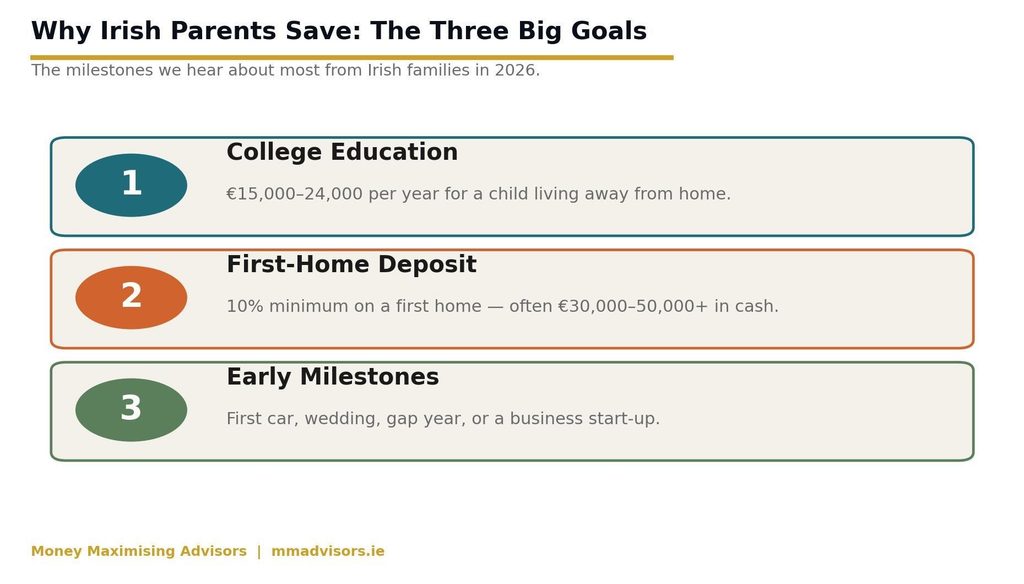
The three big money milestones we hear about most from Irish families in 2026.
What are Irish parents actually saving for in 2026?
A few years ago, this was a straightforward question. Parents saved for their children’s education, college fees, accommodation, maybe a bit of a top-up for living costs. Fast forward to today, and the picture has shifted. The cost-of-living squeeze, the housing market and the reality of adult children living at home into their late twenties have all changed what parents want to save for.
Here’s what we see across our Dublin, Cork, Galway, Limerick and Waterford clients right now:
Goal 1: Third-level education
Still the number-one reason parents open a savings plan. Roughly three in four Irish parents expect their children to go to college. If your child lives away from home during the academic year, you’re looking at €15,000 to €24,000 per year once you add the student contribution, accommodation, food, books, transport and a realistic social budget. Over a four-year degree, that’s a bill of €60,000–€96,000. See our full College Education Savings guide for the breakdown.
Goal 2: A first-home deposit
This is the newer one. With the average Irish home now costing well over €400,000, a 10% first-time-buyer deposit sits around €30,000 to €50,000+, plus stamp duty and legal costs. That’s a big ask on a starting salary. More and more parents, and grandparents, are quietly building a fund to hand over when the time comes.
Goal 3: Early-adult milestones
Weddings, first cars, gap years, business start-up costs, the miscellaneous list. These often become an unplanned drain on family finances in your late fifties or sixties, exactly when you should be maximising your own pension contributions. A modest, dedicated pot for these events takes the pressure off.
How much do these goals actually cost?
Let’s put real numbers on it. These are 2026 figures based on Citizens Information, published university cost estimates and the current Irish property market:
- College, living at home. Around €7,000–€10,000 per year including the €3,000 student contribution, transport, food, books and social budget.
- College, living away. €15,000–€24,000 per year. Dublin is at the top of the range, Cork and Galway sit lower.
- A four-year degree. €28,000–40,000 (living at home) or €60,000–96,000 (away).
- First-home deposit. €30,000–50,000+ in cash, plus another €10,000–15,000 for stamp duty and legal costs.
- Wedding. An Irish wedding averages €30,000–35,000 in 2026, though we’ve seen everything from €10,000 to €80,000+.
- First car. A safe, reliable second-hand car for a young driver typically €10,000–15,000, plus insurance.
If you’re feeling a bit overwhelmed reading that, you’re not alone. That’s exactly why starting early is the single most valuable thing you can do, not the amount you save, the time you give it.
Why starting early matters so much
The short version: because of compound growth. When your investment earns a return, that return then earns a return of its own. The longer you leave it, the more powerful the effect. Twenty years of it starts to look like magic.
Take a look at the chart. If you save €200 a month for 20 years, you actually pay in €48,000 of your own money. If you leave that in a low-interest deposit account, it grows to roughly €53,000. But if you invest it in a diversified fund that averages 5% growth a year, it grows to roughly €82,000, an extra €29,000 that costs you nothing.
Start ten years later and you don’t just save less money. You lose the compounding. To hit the same €82,000 in ten years, you’d need to save closer to €530 a month, more than two and a half times the commitment. Time really is the ingredient that does the work.
Cash savings or investment funds, which is right?
The honest answer is: it depends on how long you have. There’s a rough rule we use at Money Maximising Advisors and it’s this:
Short term (under 5 years): cash usually wins
If you know you’ll need the money within five years, a deposit account, credit union share account, or state savings product is usually the right home. Yes, the return is small, but the money is there when you need it, and you’re not exposed to a short-term market wobble at the worst possible moment. This is where you save for a car in three years, a wedding in two, or a summer trip next year.
Medium term (5–10 years): a balanced fund
Somewhere between the two. A balanced fund, typically a mix of shares, bonds and cash, has enough growth potential to comfortably beat inflation, without exposing you to the sharp swings of a pure equity fund. A good fit for a savings goal that’s a decade away, like a house deposit for a teenage child.
Long term (10+ years): an equity-focused fund
This is where investment funds really pull ahead. Over any 15–20-year period in recent Irish history, a diversified global equity fund has comfortably beaten inflation and beaten cash. Yes, there’ll be years when it drops. But short-term drops don’t matter when the money isn’t needed for 15 more years. This is the natural home for a college savings plan started when your child is little. See our Regular Saver Investment Plans for how we set these up.
| Not sure which mix is right for your family? Book Now for a free 30-minute chat with one of our advisors, or Enquire Now, we’ll come back to you within one working day. |
The Small Gift Exemption: the tax trick most Irish families miss
If there’s one piece of Irish tax law worth knowing about, it’s this. Under Revenue rules, any adult can gift up to €3,000 per year to any other person, tax-free, no forms, no strings, and it doesn’t touch the recipient’s lifetime inheritance tax threshold. It resets on 1 January every year.
That’s a rule with quiet power once you use it properly:
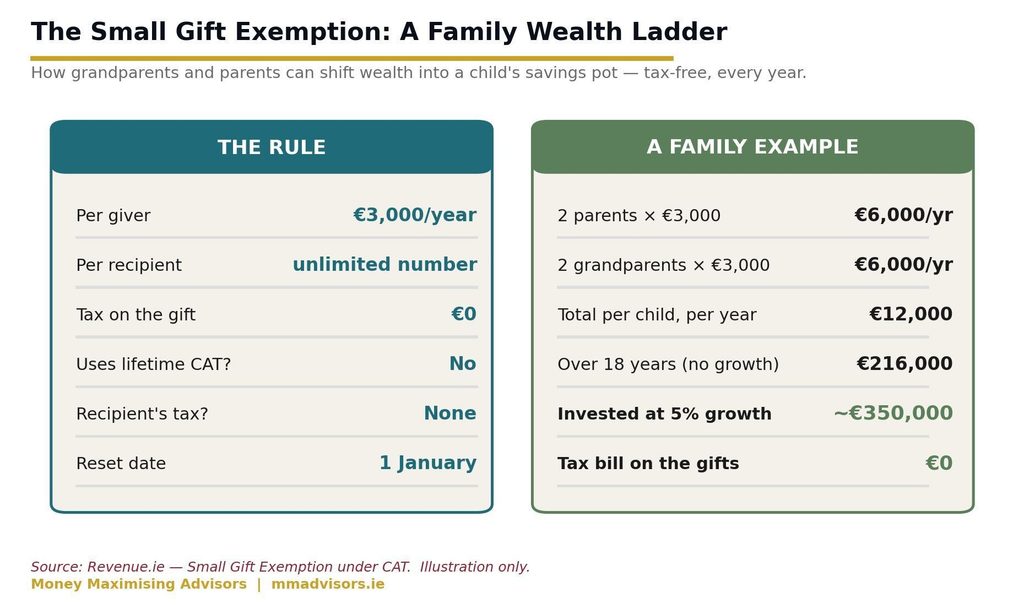
Two parents and two grandparents together can move €12,000 into a child’s savings pot every year, with zero tax.
The maths for a typical Irish family
Two parents can gift €3,000 each to a child every year, €6,000. Two grandparents can do the same, another €6,000. That’s €12,000 per child, per year, moving from the older generation into a savings fund with no tax consequences at all.
Over 18 years, that’s €216,000 shifted tax-free. Invested at 5% average growth, the fund builds toward €350,000. That’ll comfortably cover a college degree, a first-home deposit, and a wedding, with plenty left over.
Where it fits into an estate plan
This is also the single most powerful tool for reducing an eventual Capital Acquisitions Tax (CAT) bill. Every euro you gift under the Small Gift Exemption is a euro that never counts against the €400,000 (Group A) inheritance tax threshold. For families who might otherwise face a substantial CAT bill, this is a quiet, legal way to shrink it over time. See our Small Gift Exemption Savings Plan for how we structure this properly.
Regular saving vs a lump sum: which works better?
Both work. Most of our clients end up doing a mix. Here’s how to think about it.
Regular monthly saving
The workhorse. A direct debit on the same day every month, into an investment fund matched to your risk profile. The beauty of a monthly plan is that it takes the decision out of your hands. You don’t sit at the kitchen table each month wondering whether the market is up or down. The money just goes. Over 15–20 years, that discipline is what builds real wealth. See our Regular Saver Investment Plans.
A lump-sum investment
If you’ve come into money, a redundancy payment, an inheritance, a bonus, the proceeds from a downsizing move, investing that lump sum for 10–15 years is often the single most impactful thing you can do for a child’s future. The lump sum benefits from compound growth from day one. Combined with a monthly regular saver on top, it accelerates the fund significantly. See Lump Sum Investments.
The combined approach
A typical Irish family we work with will hold a mix: a modest monthly direct debit into a regular saver, a Small Gift Exemption fund set up with the grandparents, and any occasional lump sum (Christmas bonuses, an inheritance) added on top. Three vehicles, one destination, and the tax treatment optimised at each layer.
How to think about risk when you’re saving for a child
Risk sounds scarier than it needs to. In investment terms, “risk” just means how much the value of your fund is likely to bob up and down along the way. In Ireland, funds are typically rated on a scale of 1 to 7, where 1 is very cautious (mostly cash) and 7 is very high-risk (specialist or leveraged funds). Most family savings plans sit somewhere in the middle.
What matters is matching the risk to the time you have. A few sensible rules:
- 15+ years to go? You can comfortably take more investment risk. Short-term dips don’t matter when the money isn’t needed for over a decade.
- 5–10 years to go? A balanced approach. Enough growth to beat inflation, without exposing you to the sharpest swings.
- Under 5 years to go? Time to protect what you’ve built. Shift toward cash and short-dated bonds so a bad year doesn’t wipe out three years of gains just before you need the money.
This gradual shift, called a glidepath, is one of the most important things to get right in a long-term family savings plan. Get it wrong and a market wobble in your child’s last year of secondary school can leave you short at the worst possible moment. Get it right and you land safely.
The tax picture on Irish family savings
Ireland’s tax system treats different savings vehicles differently. It’s worth knowing which is which.
Deposit accounts
Interest is taxed at Deposit Interest Retention Tax (DIRT), currently 33%. The bank deducts it at source, so you don’t have to file anything. In today’s low-interest environment, DIRT on a small amount of interest is usually a non-issue.
Investment funds
Gains on Irish life-assurance investment funds and unit-linked funds are taxed at exit tax, currently 41%. This is deducted automatically on the eighth anniversary of the policy, and again on any withdrawal. Unlike a share portfolio, you don’t have to file annually, the provider handles it.
Gifts under the Small Gift Exemption
Zero tax. Zero forms. Zero impact on the lifetime CAT threshold. This is by far the most tax-efficient way to move money down the generations if you have grandparents willing to help.
Larger gifts and inheritances
Capital Acquisitions Tax (CAT) applies at 33% above the relevant threshold: €400,000 for a parent-to-child gift, €40,000 from a Group B relative (aunt, uncle, grandparent), €20,000 for everyone else. See our Inheritance Tax Advice for the full picture.
Common savings mistakes Irish parents make
- Waiting until secondary school. Leaving the plan until your child is 12 or 13 triples the monthly commitment needed to hit the same target vs starting at birth.
- Keeping 15 years of savings in cash. Deposit interest rarely beats inflation. Over 15+ years, an investment fund typically doubles or triples what a cash account would deliver in real terms.
- Ignoring the Small Gift Exemption. Grandparents often want to help but don’t know about the tax-free €3,000 window. Unused years are permanently gone, they don’t carry forward.
- Not shifting to safety near the end. A market drop in your child’s Leaving Cert year can undo three years of gains at exactly the wrong moment.
- Trying to time the market. Nobody times it well. A steady monthly direct debit through good years and bad has historically beaten trying to “buy the dip”.
- Not reviewing the plan every couple of years. Your risk profile changes as your child gets older. Your fund allocation should change with it.
Related Guides:-
Frequently asked questions
How much should I save each month for my child in Ireland?
It depends on your goal and your timeframe. As a rough guide, €172 per month invested from birth at 5% average growth builds a €60,000 fund by age 18. €300 per month at the same growth rate builds close to €105,000. Starting later means saving more each month for the same result.
What is the Small Gift Exemption in Ireland?
Under Revenue rules, any adult can gift up to €3,000 per calendar year to any other individual, tax-free, and without using any part of the recipient’s lifetime Capital Acquisitions Tax threshold. It resets on 1 January every year. Unused amounts do not carry forward.
Should I save in cash or invest for my child’s future?
For goals more than five years away, invested funds typically outperform cash after inflation. For anything within five years, a deposit account or state savings product is usually the right home. Most Irish families use both, matched to different goals.
Can grandparents save for their grandchildren tax-free?
Yes. Each grandparent can gift €3,000 per year, per grandchild, under the Small Gift Exemption. Two grandparents together move €6,000 tax-free every year. Structured into a dedicated Small Gift Exemption Savings Plan, those annual gifts can build to a substantial fund by the time the grandchild reaches college age or property-buying age.
How much does college cost in Ireland in 2026?
For a student living away from home, budget €15,000–€24,000 per year including the €3,000 student contribution, accommodation, food, books, transport and social costs. Students living at home typically cost €7,000–€10,000 per year.
What return can I expect from an investment fund in Ireland?
Historical averages for diversified Irish investment funds have run 4–7% per year over 20+ year periods, before charges. Future returns aren’t guaranteed; they can and do fall as well as rise. A qualified advisor will match a fund to your specific risk profile and timeframe.
What happens to the savings if my child doesn’t go to college?
The money is yours (or the child’s, depending on how the plan is structured) to redirect. Common alternatives include a first-home deposit, a business start-up fund, a training course, or simply leaving it invested for longer. A well-designed savings plan gives you flexibility, not a rigid tie to one specific outcome.
Reviewed by our savings and investment team
This guide was prepared and reviewed by the savings and investment team at Money Maximising Advisors, drawing on Revenue.ie guidance on the Small Gift Exemption and CAT, Citizens Information cost-of-education data, Central Bank of Ireland mortgage rules, and 2026 Irish market data. Money Maximising Advisors Limited is regulated by the Central Bank of Ireland (C154250).
Ready to build your family plan? Let’s talk.
Whether your child is a newborn, a toddler or already in secondary school, and whether you’re planning for college, a first-home deposit, or both, we’ll build a personalised savings plan for your family. Book Now for a free consultation, or Enquire Now and we’ll be in touch within one working day.
Important information:
All illustrative figures assume a 5% average annual investment return for the purposes of demonstration only, actual returns will vary and are not guaranteed. Cost-of-education figures are based on Citizens Information and published Irish university cost estimates for 2025–26. The Small Gift Exemption threshold (€3,000/year) and Capital Acquisitions Tax thresholds are as set by Revenue and were correct at the time of writing. Money Maximising Advisors Limited is regulated by the Central Bank of Ireland (C154250). This article is for general information only and does not constitute financial, tax or legal advice. The value of investments can fall as well as rise, and past performance is not a reliable indicator of future returns. You should seek personalised advice from a Qualified Financial Advisor before making any savings or investment decision.