If you live in Galway and you do not have children, whether by choice or by circumstance, you may already suspect what a growing national campaign is now spelling out: Ireland’s inheritance tax rules treat your loved ones very differently from how they treat the children of your neighbours. This pillar guide from Money Maximising Advisors walks you through Capital Acquisitions Tax (CAT) as it stands in 2026, explains the group thresholds that create the childless gap, works a real Galway example, and sets out the legitimate structures that can meaningfully reduce your family’s tax bill. Whether you plan to leave assets to a niece in Salthill, a friend in Oranmore, a carer in Athenry or a partner without civil status, the rules affect you, and there is more you can do than most people realise.
| WHY THIS MATTERS NOW Ireland’s inheritance tax system is under active political review. Budget 2026 raised the Group B threshold from €32,500 to €40,000. A campaign led from Cork by End Discrimination in Inheritance Tax (EDIT) is now pressuring Budget 2027 for a fundamental reform of how childless estates are treated. The rules could change, but for now, they are what they are, and they hit Galway families with nieces, nephews, siblings, carers or unmarried partners as beneficiaries especially hard. |
| This pillar sits within our Inheritance Tax hub and supports the specific structures our Galway clients use most often: Section 72 Policies, Section 73 Policy Savings Plan and the Small Gift Exemption Savings Plan. |
Is inheritance tax the same as Capital Acquisitions Tax?
In Ireland, what people call “inheritance tax” is technically Capital Acquisitions Tax (CAT), a single tax that covers both lifetime gifts and inheritances at death. It is charged on the beneficiary, the person receiving, not the estate itself. The current rate is 33% on the taxable value above a lifetime tax-free threshold that depends on the relationship between the person giving (the disponer) and the person receiving. For a fuller walkthrough of the mechanics, see our Demystifying Inheritance Tax in Ireland: Rules and Calculations and Gift Tax in Ireland: How Does Gift and Inheritance Tax Work?.
How does Capital Acquisitions Tax (CAT) work in Ireland?
CAT is calculated by adding up every gift and inheritance a beneficiary has received from the same threshold group since 5 December 1991, subtracting the applicable lifetime threshold, and taxing the remainder at 33%. Once your total from a group exceeds that group’s threshold, every euro after that is taxed at the full rate. There are three groups, A, B and C, and this is where the childless gap opens up.
What is the inheritance tax threshold in Ireland?
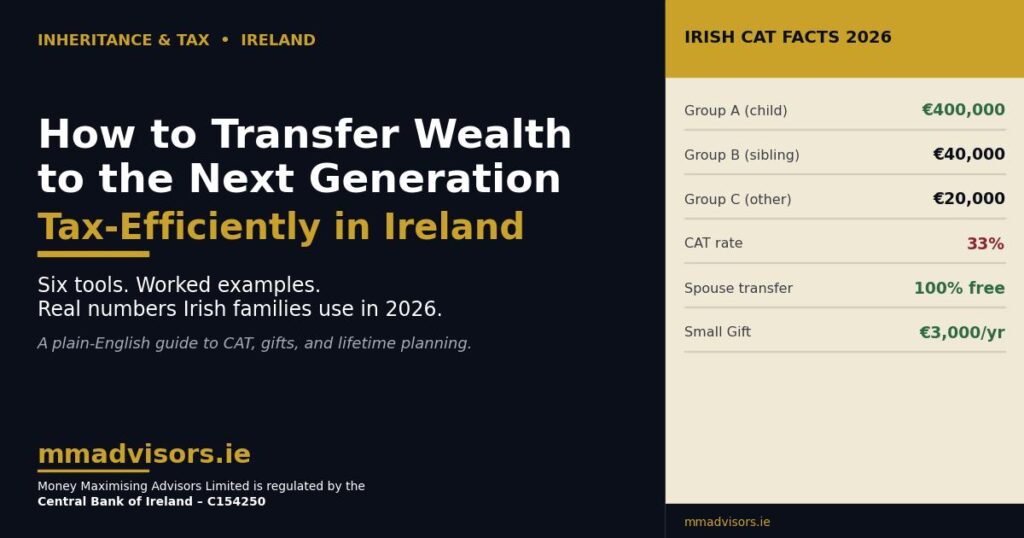
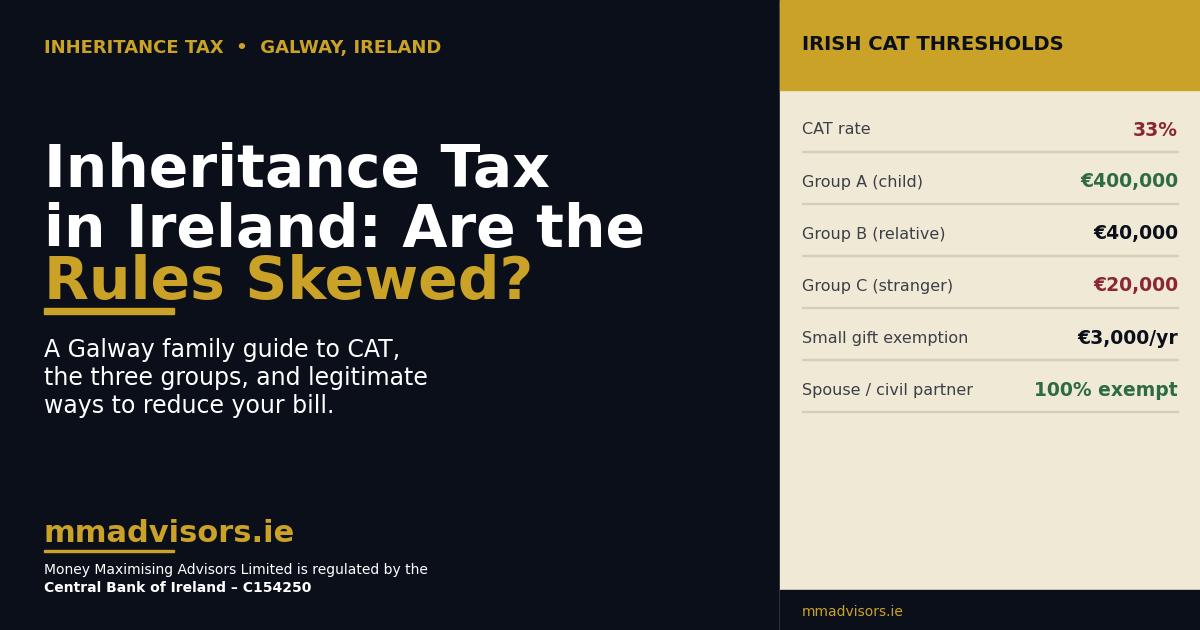
The three groups and their 2026 tax-free lifetime thresholds are:
- Group A: €400,000. A child inheriting from a parent (or in specific cases from a grandparent, where the child’s parent is deceased and the child is a minor). Foster children and stepchildren also qualify under strict conditions.
- Group B: €40,000. A sibling, niece, nephew, grandchild or grandparent of the disponer. This threshold was raised in Budget 2026 from €32,500 to €40,000.
- Group C: €20,000. Everyone else, friend, cousin, unmarried partner without civil status, carer, colleague, neighbour.
Spouses and registered civil partners are entirely outside the CAT system: gifts and inheritances between them are exempt without limit. The Small Gift Exemption allows €3,000 per year, per giver, per recipient, and does not use up any part of the lifetime threshold.
Do childless people pay more inheritance tax in Ireland?
In effect, yes, the people they leave assets to almost always do. A child inheriting from a parent can receive up to €400,000 tax-free; a niece, nephew or sibling receives only €40,000 tax-free from the same-sized estate. That is a tenfold gap. If the beneficiary is a friend, unmarried partner, carer or neighbour, they fall into Group C and receive only €20,000 tax-free, a twenty-fold gap.
Why are inheritance tax rules different for childless individuals?
The Irish system is not unique in giving preferential treatment to children and spouses, most European jurisdictions do the same. The historical rationale is the desire to keep family homes, farms and businesses intact across generations. That model works well for families with children. It works significantly less well for the estimated one million Irish adults who are single, unmarried, childless or in relationships that fall outside the civil-partnership framework.
A national campaign, End Discrimination in Inheritance Tax (EDIT), argues the current thresholds are effectively a State-imposed penalty on being childless, and has proposed a lifetime tax-free threshold available to every citizen, whatever their family status. The Government has confirmed the issue is on the agenda for Budget 2027 discussions, and increases to Group B and Group C thresholds are among the options being modelled. For Galway families, the practical implication is simple: plan for the rules as they are today, but keep an eye on what changes.
A Galway example: the same €600,000 home, two very different tax bills
Consider a house in Knocknacarra bought and paid for over a lifetime, valued at €600,000 at the point of inheritance. Two paths, two very different outcomes:
If the home is left to a child (Group A), the Group A threshold of €400,000 leaves €200,000 taxable. At 33%, that produces a CAT bill of €66,000, and the beneficiary nets €534,000. If instead the same home is left to a niece (Group B), only €40,000 is tax-free. €560,000 is taxable at 33%, producing a CAT bill of €184,800 and a net inheritance of €415,200. Same home, same value, €118,800 difference in tax.
Can nieces and nephews inherit tax-free in Ireland?
Only up to €40,000 tax-free, the Group B lifetime threshold, aggregated across every gift and inheritance received from Group B disponers since 1991. Beyond that, the standard 33% CAT rate applies. Two specific reliefs can meaningfully alter that picture:
- The “Favourite Niece / Favourite Nephew” relief. A niece or nephew who has worked substantially full-time in the disponer’s business for at least five years may inherit qualifying business assets under the Group A threshold instead of Group B. Conditions are strict and require professional advice to evidence.
- Foster child status. If a niece or nephew was raised as a child of the disponer under specific residence and duration tests, Group A treatment can apply.
For farming families across east and north Galway, Agricultural Relief reduces the taxable value of qualifying agricultural property by 90%, subject to the 80% “farmer test” and a six-year retention period. This can convert a headline CAT liability of €184,800 into just €18,480 on the same asset, if structured correctly.
How can I reduce inheritance tax legally in Ireland?
1. Use the Small Gift Exemption every single year
Every disponer can gift €3,000 per calendar year to each recipient tax-free, and this allowance does not use up the lifetime threshold. Two Galway parents can therefore transfer €6,000 per child per year, or €6,000 per niece per year, entirely outside CAT. Over twenty years, that alone shifts up to €120,000 per child, per couple, out of the taxable estate. See our Small Gift Exemption Savings Plan for the compounding version of this strategy.
2. Fund a Section 72 life insurance policy
A Section 72 policy is a Revenue-approved life insurance policy whose proceeds are specifically ring-fenced to pay CAT on inheritance. Because premiums are structured correctly, the payout is not itself subject to CAT provided it is used to settle the bill. For a childless Galway aunt leaving a large estate to nieces, this is often the single most impactful move, the policy takes the CAT hit out of the beneficiaries’ hands entirely.
3. Set up a Section 73 savings plan
For lifetime gifts rather than inheritances, an eight-year Section 73 Policy Savings Plan allows the proceeds to be paid out at maturity and used to cover the gift tax on transfers to family members. See our full walkthrough at How a Section 73 Policy Can Reduce Inheritance Tax in Ireland.
4. Consider the Dwelling House Exemption
Where the beneficiary has lived in the property as their main residence for three years before the inheritance, does not own another home, and continues to live there for six years afterward, the Dwelling House Exemption removes the property from CAT entirely. Conditions are strict but for a niece who has genuinely cared for and lived with a childless aunt in Galway city, this can be transformative.
5. Use Agricultural or Business Relief
Both reliefs reduce the taxable value of qualifying farm or business assets by 90%. In rural Galway, Athenry, Loughrea, Tuam, Ballinasloe, Agricultural Relief remains one of the largest CAT reductions available, but the tests are unforgiving and post-inheritance requirements last six years. Business Relief works similarly for qualifying trading businesses. Both are worth structuring long before the estate crystallises.
| Need a tailored Galway estate plan? Enquire Now for a no-obligation conversation with our inheritance tax team, or Book Now to schedule a full review of your estate. |
Two special situations Galway families ask about
Non-resident and ex-pat beneficiaries
CAT applies where the disponer or the beneficiary is Irish-resident, or where the assets are Irish-situated. A Galway ex-pat who left the country years ago may still be exposed on inheritances of Irish property, and returning ex-pats need to consider CAT alongside their broader mortgage and residency planning, our Ex-Pat Mortgages Ireland: A Complete Guide and Irish Mortgages and Buying Property in Ireland as an Ex-Pat give the practical picture.
Older Galway parents whose main asset is the family home
Where the estate is dominated by a house that beneficiaries do not necessarily want to inherit, a lifetime loan or equity release can allow the disponer to release capital during their lifetime, use it as they see fit (including tax-efficient gifting under the Small Gift Exemption), and reduce the net taxable estate at death. Read our Equity Release Mortgage Ireland 2026 Guide, the wider Unlocking the Potential of Your Home: Equity Release Mortgages Explained, and specifically for older homeowners: Seniors’ Equity Release Lifetime Loans. For fuller flexibility strategies, see Unlocking Home Wealth, Expert Guide to Equity Release, Remortgage and Buy-to-Let Flexibility.
Common CAT mistakes Galway families should avoid
- Assuming the family home is exempt. The Dwelling House Exemption has strict conditions, most estates do not qualify without careful planning.
- Ignoring the Small Gift Exemption. Every unused year is a permanent loss of €3,000 of tax-free capacity per recipient.
- Delaying life cover. Section 72 premiums rise sharply with age; policies taken out in your 50s are dramatically cheaper than in your 70s.
- Missing the aggregation rule. Prior gifts from the same threshold group since 5 December 1991 count, a childhood gift from an aunt can eat into a niece’s lifetime allowance decades later.
- Overlooking Agricultural or Business Relief conditions. Both require pre-death planning, you cannot retrofit them at will-writing stage.
- Leaving assets to unmarried partners without planning. A cohabiting partner without civil-partnership status is a Group C beneficiary, €20,000 lifetime threshold, then 33% on the rest.
Fitting CAT planning into a wider Galway financial plan
Estate planning is rarely done in isolation. A Galway household approaching this properly is usually thinking about at least three other topics at the same time: retirement income, family wealth transfer to the next generation, and the family home. Practical starting points:
- If a lump sum from redundancy or a business sale is in the picture, see What Is the Average Redundancy Package in Ireland? for the tax treatment of the lump sum itself.
- For families transferring wealth toward third-level education for the next generation, Build Your Child’s Future: Smart Savings and Investment Plans for College Education in Ireland pairs neatly with Small Gift Exemption planning.
- Where family investment properties are involved, our full guide to Comparing the Best Buy-to-Let Mortgage Rates in Ireland and the wider Irish Mortgage Market 2026 update cover the mortgage side.
- Public sector Galway families whose main asset is the family home and a defined-benefit pension entitlement should also see Public Sector Mortgages in Ireland for how those interact.
Most-read Irish inheritance tax guides
- Demystifying Inheritance Tax in Ireland: Rules and Calculations
- How a Section 73 Policy Can Reduce Inheritance Tax in Ireland
- Inheritance Tax Ireland | How To Avoid Legally
- Inheritance Tax Ireland, How to Reduce Your Tax Burden
- Gift Tax in Ireland: How Does Gift and Inheritance Tax Work?
Frequently asked questions
1. What is the inheritance tax threshold in Ireland?
Three thresholds apply based on the relationship between the disponer and beneficiary: Group A (parent to child) is €400,000; Group B (siblings, nieces, nephews, grandchildren, grandparents) is €40,000; Group C (everyone else) is €20,000. Amounts above these thresholds are taxed at 33%.
2. How does Capital Acquisitions Tax (CAT) work in Ireland?
CAT is charged on the beneficiary of a gift or inheritance, not the estate. Prior benefits from the same group since 5 December 1991 are aggregated. Once the lifetime threshold is exceeded, further inheritances or gifts from that group are taxed at 33%.
3. Do childless people pay more inheritance tax in Ireland?
The people receiving from them do. Because childless disponers cannot use Group A’s €400,000 threshold, their beneficiaries typically fall into Group B (€40,000) or Group C (€20,000), meaning a much larger portion of the estate is taxable at 33%.
4. Why are inheritance tax rules different for childless individuals?
Ireland’s tax framework, like most European jurisdictions, historically favours transfers between spouses and from parents to children, rooted in a policy goal of keeping family assets intact. Campaign groups argue this is now discriminatory; the Government is reviewing the position for Budget 2027.
5. Can nieces and nephews inherit tax-free in Ireland?
Only up to €40,000 (Group B). Above that, 33% CAT applies. Two exceptions can move a niece or nephew into Group A treatment: the Favourite Niece/Nephew relief for those working in the disponer’s business, and foster child status where the residence tests are met.
6. How can I reduce inheritance tax legally in Ireland?
The main tools are: the Small Gift Exemption (€3,000/year per giver per recipient), Section 72 and Section 73 policies, the Dwelling House Exemption, Agricultural Relief and Business Relief. Our Inheritance Tax Advice service maps the right combination to your specific estate.
7. Is inheritance tax the same as Capital Acquisitions Tax?
In everyday language, yes. Technically, CAT is a single tax that covers both lifetime gifts and inheritances at death, with the same rate and threshold framework applying to both.
Reviewed and researched by our Galway inheritance tax team
This pillar was prepared by the inheritance tax team at Money Maximising Advisors, drawing on Revenue.ie CAT rules, Budget 2026 thresholds and the current Budget 2027 policy debate. For personalised advice, Book Now or Enquire Now. See our full library of estate-planning walkthroughs on the Money Maximising Advisors YouTube channel.
Galway family? Let’s protect what you’ve built.
Whether you are planning for children, nieces, nephews, a partner without civil status or a beloved friend, our Galway inheritance tax team will map every legitimate relief and structure available to you and produce a written estate plan you can actually use. Book Now for your free consultation, or visit Money Maximising Advisors for more.
Important information
CAT rates, thresholds and reliefs are those in force under the Capital Acquisitions Tax Consolidation Act 2003 (as amended, including Budget 2026 changes). The 2026 Group B threshold reflects the Budget 2026 increase to €40,000. Money Maximising Advisors Limited is regulated by the Central Bank of Ireland. This article is for general information only and does not constitute financial, tax or legal advice. You should seek personalised advice from a qualified tax adviser or solicitor before making any inheritance-tax related decision.