Every October, the same deadline lands on Ireland’s self-assessed taxpayers. Miss it, and you’re looking at a surcharge, interest, and unwanted attention from Revenue. Understand it properly, and you’ll never lose a euro to a preventable penalty again.
This guide from Money Maximising Advisors explains exactly what “Pay and File” means, how the ROS extension works, and what preliminary tax actually is. You’ll also see the smart pre-deadline move that most self-assessed taxpayers overlook, and how it can genuinely cut your tax bill.
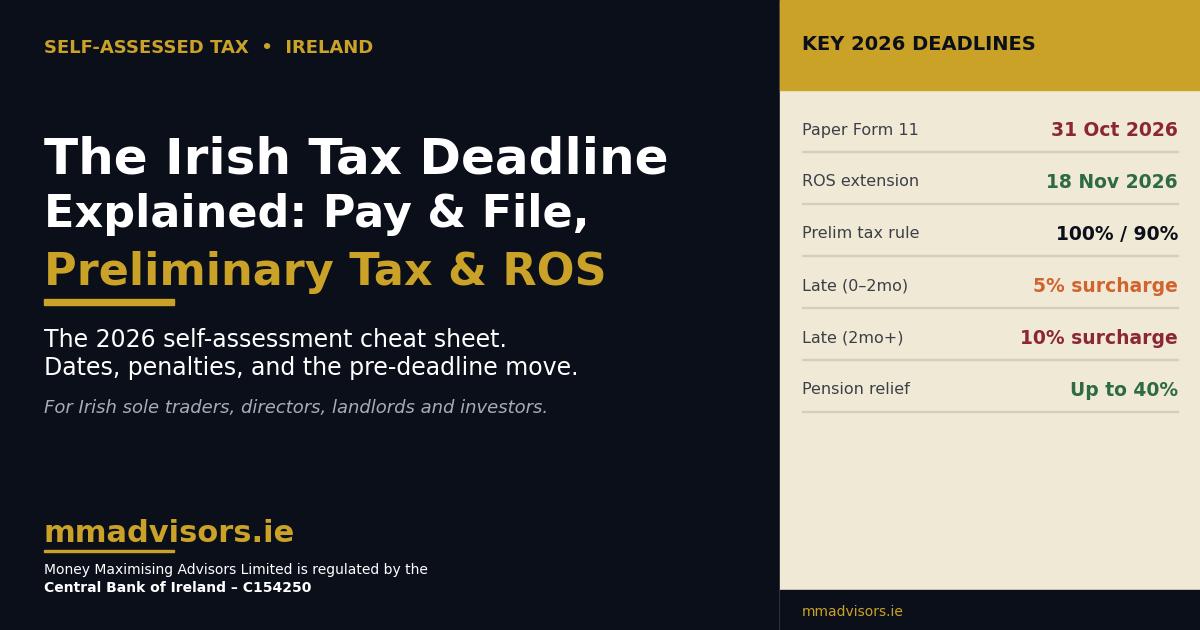
| QUICK ANSWER:The standard Irish Pay and File deadline is 31 October 2026 for the 2025 tax year. Taxpayers who both file their Form 11 return AND pay in full through ROS (Revenue Online Service) receive an extended deadline of Wednesday 18 November 2026. On the deadline you must do three things at once: file your Form 11 for the previous year, pay any balance of tax owed for that year, and pay preliminary tax for the current year. Missing the deadline triggers a 5% surcharge (capped at €12,695) if less than 2 months late, rising to 10% (capped at €63,485) if later. A backdated pension contribution paid before the deadline is one of the most effective ways to reduce your tax bill. |
What “Pay and File” actually means
Ireland runs a system called Pay and File. That’s short for what it actually does: on one date each year, you both file your tax return AND pay the tax owed.
Unlike PAYE workers, whose tax is deducted from every payslip, self-assessed taxpayers settle up once a year in one big transaction.
Three things happen on the same day
First, you file your Form 11 income tax return for the previous tax year (in 2026, that’s the return for 2025).
Second, you pay any balance of tax still owed for that previous year, after accounting for any PAYE deductions already made.
Third, you pay preliminary tax for the current year, an advance payment toward your 2026 liability.
Why it works this way
Revenue wants self-assessed taxpayers on roughly the same footing as PAYE workers. PAYE workers pay tax as they earn it. Self-assessed taxpayers pay it in one lump.
The preliminary tax mechanism means the State isn’t waiting until October 2027 to see any 2026 tax from you. You pay something on account now.
The key 2026 deadlines
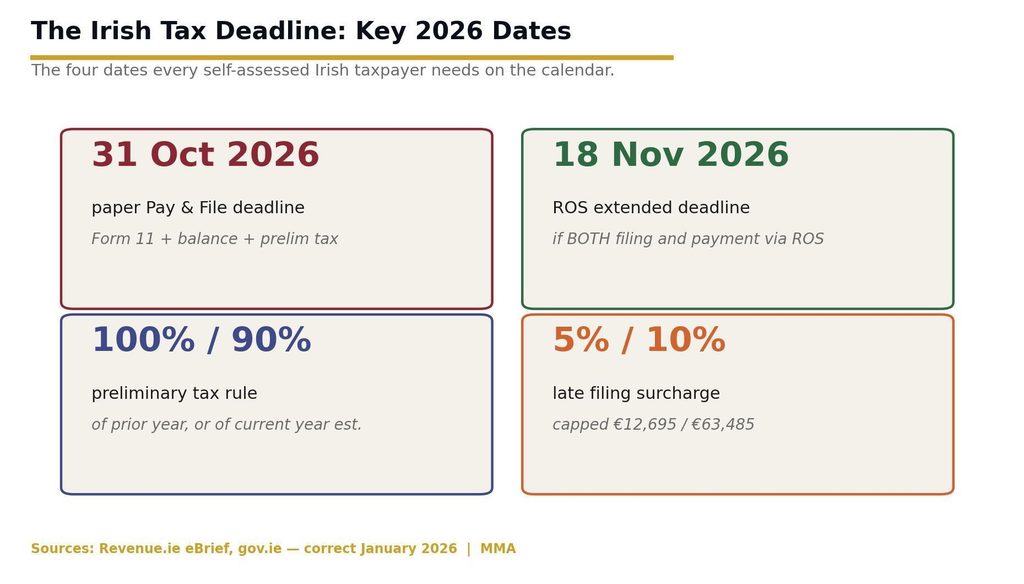
31 October 2026, paper deadline
The standard Pay and File deadline is 31 October 2026. This applies if you file on paper, or if you don’t meet both conditions for the ROS extension.
Miss this date without the ROS extension and you face the surcharge and interest rules.
18 November 2026, ROS extended deadline
Revenue has confirmed the ROS extended deadline for the 2025 tax year is Wednesday 18 November 2026.
To qualify for the extension, you must do both of the following through ROS: file your Form 11 return AND pay the full balance (2025 tax plus 2026 preliminary tax).
If you file through ROS but pay by cheque, the extension does not apply. Same if you pay through ROS but file on paper. Both filing and payment must be electronic.
31 August 2026, the free Revenue calculation option
A useful tactical option most people overlook. If you submit your completed Form 11 by 31 August 2026, Revenue will do the self-assessment calculation for you and tell you what you owe before the October deadline.
This removes the risk of miscalculating your liability. It also gives you weeks to arrange payment.
Who needs to file a Form 11?
Self-employed workers
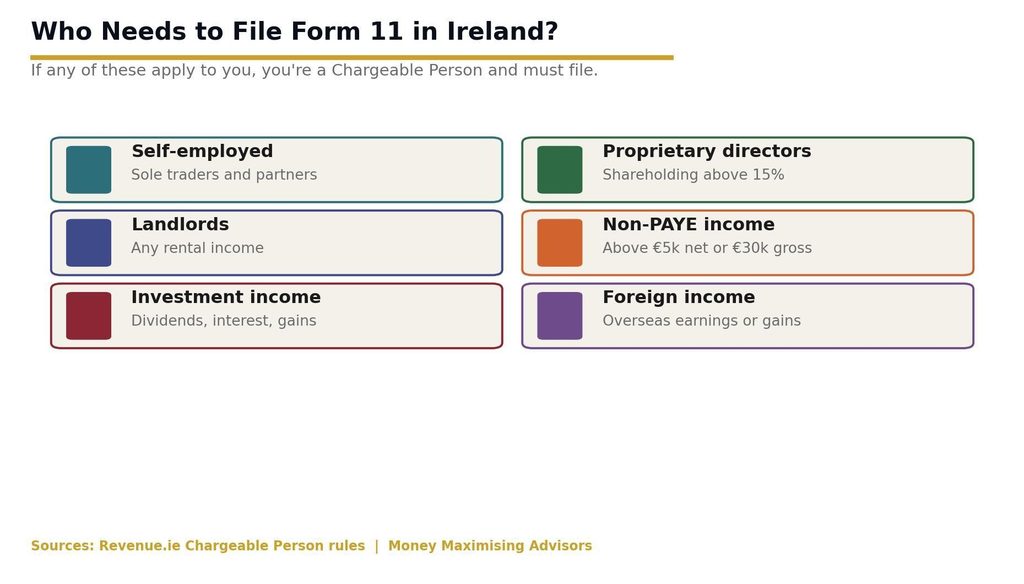
Sole traders, freelancers, contractors, and partners in a partnership. Anyone who earns income from a trade or profession outside of PAYE.
Proprietary directors
Company directors who own (directly or indirectly) more than 15% of the ordinary share capital of their company. The threshold is about shareholding, not salary size.
Getting this wrong is one of the most common mistakes we see. Directors who file Form 12 when they should file Form 11 often trigger a Revenue query years later.
Landlords
Anyone with rental income, whether it’s a spare room, a second property, or a portfolio.
Small rental income does trigger the filing obligation. There is no de minimis floor for landlords.
Anyone with non-PAYE income above thresholds
You must file Form 11 once non-PAYE income exceeds €5,000 net (i.e. after expenses) or €30,000 gross per year.
This catches side income, consulting fees, investment income, and any income Revenue can’t collect through your employer’s payroll.
Investment and foreign income
Dividends from Irish or foreign shares, interest on non-Irish deposits, capital gains, foreign rental income, and foreign employment income all typically require Form 11.
| Facing your first Form 11? Book Now for a free 30-minute pre-deadline pension review, or Enquire Now, we reply within one working day. |
Preliminary tax explained
Preliminary tax is an advance payment toward your current year’s tax liability.
When you file your 2025 Form 11 in October or November 2026, you’re paying two things at once: the balance still owed for 2025 AND preliminary tax for 2026.
How much preliminary tax to pay
Revenue accepts any of three methods. Choose the one that gives the lowest number you’re comfortable with.
Method 1: 100% of the prior year
Pay 100% of your final 2025 tax liability. If 2025’s tax bill was €15,000, your 2026 preliminary tax is €15,000.
This is the safest method, it’s a known number. Most self-assessed taxpayers use it.
Method 2: 90% of the current year
Pay at least 90% of your estimated 2026 final liability.
Better for taxpayers whose income is falling year-on-year. Risky for those whose income is rising, if your estimate is more than 10% short, interest applies to the shortfall.
Method 3: 105% of the pre-preceding year (direct debit only)
If you pay preliminary tax by monthly direct debit, you can base it on 105% of your 2024 liability.
Useful for smoothing cashflow. Requires the direct debit to be set up in advance with Revenue.
The ROS extension: how to actually get it
The extended 18 November deadline is only granted if you meet two specific conditions.
Condition 1: File through ROS
The Form 11 must be filed through ROS, not on paper, not by email attachment.
You need a valid ROS digital certificate. If you don’t have one, apply at ros.ie, the process takes several days, so don’t leave this to the week before.
Condition 2: Pay through ROS
The tax payment must also go through ROS. Payment methods include ROS Debit Instruction (RDI), electronic funds transfer, credit card, or debit card, all initiated through the ROS interface.
A cheque posted to Revenue does not qualify. Neither does a bank transfer done outside of ROS.
What if only one condition is met?
The extension is forfeited. You revert to the 31 October paper deadline.
If you missed 31 October because you thought the extension applied, you’ll face the late filing surcharge from 1 November. This is one of the most avoidable mistakes in Irish self-assessment.
What happens if you miss the deadline
Late filing surcharge
File your return within 2 months of the deadline: 5% surcharge on your total tax liability, capped at €12,695.
File more than 2 months late: 10% surcharge, capped at €63,485.
The surcharge is on the full tax liability, not just the balance due. It stings.
Daily interest on unpaid tax
On top of the surcharge, interest accrues daily on any unpaid tax. The rate is set by Revenue and typically runs at 8–10% per annum.
Loss of certain reliefs
Late filing can restrict certain reliefs, capital allowances, loss reliefs, and some deductions can be reduced or denied. This turns a filing delay into a real cash cost.
Increased Revenue scrutiny
Repeated late filers move up Revenue’s risk list. Expect closer examination of future returns, and potentially an audit invitation.
The pre-deadline move: backdated pension contribution
This is the single most effective legal way to reduce your Pay and File bill. And most self-assessed taxpayers don’t do it.
How it works
A pension contribution made before the Pay and File deadline can be elected to apply against the previous tax year.
In 2026, that means a contribution made before 31 October (or 18 November via ROS) can be applied against your 2025 tax bill.
You get tax relief at your marginal rate, up to 40% for higher-rate taxpayers.
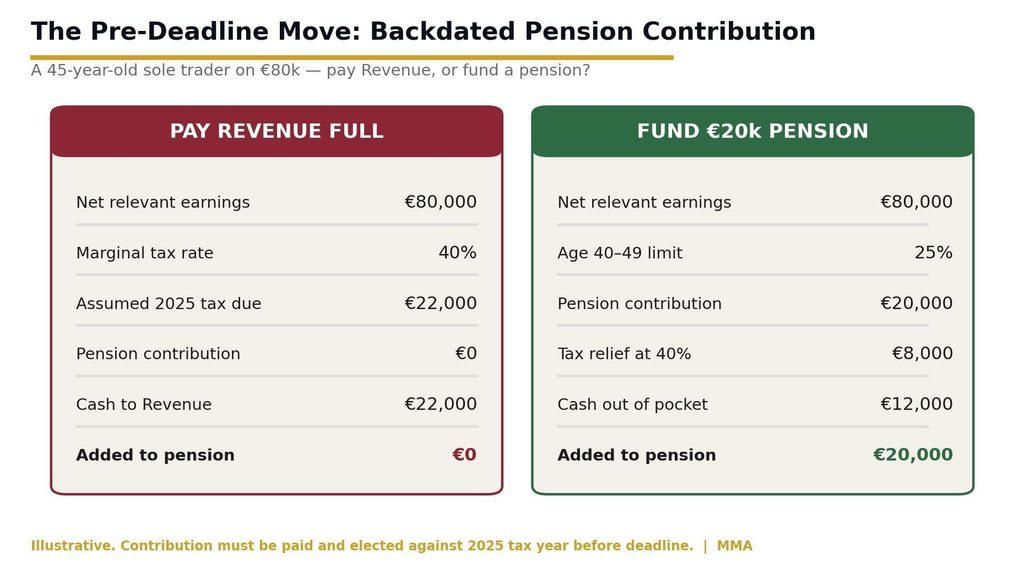
Worked example, 45-year-old sole trader on €80,000
Without a pension contribution, this taxpayer might owe roughly €22,000 in 2025 tax. All of it goes to Revenue.
With a €20,000 pension contribution (25% of €80,000, the age-related limit for 40–49 year olds), the contribution attracts €8,000 of tax relief.
Cash out of pocket to the taxpayer: €12,000. Cash to Revenue: reduced by €8,000. Cash added to pension pot: €20,000.
Age-related contribution limits
- Under 30: 15% of net relevant earnings
- 30 to 39: 20%
- 40 to 49: 25%
- 50 to 54: 30%
- 55 to 59: 35%
- 60 and over: 40%
Earnings above €115,000 don’t attract additional relief.
The critical election in ROS
Making the contribution is only half the job. You must actively elect in your Form 11 that the contribution applies to the previous tax year.
Miss this election and the contribution defaults to the current year, you lose the ability to reduce the 2025 bill you’re paying now.
Smart preparation in the weeks before
- Start in August, not October. Provider setup, ROS certificate applications, and payment clearance all take time.
- Gather every P60/T4 and payslip. Also gather rental statements, dividend vouchers, and Revenue notices of assessment.
- Model your preliminary tax choice. The 100% prior-year rule is safest. The 90% current-year rule can save cash if income is falling.
- Consider a pension contribution early. Speak to an adviser in September. Contributions cleared in October are less risky than payments attempted on the 30th.
- Check your ROS certificate is valid. Certificates expire every 2 years. An expired cert blocks filing.
- Reconcile any PAYE tax already paid. If you also have PAYE income, that tax is already gone, don’t accidentally pay it twice.
Common self-assessment mistakes to avoid
- Preliminary tax miscalculated. Estimated on gut feel rather than one of Revenue’s three approved methods. If it’s less than the required amount, interest applies.
- Foreign dividend income left off. Tax withheld abroad does not settle the Irish liability. You must still declare and reconcile.
- Poorly documented rental expenses. Deductions get disallowed if Revenue queries the return and there’s no paperwork.
- Proprietary directors filing Form 12. Shareholding percentage, not salary, drives the Form 11 requirement.
- Cryptocurrency disposals under-reported. Revenue’s data-matching with exchanges is improving year on year.
- Assuming ROS extension applies automatically. Both filing AND payment must be through ROS. Miss one condition, lose the extension.
Where MMA fits in
Money Maximising Advisors is a Central Bank regulated financial broker based in Galway. When it comes to the Pay and File season, we help with the pension side of the equation:
Our advice services, delivered directly by our qualified team, include Pensions Advice and Money Management Advice. We map how much you can contribute before the deadline and what the tax saving looks like.
On the products, we’re a multi-agency broker. We compare PRSAs, executive pensions, and last-minute AVCs across Ireland’s leading providers and help you access the right one for your income and age band.
For the return filing itself, work with a qualified tax accountant, that’s their specialism. We complement rather than replace the accountant relationship.
Also Read,
Frequently asked questions
What is the Irish tax deadline for 2026?
The standard Pay and File deadline is 31 October 2026 for the 2025 tax year. Taxpayers who both file their Form 11 return AND pay in full through ROS have an extended deadline of Wednesday 18 November 2026.
What is Pay and File in Ireland?
Pay and File is Ireland’s self-assessment tax system. Rather than filing a return and paying tax separately, self-assessed taxpayers must do both on the same date each year. On 31 October you file your Form 11 for the previous year, pay any balance owed for that year, and pay preliminary tax for the current year.
Who needs to file a Form 11 in Ireland?
You must file if you are self-employed, a proprietary director (over 15% shareholding), a landlord, or have non-PAYE income above €5,000 net or €30,000 gross per year. Investment income, foreign income, and capital gains also trigger the requirement.
What is preliminary tax?
Preliminary tax is an advance payment toward your current year’s tax liability. It’s paid at the same time as your previous year’s return. You can base it on 100% of the prior year’s tax, 90% of the current year’s estimate, or 105% of the pre-preceding year (direct debit only).
What is the ROS extension?
The ROS extension gives taxpayers an extra 2–3 weeks past 31 October (in 2026, until 18 November) if they both file their Form 11 return AND pay all tax due through ROS. Miss either condition and you revert to the standard 31 October deadline.
What happens if I miss the Pay and File deadline?
A late filing surcharge of 5% of your total tax liability applies if filed within 2 months (capped at €12,695), rising to 10% if later (capped at €63,485). Daily interest also accrues on any unpaid tax. Certain reliefs may be restricted.
Can I reduce my tax bill before the deadline?
Yes. A pension contribution made before the Pay and File deadline can be elected to apply against the previous tax year’s income, generating tax relief at your marginal rate (up to 40%). Age-related percentage limits apply: 15% under 30, rising to 40% at age 60+. This is one of the most effective legal ways to reduce your Pay and File bill.
Reviewed by our pension team
This guide was prepared and reviewed by the pension team at Money Maximising Advisors, drawing on Revenue.ie eBrief notices, Pensions Authority guidance, and daily pre-deadline pension work with self-employed clients. MMA is regulated by the Central Bank of Ireland (C154250). For your tax return itself, work with a qualified tax accountant.
Beat the deadline with a pre-deadline pension contribution
Whether you’re a sole trader, contractor, director, or landlord, our team maps your maximum backdated pension contribution and shows you the tax saving. Start in September to be safe. Book Now for your free 30-minute consultation, or Enquire Now, we reply within one working day.
| Important information Deadlines, preliminary tax rules, and surcharge caps referenced are those in force in Ireland at time of writing (January 2026) and are subject to change with each Finance Act. Revenue announces the ROS extended deadline each year separately, always verify the current-year date on Revenue.ie. Worked examples are illustrative and simplified. For your Form 11 preparation and filing, engage a qualified tax accountant. Rates, thresholds and rules referenced are correct at time of writing and are subject to change. Money Maximising Advisors Limited is regulated by the Central Bank of Ireland (C154250). This article is for general information only and does not constitute personalised financial, tax or legal advice. You should always speak to a Qualified Financial Advisor before making any decision. |
Sources
This guide draws on the authoritative Irish sources below. Rules, thresholds and deadlines change with each Finance Act, always verify with the primary source or a qualified adviser before acting.