
If you’ve recently inherited property or assets — or you’re thinking about what happens to your estate when you’re gone — understanding inheritance tax Ireland rules is more important than ever in 2026. With property values rising across Dublin, Galway, and beyond, more Irish families are finding themselves unexpectedly caught by a tax bill they never saw coming.
At Money Maximising Advisors Limited, we work with families across Ireland every day to help them understand their tax obligations and plan ahead so they keep more of what they’ve worked hard to build. This guide breaks down everything you need to know — from thresholds and rates to the exemptions most people don’t know about.
What Is Inheritance Tax in Ireland?
Inheritance tax Ireland is officially known as Capital Acquisitions Tax, or CAT. It’s a tax charged on gifts and inheritances received above a certain threshold. Whether you inherit money, property, shares, or any other assets, CAT may apply depending on your relationship to the person who left you the gift and the total value of what you receive.
The tax is administered by Revenue and is governed under the Capital Acquisitions Tax Consolidation Act 2003, though rates and thresholds are updated in the annual Budget. For inheritance tax Ireland 2026, the rules remain largely consistent with recent years, but threshold amounts have seen adjustments — which we’ll cover below.
How Does CAT Tax Ireland Work?
Under CAT tax Ireland, every beneficiary is placed in one of three threshold groups depending on their relationship to the person giving the gift or leaving the inheritance:
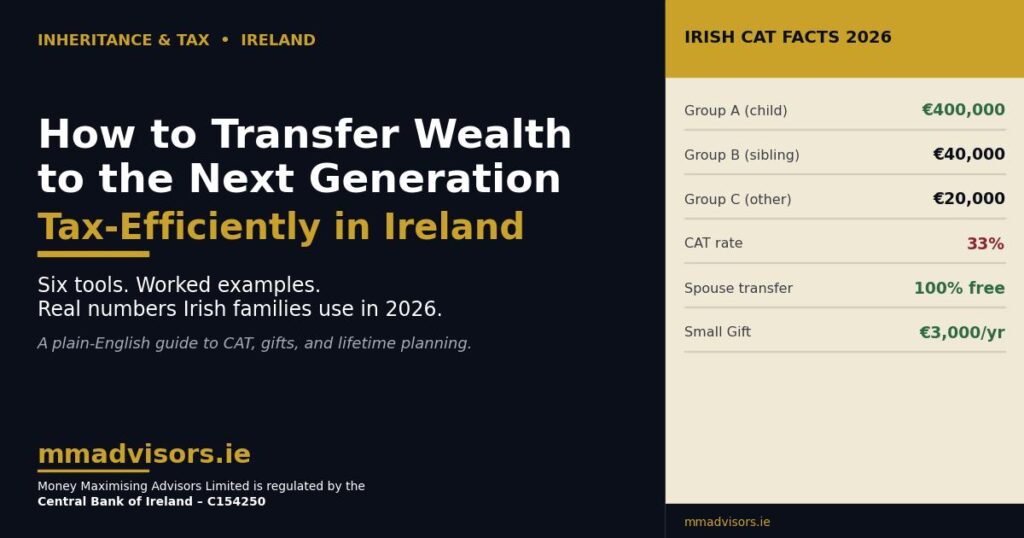
Group A — Children (including stepchildren and adopted children) inheriting from a parent. The current threshold is €400,000.
Group B — Siblings, nieces, nephews, grandchildren, and lineal ancestors. Threshold: €40,000.
Group C — Everyone else, including cousins, friends, and unrelated parties. Threshold: €20,000.
These are lifetime thresholds, not annual ones. That means every gift or inheritance you receive from within the same group is added together over your entire lifetime. Once the cumulative total exceeds your threshold, Ireland inheritance tax rates of 33% apply to the excess.
For example, if you are a child inheriting €550,000 from a parent, the first €400,000 is tax-free. The remaining €150,000 is taxed at 33%, resulting in a CAT bill of €49,500.
Inheritance Tax Thresholds Ireland: A Quick Overview
Here’s a summary of the current inheritance tax thresholds Ireland for 2026:
- Group A (parent to child): €400,000
- Group B (other close relatives): €40,000
- Group C (strangers and distant relatives): €20,000
It’s worth noting that the Group A threshold has been raised progressively in recent Budgets, partly in response to rising property prices. However, given that the average Dublin home now exceeds €450,000, even a straightforward parent-to-child inheritance can breach the threshold.
Key Exemptions Under Inheritance Tax Ireland Rules
Understanding inheritance tax Ireland exemptions can make a significant difference to your final tax bill. Some of the most important ones include:
Dwelling House Exemption — If you inherit the family home and you’ve been living there for at least three years before the inheritance, and you don’t own another property, you may be fully exempt from CAT on that property.
Small Gift Exemption — Anyone can receive up to €3,000 per year from any individual completely free of CAT. This applies regardless of group threshold and is a useful tool for gradual wealth transfer.
Spouse and Civil Partner Exemption — Inheritances between spouses and civil partners are fully exempt from CAT with no upper limit. This is one of the most generous exemptions in the Irish tax code.
Agricultural Relief — If the inherited assets are qualifying agricultural property and you meet the active farmer test, you can reduce the taxable value by 90%.
Business Relief — Similar to agricultural relief, this can reduce the taxable value of qualifying business assets by 90%.
Understanding which exemptions apply to your situation is where professional advice pays for itself many times over. If you’d like expert guidance tailored to your circumstances, enquire now and a member of our team will be in touch.
How to Use the Inheritance Tax Ireland Calculator
Revenue provides an online inheritance tax Ireland calculator on its website that allows you to estimate your potential CAT liability. You’ll need to know:
- Your relationship to the person who left you the inheritance
- The total market value of the assets received
- Any previous gifts or inheritances you’ve received from the same group
While the calculator gives a useful ballpark figure, it won’t account for reliefs, exemptions, or planning strategies that could significantly reduce your bill. That’s why speaking to a qualified advisor matters before you file.
Related Reading
If you want to go deeper on specific aspects of capital acquisitions tax Ireland, these guides from our team cover the most common questions we hear:
- Demystifying Inheritance Tax in Ireland: Rules and Calculations
- How a Section 73 Policy Can Reduce Inheritance Tax in Ireland
- Inheritance Tax Ireland — How To Avoid Legally
- Inheritance Tax Ireland – How to Reduce Your Tax Burden
- Gift Tax in Ireland: How Does Gift and Inheritance Tax Work?
How Much Is Inheritance Tax in Ireland? Planning Strategies That Work
Knowing how much is inheritance tax in Ireland is one thing — knowing how to legally minimise it is another. Here are some of the most effective planning approaches Irish families use:
Start gifting early. Using the €3,000 annual small gift exemption consistently over a number of years can transfer significant wealth tax-free. A grandparent with four grandchildren could gift up to €12,000 a year without any CAT implications.
Take out a Section 72 or Section 73 life insurance policy. These Revenue-approved policies are specifically designed to cover an inheritance tax bill, meaning your beneficiaries won’t be forced to sell a property or business to meet a tax liability. Read more about the Section 73 approach here.
Make use of agricultural and business reliefs. If you own farming land or a family business, these reliefs can reduce your taxable value dramatically — but the rules around qualifying are strict and must be carefully managed.
Plan your will strategically. The order in which assets are passed and to whom can affect the thresholds that apply. A well-drafted will, combined with tax planning advice, can make a considerable difference to what your beneficiaries ultimately receive.
Ready to start planning? Book a consultation here with one of our expert advisors today.
Why 2026 Is the Right Time to Act
Inheritance tax Ireland 2026 planning matters now more than ever. Property prices across Ireland, particularly in Dublin and Galway, continue to rise. The value of family homes is increasingly pushing estates beyond the Group A threshold, exposing families to unexpected tax bills. Meanwhile, changes to CAT thresholds and reliefs can be introduced in any Budget, meaning strategies that work today may be less effective in future years.
Early planning gives you options. Waiting until an estate is being administered often means it’s too late to take advantage of the most impactful reliefs and strategies.
Frequently Asked Questions
1. What is inheritance tax in Ireland?
Inheritance tax in Ireland is officially called Capital Acquisitions Tax (CAT). It’s charged at 33% on gifts and inheritances received above a set lifetime threshold, which varies depending on your relationship to the person leaving you the assets.
2. How much inheritance tax do you pay in Ireland?
You pay 33% on the value of the inheritance that exceeds your applicable group threshold. For children inheriting from a parent, the first €400,000 is tax-free. Everything above that is taxed at 33%.
3. What is the current CAT rate in Ireland?
The current CAT tax Ireland rate is 33%. This rate applies to the taxable value of a gift or inheritance above the relevant group threshold.
4. How much can you inherit tax-free in Ireland?
Under current inheritance tax Ireland rules, children can inherit up to €400,000 tax-free from a parent (Group A). Close relatives such as siblings and nieces/nephews have a €40,000 threshold (Group B), and all others have a €20,000 threshold (Group C).
5. Do thresholds apply per year or lifetime?
Thresholds are lifetime limits, not annual ones. Every gift or inheritance you receive from within the same group is accumulated over your entire lifetime. Once you exceed the threshold, 33% CAT applies to the excess.
6. Are there any exemptions from inheritance tax in Ireland?
Yes. Key inheritance tax Ireland exemptions include the dwelling house exemption, the annual small gift exemption of €3,000, full spousal exemption, agricultural relief (up to 90%), and business relief (up to 90%). Each has specific qualifying conditions.
Conclusion
Inheritance tax Ireland doesn’t have to be a shock or a burden — with the right planning, most families can manage their exposure significantly and ensure that wealth passes to the next generation as efficiently as possible. Whether you’re a parent thinking about your estate, or someone who has recently inherited assets and isn’t sure what to do next, expert advice is the single most valuable step you can take.
At Money Maximising Advisors Limited, our team of Certified Financial Planners, Qualified Financial Advisors, and Tax Advisors is here to help. We work with clients across Dublin, Galway, and throughout Ireland to build tailored inheritance tax plans that are practical, legal, and effective.
Contact us today to have a conversation about your situation — or book an appointment with one of our advisors at a time that suits you. The sooner you plan, the more options you have.
Disclaimer: This article provides general information about inheritance tax in Ireland and should not be considered personalised financial or tax advice. Capital Acquisitions Tax rules, thresholds, and reliefs are subject to change in annual Budgets, and individual circumstances vary considerably. Always consult with a qualified financial advisor or tax professional before making significant decisions about estate planning or inheritance tax. Money Maximising Advisors Limited is regulated by the Central Bank of Ireland.