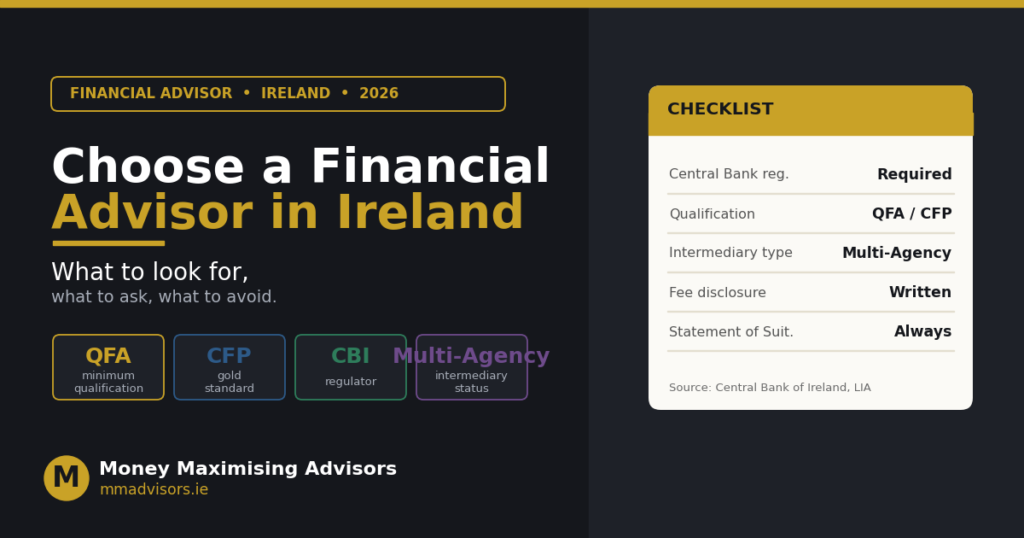

Finding the right financial advisor Ireland can be one of the most important decisions you’ll make for your financial future. Whether you’re planning for retirement, managing investments, or navigating inheritance tax, the right adviser can make all the difference between reaching your goals and falling short. With so many options available across Dublin, Galway, and beyond, how do you separate the truly qualified professionals from those who might not have your best interests at heart?
At Money Maximising Advisors Limited, we understand that choosing a financial adviser is about more than just numbers—it’s about trust, expertise, and finding someone who genuinely understands your unique financial situation. In this comprehensive guide, we’ll walk you through everything you need to know to make an informed decision.
Why Working with a Financial Advisor Matters in 2026
The financial landscape in Ireland has become increasingly complex. From changing pension regulations and evolving tax legislation to volatile investment markets and rising property prices, managing your finances effectively requires specialist knowledge. Many Irish people are discovering that professional financial guidance isn’t just for the wealthy—it’s for anyone who wants to make smarter decisions with their money.
Research shows that individuals who work with qualified advisers tend to accumulate significantly more wealth over their lifetime compared to those who go it alone. This isn’t magic—it’s the result of strategic planning, tax efficiency, and avoiding costly mistakes. If you’ve ever wondered whether you’re on track for retirement or if your investments are properly structured, working with a financial advisor Ireland professional can provide clarity and peace of mind.
Understanding Financial Advisor Qualifications in Ireland
Not all financial advisers are created equal. In Ireland, proper qualifications are essential, and knowing what to look for can protect you from unsuitable advice.
The Qualified Financial Adviser (QFA) Designation
The Qualified Financial Adviser (QFA) Ireland qualification is the minimum standard for anyone providing financial advice in Ireland. Regulated by the Central Bank of Ireland, this designation ensures advisers have completed rigorous training in:
- Investment products and strategies
- Pension planning and retirement solutions
- Life insurance and protection planning
- Irish tax legislation and regulations
- Ethics and professional conduct
When evaluating potential advisers, always verify they hold a current QFA designation. This is your first line of defence against unqualified individuals.
Additional Certifications That Matter
While the QFA is essential, many top advisers pursue additional qualifications:
- Certified Financial Planner (CFP): An internationally recognised designation requiring extensive education, examination, and experience
- Specialist tax qualifications: Particularly valuable for inheritance tax planning and estate management
- Specialist pensions expertise: Critical for retirement planning Ireland strategies
At Money Maximising Advisors Limited, our team includes Certified Financial Planners, Qualified Financial Advisers, and experienced tax advisors—ensuring you receive comprehensive, expert guidance across all areas of financial planning.
Looking for more insights on financial planning? Check out our article on Financial Planner Ireland: 10 Reasons Why You Need a Financial Advisor.

Independent vs. Tied Financial Advisors: What’s the Difference?
One of the most crucial distinctions you’ll encounter is between independent and tied advisers.
Independent Financial Advisor Ireland
An independent financial advisor Ireland professional can recommend products from the entire market. They’re not restricted to specific providers or product ranges, which means they can genuinely search for the best solution for your circumstances. Independence ensures objectivity and access to the full spectrum of financial planning services Ireland has to offer.
Tied Advisors
Tied advisers work for or represent specific financial institutions. While they may offer quality products, their recommendations are limited to their company’s offerings. This restriction can mean missing out on better alternatives available elsewhere.
For unbiased advice tailored specifically to your needs, an independent financial advisor Ireland provides the most comprehensive service.
Fee-Based vs Commission-Based Advisors: Understanding How They’re Paid
How your adviser is compensated can significantly impact the advice you receive. Understanding the difference between fee-based vs commission advisor models is essential.
Commission-Based Advisors
Commission-based advisers earn money when you purchase financial products. While many commission advisers provide excellent service, this model can create potential conflicts of interest, as there may be incentive to recommend products that generate higher commissions rather than those best suited to your needs.
Fee-Based Advisors
Fee-based advisers charge directly for their time and expertise, either as a flat fee, hourly rate, or percentage of assets under management. This model typically provides greater transparency and alignment of interests, as the adviser’s compensation isn’t tied to product sales.
Many modern financial planning services Ireland firms are moving toward fee-based models to ensure complete objectivity and client-focused service.
Ready to take control of your financial future? Contact us today to discuss your options.
Key Services to Look for in a Financial Advisor
The best financial advisor in Ireland should offer comprehensive services tailored to your life stage and goals:
Retirement Planning Ireland
Whether you’re decades away from retirement or approaching it soon, a qualified pension planning Ireland specialist can help you:
- Maximise your pension contributions
- Choose between defined benefit and defined contribution schemes
- Navigate Additional Voluntary Contributions (AVCs)
- Plan tax-efficient pension drawdowns
- Optimise State Pension entitlements
For public sector workers, specialised advice on superannuation and AVCs is particularly valuable. Learn more about Common Financial Pitfalls Faced by Individuals in Ireland to avoid mistakes.
Investment Planning and Portfolio Management
An experienced investment advisor Ireland professional should help you build a diversified portfolio aligned with your risk tolerance and time horizon. This includes guidance on:
- Asset allocation strategies
- Tax-efficient investment structures
- Regular portfolio reviews and rebalancing
- Ethical and ESG investment options
Wondering about tax implications? Read our guide on Financial Planning Advice: Do You Pay Taxes on Investments?
Estate and Inheritance Tax Planning
Inheritance tax (Capital Acquisitions Tax in Ireland) can significantly impact what you leave to loved ones. Professional advisers can structure your estate to:
- Minimise tax liabilities legally
- Utilise available exemptions and reliefs
- Ensure smooth wealth transfer between generations
- Protect assets for future beneficiaries
Discover more in our article: How Much Money Can You Gift to a Family Member Tax-Free in Ireland?
Protection and Life Insurance
Adequate protection ensures your family’s financial security if the unexpected happens. This includes life insurance, income protection, serious illness cover, and mortgage protection.
Mortgage Advice
Navigating Ireland’s property market requires specialist mortgage guidance to secure the best rates and terms for your situation.
How to Verify Your Financial Advisor Is Regulated
The Central Bank of Ireland maintains strict oversight of financial advisers. Before engaging any financial advisor Ireland professional, verify they’re properly regulated:
- Check the Central Bank’s Registers: Visit the Central Bank of Ireland website and search their public registers to confirm the adviser is authorised
- Request their regulatory number: Legitimate advisers will readily provide their regulatory reference
- Verify their insurance: Ensure they hold appropriate professional indemnity insurance
- Review their statement of suitability: Advisers must provide documentation explaining why their recommendations suit your circumstances
Never work with an unregulated adviser, regardless of how attractive their promises may seem.
Questions to Ask When Choosing a Financial Advisor
Before committing to a financial advisor Ireland, ask these essential questions:
- What qualifications and designations do you hold?
- Are you independent or tied to specific providers?
- How are you compensated—fees or commissions?
- What is your experience with clients in similar situations to mine?
- Can you provide client references or testimonials?
- How often will we review my financial plan?
- What is your investment philosophy?
- What services are included in your fees?
The right adviser will answer these questions openly and help you feel confident in your decision.
Red Flags to Watch Out For
Protect yourself by recognising warning signs of unsuitable advisers:
- Guaranteeing specific investment returns (no legitimate adviser can do this)
- Pressuring you to make quick decisions
- Being vague about fees or compensation
- Lacking proper credentials or regulatory authorisation
- Offering one-size-fits-all solutions without understanding your circumstances
- Being reluctant to put advice in writing
Trust your instincts—if something feels wrong, seek a second opinion.
The Value of Local Expertise
While financial principles are universal, Irish-specific knowledge is invaluable. An adviser familiar with Ireland’s tax system, pension regulations, property market, and local economic conditions can provide insights that generic advice cannot match.
Whether you’re based in Dublin, Galway, or elsewhere in Ireland, working with local experts who understand your regional market and lifestyle considerations ensures more relevant, actionable advice.
For senior investors, our guide on Smart Investing for Seniors in Ireland: A Practical Guide to Financial Peace of Mind offers valuable insights.
Taking the Next Step: Book Your Consultation
Choosing the right financial adviser doesn’t have to be overwhelming. By focusing on qualifications, independence, fee transparency, and regulatory compliance, you can find a trusted partner to guide your financial journey.
At Money Maximising Advisors Limited, our team of Experienced Tax Advisors, Certified Financial Planners (CFP), and Qualified Financial Advisers (QFA) is dedicated to helping Irish clients achieve their financial goals. From pension planning and investments to mortgages, life insurance, and inheritance tax planning, we provide comprehensive, objective advice tailored to your unique circumstances.
Ready to maximise your financial potential? Book an appointment today and discover how professional financial guidance can transform your financial future.
Read more about Maximising Your Wealth: Benefits of Working with a Financial Planner to understand the full value of professional advice.
Frequently Asked Questions
- What qualifications should a financial advisor in Ireland have?
At minimum, your adviser should hold the Qualified Financial Adviser (QFA) designation regulated by the Central Bank of Ireland. Additional credentials like Certified Financial Planner (CFP) or specialist tax qualifications indicate enhanced expertise and commitment to professional development.
2. How much do financial advisors charge in Ireland?
Fees vary depending on the complexity of your needs and the adviser’s compensation model. Commission-based advisers earn from product sales, while fee-based advisers typically charge hourly rates (€150-€350), flat fees for specific services, or a percentage of assets under management (typically 0.5%-2% annually).
3. What is the difference between a fee-based and commission-based advisor?
Fee-based advisers charge directly for their services and time, creating transparency and reducing conflicts of interest. Commission-based advisers earn money when you purchase financial products, which can sometimes influence recommendations. Fee-based models generally offer more objective advice.
4. How can I check if a financial advisor is regulated in Ireland?
Visit the Central Bank of Ireland’s website and search their public registers of regulated financial service providers. You can search by the adviser’s name or their firm’s name to verify they’re authorised to provide financial advice.
5. Why choose an independent financial advisor?
Independent advisers can recommend products from the entire market rather than being restricted to specific providers. This ensures you receive objective advice and access to the full range of solutions available, increasing the likelihood of finding the best options for your needs.
6. What services do financial advisors offer in Ireland?
Comprehensive advisers provide pension and retirement planning, investment management, mortgage advice, life insurance and protection planning, inheritance tax and estate planning, budgeting and cash flow forecasting, and ongoing financial reviews to keep your plan on track.
7. How do I know if a financial advisor is right for my goals?
The right adviser should take time to understand your specific circumstances, goals, and risk tolerance before making recommendations. They should communicate clearly, be transparent about fees, hold appropriate qualifications, and make you feel comfortable asking questions. Trust your instincts during initial consultations.
We Also Provide:
Whether you need guidance on pensions, mortgages, or estate planning, we’re here to help:
- Pension Enquiries | Book Pension Consultation
- Mortgage Enquiries | Book Mortgage Consultation
- Protection Enquiries | Book Protection Consultation
- Inheritance Tax Enquiries | Book Inheritance Tax Consultation
- Public Sector Enquiries | Book Public Sector Consultation
- Savings & Investments Enquiries | Book Savings Consultation
- Superannuation Calculations | Book Superannuation Consultation
Disclaimer: This article provides general information and should not be considered personalised financial or tax advice. Irish tax laws and financial regulations change periodically, and individual circumstances vary significantly. Always consult with qualified financial advisers or tax professionals before making significant financial decisions. The information provided is accurate as of January 2026 but may be subject to change.