Every October, Irish sole traders and contractors face the same choice. Pay more tax to Revenue, or divert some of that money into a pension and cut the bill significantly. This guide from Money Maximising Advisors shows you exactly how to do the second.
You will see the exact deadlines. You will see the age-based contribution limits. And you will see a worked example on a real self-employed income.
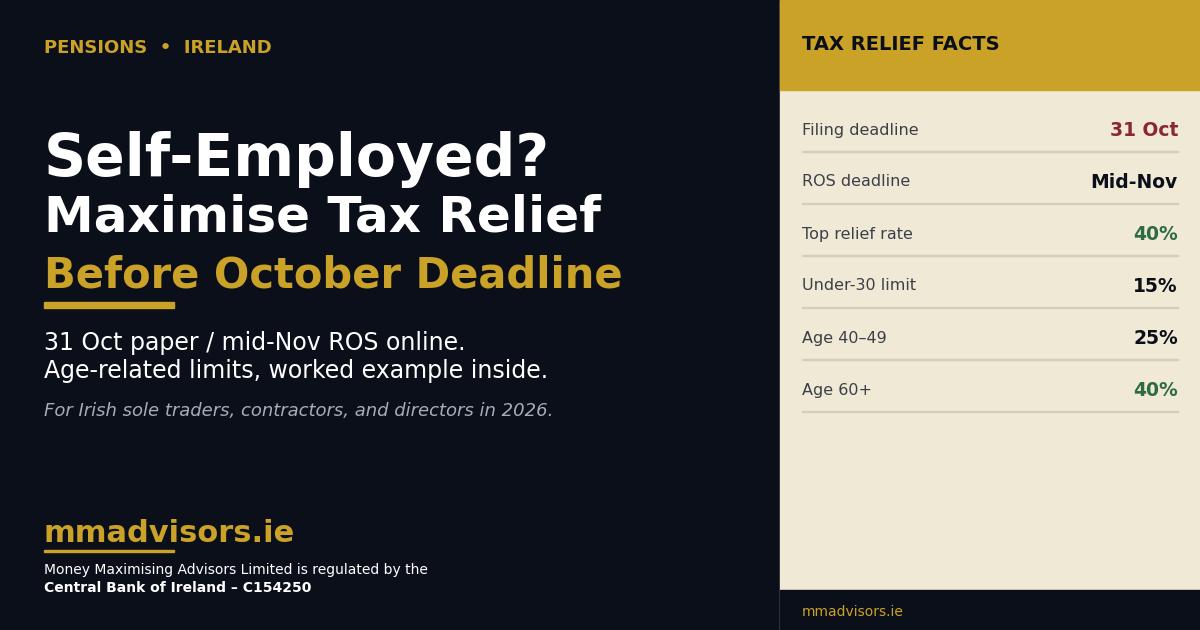
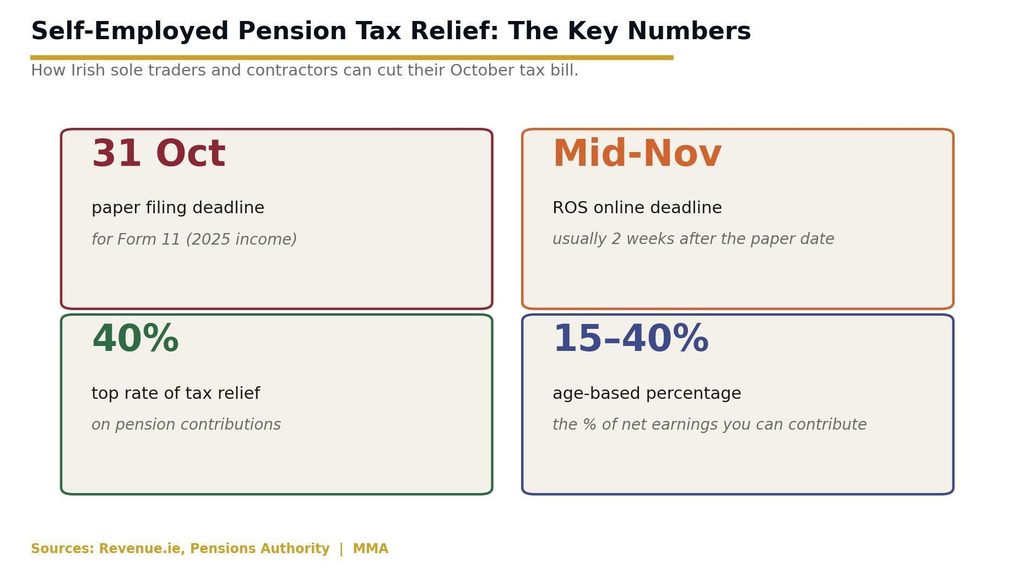
| QUICK ANSWER: Irish self-employed can maximise tax relief by making a pension contribution before the 31 October Form 11 deadline (or mid-November ROS online deadline). You get tax relief at your marginal rate, up to 40%, on age-related percentages of net relevant earnings: 15% under 30, 20% for 30–39, 25% for 40–49, 30% for 50–54, 35% for 55–59, and 40% for 60+. Contributions apply to the previous tax year’s earnings if paid before the deadline. A 45-year-old sole trader on €80,000 can contribute up to €20,000 and save €8,000 in tax. |
| This pillar connects self-employed workers to Pensions for the Self Employed, Directors Pension and Last Minute AVCs, all brokered on your behalf across Ireland’s leading providers. |
Why the October deadline matters
The Irish self-assessment tax year runs to 31 December. But your tax bill is not calculated then. It’s calculated when you file your Form 11 the following year.
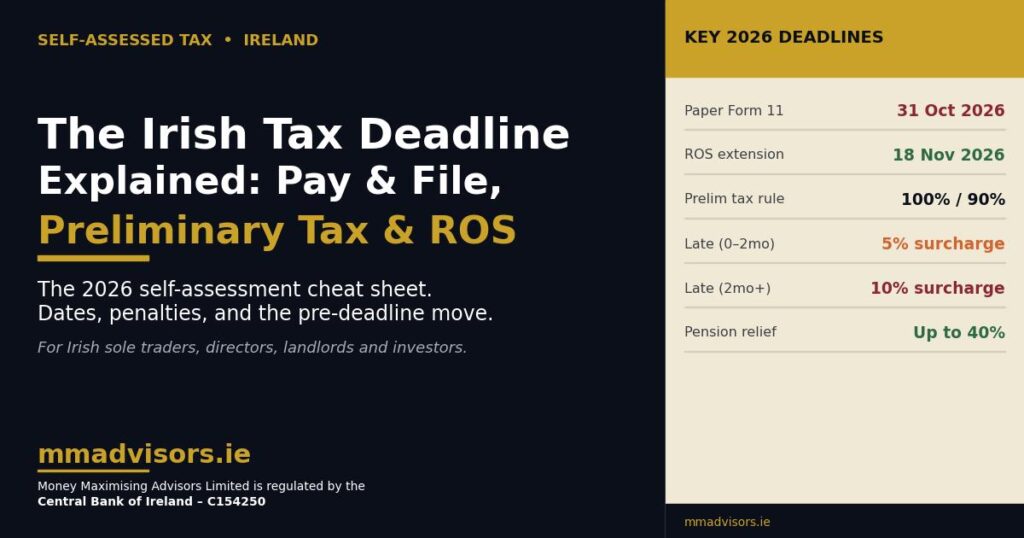
The paper Form 11 deadline for the previous year’s income is 31 October. If you file online through ROS, you usually get an extended deadline in mid-November.
Here’s the powerful part. You can make a pension contribution up to this deadline and claim relief against the previous year’s income. That means you have until October 2026 to reduce your 2025 tax bill.
How much can you contribute for tax relief?
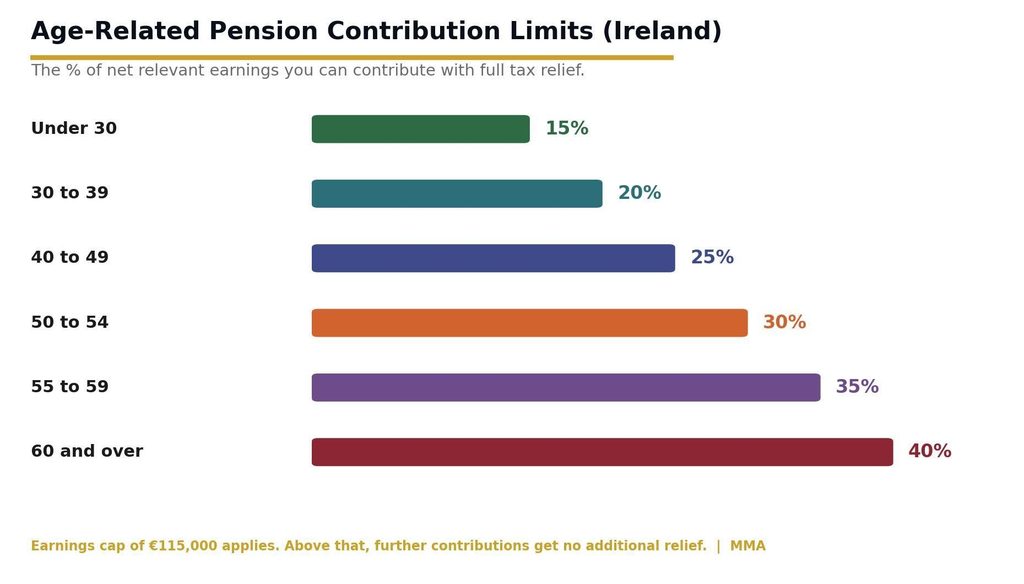
The Irish rules base your allowable contribution on age and net relevant earnings. The older you are, the higher the percentage you can contribute.
Under age 30
You can contribute up to 15% of net relevant earnings.
Age 30 to 39
The limit rises to 20%.
Age 40 to 49
The limit climbs to 25%. This is where many higher-earning self-employed sit.
Age 50 to 54
30% of net relevant earnings.
Age 55 to 59
35% of net relevant earnings.
Age 60 and over
The maximum: 40% of net relevant earnings.
One extra rule: contributions are capped based on €115,000 of earnings. Above that, further contributions still count against your Standard Fund Threshold but don’t attract additional tax relief.
A worked example: 45-year-old sole trader on €80,000
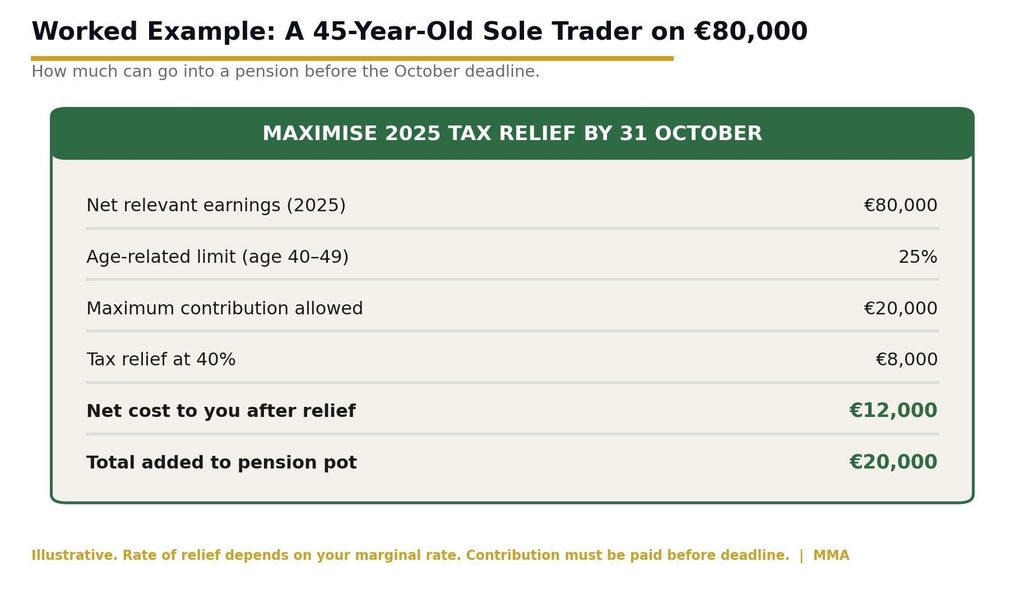
Meet Ronan. He’s a 45-year-old sole trader in the tech sector. His net relevant earnings for 2025 were €80,000.
Step 1: Work out the maximum contribution
At age 45, Ronan sits in the 40–49 age band. His limit is 25% of net relevant earnings. Maximum contribution: €80,000 × 25% = €20,000.
Step 2: Calculate the tax saving
Ronan pays income tax at the 40% marginal rate on this income. Full contribution of €20,000 attracts tax relief of €20,000 × 40% = €8,000 back off his tax bill.
Step 3: See the net cost
Ronan puts €20,000 into his pension. His tax bill drops by €8,000. Net cost to him: €12,000. Amount added to his pension pot: €20,000.
Over 20 years at 5% growth, that €20,000 becomes roughly €53,000. From a net personal outlay of €12,000. That’s the power of pension tax relief.
Beat the October pension deadline
Book a free 30-minute self-employed pension review, or send us your details and we'll be in touch.
Money Maximising Advisors Limited is regulated by the Central Bank of Ireland – C154250
What counts as ‘net relevant earnings’?
For sole traders and partnerships, net relevant earnings is your Schedule D Case I/II profit after allowable deductions, but before pension contributions.
For sole traders
Take your gross business income. Subtract allowable business expenses. What remains is your net relevant earnings for pension purposes.
For company directors
If you draw a salary from your own company, your salary is your relevant earnings. Company pension contributions (from the employer side) follow different rules and are typically far more generous.
For contractors on PAYE
If you’re a PAYE contractor rather than self-assessed, your salary from the contract is your relevant earnings. You can top up an existing workplace pension with AVCs or open a personal PRSA.
Where to put the contribution
Self-employed workers have three main vehicles for pension contributions.
Personal Retirement Savings Account (PRSA)
The most flexible option. You control fund choice, contribution amounts, and provider. Fees are transparent. Our Pensions for the Self Employed service brokers across Ireland’s leading PRSA providers.
Personal Pension Plan
The traditional route for self-employed savers. Similar tax treatment to a PRSA. Different provider structure and fee models. Suits some savers better, a comparison shows which fits your case.
Executive Pension / Directors Pension
If you operate through a limited company, an Executive or Directors Pension typically allows far larger contributions. Company contributions can be uncapped, subject to the Standard Fund Threshold. This is often the biggest tax-relief opportunity for high-earning self-employed.
Common self-employed pension mistakes
- Missing the deadline. Contributions must be paid and marked against the previous tax year before 31 October (or the ROS extended deadline). Late contributions apply against the current year only.
- Contributing more than the age limit. Excess contributions above the age-related limit get no tax relief. They still eat into your Standard Fund Threshold.
- Not knowing your correct age band. Your age at the end of the tax year determines the limit. Someone turning 40 during 2025 gets the 25% limit for the full 2025 contribution.
- Ignoring the executive pension option. Directors of limited companies often leave much bigger tax relief on the table by using a personal PRSA instead of a corporate scheme.
- Waiting until 30 October. Provider setup, fund choice, and payment clearance take time. Start the process in September for a clean deadline hit.
- Forgetting to elect in ROS. You must formally elect that the contribution applies to the previous tax year when you file. Missing this election defaults to the current year.
What if you’re behind on pension planning?
Many self-employed workers reach their 40s or 50s having under-contributed for years. There are two catch-up options.
Higher age-related percentages
Your allowable contribution % rises significantly in your 50s and 60s. A 55-year-old can contribute 35% of net earnings. A 60-year-old can contribute 40%. Use these bigger allowances.
Executive pension top-ups (limited companies only)
Company contributions to an executive pension are largely uncapped (subject to the Standard Fund Threshold of €2.2m in 2026). This can dramatically accelerate late-career pension building. See our Directors Pension service.
Related posts
| Pensions For The Self Employed | Directors Pension Ireland | Last Minute AVC |
| Pension Tax Relief in Ireland: Maximise Your Benefits | Standard Fund Threshold 2026 for Your Pension | Pensions Advice Ireland |
Frequently asked questions
What is the deadline for pension contributions in Ireland for self-employed?
The paper Form 11 deadline is 31 October. If you file online through ROS, the deadline typically extends to mid-November. Contributions made before the deadline can be applied against the previous tax year’s income for immediate tax relief.
How much can a self-employed person contribute to a pension in Ireland?
Age-based percentages of net relevant earnings apply: 15% under 30, 20% for 30–39, 25% for 40–49, 30% for 50–54, 35% for 55–59, and 40% for 60+. Earnings are capped at €115,000 for relief purposes.
What is the top rate of tax relief on Irish pension contributions?
Up to 40% for higher-rate taxpayers. If your marginal income tax rate is 40%, every euro contributed within your age limit saves 40 cents in tax.
Can I claim pension tax relief against last year’s income?
Yes. Contributions made before the 31 October (or mid-November ROS) deadline can be elected to apply against the previous tax year’s income. This is the main reason the October deadline matters for self-employed pension planning.
What’s the difference between a PRSA and an executive pension?
A PRSA is a personal pension you own directly. Contributions come from you personally with tax relief at your marginal rate up to age-related percentage limits. An executive pension is a company-based scheme where the company contributes on your behalf, typically allowing much larger contributions with different tax treatment.
What happens if I contribute more than my age-related limit?
Excess contributions do not attract tax relief that year. They still count toward your Standard Fund Threshold (€2.2m in 2026). Unrelieved contributions can sometimes be carried forward, but the rules are complex, seek advice before over-contributing.
Reviewed by our pension team
This guide was prepared and reviewed by the pension team at Money Maximising Advisors, using Revenue.ie current rules, Pensions Authority guidance, and Central Bank of Ireland fund data. MMA is regulated by the Central Bank of Ireland (C154250).
Beat the October deadline
Whether you’re a sole trader, contractor, or company director, our team maps your maximum contribution, models the tax saving, and gets it set up before the deadline. Start in September to be safe.
Beat the October pension deadline
Book a free 30-minute self-employed pension review, or send us your details and we'll be in touch.
Money Maximising Advisors Limited is regulated by the Central Bank of Ireland – C154250
| Important information Pension contribution age limits, earnings caps, and tax rates referenced are those in force in Ireland at time of writing (2026) and are subject to change with each Finance Act. Rates, thresholds and rules referenced are correct at time of writing and are subject to change. Money Maximising Advisors Limited is regulated by the Central Bank of Ireland (C154250). This article is for general information only and does not constitute personalised financial, tax or legal advice. You should always speak to a Qualified Financial Advisor before making any decision. |