
Gifting money to loved ones is a thoughtful gesture, but in Ireland, navigating the tax implications can feel like walking through a maze. Whether you’re a parent wanting to help your children financially, an employer considering gifts for staff, or simply someone who wants to share their wealth without triggering unexpected tax bills, understanding the small gift exemption is essential for 2026.
At Money Maximising Advisors Limited, we help Irish families and businesses make the most of legitimate tax-saving opportunities. With rising living costs across Dublin, Galway, and throughout Ireland, every euro counts—and the small gift exemption is one of the most underutilised wealth transfer tools available to Irish residents today.
In this comprehensive guide, we’ll explore everything you need to know about the small gift exemption, from basic rules to strategic planning tips that could save your family thousands in Capital Acquisitions Tax (CAT).
What Exactly Is the Small Gift Exemption in Ireland?
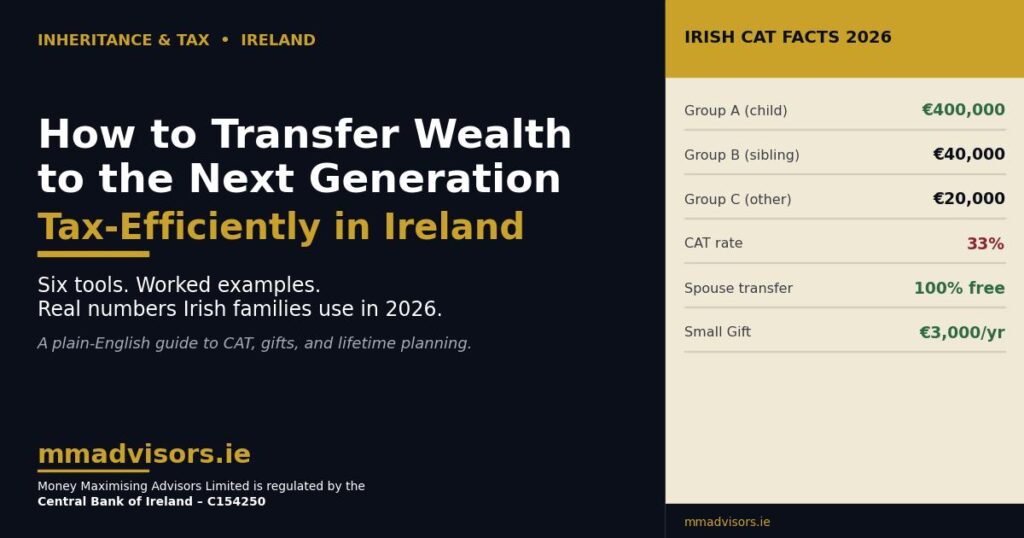
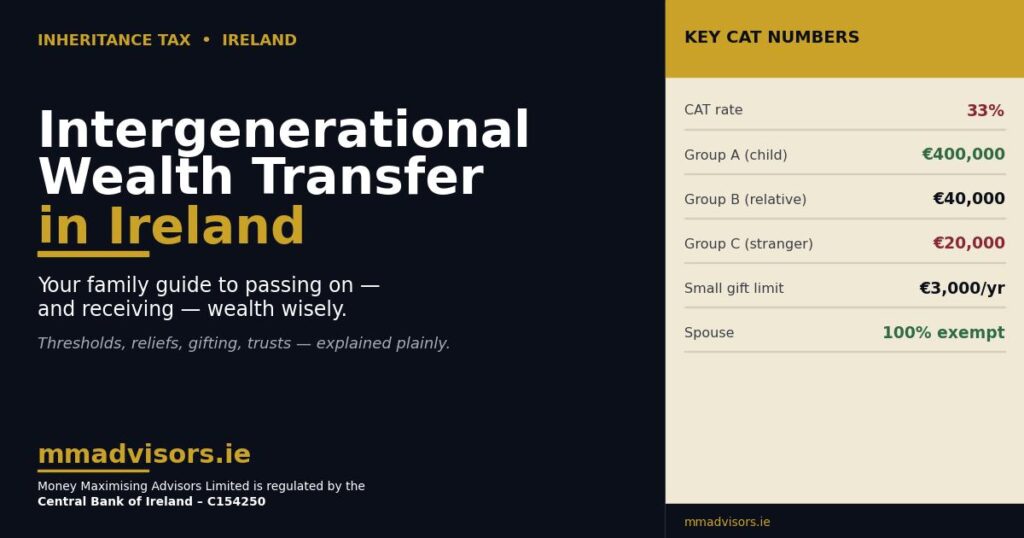
The small gift exemption is a provision under Irish tax law that allows you to give up to €3,000 per person, per calendar year, completely free of Capital Acquisitions Tax. This exemption applies to gifts—not inheritances—and represents one of the most straightforward ways to transfer wealth without tax consequences.
Here’s what makes this exemption particularly valuable:
- No limit on the number of recipients: You can give €3,000 to as many people as you wish each year
- Independent of CAT thresholds: These gifts don’t count against the recipient’s lifetime tax-free threshold
- No paperwork required: Unlike larger gifts, you don’t need to file forms with Revenue
- Repeatable annually: The exemption resets every calendar year, allowing systematic wealth transfer
For families planning their financial futures in 2026, this exemption offers a legitimate pathway to reduce potential inheritance tax burdens whilst providing timely support to children, grandchildren, or other loved ones.
How Does the Small Gift Exemption Differ From Other Tax-Free Transfers?
Many people confuse the small gift exemption in Ireland for family members with other gift and inheritance tax rules. Let’s clarify the key differences:
Small Gift Exemption vs CAT Group Thresholds
Whilst you can gift significant amounts under CAT group thresholds before tax applies (€335,000 from parents to children as of 2026), the small gift exemption operates completely separately. This means a parent could give their adult child €3,000 under the small gift exemption and an additional amount under the Group A threshold in the same year.
Tax-Free Gift to Child Ireland: Strategic Planning
Consider this practical example: A couple in Dublin with three adult children could collectively gift €18,000 annually (€3,000 per parent to each child) without any tax implications. Over ten years, that’s €180,000 transferred tax-free—a substantial amount that reduces the estate value for inheritance tax purposes.
Ready to create a strategic gifting plan for your family? Enquire now to speak with one of our Certified Financial Planners about maximising the small gift exemption for your circumstances.
Small Gift Exemption From a Company: Can Employers Use This?
Business owners often ask whether the small gift exemption from a company applies to employee gifts. The answer requires careful distinction between two separate tax provisions.
Small Gift Exemption Ireland Employer Rules
Employers cannot use the €3,000 small gift exemption for employee gifts. However, Ireland has a different provision called the Small Benefit Exemption Scheme, which allows employers to give staff benefits worth up to €1,000 annually (increased from €500 in recent years) without triggering benefit-in-kind tax.
The small gift exemption employees might hope for doesn’t technically exist in employment contexts, but the Small Benefit Exemption serves a similar purpose. Employers in Galway, Dublin, and across Ireland can use this scheme for:
- Vouchers and gift cards
- Christmas hampers
- Event tickets
- Wellness benefits
For detailed guidance on implementing this for your business, read our article: How to Use the Small Benefit Exemption Scheme for Your Business.
Gifts From Business Owners to Non-Employees
Here’s where it gets interesting: A business owner can absolutely use the personal small gift exemption to gift €3,000 to family members or others—these are personal gifts, not employment-related benefits. This distinction is crucial for family businesses planning succession strategies.
Small Gift Exemption in Ireland Form: What Documentation Do You Need?
One of the most attractive features of the small gift exemption is its simplicity. Unlike larger gifts that require CAT returns, there’s no specific small gift exemption in Ireland form that must be completed for gifts under €3,000.
However, we strongly recommend maintaining personal records including:
- Dates and amounts of gifts given
- Recipients’ names and relationships
- Method of transfer (bank transfer, cheque, etc.)
- A simple note confirming the gift falls under the annual exemption
Whilst Revenue doesn’t require formal notification, proper documentation protects both giver and receiver if questions arise during future audits or inheritance tax assessments.
Looking to establish a formal gifting strategy with proper documentation? Book now for a consultation with our Qualified Financial Advisors.
Can You Backdate Small Gift Exemption? Understanding the Timing Rules
A common question we receive at our offices: “Can you backdate small gift exemption if I forgot to make gifts in previous years?”
The straightforward answer is no—you cannot backdate the small gift exemption. Each calendar year’s exemption is unique and cannot be carried forward or applied retrospectively. If you didn’t use your €3,000 exemption in 2024, you cannot give €6,000 tax-free in 2026 by claiming both years.
This “use it or lose it” nature makes annual planning essential. Families serious about wealth transfer should establish systematic gifting schedules rather than ad hoc approaches.
Strategic Timing Considerations
Smart timing can maximise benefits:
- End-of-year planning: December gifts count for that calendar year, whilst January gifts start the new year’s allowance
- Regular monthly transfers: Some families set up standing orders of €250 monthly (€3,000 annually) to smooth cash flow
- Coordinated family gifting: Both spouses can independently use their exemptions, doubling the benefit
For more insights on maximising Ireland’s gift tax rules, explore: Gift Tax in Ireland: How Does Gift and Inheritance Tax Work?
How Much Money Can a Person Receive as a Gift Without Being Taxed in Ireland?
The question “How much amount of gift is tax-free?” doesn’t have a single answer in Ireland—it depends on several factors including the relationship between giver and receiver.
The Complete Picture of Tax-Free Gifting:
- Small Gift Exemption: €3,000 per person, per year, from any number of givers
- CAT Group Thresholds (lifetime limits before tax applies):
- Group A (parents to children): €335,000
- Group B (relatives like siblings, grandparents to grandchildren): €32,500
- Group C (all others): €16,250
A child in Dublin could theoretically receive €3,000 annually from each parent under the small gift exemption (€6,000 total), plus additional amounts under the Group A threshold, all without immediate tax consequences.
The strategic advantage? Small gift exemption amounts never count against these lifetime thresholds. A parent who systematically gifts €3,000 annually for twenty years transfers €60,000 whilst preserving the entire €335,000 Group A threshold for future inheritance or larger gifts.
Curious about structuring a comprehensive wealth transfer plan? Read: How Much Money Can You Gift to a Family Member Tax-Free in Ireland?
How to Avoid Gift Tax Ireland Parent to Child: Practical Strategies
Irish families increasingly seek legitimate ways to reduce inheritance tax burdens. Whilst you cannot “avoid” tax on amounts exceeding thresholds, strategic planning significantly reduces CAT liability.
Seven-Year Planning Approach
Combining the small gift exemption with broader estate planning creates powerful results:
- Year 1-7: Parents gift €3,000 annually to each child
- Result: €21,000 transferred per child tax-free
- For a couple with two children: €84,000 moved out of the estate over seven years
- All without touching CAT thresholds
Multi-Generational Gifting
Grandparents often overlook their gifting power. Each grandparent can gift €3,000 annually to each grandchild, potentially transferring substantial wealth whilst maintaining family support across generations.
For a comprehensive understanding, visit: Small Gift Exemption in Ireland: What Do You Need to Know?
Real-World Applications: Who Benefits Most From the Small Gift Exemption?
Young Adults Entering the Property Market
With property prices soaring in Dublin and Galway, many first-time buyers rely on family support. Parents using the small gift exemption can contribute €3,000 annually toward savings without tax implications—both parents together provide €6,000 yearly toward a deposit fund.
Families With Special Needs Planning
Parents of children with disabilities often create long-term financial plans. Regular small gifts help build supplementary funds whilst preserving means-tested benefits that larger lump sums might jeopardise.
Business Succession Planning
Family business owners can gradually transfer wealth to the next generation through systematic gifting, reducing estate values before eventual business transfers occur.
Retirees Supporting Adult Children
Pensioners with comfortable retirement income often wish to help children during their working years rather than leaving everything as inheritance. The small gift exemption allows them to witness and enjoy the benefit their support provides.
Wondering if you’re making the most of available exemptions? Check out: Are You Making the Most of the Small Annual Gift Exemption?
Common Mistakes to Avoid With the Small Gift Exemption
Despite its simplicity, people often make errors that can have tax consequences:
Mistake 1: Exceeding the Annual Limit
Gifting €3,500 instead of €3,000 means the entire amount may fall outside the exemption, potentially triggering CAT obligations on the full sum—not just the €500 excess.
Mistake 2: Assuming Joint Gifts Work Differently
A couple giving a joint gift of €6,000 represents two separate €3,000 gifts, which is perfectly acceptable. However, a single person cannot give €6,000 to one recipient and claim two years’ worth of exemptions.
Mistake 3: Confusing Assets With Cash
The exemption applies to the value of gifts, not just cash. Gifting shares, property, or other assets worth €3,000 also qualifies, but valuation must be accurate at the time of transfer.
Mistake 4: Poor Record-Keeping
Without documentation, proving gifts fell under the annual exemption becomes difficult during Revenue reviews or inheritance tax calculations years later.
Planning for 2026: Making the Small Gift Exemption Work for Your Family
As we move through 2026, Irish families face both opportunities and challenges. Rising property costs, evolving tax legislation, and longevity mean strategic wealth transfer planning matters more than ever.
The small gift exemption isn’t just about saving tax—it’s about empowering your family when support matters most. Whether helping a child through university, assisting with a first home purchase, or simply reducing your estate’s future tax burden, this exemption provides a legitimate, powerful tool.
For personalised guidance on integrating the small gift exemption into your broader financial plan, contact us today. Our team of Experienced Tax Advisors and Certified Financial Planners serves clients throughout Dublin, Galway, and all of Ireland.
Conclusion
Understanding and utilising the small gift exemption represents smart financial planning for Irish families in 2026. At Money Maximising Advisors Limited, we’ve helped countless families across Ireland implement strategic gifting plans that provide immediate family support whilst reducing long-term tax burdens.
The rules are straightforward: €3,000 per person, per year, with no limits on the number of recipients. Yet the long-term implications are profound. A systematic approach to using this exemption, combined with broader estate planning strategies, can transfer significant wealth tax-efficiently whilst you’re alive to see your generosity make a difference.
Don’t leave money on the table—or in Revenue’s hands—when legitimate planning options exist. Ready to create your family’s wealth transfer strategy? Book an appointment with our Qualified Financial Advisors to explore how the small gift exemption fits into your comprehensive financial plan.
Frequently Asked Questions
1.What is the small gift exemption in Ireland?
The small gift exemption allows you to give up to €3,000 per person, per calendar year, completely free from Capital Acquisitions Tax. There’s no limit on how many people you can gift to, and these gifts don’t count against lifetime CAT thresholds.
2. Do you have to declare small gifts?
No formal declaration is required for gifts under €3,000 that fall within the small gift exemption. However, maintaining personal records of these gifts is advisable for your own documentation, especially if Revenue ever reviews your affairs or calculates inheritance tax.
3. How to avoid gift tax Ireland parent to child?
Parents can utilise the €3,000 annual small gift exemption per parent, potentially giving €6,000 combined each year tax-free. This strategy, used consistently over multiple years alongside the €335,000 Group A lifetime threshold, significantly reduces potential CAT liabilities whilst providing timely support.
4. How much money can a person receive as a gift without being taxed in Ireland?
A person can receive €3,000 from each individual donor annually under the small gift exemption without tax implications. Additionally, they have lifetime CAT thresholds (€335,000 from parents, €32,500 from other relatives, or €16,250 from non-relatives) before gift tax applies to amounts exceeding these limits.
5. What is the small benefit exemption in Ireland?
The small benefit exemption is a separate scheme allowing employers to provide benefits worth up to €1,000 annually to employees without triggering benefit-in-kind tax. This differs from the personal small gift exemption and applies specifically to employment-related benefits like vouchers or event tickets.
6. How much amount of gift is tax-free?
In Ireland, gifts of up to €3,000 per person per year are completely tax-free under the small gift exemption. Beyond this, tax-free amounts depend on the relationship between giver and receiver, with lifetime thresholds ranging from €335,000 (parent to child) down to €16,250 (unrelated individuals) before CAT applies.
Disclaimer: This article provides general information and should not be considered personalised financial or tax advice. Irish tax laws change periodically, and individual circumstances vary. Always consult with our qualified financial advisors or tax professionals before making significant financial decisions.