Sending a child to third-level education in Ireland is a major financial commitment. It is also one of the most rewarding investments a parent can make. This guide from Money Maximising Advisors walks you through every tax-efficient way to save.
We cover regular savers, lump sums, small gift exemption strategies, and investment plans. You will see the real cost of college in 2026. You will see how much to save each month. And you will see which vehicle fits your family situation.
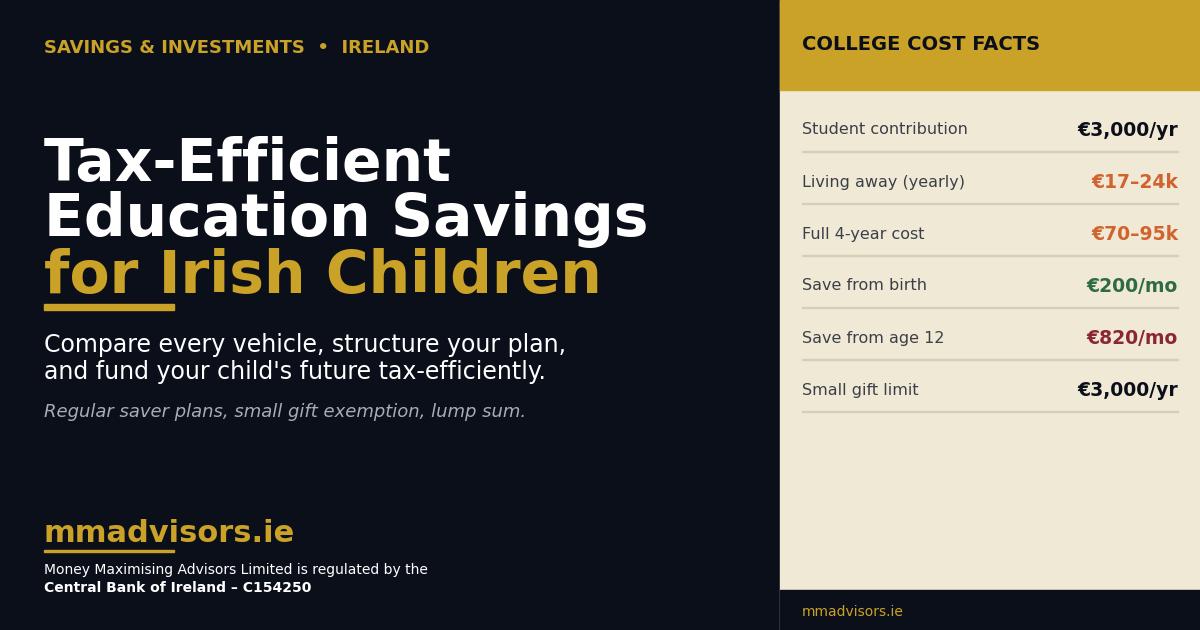
| QUICK ANSWER: The most tax-efficient education savings plan in Ireland combines three vehicles: a Regular Saver Investment Plan for compounding growth, the Small Gift Exemption (€3,000 per giver per child per year) for grandparent contributions, and a Lump Sum Investment for windfalls. Starting from your child’s birth requires roughly €200/month to reach €70,000 by age 18. Starting at age 12 requires €820/month for the same target. |
| This pillar sits within our Savings & Investments hub and connects to College Education Savings, Regular Saver Investment Plans, Lump Sum Investments and the Small Gift Exemption Savings Plan. |
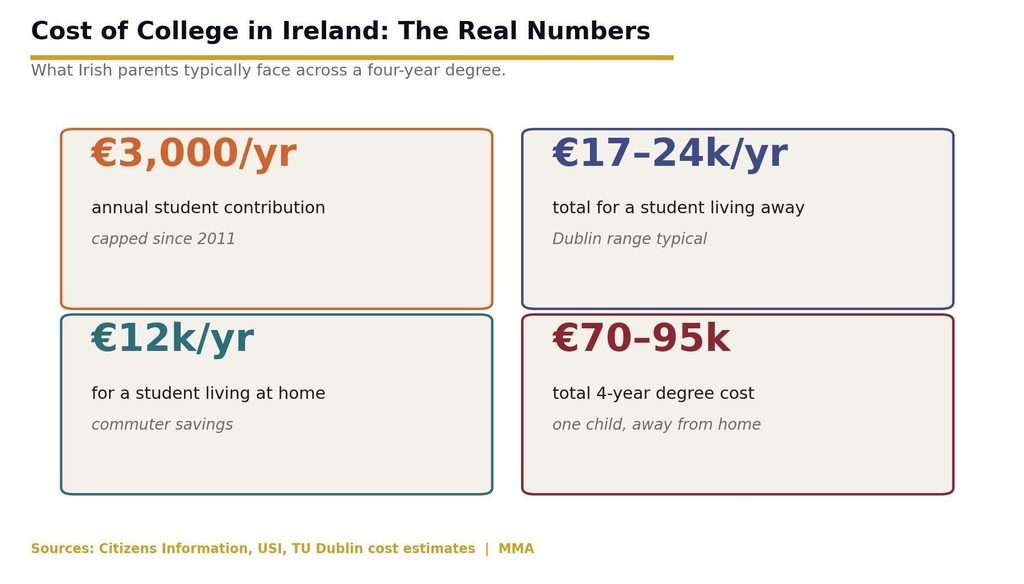
The real cost of Irish third-level education across a four-year degree.
How much does college in Ireland actually cost?
The student contribution charge is €3,000 per year. Every third-level student pays this. It has been capped at this level since 2011.
The bigger cost is living away from home. Accommodation, food and transport typically add €14,000–€21,000 per year for a student in Dublin.
Books, laptop, materials and social budget add another €2,000–€4,000. Across a standard four-year degree, expect €70,000–€95,000 in total costs for a child living away from home.
A commuter student living at home costs significantly less. Budget €10,000–€12,000 per year. That’s still a substantial commitment.
When should you start saving for college?
The best time to start is the year your child is born. The second best time is today. Every year you delay, the monthly commitment rises sharply.
Starting from birth requires roughly €200 per month. Starting from age 3 requires €270. Starting from age 8 pushes it to €450.
Starting from age 12 requires €820 per month. That’s a serious drain on family cashflow. Time in the market is what does the heavy lifting.
What are the main college savings options in Ireland?
Regular Saver Investment Plan
A monthly direct debit into a diversified investment fund. This is our most-recommended starting point for parents with 10+ years to go. Regular Saver Investment Plans grow with market returns over the long term.
Compounding does the heavy lifting. €200 per month for 18 years, growing at 5% per year, produces roughly €70,000. €300 per month over the same period produces over €105,000.
Small Gift Exemption for grandparents
Every grandparent can gift each grandchild €3,000 per year tax-free. This is called the Small Gift Exemption. Two grandparents can give €6,000 per child per year.
The gift does not use up the child’s lifetime CAT threshold. It’s a permanent tax-free transfer. Over 18 years, this alone can build a fund of €100,000+ without any tax cost.
This is arguably the single most tax-efficient tool available to Irish families. It requires the grandparents to be willing and able to contribute, but the results speak for themselves.
Lump Sum Investment
A one-off deposit invested for the long term. Suits parents receiving an inheritance, bonus or redundancy payment. Our Lump Sum Investments service handles the fund selection and structure.
A single €20,000 lump sum invested at birth, growing at 5%, becomes roughly €48,000 by age 18. Add €100/month on top and you exceed €85,000.
Deposit accounts (DIRT)
Cash deposit accounts are the simplest option. But they are the least effective for long-term goals. Interest is taxed at 33% DIRT.
Over 10–18 years, deposit interest struggles to keep pace with inflation. Cash has a role for the final 2–3 years before college, not the whole journey.
| Want to model your specific target? Book Now for a free 30-minute review, or Enquire Now, we reply within one working day. |
How to combine vehicles for maximum efficiency
Most Irish families use two or three of these vehicles together. Here’s a common structure that works.
Parents open a Regular Saver Investment Plan from the child’s birth. €150–€250 per month. Growing tax-efficiently for 18 years.
Grandparents use the Small Gift Exemption annually. €3,000 per grandparent per child, tax-free. Paid into the same fund or a separate child-name account.
Windfalls go into a Lump Sum Investment. A tax refund, bonus, inheritance or redundancy top-up boosts the fund every few years.
This three-layer approach builds €100,000–€150,000 by the time the child starts college. That’s enough to cover the full cost of most Irish degrees.
What if you can’t save the full target?
Not every family can save €200 per month from birth. That’s fine. Something is better than nothing.
There are also State supports to fall back on. SUSI (Student Universal Support Ireland) provides means-tested grants. The full non-adjacent maintenance grant is roughly €7,500 per year in 2026.
Part-time student jobs typically cover €5,000–€8,000 per year. Between family savings, State grants and part-time work, most Irish families successfully fund a college education.
The key is starting early. Even €50 per month for 18 years produces €17,000–€20,000. That’s a meaningful contribution and it takes the pressure off. Speak to our team about how to fit college savings into your wider Money Management Advice.
Common mistakes Irish parents make
- Waiting until the child is a teenager. Every year you delay adds 15–25% to the monthly commitment needed.
- Using deposit accounts for the entire journey. DIRT-taxed interest rarely beats inflation over 15+ years.
- Missing the Small Gift Exemption. Every unused year is €3,000 of tax-free capacity permanently lost.
- Not diversifying. Putting everything into one asset class exposes you to sequence-of-returns risk.
- Skipping professional advice. A one-hour review can identify the right vehicle mix for your specific situation.
Frequently asked questions
What is the most tax-efficient way to save for college in Ireland?
The most tax-efficient combination is a Regular Saver Investment Plan funded by parents, topped up annually by grandparents using the €3,000 Small Gift Exemption. This produces the largest tax-free fund by the child’s 18th birthday.
How much should I save monthly for my child’s education?
From birth, roughly €200/month reaches €70,000 by age 18 at 5% growth. From age 8, that jumps to €450/month. Start as early as you can.
Can grandparents give tax-free money for education?
Yes. Each grandparent can give each grandchild €3,000 per year tax-free under the Small Gift Exemption. Two grandparents can give €6,000 per child per year, and it does not use up any lifetime CAT threshold.
What’s the difference between a college savings plan and a regular deposit account?
A regular saver investment plan invests in diversified funds. Over 10+ years, expected returns typically beat DIRT-taxed cash. Deposit accounts are safer short-term but rarely keep pace with inflation over long periods.
Are there Irish state supports for college costs?
Yes. SUSI (Student Universal Support Ireland) provides means-tested grants for third-level students. The 2026 maximum non-adjacent maintenance rate is roughly €7,500 per year, with additional grants covering the student contribution charge for eligible families.
Reviewed by our savings team
This guide was prepared and reviewed by Money Maximising Advisors, drawing on current SUSI grant rates, Revenue guidance on the Small Gift Exemption, and Central Bank fund performance data. MMA is regulated by the Central Bank of Ireland (C154250).
Ready to start? Let’s build the plan.
Whether your child is newborn or already in secondary school, we can build a savings plan around your family cashflow. Book Now for a free consultation, or Enquire Now, we reply within one working day.
Important information
Investment returns are illustrative and are not guaranteed. The value of investments can fall as well as rise, and past performance is not a reliable indicator of future returns. SUSI grant rates and Small Gift Exemption values are those in force at time of writing and are subject to change. Money Maximising Advisors Limited is regulated by the Central Bank of Ireland (C154250). This article is for general information only and does not constitute financial, tax or legal advice. You should seek personalised advice from a Qualified Financial Advisor before making any investment decision.