
Pensions From Previous Employments
- Home
- Pensions From Previous Employments
Pensions From Previous Employments
Once you cease any pensionable employment, your ex-employers HR/Pensions department will usually send your ‘Leaving Service Options’ to review in relation to pension. This document outlines the various options available in relation to your pension. You are encouraged to choose one of these options and send back the paperwork to your employer who will then process your request.
The 3 options that are offered are as follows;
- Leave this pension where it is, in your ex-employer’s pension fund.
- Transfer the pension fund to your new employer’s pension fund.
- Transfer it into either a PRSA or a Personal Retirement Bond with one of the main pension providers in Ireland to have full control and early access options to your fund.

The question is, what option (if any) did you choose and was this the best option available?
There are pros and cons to each option, but it is important to fully understand these options in detail to make an informed decision.
Early Acccess options and the tax implications on both your pension on retirement and on death should all be considered from all options before any decision is made.
If you are unsure what options you chose when you left your previous employment, or didn’t make a decision for whatever reason, your pension is probably still in your ex-employers company pension scheme.
If you would like clarify or more information on the options available to you (even if you have already transferred your pension), you can always book a free call with one of our highly experienced and qualified pension specialists and they would be happy to answer any of your queries.
All our Certified Financial Planners, Qualified Financial Advisors and Tax Advisors have vast experience in all Pensions related queries and advise.
Below is a list of the main pension related queries we help our clients with
- Requesting transfer values from previous employers
- Tracing and locating old pensions
- Advising on the most tax efficient option available in relation for pension transfers
- Early access options
- How to maximize your tax free lump sums receivable
- Receiving pension income post retirement and taxes payable
- Death benefit analysis - pre and post-retirement
- Future Cashflow analysis in a report format helping clients see their financial future with each pension transfer option.
- Assist in choosing the best pension provider for any pension transfer in relation to
- Fees and charges
- The best investment fund performance
- The customer service support
- Choosing the best investment strategy that suits your requirements
- Choosing the best investment strategy that suits your requirements
Types of pensions and the option available for each one
Below is a more detailed analysis of Occupation/company pensions and the options available to you in relation to any previous pensions.
Types of pensions and the option available for each one
In general, there are two specific types of Occupational/company pensions?
- 1. Defined Benefit Pensions
- 2. Defined Contribution Pensions
On occasions, some pensions are a part Defined Benefit and part Defined Contribution (hybrid pension).
It is very important to understand what type of pension you have as the options differ slightly for each type.
Below is a detailed analysis of both defined benefit and defined contribution pensions? Each are analysed on the following
- Brief background of how these pensions are calculated
- The various leaving service options offered to ex-employees
- The tax implications of each leaving service option (pre and post retirement)
- The death benefit of each leaving service option (pre and post retirement)
- The advantages and disadvantages of each leaving service option.

1. PREVIOUS DEFINED BENEFIT PENSIONS
Background to DB Pensions
Defined Benefit Pensions are not as common in Ireland as they once were. The pension benefit received with these types of pensions are usually calculated/earned from each employee’s year’s of service with this employment and their final salary. The pension benefits are received by the employees on retirement as follows;
- A Tax-free lump sum is received at normal retirement age (NRA)
- An annual pension income is received at NRA and payable for life.
Leaving a pensionable job prior to NRA
If an employee leaves their job before their normal retirement age, they will be offered the following options in relation to their pension;
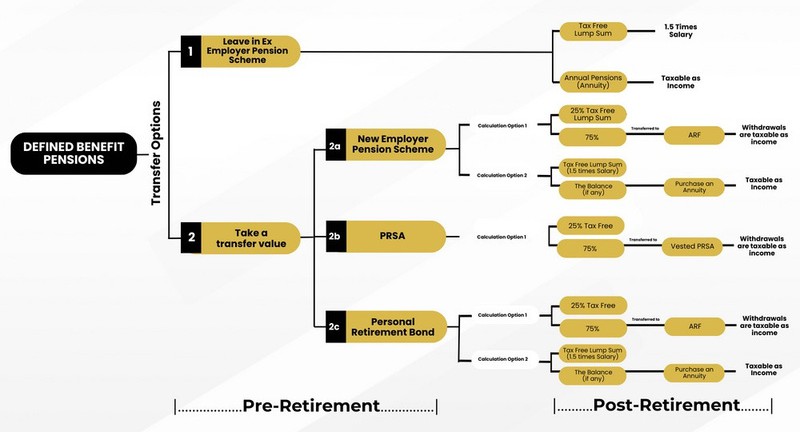
Option 1
LEAVE IT WHERE IT IS – IN THE EX-EMPLOYERS PENSION SCHEME
If this option is chosen, this deferred pension entitlement will be left in exemployers pension scheme.
- Access to the pension
Access is usually restricted to the normal retirement age of the main pension scheme (usually 60 or 65 etc)
- How the Pension funds are received ?
On drawdown, the following entitlements are received by each ex-employee;
- A Tax-Free Lump Sum
- An Annual Pension income
- Tax implications on death
- Death – Pre Retirement – If the pension owner dies prior to the Normal retirement age of this pension scheme, a tax free death benefit of usually 1.5 times Salary (salary at date of leaving this employment) is be payable to the surviving spouse. 50% of the annual pension income is also usually paid to the surviving spouse until his/her death. This income is taxable (Income tax/PRSI/USC etc.).
If widowed/divorced/single, the pension annual income dies with the pension owner. No benefit is passed down to their next of kin (children).
- Death – Post Retirement – On the death of the pension owner, there is no lump sum benefit payable. However, 50% of the annual pension income is paid to the surviving spouse until his/her death. This income is taxable (Income tax/PRSI/USC etc.). If widowed/ divorced/ single, the pension annual income dies with the pension owner. No benefit is passed down to their next of kin (children)
Option 2
ACCEPT A Pension Lump sum TRANSFER VALUE in lieu of their annual pension entitlement (explained in option 1).
This Pension transfer value offered is a usually sizable lump sum. It is predominantly calculated as a multiple of the annual pension entitlement from point 1 above (between 15-20 times the annual pension income entitlement) and is calculated by the pension trustees/actuaries of the main pension scheme. Some of this Lump Sum is received tax free and some may be taxable when accessed (depending on the financial circumstances of the pension recipient.
Once the transfer value option is taken, the full fund value is then transferred into one of the following.
- 2.1 - A new Employers pension scheme (rarely advisable)
- 2.2- Either a PRSA or a Personal Retirement Bond (PRB) with one of the
Pension Providers (Irish Life/Zurich/Aviva, etc).
Below is a detailed analysis of these 2 options;
- 2.1 Transferring to a New Employer Pension Scheme explained
If the new employer pension scheme is also a defined benefit pension scheme,
then all of the access and draw down rules are similar to the rules mentioned
in option 1. However, if the new employer pension is defined contribution, then
the following rules apply;
- Access to the pension
Restricted to the Normal Retirement Age of that pension scheme (usually 60 or 65)
- How pension benefits are received and taxed?
Defined Contribution Occupational pension schemes are usually accessed as follows;
- 25% of the Pension fund is usually received as a tax free lump sum
- The remaining 75% is usually either
- Taken as Taxable cash or
- Transferred into an Approved Retirement fund (ARF) or a Vested PRSA
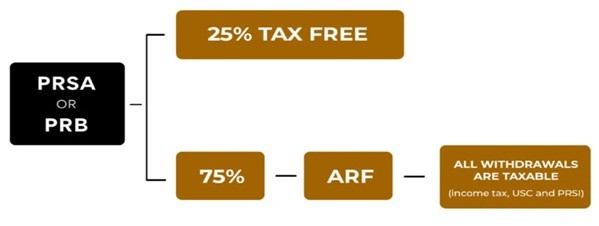
It is rarely advisable to take the remaining 75% of the pension fund as taxable cash as you can end up giving half of the fund value to the revenue as a taxe liability. Transferring these funds into a Approved Retirement fund (ARF) or a Vested PRSA is usually the preferred and most tax efficient method to choose. The pension funds withdrawn from the ARF/Vested PRSA are taxable as income – liable to PAYE, PRSI (until age 66), and USC. This ARF/Vested PRSA income can be received monthly/quarterly or annually, whichever pension holder chooses. An annual minimum withdrawal of 4% of the total pension fund value is compulsory from age 61, but they can withdraw as much as they wish from this pot of money at any time. It is prudent to withdraw these funds tax efficiently. It is possible to pay very minimal taxes (if any at all) on this income if certain annual income limits and thresholds are not exceeded.
Transferring into a new employers Defined Benefit Pension scheme is rarely advisable. Many people who start working in the public sector later in their working career often transfer any previous employment pensions into the public sector superannuation pension scheme to bump up their public sector pension on retirement. However, this rarely makes financial sense and is not advisable.
- Tax implications on Death – pre retirement In the event of death prior to Normal retirement age (NRA) of your new employer defined contribution pension scheme, the full fund value is left to the surviving spouse. However, this benefit cannot exceed 4 times final salary If widowed/divorced/single – the pension fund is left to next of kin (children) as and taxed as inheritance. No tax is paid if the lifetime limit of €400000 gift/inheritance threshold is not exceeded.
If the new employer’s pension is a defined benefit scheme, then a tax free death benefit of usually 1.5 times Salary (salary at date of leaving this employment) is be payable to the surviving spouse. 50% of the annual pension income is also usually paid to the surviving spouse until his/her death. This income is taxable (Income tax/PRSI/USC, etc.). If widowed/ divorced/ single, the pension annual income dies with the pension owner. No benefit is passed down to their next of kin (children).
- Death – Post Retirement – If the pension holder dies after he/she has accessed the PRSA/PRB or the PRB, they will have received their 25% pension Tax free lump sum and the remaining balance will have been transferred into either an ARF or a Vested PRSA. In this scenario, the full fund value will be transferred to the surviving spouse tax free. However, all withdrawals from either the ARF or Vested PRSA by the surviving spouse are liable for income tax/PRSI and USC. If the pension holder is widowed/single/divorced, on death, the full ARF/Vested fund value is then transferred to next of kin and are liable for inheritance tax rules. The funds can be accessed immediately (children) once the CAT taxes have been paid (if due).
- Tax implications on Death – Post Retirement – If the pension holder has reached Normal Retirement age of his new employers defined contribution scheme and a tax-free lump sum received prior to death, the remaining funds will usually have been transferred into an ARF/Vested PRSA. On death, these benefits are then passed onto the surviving spouse tax free. However withdrawals from the ARF/Vested PRSA are taxable as income. If widowed/ divorced/single, the remaining funds within the ARF/Vested PRSA are passed onto next of Kin (usually children). Children under 21 are taxed under normal inheritance tax rules but may pay no tax if their lifetime limit for gift/inheritance limits/thresholds of €400000 are not exceeded. (see table below). Children over 21 are not taxed as inheritance but instead pay a compulsory standard tax rate of 30% on funds due from ARF/Vested PRSA. If the new employers pension is a defined benefit scheme then 50% of the annual pension income is paid to the surviving spouse until his/her death. This income is taxable (Income tax/PRSI/USC etc.). If widowed/divorced/single, the pension annual income dies with the pension owner. No benefit is passed down to their next of kin (children).
- 2.1 Transferring to a New Employer Pension Scheme explained
- Access – access to the a PRB or a PRSA can be gained from age 50 onward. This is a HUGE benefit when compared to the other options.
- How are the pension benefits received and taxed? the most tax efficient of the following calculation/options;
- 25% as tax free lump sum with the remaining balance invested in an ARF/Vested PRSA or
- 1.5 times salary as a tax-free lump sum with the balance used to purchase an annuity (annual pension income).
Both the withdrawals from the ARF/Vested and the annuity income are taxed as income and liable for income tax, PRSI and USC.
- Tax implications on Death – Pre Retirement – In the event of death prior to Normal retirement age (NRA), the full fund value is left to the surviving spouse. If widowed/ divorced/single – the pension fund is left to next of kin (children) as and taxed as inheritance. No tax is paid if the lifetime limit of €400000 gift/inheritance threshold is not exceeded. Please see figure 1.2 for inheritance tax table thresholds/limits.
- Tax implications on Death – Post Retirement – If the pension has been retired and a tax-free lump sum received by the pension holder prior to death, then the remaining funds will usually have been transferred into an ARF/Vested PRSA. These benefits are then passed onto the surviving spouse tax free. However withdrawals from the ARF/Vested PRSA are taxable as income. If widowed/divorced/single, the remaining funds within the ARF/Vested PRSA are passed onto next of Kin (usually children). Children under 21 are taxed under normal inheritance tax rules but may pay no tax if their lifetime limit for gift/inheritance limits/thresholds of €400000 are not exceeded. (see table below). Children over 21 are not taxed as inheritance but instead pay a compulsory standard tax rate of 30% on funds due from ARF/Vested PRSA.
- PLEASE NOTE:
- Public sector occupations employed by the Department of Education, HSE cannot take a transfer value for their pensions. However, most semi-state bodies can (Eircom, An Post, Banks, etc).
- Deferred pension holders of such companies as Eircom, Intel, An Post, many Ulster Bank employees, Bank of Ireland, AIB, Ulster Bank, etc. have all been offered ‘Enhanced Transfer Values’ with this new draw-down pension option.
Points to consider before choosing which option to take
There are advantages and disadvantages to each option below is a brief breakdown of these for each option
- Option 1 – leaving it in your ex-employers DB pension scheme
Advantages
- A set tax free lump sum at retirement and an annual pension, payable for life – no matter how long you live
- 50% of the annual pension left to surviving spouse on death
Disadvantages
- No guarantee that your previous employer will have the funds in its penson scheme to pay for your annual pension income e.g mismanagement of company pension funds/company closing down or moving out of Ireland etc.
- Your ex-employer can change the rules of the pension scheme if the company scheme is underfunded changing retirement age/changing the scheme to a defined contribution scheme.
- You have limited Control with your pension as long as it is part of the main pension scheme
- As the annual pension income is taxable, the pension recipient could end up pay up to 40-52% tax on this annual pension income if this annual income of the pension recipient is significant.
- You don’t have the option to take any additional lump sum from pension pot after the initial tax free lump sum is taken.
- If divorced/widowed/single on death, your pension dies with you and your children get nothing.
- Option 2 – Taking the transfer Value and transferring the funds into a new employer’s pension scheme
There are rarely any advantages of transferring your previous defined benefit pension into a new employer defined benefit pension scheme. All of the rules, tax implications, access/retirement ages and death benefits are very similar.
Many people who start working in the public sector later in their working career often transfer any previous employment pensions into the public sector superannuation defined benefit pension scheme in order to ‘buy back pensionable years or service and bump up their public sector pension on retirement.
However, this rarely makes financial sense when the cost associated with buying back these years are analysed against the potential increase in annual pension income.
Transferring to a new employer defined contribution pension scheme may be worth considering on occasions. However the majority of benefits gained from this transfer would be gained by option 3 – transferring it into a PRSA or a PRB (see below) as well as earlier potential access to the pension funds.
- Option 3– Taking the transfer value offered by your ex-employer and transferring to a PRSA/PRB
Advantages
- Early access from age 50 onwards
- Full control of where your pension is invested
- Mitigate any risk of mismanagement of pension by ex-employer
- Flexibility on how much you can withdraw from your ARF/vested PRSA. e.g. if you need extra funds withdrawn for whatever reason (eg car purchase, house renovations, holiday cruise etc.
- On death, the full fund value of the pension is left to your next of kin. It is particularly advantageous if divorced/widowed/single.
- More flexibility with annual withdrawals in order to reduce or eliminate any tax liabilities. Eg. If a married couple over 65 keep all incomes under €36000, they will face a zero-tax bill on this income. However if incomes exceed this threshold, all the income is liable for normal PAYE taxes.
Disadvantages
- The transfer value offered by your ex-employer may not be value for money.
- No set income for life
- Your Pension fund can ‘bomb out’ (run out) while you are still alive if you withdraw too much too early.
- Can experience negative returns on your pension fund if you choose an unfavorable/high risk investment strategy.
Conclusion
There are pros and cons to each option as explained above.
The transfer values offered to deferred Defined benefit pension holders are calculated by their ex- employers pension actuaries department. These values can go up and down over a period of time. Whether or not this is the preferred option for you, there is absolutely no harm in requesting a transfer value from your employer to assess all of your options. You can then make an informed decision of what is the best option for you and your financial future.
If you would like any assistance in making your decision you can contact book a free consultation with one of our Highly qualified and experienced Pension Specialists.
- Below is a list of the main pension related queries we help our clients with:
- Requesting transfer values from previous employers
- Tracing and locating old pensions
- Advising on the most tax efficient option available in relation for pension transfers
- Early access options
- How to maximize your tax free lump sums receivable,
- Receiving pension income post retirement and taxes payable
- Death benefit analysis - pre and post-retirement
- Future Cashflow analysis in a report format helping clients see their financial future with each pension transfer option.
- Assist in choosing the best pension provider for any pension transfer in relation to
- Fees and charges
- The best investment fund performance
- The customer service support
- Choosing the best investment strategy that suits your requirements
- Ongoing Management of client’s pensions – pre and post retirement
The whole point of insurance is that it’s there to protect
Background on DC pensions
Defined Contribution pensions are the most common type of pension in Ireland presently.
Contributions are made by both employer and employees into these pensions. Thes aggregated contributions added with any compounded investment returns (positive or negative) to make up the total pension fund due to the employee at retirement.
On retirement, the pension benefits can be calculated and subsequently received by the pension holder in one of 2 methods;
- First Option
- 25% of the total pension fund will be received as a tax free lump sum and The remaining balance (75%) can be accessed either;
- Taken as taxable cash (rarely advisable)
- Transferred into an Approved Retirement Fund/Vested PRSA. Withdrawals from an ARF/Vested PRSA are taxed as income (liable for income tax, PRSI and USC).
- Second Option;
- Receive a tax-free lump sum of 1.5 times final salary with the remaining balance used to purchase an Annuity (annual pension income). The annuity income is taxed as income and liable to income tax, PRSI and USC.
- The option chosen to calculate the pension benefits receivable will be directly correlated to which option gives the pension holder the most tax efficient pension benefits.
Leaving a pensionable job prior to NRA
If an employee leaves their job before their normal retirement age, they will be offered the following options in relation to their pension;
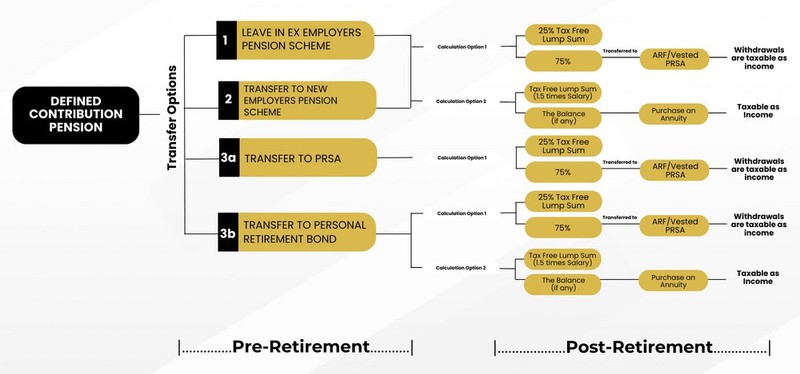
Option 1
LEAVE IT WHERE IT IS – IN THE EX-EMPLOYERS PENSION SCHEME
If this option is chosen, this deferred pension entitlement will be left in exemployers pension scheme.
- Access - limited to the normal retirement age of the scheme (usually 65).
- How are the pension benefits received and taxed? the most tax efficient of the following options
- 25% as tax free lump sum with the remaining balance invested in an ARF/Vested PRSA or
- 1.5 times salary as a tax-free lump sum with the balance used to purchase an annuity (annual pension income).
Both the withdrawals from the ARF/Vested and the annuity income are taxed as income and liable for income tax, PRSI and USC.
- Tax implications on Death – Pre Retirement – In the event of death prior to Normal retirement age (NRA), the full fund value is left to the surviving spouse. However, this benefit is capped at 4 times final salary. If widowed/divorced/single – the pension fund is left to next of kin (children) as and taxed as inheritance. No tax is paid if the lifetime limit of €400000 gift/inheritance threshold is not exceeded. Please see figure 1.2 for inheritance tax table thresholds/limits.
- Tax implications on Death – Post Retirement – If the pension has been retired and a tax-free lump sum received by the pension holder prior to death, then the remaining funds will usually have been transferred into an ARF/Vested PRSA. These benefits are then passed onto the surviving spouse tax free. However withdrawals from the ARF/Vested PRSA are taxable as income. If ·widowed/divorced/single, the remaining funds within the ARF/Vested PRSA are passed onto next of Kin (usually children). Children under 21 are taxed under normal inheritance tax rules but may pay no tax if their lifetime limit for gift/inheritance limits/thresholds of €400000 are not exceeded. (see table below). Children over 21 are not taxed as inheritance but instead pay a compulsory standard tax rate of 30% on funds due from ARF/Vested PRSA.
Option 2
Transfer their pension to their new occupational scheme with their new employer
- Access - limited to the normal retirement age of the scheme (usually 65).
- How are the pension benefits received and taxed? the most tax efficient of the following options;
- 25% as tax free lump sum with the remaining balance invested in an ARF/Vested PRSA or
- 1.5 times salary as a tax-free lump sum with the balance used to purchase an annuity (annual pension income).
Both the withdrawals from the ARF/Vested and the annuity income are taxed as income and liable for income tax, PRSI and USC.
- Tax implications on Death – Pre Retirement – In the event of death prior to Normal retirement age (NRA), the full fund value is left to the surviving spouse. However, this benefit cannot exceed 4 times final salary. If widowed/divorced/single – the pension fund is left to next of kin (children) as and taxed as inheritance. No tax is paid if the lifetime limit of €400000 gift/inheritance threshold is not exceeded. Please see figure 1.2 for inheritance tax table thresholds/limits.
- Tax implications on Death – Post Retirement – If the pension has been retired and a tax-free lump sum received by the pension holder prior to death, then the remaining funds will usually have been transferred into an ARF/Vested PRSA. These benefits are then passed onto the surviving spouse tax free. However withdrawals from the ARF/Vested PRSA are taxable as income. If widowed/divorced/single, the remaining funds within the ARF/Vested PRSA are passed onto next of Kin (usually children). Children under 21 are taxed under normal inheritance tax rules but may pay no tax if their lifetime limit for gift/inheritance limits/thresholds of €400000 are not exceeded. (see table below). Children over 21 are not taxed as inheritance but instead pay a compulsory standard tax rate of 30% on funds due from ARF/Vested PRSA.
Option 3
Transfer the full Pension Value to a Personal Retirement Bond or PRSA with one of the main pension providers in Ireland
- Access - access to the a PRB or a PRSA can be gained from age 50 onward. This is a HUGE benefit when compared to the other options.
- How are the pension benefits received and taxed? the most tax efficient of the following options;
- 25% as tax free lump sum with the remaining balance invested in an ARF/Vested PRSA or
- 1.5 times salary as a tax-free lump sum with the balance used to purchase an annuity (annual pension income).
Both the withdrawals from the ARF/Vested and the annuity income are taxed as income and liable for income tax, PRSI and USC.
- Tax implications on Death – Pre Retirement – In the event of death prior to Normal retirement age (NRA), the full fund value is left to the surviving spouse. If widowed/divorced/single – the pension fund is left to next of kin (children) as and taxed as inheritance. No tax is paid if the lifetime limit of €400000 gift/inheritance threshold is not exceeded. Please see figure 1.2 for inheritance tax table thresholds/limits.
- Tax implications on Death – Post Retirement – If the pension has been retired and a tax-free lump sum received by the pension holder prior to death, then the remaining funds will usually have been transferred into an ARF/Vested PRSA. These benefits are then passed onto the surviving spouse tax free. However withdrawals from the ARF/Vested PRSA are taxable as income. If widowed/divorced/single, the remaining funds within the ARF/Vested PRSA are passed onto next of Kin (usually children). Children under 21 are taxed under normal inheritance tax rules but may pay no tax if their lifetime limit for gift/inheritance limits/thresholds of €400000 are not exceeded. (see table below). Children over 21 are not taxed as inheritance but instead pay a compulsory standard tax rate of 30% on funds due from ARF/Vested PRSA.
Points to consider before choosing which option to take
In general, it almost always make sense to choose option 3 – transferring into a PRB or PRSA.
Why?
- Early access from age 50
- More comprehensive death benefit
- Mitigate and risks associated with your ex-employer
- mismanaging your pension or
- charging excessive annual fees and charges
- getting into financial difficulty/ceasing trading/moving its operations outside Ireland
- Full control over your where your pension fund is invested
If you would like any assistance in making your decision you can contact book a free consultation with one of our Highly qualified and experienced Pension consultants. We have vast experience in all of the following areas;
- Requesting transfer values from previous employers on your behalf
- Tracing and locating old pensions
- Assessing and advising on the most tax efficient option available to you in relation tax free lump sums receivables, taxes payable on drawdown and death benefit analysis.
- Processing all of the paperwork required if taking the transfer value.
- Assist in choosing the best pension provider for any pension transfer.
- Choosing the best investment strategy that suits your requirements
Ready to Explore Your Options?
Money Maximising Advisors Limited is regulated by the Central Bank of Ireland – C154250