When it comes to building wealth through Irish real estate, it isn’t just about finding the right house in the right location. It’s about how you hold that property. At Money Maximising Advisors Limited, we often see two investors buy the exact same property with the same rental income and costs, yet one walks away with thousands more in cash simply because they chose the correct ownership structure.
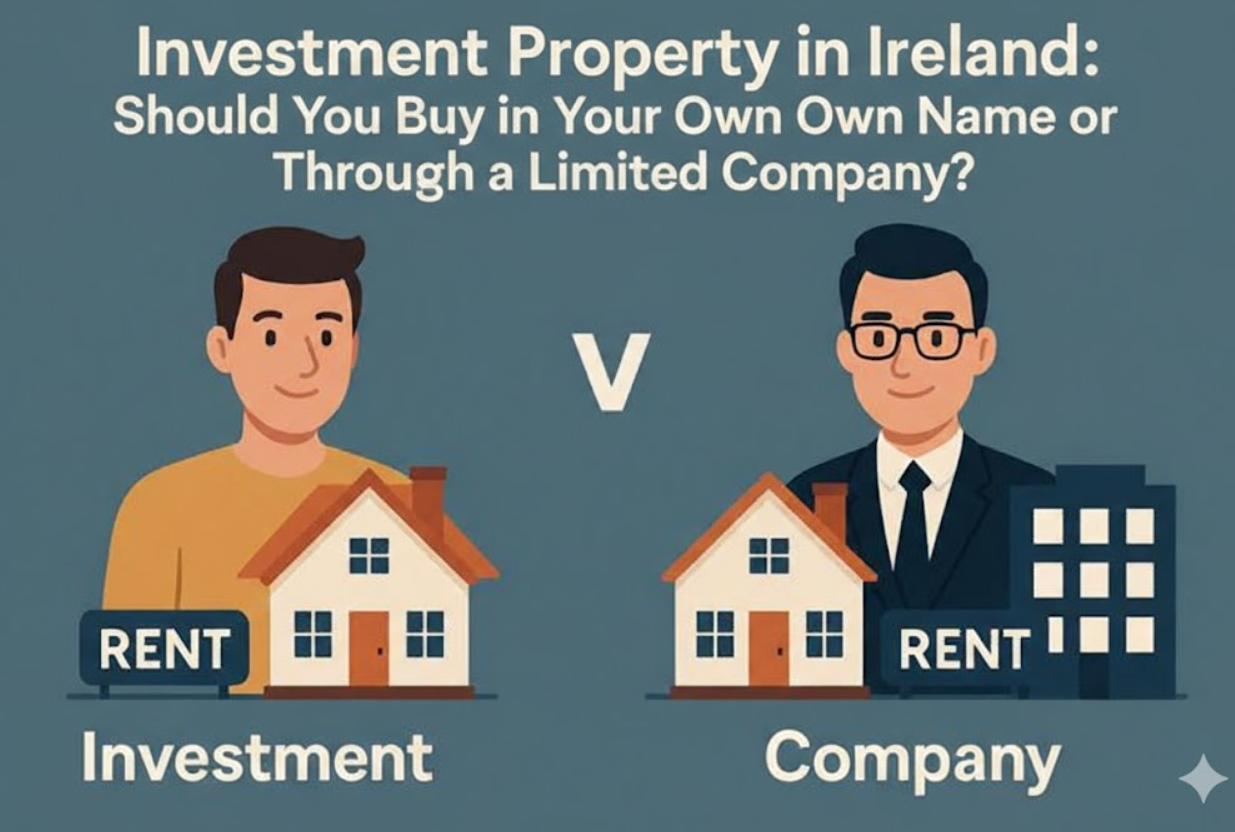
Choosing between personal ownership and a limited company is like plumbing a house; get the pipes wrong, and you’ll pay for leaks forever. This guide breaks down the pros and cons of each to help you decide which path fits your financial goals.
1. Buying in Your Own Name: The Simple Start
Most Irish investors begin by purchasing property in their own name because it is straightforward, involves no extra admin, and offers direct access to cash.
The Tax Reality
If you earn a salary of, say, €70,000 from your day job and your rental property brings in €5,000 in net profit, that profit is added to your regular income. In Ireland, once your total income crosses the higher threshold (currently €44,000 for a single person), you move from the 20% to the 40% income tax rate.
When you add USC and PRSI (currently 4.35% for landlords), your extra €5,000 profit could cost you roughly €2,000 in taxes, leaving you with just €3,000 in your pocket. This remaining cash is immediately yours to spend, save, or reinvest without additional paperwork.
The “Hidden” Legacy Advantage
The major benefit of personal ownership is legacy planning. If you sell a property after 15 years for a €150,000 gain, you would typically pay 33% Capital Gains Tax (CGT)—just under €50,000.
However, if you pass away while still owning the property, the capital gain essentially disappears. Your heirs inherit the property at its market value on the date of death. While they may owe Capital Acquisitions Tax (CAT), the first €400,000 inherited from a parent to a child is currently tax-free under the Group A threshold. This makes personal ownership highly efficient for transferring wealth to the next generation.
2. Buying Through a Limited Company: The Growth Engine
A limited company structure (often a Special Purpose Vehicle or SPV) changes the game entirely for those looking to scale a portfolio.
Lower Corporate Tax
If a company earns €5,000 in rental profit, it pays a 25% corporation tax rate (€1,250), leaving €3,750 inside the company. While taking this out as a dividend would trigger personal income tax, the real power lies in leaving the money in the company to reinvest.
Scaling with Mortgages
Personal borrowing is often capped based on your salary—typically around four times your income. However, with a company, lenders focus primarily on the property’s rental income rather than your personal salary. This can open doors to financing multiple properties as your portfolio grows.
Expert Insight: To navigate these structures effectively, you need a plan. Contact Us today to discuss your portfolio or Book an Appointment with one of our Qualified Financial Advisors.
3. Key Comparisons at a Glance
| Feature | Personal Ownership | Limited Company (SPV) |
| Setup & Admin | Simple; no setup costs | Complex; legal/accounting fees |
| Tax on Profit | Marginal rate (up to ~52%) | 25% Corporation Tax |
| Access to Cash | Immediate and direct | Double tax if taken as dividend |
| Borrowing Power | Capped by personal salary | Based on rental yields |
| Inheritance | CGT “uplift” at death | Shares passed (CGT remains) |
4. Avoiding Common Pitfalls
- The 18-Month Rule: In Ireland, a 20% Close Company Surcharge applies to investment income that isn’t distributed as a dividend within 18 months of the end of the accounting period. Reinvesting the profits or careful timing is essential to avoid this.
- Transferring Existing Property: Moving a property you already own personally into a company is rarely efficient. Revenue treats this as a sale at market value, which can trigger immediate CGT, Stamp Duty, and legal fees.
- Benefit-in-Kind (BIK): You cannot live in a property owned by your limited company rent-free. This would be treated as a taxable BIK by Revenue, potentially costing you more than owning it personally.
Conclusion
Your choice depends on your ultimate goal. If you want simplicity and a clear way to pass wealth to your children, personal ownership is often best. If you want to scale a large portfolio quickly and reinvest profits tax-efficiently, a limited company is the superior tool.
At Money Maximising Advisors Limited, we are here to help you navigate these complexities and build a legacy that lasts.
FAQs
- Is it more expensive to get a mortgage through a company?
Generally, yes. Company mortgages (SPV loans) often come with slightly higher interest rates than personal buy-to-let loans.
- Can I take money out of the company tax-free?
Only if you are repaying a Director’s Loan. If you personally put money into the company for a deposit, you can draw that exact amount back out without paying income tax.
- What is the biggest downside to company ownership?
The “double tax” trap. You pay 25% tax on company profits and then personal income tax (up to 52%) if you want to take that money out for personal use.
- Should I use both structures?
Many investors choose a hybrid approach: starting in their own name to use their personal tax thresholds and later forming a company once they reach three or more properties to help with scaling.
Disclaimer: This article provides general information and should not be considered personalised financial or tax advice. Irish tax laws change periodically, and individual circumstances vary. Always consult with our qualified financial advisors or tax professionals before making significant financial decisions.