| ▶ WATCH THE 60-SECOND EXPLAINER In this 60-second reel we walk through the exact mechanic that lets investors acquire a €300,000 rental property in Ireland with €0 out of their own bank account using a Special Purpose Vehicle (SPV) and a directors’ loan structure. If you’ve been sitting on the sidelines waiting for savings to catch up with property prices, this is worth 60 seconds of your time. Reel: https://www.instagram.com/reel/DZ2rRLPjjZX/ |
| IN THIS ARTICLE What an SPV actually is and why Irish investors use oneThe €0-personal-cash mechanic explained step-by-stepQuick answers to the six questions every landlord asksPersonal buy-to-let vs SPV route, side-by-side numbersSetup timeline, costs and lenders active in 2026Common mistakes and how to avoid them |
Why serious Irish property investors are moving from personal-name BTLs to SPV structures in 2026.
For years, the assumed path into a buy to let mortgage ireland investors would take was straightforward: save a large personal deposit, apply for the mortgage in your own name, become a personal landlord. That model still exists, but it is no longer the only path, and for many investors it is no longer the smartest. A SPV buy-to-let mortgage (SPV = Special Purpose Vehicle, a limited company set up specifically to hold investment property mortgage assets) lets you separate the property investment from your personal finances, unlock a director’s loan mechanic that can dramatically reduce the cash you personally put in, and structure your property investment for long-term tax efficiency. This guide walks you through exactly how it works, the numbers, the timeline and the trade-offs. Ready to talk to an advisor? Explore our buy-to-let mortgages hub or book an appointment today.
Quick answers: six questions every Irish landlord asks about SPV buy-to-let
What is an SPV in property investment?
An SPV is a limited company, incorporated in Ireland under the Companies Act 2014, that exists for a single, ring-fenced purpose: to acquire and hold one or more investment properties. It has its own directors, shareholders, tax number, bank account and audited accounts. Rental income and property gains sit inside the SPV, not in your personal name.
Can I get a buy-to-let mortgage through an SPV?
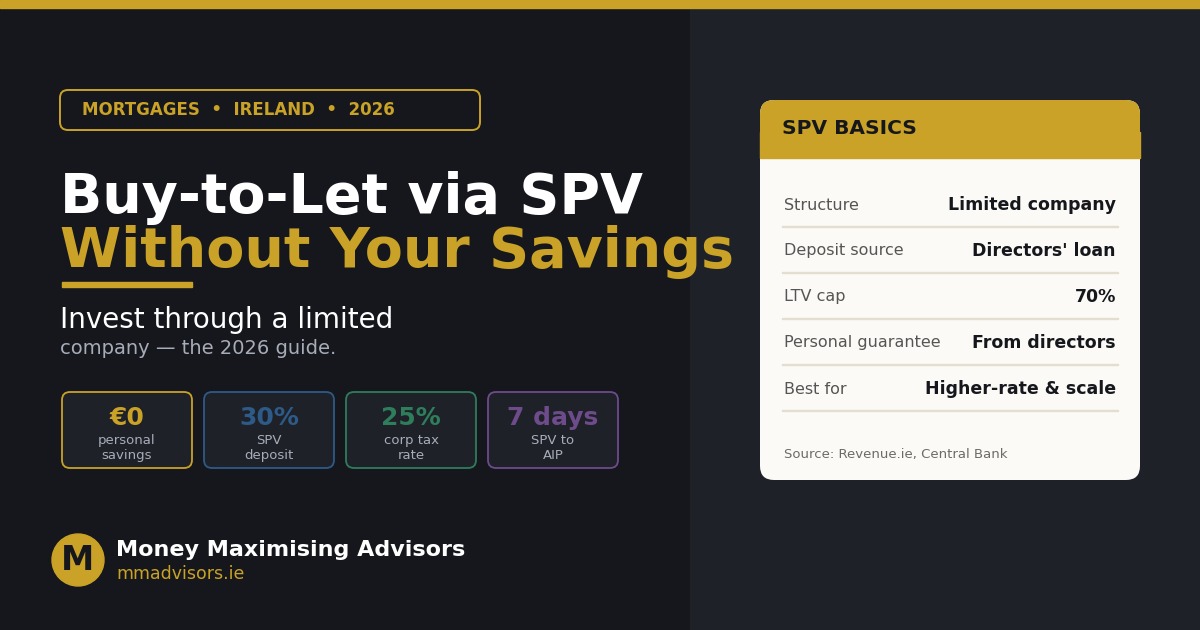
Yes. Specialist Irish lenders, including Finance Ireland and ICS Mortgages, lend directly to SPVs on buy-to-let terms. The company is the borrower, the directors typically provide a personal guarantee, and the property is the primary security. The 70% loan-to-value ceiling that applies to personal BTL mortgages generally applies to SPV borrowing too.
Is buying property through an SPV a good idea?
For an investor building a portfolio of two or more properties, or with taxable income in the higher rate band, the answer is usually yes. The SPV lets you access 25% corporation tax on passive rental income (12.5% where the trade is classified as active property trading) instead of your personal marginal rate of up to 52%. For a single property held for the short term, the SPV overhead may not be justified. It is a portfolio-building structure, not a one-off tool.
What are the benefits of using an SPV for buy-to-let?
Four benefits matter most:
(1) tax efficiency via corporation tax rather than personal income tax;
(2) liability ring-fencing — the property debt sits with the company, not you personally;
(3) portfolio scalability — additional properties fold in cleanly under one legal wrapper; and
(4) the director’s loan mechanic that can reduce the personal cash needed at completion to nearly zero. Each is explored below.
Can first-time landlords use an SPV?
They can, but underwriting is stricter. Lenders will look for a provable track record of managing finances, personal income sufficient to sit behind the personal guarantee, and a well-drafted business plan with realistic rental yield assumptions. Working with an advisor who packages the application is often the difference between approval and decline for a first-time SPV borrower.
How much deposit do I need for an SPV buy-to-let mortgage?
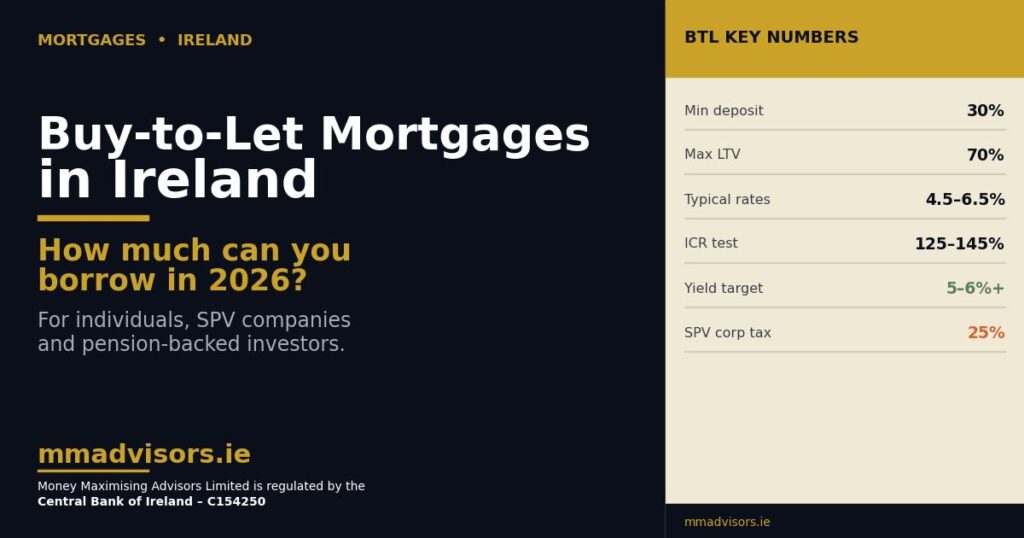
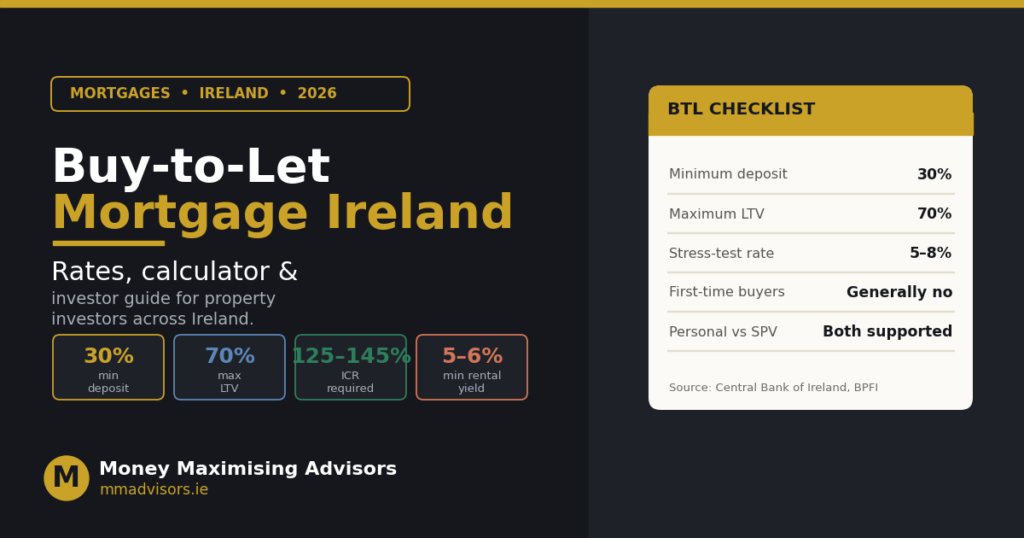
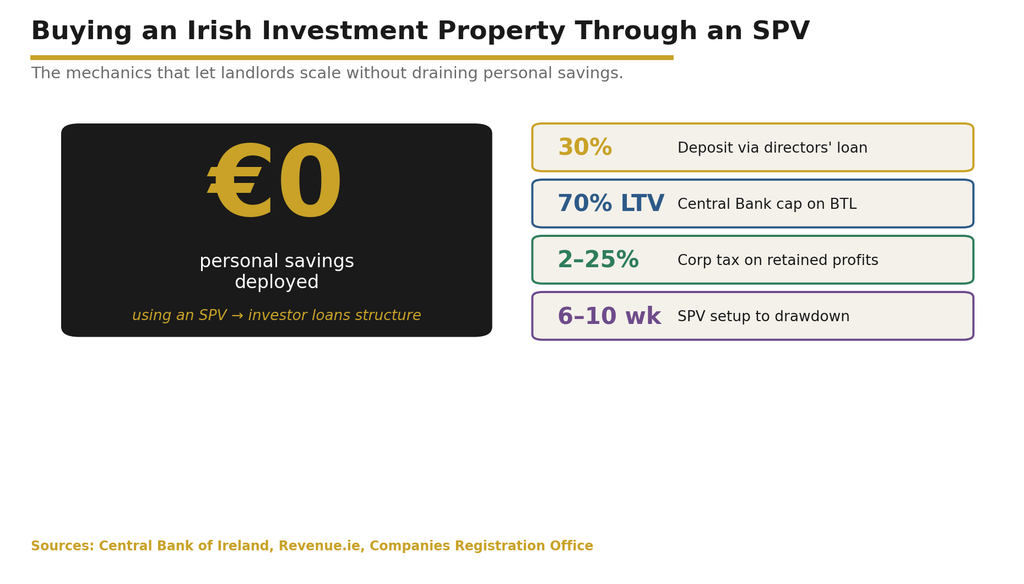
Irish specialist lenders typically require a minimum 30% deposit (i.e. a 70% LTV cap) on SPV buy-to-let mortgages. Crucially, the deposit does not have to come from your personal savings; it can be structured as a director’s loan into the SPV, which is then treated as a company debt and repaid to you tax-efficiently over time. That is the mechanic the Instagram reel above explains.
Personal buy-to-let vs SPV route — the numbers on a €300,000 rental
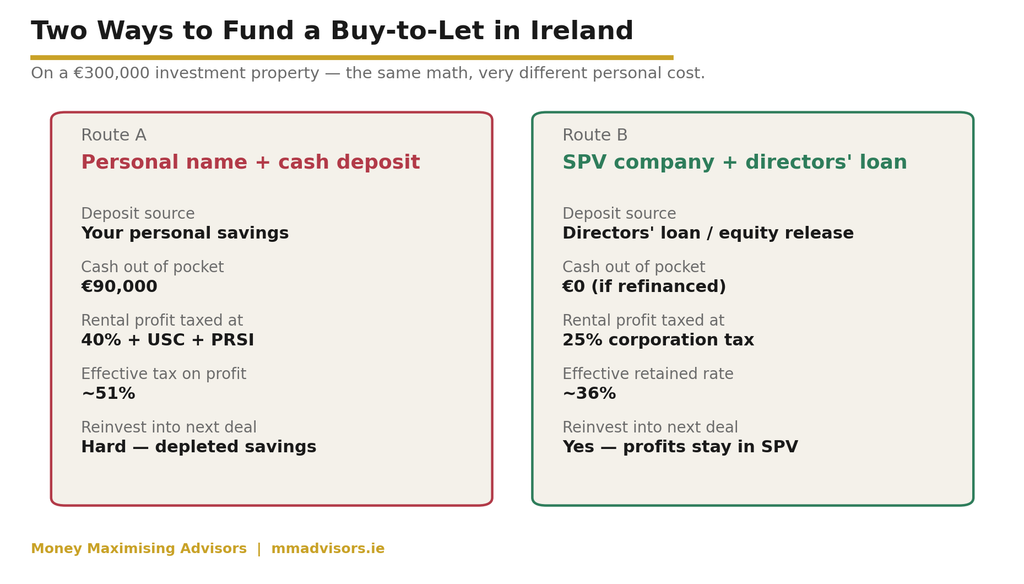
Same property, same tenant, two very different tax and cash-flow profiles.
Consider a Dublin higher-rate taxpayer buying a €300,000 residential investment property with a €1,600/month rental income. Under the personal-name buy-to-let route, the investor puts a €90,000 personal deposit (30%), takes a €210,000 mortgage in their own name, and pays income tax on the net rent at their personal marginal rate, up to 52% including USC and PRSI. Under the SPV route, the residential investment property is acquired by the company. The director loans €90,000 to the SPV (or funds it via refinancing existing equity, remortgaging their own home, or a combination). The SPV pays 25% corporation tax on the net rental profit rather than 52%. The €90,000 director’s loan is repayable to the investor from company reserves — tax-free, because it is repayment of debt, not distribution of income.
Over ten years, the compounding difference is material. A €1,000/month net-of-costs rental yield taxed at 52% delivers roughly €58,000 of cumulative after-tax cash to the investor. Taxed at 25% inside an SPV, the same rental delivers €90,000 of after-tax cash into the company, available to fund the next deposit, repay the director’s loan, or roll into further property. This is why the limited company buy-to-let structure has become the default for portfolio investors in Ireland.
Where to get advice — the Money Maximising Advisors group
| MONEY MAXIMISING ADVISORS GROUP — NATIONAL COVERAGE The article you are reading is from mmadvisors.ie, the flagship of the Money Maximising Advisors group. Two sister brands now form part of the same Central Bank-regulated group and provide localised advice across Ireland: • mmadvisors.ie — Money Maximising Advisors Limited (Tuam, Co Galway) — national coverage, HQ for the group. Full product range across mortgages, pensions, protection, savings, investments and inheritance tax. • jcfc.ie — Joe Coyle Financial Consultants (Mountcharles, Co Donegal) — North West Ireland specialists, with a particular focus on business-owner protection, pensions and succession advice. • moneysense.ie — Money Sense Financial Services (Killarney, Co Kerry) — South West Ireland family-run advisory, over four decades of experience across financial planning, mortgages, protection and retirement. |
Real-world scenario: a Dublin higher-rate professional building a portfolio
| CASE STUDY: SOFTWARE ENGINEER, DUBLIN 8, AGE 34 Aoife earns €110,000 in a Dublin tech role. She owns her home outright following an inheritance and wants to build a two-property rental portfolio without exhausting her savings. Working with an advisor, she sets up Aoife Property SPV Ltd with an appropriate SIC code, remortgages €180,000 of equity from her home at a residential rate, and lends this amount to the SPV as a director’s loan. The SPV then acquires two €300,000 properties, each with a 70% LTV specialist BTL mortgage. Rental income of €38,400/year across both properties, less mortgage interest and expenses, delivers €18,000 net into the SPV, taxed at 25%. Over five years she rebuilds €65,000 of company reserves and receives directors’ loan repayments of €40,000 tax-free; all while her home equity is repaid at low residential rates. |
SPV setup timeline: from incorporation to mortgage drawdown
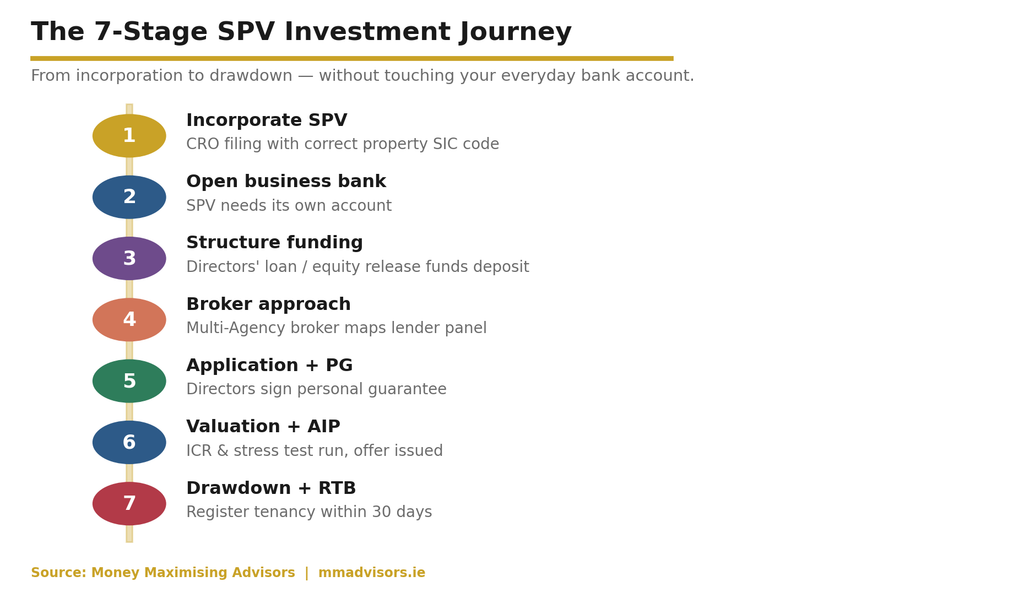
End-to-end timeline: budget 6-10 weeks from incorporation to mortgage drawdown on your first property.
The full end-to-end setup takes six to ten weeks and involves seven distinct workstreams:
- 1. Company incorporation. Register the SPV with the Companies Registration Office (CRO) with an appropriate SIC code for property investment. Budget one to two weeks.
- 2. Business bank account. Open the SPV’s dedicated business current account. Two to three weeks with a mainstream Irish bank; faster with challenger banks.
- 3. Tax registration. Register for Corporation Tax and, if applicable, VAT with Revenue.
- 4. Director’s loan documented. The loan from you to the SPV must be documented in a formal loan agreement with commercial interest terms.
- 5. BTL mortgage application. Submit to a specialist lender; typically Finance Ireland or ICS Mortgages, with the SPV as borrower and personal guarantee from the director(s).
- 6. Property sourcing & sale-agreed. Run in parallel with the mortgage application.
- 7. Legal completion. Solicitor completes searches, drafts the deed of the SPV, and handles drawdown. Two to four weeks depending on the vendor’s solicitor.
| READY TO TALK TO A CENTRAL BANK-REGULATED ADVISOR? Whether you are buying your first investment property or restructuring an existing portfolio into an SPV, our mortgage team can model both routes side-by-side for your exact circumstances. → Enquire Now | → Book an Appointment | → Contact Us |
Common mistakes SPV buy-to-let investors make in Ireland
- Using the wrong SIC code. Property investment must be incorporated under the correct classification, the wrong code can trigger scrutiny from Revenue and complicate future lender applications.
- Missing the director’s loan documentation. If the loan isn’t documented in writing with commercial interest terms, Revenue can reclassify future repayments as taxable distributions.
- Treating the SPV bank account as personal. Every euro in and out must be clean, documented and separate. Blurring the line invites Revenue enquiries and lender concerns on refinancing.
- Underestimating personal guarantees. The SPV is a separate legal entity, but as director you almost always sign a personal guarantee for the mortgage. In default, the lender can pursue you personally.
- Skipping close-company tax planning. Irish close companies (five or fewer participators) face a surcharge on undistributed income of 20%. Distribution and reinvestment strategy needs planning, don’t leave surplus rent sitting in the SPV indefinitely without advice.
Related reading
| Related post | Category | Read more |
|---|---|---|
| Mortgage Broker in Dublin: Switching Mortgage — How to Get My BER Certificate 2026 Guide | Mortgages | Read article |
| First Time Mortgage Buyers in Galway: Inflation and Its Impact on Interest Rates | Mortgages | Read article |
| 10 Things to Know Before Applying for a Mortgage in Ireland | Mortgages | Read article |
| Public Sector Mortgage Ireland: What Do I Need to Apply for a Mortgage? | Public Sector | Read article |
Frequently asked questions
Can I transfer an existing personal buy-to-let into an SPV?
Technically yes, but tax-inefficiently, the transfer is treated as a disposal at market value, potentially triggering Capital Gains Tax and Stamp Duty on the SPV’s acquisition. Most investors leave existing personal BTLs where they are and route new acquisitions through the SPV. Speak to a tax adviser before restructuring.
What happens to my SPV if I want to exit the investment?
You have three routes: (a) the SPV sells the property, pays CGT at 33% on the gain, distributes reserves to you as dividends (subject to Irish income tax and USC/PRSI) or capital via a formal winding-up; (b) you sell the shares in the SPV to a new investor; or (c) transfer to a family member as part of a succession plan, using Business Relief where the SPV qualifies as a trading company.
Do SPV buy-to-let rates differ from personal BTL rates?
They are typically higher; specialist SPV lenders currently price around 1.0-1.5 percentage points above personal BTL rates in Ireland. However, the corporation-tax advantage on the rental income normally more than compensates for the rate premium for higher-rate taxpayers building a portfolio.
About the author
| REVIEWED BY: MONEY MAXIMISING ADVISORS This guide is reviewed by advisors at Money Maximising Advisors Limited, a Qualified Financial Advisor firm regulated by the Central Bank of Ireland. Our team holds QFA, CFP®, RPA and Specialist Investment Adviser qualifications and works alongside our sister brands jcfc.ie (Donegal) and moneysense.ie (Kerry) to deliver advice across every county in Ireland. Every recommendation is documented in a written Statement of Suitability. |
Important information
WARNING: Your property may be repossessed if you do not keep up your repayments on your mortgage.
WARNING: If you do not meet the repayments on your loan, your account will go into arrears. This may affect your credit rating, which may limit your ability to access credit in the future.
Mortgage loan-to-value limits (70% BTL cap), specialist SPV lender criteria (Finance Ireland, ICS Mortgages), corporation tax rates (25% passive, 12.5% trading), the close-company surcharge (20% on undistributed investment income) and Central Bank regulatory position referenced here are correct as at June 2026. Money Maximising Advisors Limited is regulated by the Central Bank of Ireland. This article is for general information only and does not constitute financial, tax or legal advice. SPV structures involve tax, legal and mortgage decisions that must be tailored to your individual circumstances, seek personalised advice from a Qualified Financial Advisor, tax adviser and solicitor before proceeding.