1
Apply as an
Individual
Purchase and own the investment property personally.
Individual applications are assessed based on the lender’s affordability, income, credit and property criteria.
Whether you are purchasing your first investment property or looking to expand an existing portfolio, Buy-to-Let mortgage options are available through an individual, a limited company/SPV or an eligible pension arrangement, depending on your circumstances and investment plans.
BENEFITS SUMMARY
HOW IT WORKS
Three common borrower types, each with different lending, tax, ownership and investment considerations.
Apply as an
Purchase and own the investment property personally.
Individual applications are assessed based on the lender’s affordability, income, credit and property criteria.
Apply through a
Purchase the investment property through a limited company or Special Purpose Vehicle.
A company/SPV structure can be suitable for investors who want to build or manage a property portfolio through a company, subject to lender and tax considerations.
Apply through an
Some eligible self-administered pension arrangements may be able to invest in property.
This is subject to Revenue rules, trustee requirements and lender criteria.
Each structure has different lending, tax, ownership and investment considerations.
Buy-to-Let lending criteria vary depending on the lender and whether you are applying as an individual, through a company/SPV or through an eligible pension arrangement.
Depending on the lender and borrower structure:
For example, some lenders’ current criteria require a minimum annual income of €40,000 per single or joint application for their individual and company Buy-to-Let products.
The term can be extended to your 80th birthday if required (max term of 40 years). However, mortgage terms over the applicant’s 68th birthday will require proof of a pension entitlement to qualify.
Interest rates vary depending on the loan-to-value ratio after the cash is released. However, the rates typically offered are as follows:
Please see below a table comparing the key features of each borrowing option for a Buy-to-Let mortgage.
| Feature | Individual | Company (SPV) | Pension |
|---|---|---|---|
| Loan Amount | min €40,000 | max varies | min €80,000 | max varies | €50,000 to €1,500,000 |
| Max Loan-to-Value | 70% LTV | 70% LTV | 50% LTV |
| Interest Rate Options | Interest only: up to 15 yrs Capital & interest: up to 35 yrs | Interest only: up to 15 yrs Capital & interest: up to 35 yrs | Capital & interest only: 5 to 15 yrs |
| Interest Rate | approx. 4.85% to 5.90% | approx. 5.70% to 5.90% | approx. 5.90% |
| Credit Check | CCR: Yes | CCR: Yes | Lender / Trustee checks |
| Individual Income Assessed | Yes | Yes* | Pension / Trustee criteria |
| Tax Treatment | 20% / 40% Income Tax + USC / PRSI* | 25% Corporation Tax* | 0% Income Tax / CGT* |
| Property Value | Varies by lender | Varies by lender | min €100,000 |
| Age of Applicants | approx. 18 to 75* | approx. 21 to 80* | Must meet pension / retirement-age rules |
| Term Available | 5 to 35 yrs | 5 to 35 yrs | 5 to 15 yrs |
*Subject to lender, Revenue, trustee and individual circumstances.
Meet John. He owns a home valued at €400,000, with only €100,000 left on the mortgage.
John had a clear goal: buy a second property to generate rental income and build long-term wealth. He easily qualified for a second mortgage, but didn’t have the 30% deposit required to make the purchase.
So, what did he do?
He re-mortgaged his current home for €175,000, unlocking €75,000 in equity.
That €75,000 became the deposit he needed to secure his second buy-to-let property.
Now, John:
💡 You don’t always need more cash, just the right strategy.
Illustrative examples only. Figures are simplified for illustration; actual amounts, interest rates and repayments will depend on your individual circumstances and lender approval.
Case examples
Three examples showing how the individual, company/SPV and pension structures can work in practice.
Investor A
Bought a rental property in Galway worth €250,000.
Secured a loan of €175,000 at 70% LTV. Chose a 10-year interest-only term, where available, to maximise cash flow, with a plan to restructure after 10 years.
Investor B
Refinanced two properties in Dublin valued at €1 million.
Secured €600,000 at 60% LTV and used the equity released to help fund a third rental property.
Investor C
Purchased a €200,000 rental property in Limerick.
Used €100,000 from an eligible self-administered pension and borrowed €100,000, giving a 50% LTV.
Rental income is paid back into the pension, where it may benefit from the pension’s tax treatment, subject to Revenue, RTB and trustee requirements.
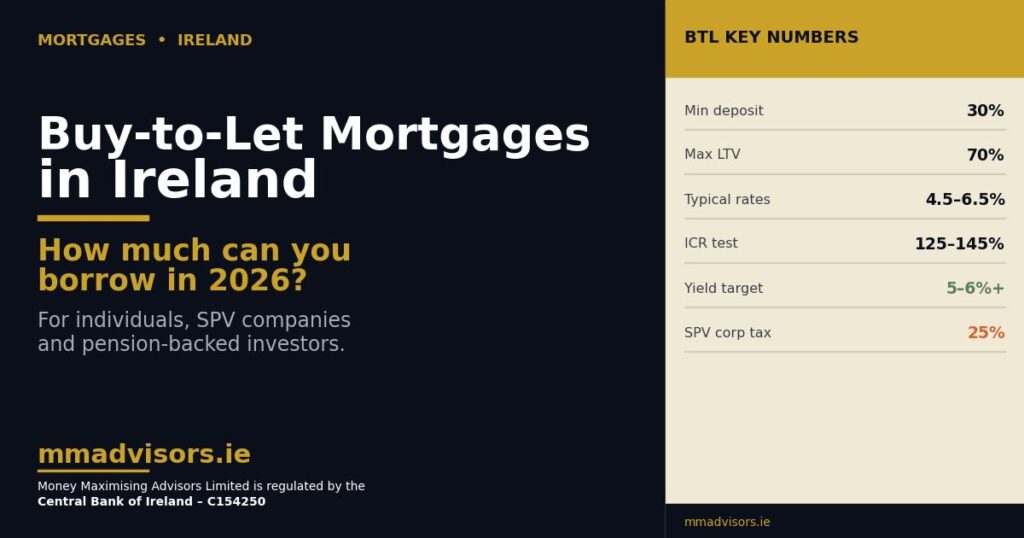
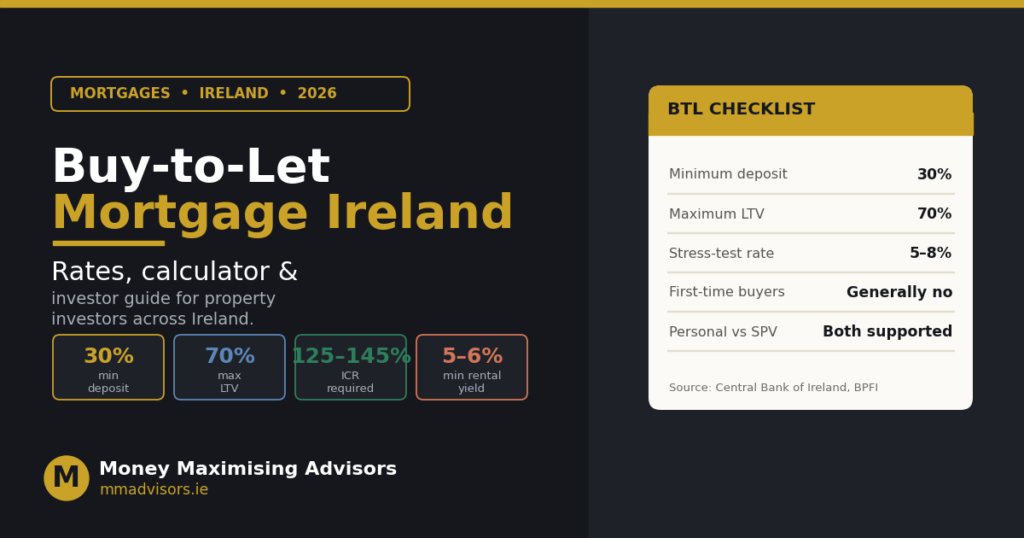
Typically, Buy-to-Let mortgages require a 30% deposit, with borrowing capped at 70% LTV.
For larger loans, some lenders may apply a lower LTV limit, such as 65% LTV. Certain pension-based Buy-to-Let products may require a 50% deposit.
Buy-to-Let can be a suitable long-term investment for some investors, depending on rental income, mortgage costs, tax, maintenance costs and property values.
Depending on the lender, options may include up to 15-year interest-only or 35-year capital and interest mortgage terms.
The Central Bank’s Loan-to-Income limits do not apply to Buy-to-Let mortgages.
The amount you can borrow will depend on the lender’s assessment, including rental income, Loan-to-Value, affordability and the property value.
Some specialist lenders currently require a minimum annual income of €40,000 per single or joint application.
Minimum loan amounts vary by lender. Current Buy-to-Let products reviewed start from around €40,000, while some specialist lenders have a minimum loan amount of €80,000.
Generally, you will need a deposit of at least 30%, as the Central Bank’s standard Buy-to-Let limit is 70% LTV. Some lenders may require a larger deposit for higher loan amounts or certain borrowing structures. Pension-based borrowing may require a deposit of around 50%.
Rental property can generate regular income, but profitability will depend on factors such as rental income, mortgage repayments, tax, maintenance costs, insurance and periods when the property is vacant.
Investors may also be able to refinance existing properties to release equity and help fund additional property purchases, subject to lender criteria.
Returns vary by location and property type. Recent 2026 market data estimates the average gross rental yield at approximately 7.7%, although individual properties can be higher or lower.
Gross rental yield is not the same as net ROI, as costs such as mortgage interest, maintenance, insurance, vacancy periods and tax must also be considered.
The standard minimum deposit is 30% (70% LTV) for Buy-to-Let buyers. Certain pension-based mortgage products require a 50% deposit (50% LTV).
Some specialist lenders may allow total portfolio borrowing of up to €7 million, subject to a weighted average LTV of 60% or below.
To get a Buy-to-Let mortgage in Ireland, you will generally need to meet criteria such as:
You can apply as an individual, through a company/SPV, or through an eligible self-administered pension arrangement.
For individual landlords, net rental income is generally subject to Income Tax at 20% or 40%, plus USC and PRSI where applicable.
Up to 100% of qualifying mortgage interest may be deducted from rental income where Revenue’s conditions are met, including RTB registration where required.
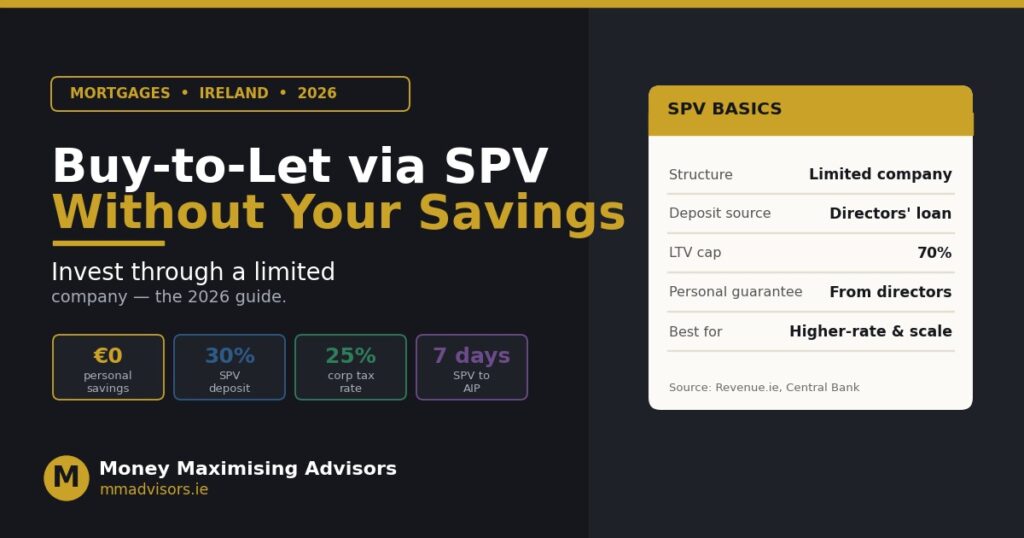
For properties held through a company/SPV, rental income is generally subject to 25% Corporation Tax, with additional tax potentially applying when profits are retained or extracted.
Tax treatment differs for pension-owned property, so professional tax and pension advice should be obtained.
MORE HELPFUL GUIDES & ADVICE
CLIENT TESTIMONIALS
Trustindex verifies that the original source of the review is Google. Excellent thorough service provided by Lorna.Posted on GoogleTrustindex verifies that the original source of the review is Google. MMA team made my mortgage application to approval easy and possible. They are efficient and swift with responses. The level of professionalism is second to none and special thanks to Cris for her support. At some point I was the one delaying the process yet you were very patient with me, guide me through every process and arrange meetings for clarity. Surely this is the best mortgage adviser I have encountered and I strongly recommend them cause they don’t disappoint. Thanks team ElizabethPosted on GoogleTrustindex verifies that the original source of the review is Google. Great company! My advisors, Jack and Maricris, were very attentive, very professional. No advanced fees charged and as advertised, if you don’t close a deal, if you don’t draw down, there’s no charge, which unfortunately was my case, so after being helped through the process, they didn’t charge me anything.Posted on GoogleTrustindex verifies that the original source of the review is Google. Cris and Sean were excellent and couldn’t do enough to help me in getting the keys to my first home. Sean is incredibly knowledgeable and very personable. I highly recommend them.Posted on GoogleTrustindex verifies that the original source of the review is Google. I'd like to thank everyone at MM Advisors especially Sean and Cris. They were amazing throughout the whole process. Extremely professional and always on hand to help us along the way.
Whether you are just starting or managing a growing portfolio, our advisors are here to help. Let us guide you to the right provider, competitive rates and a borrowing structure suited to your property investment plans.
Money Maximising Advisors Ltd is regulated by the Central Bank of Ireland. C154250.
Warning: If you do not meet the repayments on your loan, your account will go into arrears. This may affect your credit rating, which may limit your ability to access credit in the future.
Warning: The cost of your monthly repayments may increase.
Warning: You may have to pay charges if you pay off a fixed-rate loan early.
Warning: This new loan may take longer to pay off than your previous loans. This means you may pay more than if you paid over a shorter term.